
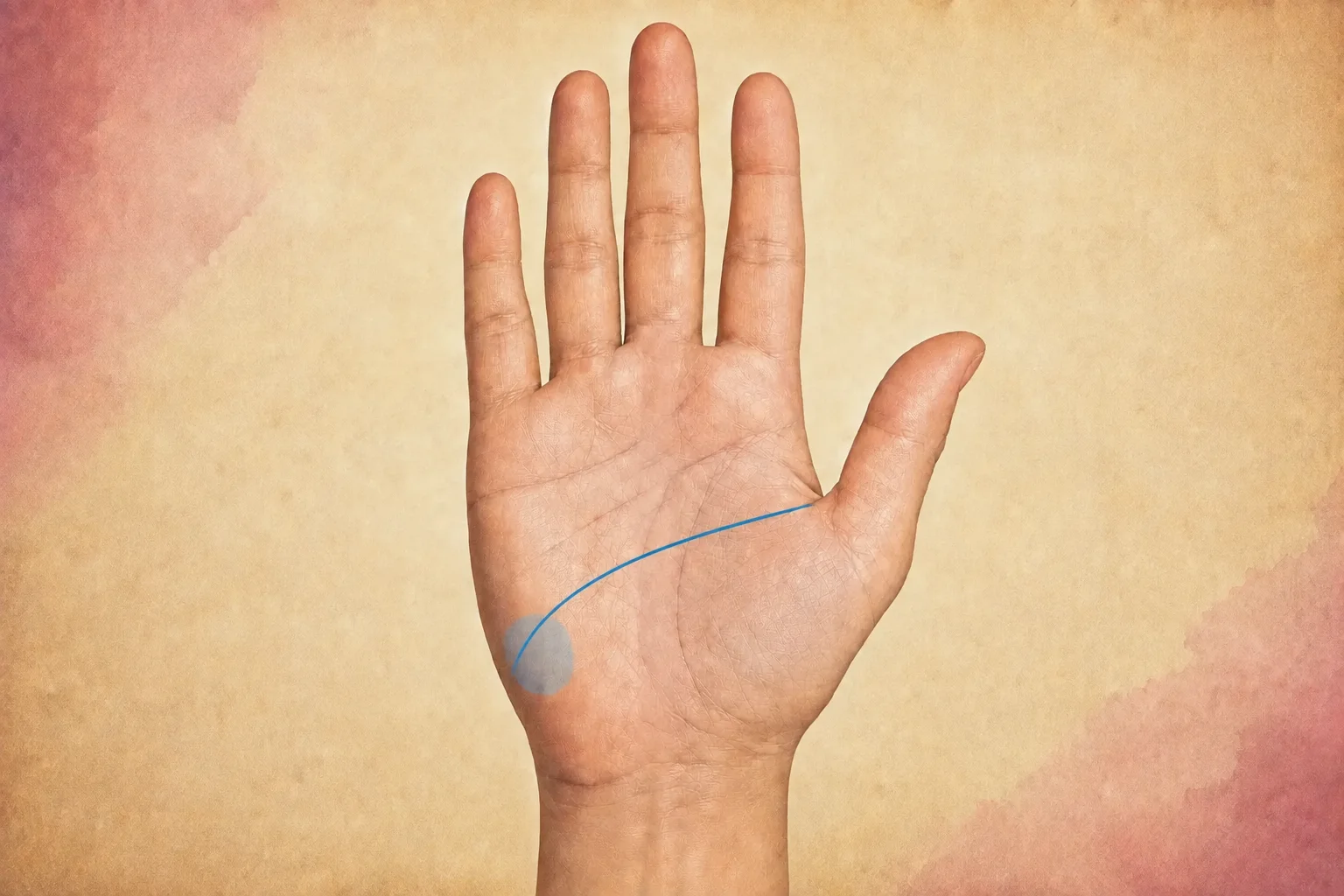
In traditional palmistry, a head line that slopes downward toward the Mount of Moon is read as an imaginative, intuitive, associative, and context-sensitive thinking style. A gentle slope is commonly linked with creative ideas that can still be applied practically. A deep descent places more emphasis on inner imagery, mood, symbolism, and subjective perception, so palmists look for clear line quality and grounding features before interpreting it.
A Moon-directed head line becomes meaningful only after the thumb-side origin, complete parent route, exact Moon endpoint, degree and starting point of the slope, length, depth, continuity, grounding features, work and communication signs, and both hands are compared. A whole-hand reading can show how imagination, intuition, judgment, expression, follow-through, and direction work together.
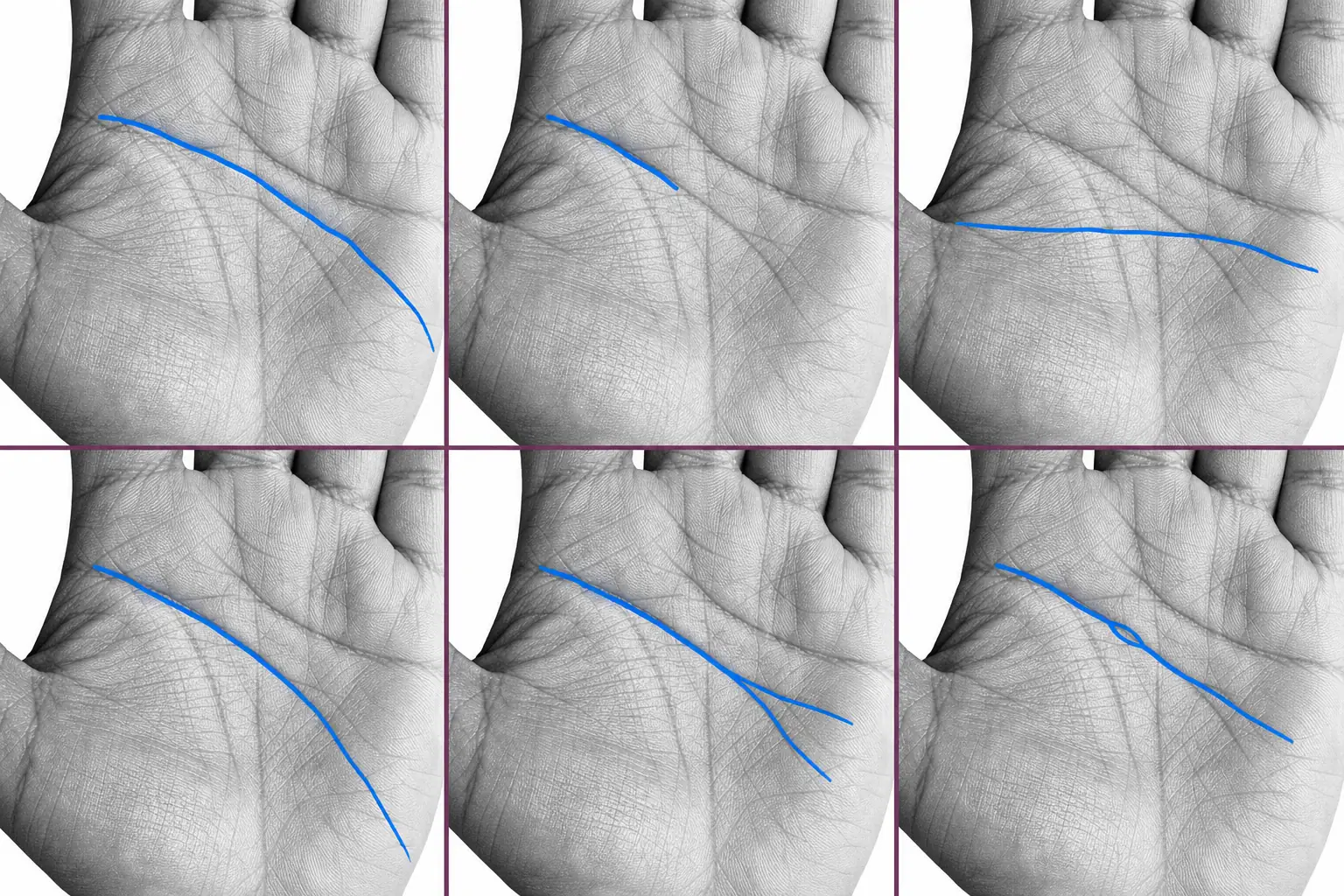
Use a nine-part Moon-directed head-line method: confirm the thumb-side origin, trace one continuous parent route, find the exact endpoint, verify that it enters Moon, measure the descent from its starting level, record where the slope begins, assess length, depth, and continuity, compare practical support features, then read both hands. The slope describes how thought moves. It does not measure intelligence, prove psychic ability, or guarantee an artistic career.
One parent line must reach Moon
This guide covers a single head-line parent whose own route descends into the lower outer palm. A straight parent with one downward terminal prong is a fork. A smaller route leaving a continuing parent is a branch. A line rising from Moon toward Saturn is usually a fate-line candidate. Classify the complete route before interpreting imagination or intuition.
Where the Mount of Moon and sloping head line sit
The head line usually begins near the thumb-index web, beside or briefly joined to the life line. It crosses the middle of the palm below the heart line. The Mount of Moon occupies the lower outer palm opposite the thumb pad, extending upward from the wrist-side edge toward the outer Mars area. A Moon-directed head line travels from the thumb side across the middle palm and finishes within that lower outer zone.
| Route | Geometry | Traditional thinking emphasis |
|---|---|---|
| Straight head line | Runs approximately level across the middle palm | Facts, sequence, structure, direct application |
| Gently sloping head line | Descends gradually toward upper or middle Moon | Practical imagination, context, visual association |
| Deeply sloping head line | Curves decisively into lower Moon | Inner imagery, symbolism, subjectivity, creative immersion |
| Fork with Moon prong | Straight parent ends in two connected destinations | Two mental modes rather than one descending parent |
Trace the line from its known thumb-side origin. Direction can look reversed in photographs, especially when the thumb side is cropped. The complete head-line guide maps origins, length, direction, quality, branches, and interruptions before one variation is isolated.
How to verify a Moon-directed head line
Begin at the thumb-index web and follow the same groove across every crossing. The parent should descend as it moves toward the outer hand. Use the endpoint, not a nearby curve, to name the destination. If the line straightens before Moon and only a smaller offshoot descends, keep the parent and branch separate. If two prongs leave one final junction, use the forked-head-line method.
| Lookalike | Defining difference | Correct reading task |
|---|---|---|
| Single sloping head line | One parent descends continuously from the thumb side into Moon | Read slope, endpoint, quality, and support |
| Writer's fork | One parent divides into straight and Moon-directed terminal prongs | Compare both prongs and their relative strength |
| Downward branch | A smaller route leaves while the head-line parent continues | Read the branch destination beside the parent |
| Moon-origin fate line | Begins in Moon and rises vertically toward Saturn | Trace upward direction and Saturn destination |
| Moon travel line | Begins at the outer edge or inside Moon and stays independent | Read travel or environmental movement separately |
| Falling heart line | Begins below the little finger and travels across the upper palm | Return to the outer-edge emotional-line origin |
| Crossing influence | Passes through the head line without sharing its route | Keep both parent lines distinct |
Tilt a relaxed hand under soft side light. Fine skin creases often touch the head line by chance, and a strong fate line can dominate a photograph. Follow continuity rather than choosing the darkest segment. A reliable identification should remain the same when the hand is viewed from two angles.
Gentle slope versus a deep slope to Moon
There is no universal degree chart. Compare the endpoint with the line's starting level and note whether the descent is gradual, moderate, or steep. A gentle route remains near the middle plane before entering upper or middle Moon. A deep route moves clearly toward the wrist and ends lower in Moon. Describe what the hand shows instead of assigning an invented angle.
| Degree of descent | Traditional strength | What modifies it most |
|---|---|---|
| Slight dip | Flexible thinking and accessible imagination | Line depth and a practical straight first section |
| Gentle continuous slope | Visual, creative, empathetic, or story-led thought | Clear endpoint, firm thumb, and balanced Moon |
| Pronounced curve | Strong inner life and subjective or symbolic processing | Continuity, head-line strength, fingers, and texture |
| Very low ending | Deep imaginative immersion or need for private mental space | Grounding, practical outlets, and both-hand comparison |
A steeper line is not automatically more creative, intuitive, or talented. Talent needs expression, skill, and follow-through. A deep clear route with a firm thumb can carry sustained imaginative work. A steep line that is faint, chained, or heavily crossed describes a different pattern because concentration and continuity are less settled.
Traditional meaning of a head line sloping to Moon
Moon is traditionally associated with imagination, memory, atmosphere, dreams, symbolism, empathy, travel of mind or place, and responsiveness to surroundings. A head line entering this area suggests that thought does not move only through linear facts. Images, analogies, emotion, intuition, pattern, story, and context may contribute to understanding.
This can suit writing, design, music, research, psychology, counseling, storytelling, strategy, invention, spiritual study, film, or any work that requires seeing connections beyond a literal surface. The same route can also show a need for solitude or quiet concentration. It does not mean the person must work in the arts; practical fields also need imagination, perspective, and the ability to model possibilities.
The challenge traditionally associated with a strong Moon emphasis is subjectivity: mood or imagination can color what seems true. That is why a good reading checks line clarity, the thumb, fingers, Mars, Saturn, hand texture, and real-world habits. The Mount of Moon guide distinguishes a balanced, firm Moon area from flat, soft, overdeveloped, or heavily marked variations.
Does a sloping head line mean creativity or intuition?
It supports those traditional themes, but it does not prove a creative profession, supernatural perception, or reliable instinct. Palmists look for repetition: a clear Moon-directed route, balanced Moon, flexible but controlled thumb, communication features under Mercury, expression through Apollo, a stable fate line, or related signs on both hands.
Imagination and intuition are also different. Imagination generates images, possibilities, and associations. Intuition is the sense of reaching a conclusion without consciously listing every step. A Moon-directed head line can be read as receptive to both, but discernment and accuracy cannot be measured from the crease. The intuition-signs guide explains the multi-feature pattern without turning one line into proof.
How length, depth, and continuity change the meaning
Length describes how far the thought route travels, not intelligence. Depth shows how firmly the pattern is marked. Clarity shows how directly it can be followed. Continuity shows whether attention holds through the route. Read these qualities before adding the Moon symbolism.
| Line quality | Traditional synthesis with Moon slope | Check next |
|---|---|---|
| Long, deep, clear | Sustained imaginative concentration and wide mental range | Thumb, fate line, and practical output |
| Long and fine | Wide-ranging ideas expressed more subtly or flexibly | Whether side light reveals full continuity |
| Chained | Associative thought with repeated shifts or divided focus | Where the chain begins and ends |
| Broken with aligned restart | A change in mental approach or interrupted concentration | Gap, overlap, timing, and support lines |
| Deep first section, faint Moon ending | Practical thinking that opens into a less settled imaginative mode | Where the quality changes |
| Fine first section, deep Moon ending | Inner or creative focus strengthens later in the route | Matching fate or Apollo changes |
A bend that begins only after a straight first section may traditionally describe a practical baseline that develops a more imaginative or inward approach. Palmists sometimes estimate a broad chapter from the bend point, but exact ages are unreliable. Use the timing guide to compare landmarks and known events rather than promising a date from one curve.
Which features ground a Moon-directed head line?
Grounding does not cancel imagination. It shows how ideas become decisions, boundaries, routines, or finished work. A firm, proportionate thumb adds will and judgment. A clear fate line adds direction and sustained responsibility. A balanced Saturn area adds patience. Firm Mars adds steadiness under pressure. A straight opening section can add practical framing before the line descends.
| Supporting feature | What it adds | Possible synthesis |
|---|---|---|
| Firm flexible thumb | Will plus adaptability | Ideas can be revised and completed |
| Clear fate line | Direction and continuity of responsibility | Imagination is applied to a sustained path |
| Balanced Saturn mount | Patience, limits, and follow-through | Creative work can tolerate structure |
| Firm Mars areas | Composure and constructive resistance | Sensitivity is supported under pressure |
| Clear Mercury features | Communication and applied skill | Inner images can be translated for others |
| Clear Apollo line | Expression, satisfaction, or visibility | Creative output gains a public channel |
Work, learning, and communication combinations
A Moon-directed head line can support roles that depend on perspective, narrative, empathy, spatial imagination, conceptual modeling, design, or understanding people. It does not choose a profession alone. Career interpretation also needs the fate line's origin and route, Apollo and Mercury features, fingers, thumb, mounts, and the question being asked.
A clear sloping head line with a strong Mercury area can emphasize explaining complex ideas, counseling, teaching, sales through story, or writing. With Apollo, it can support design, performance, visual communication, or creative visibility. With a strong fate line and Saturn, it may place imaginative thinking inside research, strategy, technology, or structured professional work. With a developed Moon and travel signs, new environments or international contact may feed ideas without guaranteeing relocation.
Sloping head line on one hand or both
A similar Moon-directed route on both palms gives imaginative or contextual thinking more structural weight. If the active hand slopes more deeply, present life may be developing greater creative, intuitive, emotional, or symbolic engagement. If the active hand has become straighter, practical demands, training, or deliberate structure may be shaping how the underlying imagination is used.
Compare the exact origin, straight first section, bend point, endpoint height, depth, continuity, branches, Moon development, thumb, fate line, and Apollo or Mercury support. The hands do not need to mirror each other. The which-hand guide explains active and less-active comparison without gender rules.
Worked examples
A long clear line slopes gently into Moon with a firm flexible thumb
The combination traditionally suggests sustained imaginative thought with adaptable judgment and enough will to shape ideas. Fate and Mercury features show whether the strongest outlet is work, communication, study, or a private pursuit.
A very deep slope reaches lower Moon but the line is chained
Inner imagery and subjective response are strongly emphasized, while the chained quality suggests repeated shifts in focus or mental complexity. Check where clarity returns, how Mars and Saturn are formed, and whether the active hand shows greater continuity.
A straight head line ends in one downward Moon prong
This is a terminal fork rather than the single sloping parent covered here. The straight and Moon-directed prongs should be compared by length, depth, destination, and balance.
Photo checklist for a sloping head line
- Photograph both full palms from wrist to fingertips.
- Keep the thumb-index web and the entire outer edge visible together.
- Add one close image of the middle and lower outer palm.
- Relax the palm so stretching does not flatten or exaggerate the curve.
- Use soft side light to show the parent groove through crossings.
- Trace from the thumb-side origin to one final endpoint.
- Confirm whether the parent slopes or only one branch descends.
- Record the starting level, bend point, endpoint zone, length, depth, and continuity.
- Include the thumb, Moon, Mars, Saturn, fate line, and Mercury area.
- State hand dominance and whether your question concerns creativity, decisions, intuition, study, or work.
Read the slope inside your complete thinking pattern
A Full Palm Reading maps the head-line origin, complete route, Moon endpoint, degree of slope, bend point, length, depth, continuity, branches, Moon development, thumb, grounding features, career and communication lines, and both palms. It then adds the heart, fate, life, Sun, and Mercury lines, mounts, fingers, shape, and texture into one holistic reading focused on your questions.
The complete answer
A head line sloping toward the Mount of Moon traditionally emphasizes imaginative, intuitive, visual, associative, and context-sensitive thinking. A gentle slope can blend creativity with practical use; a deep descent gives greater weight to inner imagery and subjective perception. Verify one continuous parent, measure the descent from its start, then add the endpoint, bend point, length, depth, continuity, thumb, Moon, grounding features, career lines, communication features, and both hands. A Full Palm Reading maps every important feature across both palms and combines them into a holistic reading focused on your questions about creativity, decisions, intuition, learning, communication, work, purpose, and direction.
A Full Palm Reading
Ask how your imaginative head-line route works in the complete hand
Your reading maps the head-line origin, complete route, Moon endpoint, degree and bend point of the slope, length, depth, continuity, branches, Moon development, thumb, grounding features, career and communication signs, and both palms, then adds the heart, fate, life, Sun, and Mercury lines, mounts, fingers, shape, and texture into one holistic reading focused on your questions.
Your Full Palm Reading maps all the important features—hand shape, skin texture, thumb, fingers, mounts, major and minor lines, markings, and the differences between both palms—and brings them together in a holistic reading focused on your questions.