
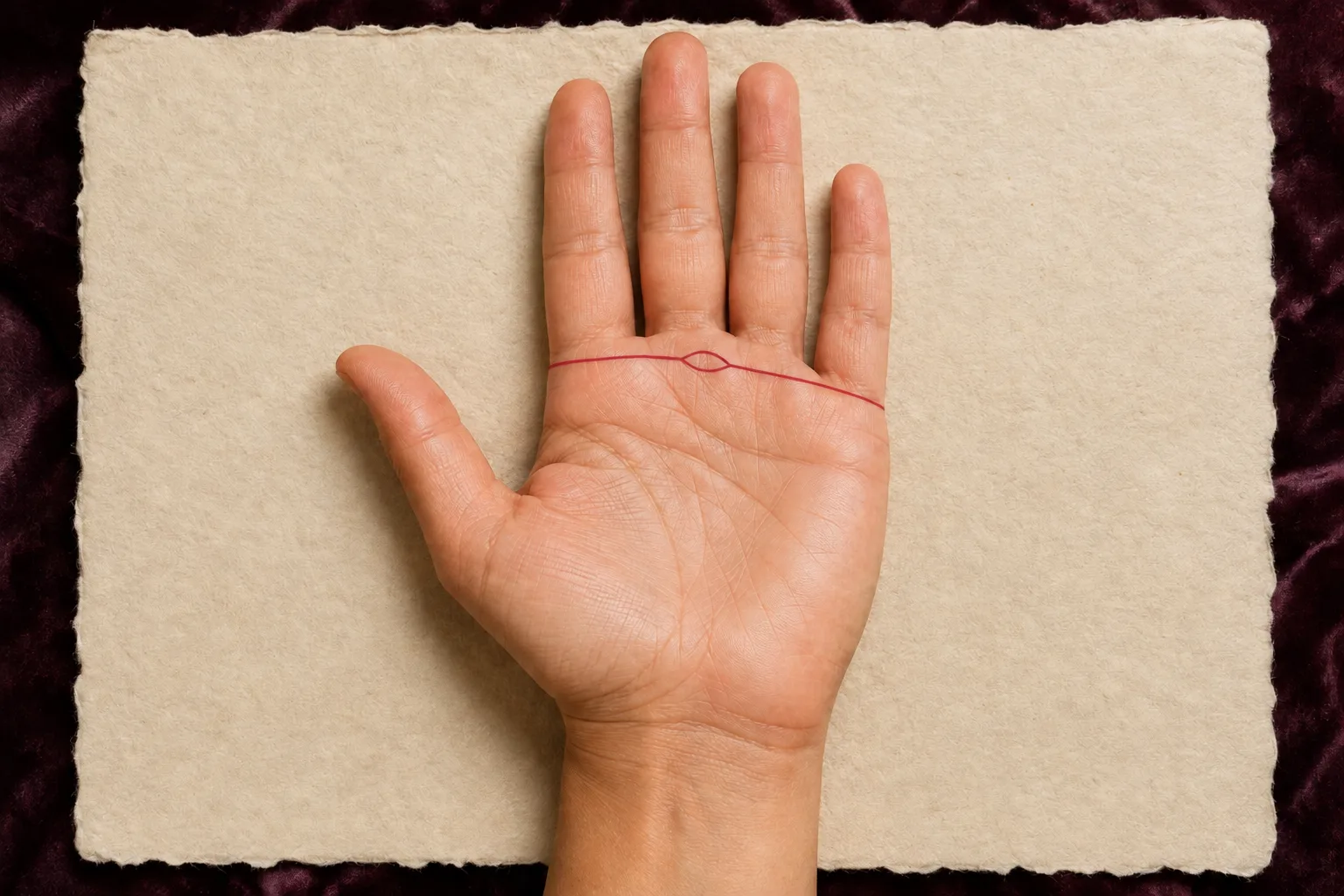
An island on the Heart line is one closed oval or almond-shaped space formed when the upper major line divides into two strands and then reunites. In traditional palmistry, it describes a bounded stretch of divided feeling, emotional uncertainty, guarded expression, or competing relationship demands. It does not prove betrayal, predict separation, diagnose a heart condition, or decide whether a relationship will last.
One Heart-line island becomes personal only after the true little-finger-edge parent, single closed split-and-reunion geometry, exact mount location, proportional size, depth, color, curve, clarity before and after, chain, crossing, fork, break, branch and Girdle tests, endpoint, Venus, Head, Fate, thumb, relationship lines, timing, actual behavior, and both palms are compared. A whole-hand reading can show where feelings divide, what supports repair, and what becomes clearer afterward.
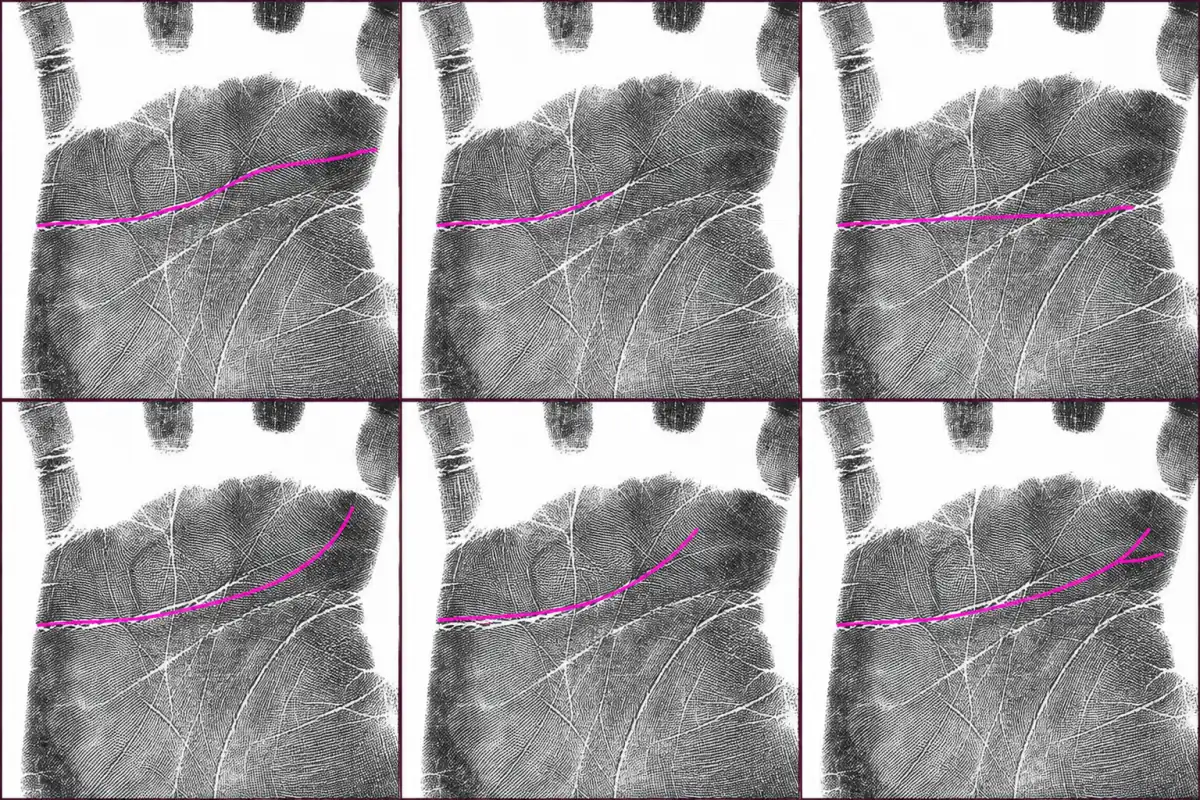
The island becomes meaningful only after the complete Heart line is traced. Find where the split begins, where it closes, which finger mount sits above it, and whether the outgoing line becomes clearer, weaker, more curved, straighter, broken, or forked. One island followed by a strong line reads differently from several linked loops across a long section.
An island is a chapter inside the emotional pattern
The incoming Heart line shows how feeling and closeness enter the divided section. The island shows the period or subject pulled in more than one direction. The reunited line shows how expression, trust, affection, or boundaries develop afterward. Read all three before making a relationship interpretation.
How to identify an island on the Heart line
The Heart line is normally the uppermost major crease. It enters from the outer edge below the little finger and travels beneath the finger bases toward Saturn or Jupiter. Begin at that little-finger edge and follow one continuous parent. Do not start with the oval and guess which nearby line owns it.
Use this ten-part island-on-Heart-line method:
- Confirm the true outer-edge Heart-line parent.
- Trace it inward beneath the fingers to the suspected mark.
- Find the exact point where one groove becomes two.
- Confirm that both sides enclose one visible space.
- Find the exact reunion into one outgoing route.
- Record whether Mercury, Apollo, Saturn, or Jupiter sits above it.
- Compare depth, color, curve, and clarity before and after.
- Separate a chain, crossing, fork, break, branch, and Girdle.
- Add Venus, Head, thumb, relationship lines, and real behavior.
- Compare the same position and complete route on both palms.
The general island guide explains the geometry on Life, Head, Fate, Sun, and other lines. This page owns the emotional-expression and relationship question created by one closed island on the Heart-line parent.
Island versus chain, crossing, fork, break, and Girdle of Venus
Natural upper-palm texture can make several shapes appear connected in a flat photograph. Use bright indirect light, then a gentle side light. Trace every stroke without drawing on the original image.
| Formation | Geometry | Reading boundary |
|---|---|---|
| One Heart-line island | Parent splits once, encloses one space, and rejoins | Read one bounded emotional section |
| Chained Heart line | Several adjacent linked loops repeat | Read a recurring or extended texture |
| Crossed-line eye | Independent creases form an oval around an intact parent | Read the crossings separately |
| Fork | One route divides into arms that do not rejoin | Read the destinations of both arms |
| Break | Empty skin separates related Heart-line sections | Read interruption and restart |
| Branch | An offshoot leaves while the parent continues | Read its direction and destination |
| Girdle of Venus | Separate arc above the Heart line beneath the finger bases | Read it as an independent sensitivity feature |
Repeated loops belong in the chained Heart line guide. A genuine gap belongs in the broken Heart line guide. A Girdle sits above the Heart line and must not be used to complete a missing island side.
What an island on the Heart line traditionally means
The Heart line is traditionally associated with emotional expression, attachment, trust, affection, ideals, and how closeness is handled. Its brief split can be explored as a time or subject in which feeling ran in two directions: caring while holding back, wanting closeness while needing space, balancing a relationship with family duty, or sorting personal values inside a complicated bond.
The mark does not name the people involved. It cannot tell whether the theme concerns a partner, parent, child, friend, grief, private values, or the emotional weight of another life decision. Relationship history and the rest of the hand supply that context. A good reading asks what genuinely fits instead of turning the oval into a prediction.
Size and balance refine the traditional theme. A small narrow island suggests a concentrated issue. A longer oval broadens the divided section. A wide island can emphasize two clearly separated emotional routes. If one side is deeper, one response may have carried more weight. If both sides are faint, expression may have been uncertain throughout the section.
Meaning under Mercury, Apollo, Saturn, or Jupiter
The mount above the island adds the setting in which the divided feeling is expressed. First identify the finger column accurately. A camera angle can shift an oval visually from one mount to another.
| Island location | Traditional focus | Context to compare |
|---|---|---|
| Below Mercury, the little finger | Communication, trust, disclosure, negotiation, or mixed messages | Little finger, Mercury lines, relationship lines, actual conversations |
| Below Apollo, the ring finger | Affection and appreciation mixed with visibility, pride, approval, or creative identity | Sun line, Apollo mount, recognition needs, shared enjoyment |
| Below Saturn, the middle finger | Love weighed against duty, caution, responsibility, distance, or serious commitments | Fate line, Saturn mount, obligations, boundaries, timing |
| Below Jupiter, the index finger | Ideals, standards, commitment expectations, admiration, or future plans | Jupiter mount, endpoint, fork, ambition, shared values |
| Between Saturn and Jupiter | Balancing realism with ideals in attachment | True endpoint, curve, branch direction, behavior |
Mount location does not identify an affair, divorce, secret, or future spouse. Under Apollo, for example, divided feeling may concern being appreciated or balancing private affection with public identity. Under Saturn, it may concern duty and intimacy. The same geometry can serve different stories.
Why the Heart line before and after the island matters
The outgoing route shows how the pattern develops after the two strands reunite. A deep clear continuation traditionally suggests that feelings or boundaries become more coherent. A clearer curve toward Jupiter can emphasize open expression and ideals. A straighter continuation can emphasize contained or deliberate expression. Neither route is better; they describe different ways of handling closeness.
- Clear before, clear after: a bounded divided phase within an otherwise steady emotional style.
- Faint before, clearer after: expression, trust, or boundaries consolidate after uncertainty.
- Clear before, faint after: feelings remain tentative or more private after the issue.
- Island followed by an upward branch: the divided section resolves before renewed expression or hope.
- Island followed by a downward branch: affection continues while energy moves toward a demanding concern.
- Island followed by a fork: one divided chapter closes before two stable modes or destinations emerge.
- Island followed by a break: complexity and interruption are separate stages.
Endpoint remains separate from the island. Use the Jupiter-versus-Saturn endpoint guide to distinguish ideals, balanced expression, and reserve. A midline island cannot replace the complete endpoint reading.
What Venus, Head, thumb, and relationship lines add
The Mount of Venus adds warmth, attachment, sociability, and the need for closeness in traditional palmistry. A full active Venus area can show strong involvement around the island theme, while a calmer mount can show more selective expression. Fine influence lines across Venus can connect the emotional section with family or close relationships, but they still do not name a person.
The Head line shows how feelings are processed. A clear practical Head line can add structure and direct communication. A Moonward Head line can add empathy, imagination, memory, or sensitivity to context. A Head marking near the same broad zone suggests that thinking and feeling were both engaged, though the two lines must be read separately.
The thumb adds will, reason, flexibility, and boundaries. Relationship lines at the outer edge can add the structure of a significant bond, but their number does not count marriages. Use actual patterns such as openness, avoidance, repair, repeated conflict, and consistent action to test the symbolic reading. The complete love and relationship guide combines these features without reducing a bond to one line.
Can a Heart-line island show when a relationship problem happens?
Only as a broad traditional range. Many systems move from the little-finger outer edge toward the index side, but scales differ and the line's length and endpoint change the spacing. Mark both the opening and closing of the island. A long oval covers a range rather than one date.
- Confirm the direction of the Heart-line parent from Mercury toward Jupiter.
- Mark where the island opens and where it closes.
- Place both points beneath the correct finger mounts.
- Compare nearby Fate, Head, influence, and relationship-line changes.
- Calibrate with a known attachment, family, grief, value, or boundary period.
- Repeat on the other hand and keep the estimate broad.
The timing guide explains proportional landmarks and calibration. The island cannot name a future partner, guarantee a breakup, or supply an exact marriage or separation date.
What a Heart-line island means in one hand or both
Compare both palms under matched light and state hand dominance. A common modern convention uses the less-active hand for background pattern and the active hand for current development. Treat this as a comparison method and let the person's real emotional behavior carry more weight than the convention.
| Two-hand pattern | Traditional comparison | Useful question |
|---|---|---|
| Similar island under the same mount in both | The divided theme repeats strongly | Which attachment, duty, value, or communication pattern fits? |
| Island only in the active hand | Current experience may have formed the pattern | What present bond or boundary divides feeling? |
| Island only in the less-active hand | An underlying uncertainty may be expressed more clearly now | What choice or skill strengthened the active Heart line? |
| Shorter island in the active hand | The emotional division may be more contained now | What repair, support, or boundary helped? |
| Clearer outgoing active line | Later expression or trust may be consolidating | What consistent behavior created clarity? |
The two-hand guide explains why one hand should not automatically be labeled the past and the other the future. Development between palms can be the most useful part of this marking.
Five worked examples
1. Small Apollo island with a clear continuation
One narrow oval sits below the ring finger, and the Heart line resumes at equal depth toward Jupiter. This can fit a bounded period in which affection, appreciation, pride, or public identity felt divided. The clear continuation suggests the issue does not define the complete relationship pattern.
2. Saturn island with a Fate crossing
The oval lies below the middle finger while a verified Fate line crosses nearby. Traditional reading can connect emotional uncertainty with duty, work, responsibility, or a serious commitment. It cannot decide whether the event concerns a partner, career, caregiving, or family obligation.
3. Mercury island with a stronger outgoing line
The island sits near the little-finger side, while the Heart line becomes deeper after it. This may describe unclear communication or guarded disclosure followed by more direct expression. Mercury, the little finger, relationship lines, and actual conversation habits show what changed.
4. Girdle mistaken for the island's upper side
A separate curved fragment sits above the Heart line and appears to close an oval in one photograph. Tracing shows no junction with the parent. The Heart line stays single, while the upper arc belongs to a possible Girdle of Venus; there is no verified island.
5. One island followed by chaining
The first oval closes independently, then three linked loops begin. Record the island as one bounded section and the chain as an extended variable texture. The clear line after both shows whether expression becomes steadier.
Photo checklist for a Heart-line island
- Photograph both full palms from fingertips through wrists.
- Include the complete little-finger edge where the Heart line begins.
- Keep every finger base visible so mount location stays accurate.
- Use bright indirect light without flash glare.
- Add one gentle side-lit close-up of the suspected oval.
- Relax the palm instead of pulling the fingers backward.
- Trace the incoming parent, both island sides, and outgoing line.
- Check for a Girdle, crossing Fate line, branches, and repeated loops.
- Keep one unmarked original and annotate only a duplicate.
- State hand dominance and the question about trust, feeling, boundaries, or relationship patterns.
Frequently asked questions
Does an island on the Heart line mean heartbreak?
No. Traditional palmistry reads divided feeling or emotional complexity within a section. The mark cannot predict betrayal, rejection, separation, or the outcome of a relationship.
Does it mean heart disease?
No. The Heart line is a symbolic palmistry name, not a medical test. Palm creases cannot diagnose cardiovascular, eye, hearing, or emotional-health conditions.
Is a Heart-line island always about romance?
No. It may be explored through attachment, family, grief, friendship, values, boundaries, or the emotional weight of work and duty. The whole hand and the person's real situation identify the useful context.
What is the difference between an island and a chained Heart line?
An island is one closed oval created by one split and reunion. A chain contains several adjacent linked loops. The first is local; the second shows a repeated texture across a longer section.
What does an island under Saturn mean?
Traditional readers add Saturn themes such as duty, caution, boundaries, responsibility, or seriousness. Fate, the complete Heart-line endpoint, real obligations, and both palms show how that theme is expressed.
What if the Heart line is clearer after the island?
A clearer continuation traditionally suggests expression, trust, or emotional direction becoming more coherent after the divided section. Ask what repair, decision, support, or boundary fits that change.
Can the island give an exact age?
No. Its location can offer a broad range within one timing system. Mark the opening and closing points, compare other landmarks, and calibrate against known experience.
Can the island change over time?
Fine crease visibility changes with light, skin condition, hand position, and image quality. Compare matched photographs before deciding that the oval has opened, closed, or become clearer.
The complete answer
An island on the Heart line is one closed oval formed when the upper major parent divides and then reunites. Traditional palmistry associates it with a bounded period or theme of divided feeling, emotional uncertainty, guarded expression, or competing relationship demands, not guaranteed heartbreak, separation, or illness. Verify the outer-edge parent, one closed space, reunion, and outgoing route against a chain, crossed-line eye, fork, break, branch, and Girdle of Venus. Then add its location beneath Mercury, Apollo, Saturn, or Jupiter; proportional size; depth and clarity before and after; curve; endpoint; branches; Venus; Head; Fate; thumb; relationship lines; broad timing; actual behavior; and both palms. A Full Palm Reading maps all the important features across both hands and combines them into a holistic reading focused on your questions about affection, trust, communication, boundaries, commitment, relationship patterns, and what becomes clearer after an emotionally divided phase.
A Full Palm Reading
Ask how your Heart-line island fits your complete relationship pattern
Your reading maps the true little-finger-edge Heart-line parent, one closed split-and-reunion island, exact mount location, proportional size, depth, color, curve, clarity before and after, chain, crossing, fork, break, branch and Girdle tests, endpoint, Venus, Head, Fate, thumb, relationship lines, timing, actual behavior, and both palms, then adds every other important line, mount, finger, marking, shape, and texture into one holistic reading focused on your questions.
Your Full Palm Reading maps all the important features—hand shape, skin texture, thumb, fingers, mounts, major and minor lines, markings, and the differences between both palms—and brings them together in a holistic reading focused on your questions.