
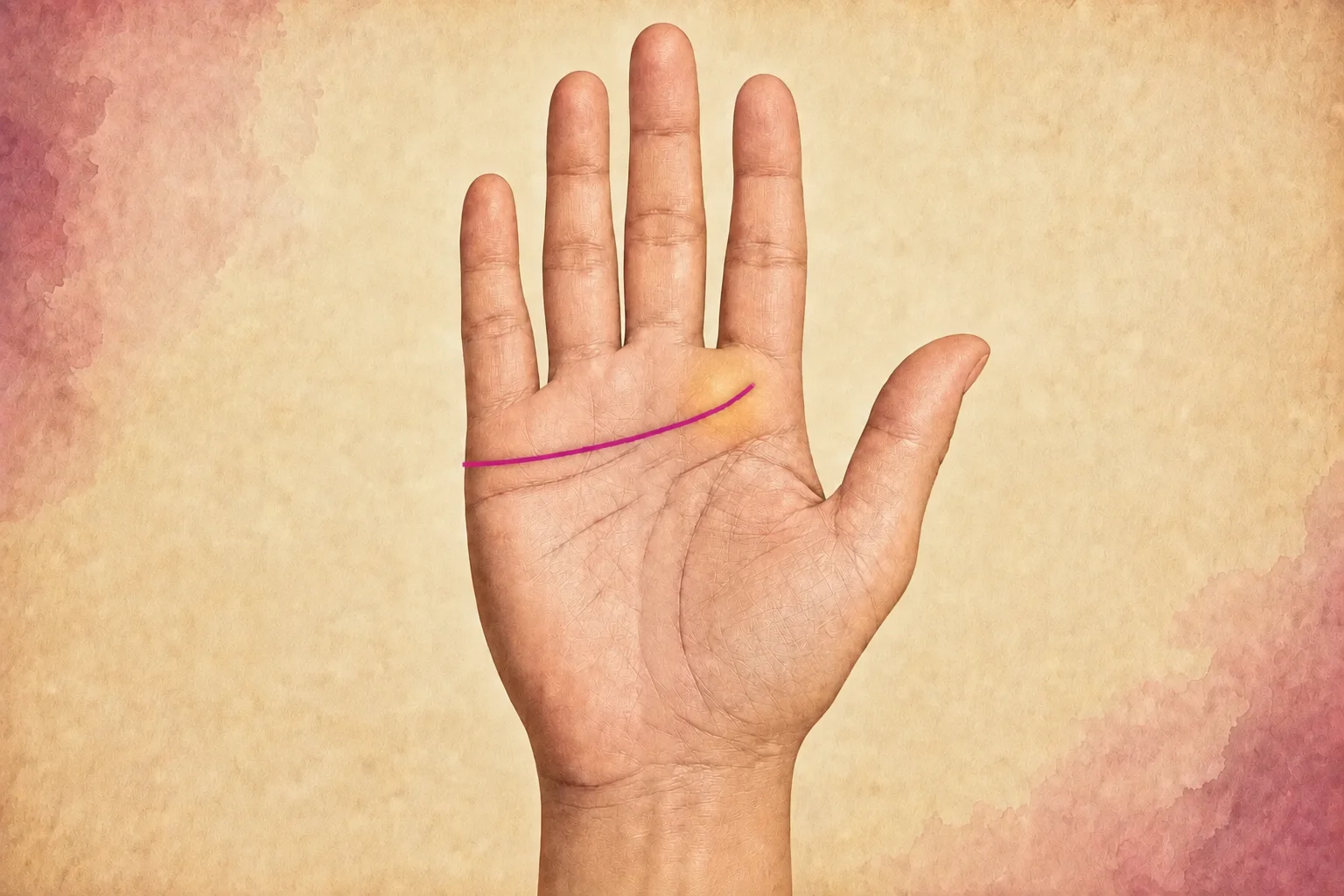
In traditional palmistry, a single heart line ending under Jupiter is read as emotionally idealistic, devoted, and guided by high standards; an ending between Jupiter and Saturn balances ideals with practical judgment; and an ending under Saturn emphasizes steadiness, realism, privacy, and present needs. None of these positions proves whether a relationship will succeed, describes a partner on its own, or ranks one emotional style above another.
A heart-line endpoint becomes meaningful only after the outer-edge origin, complete parent route, final traceable point, Jupiter or Saturn zone, curve, length, depth, branches, supporting Venus and thumb features, and both hands are compared. A whole-hand reading can show how ideals, practicality, emotional expression, boundaries, affection, communication, and relationship patterns work together.
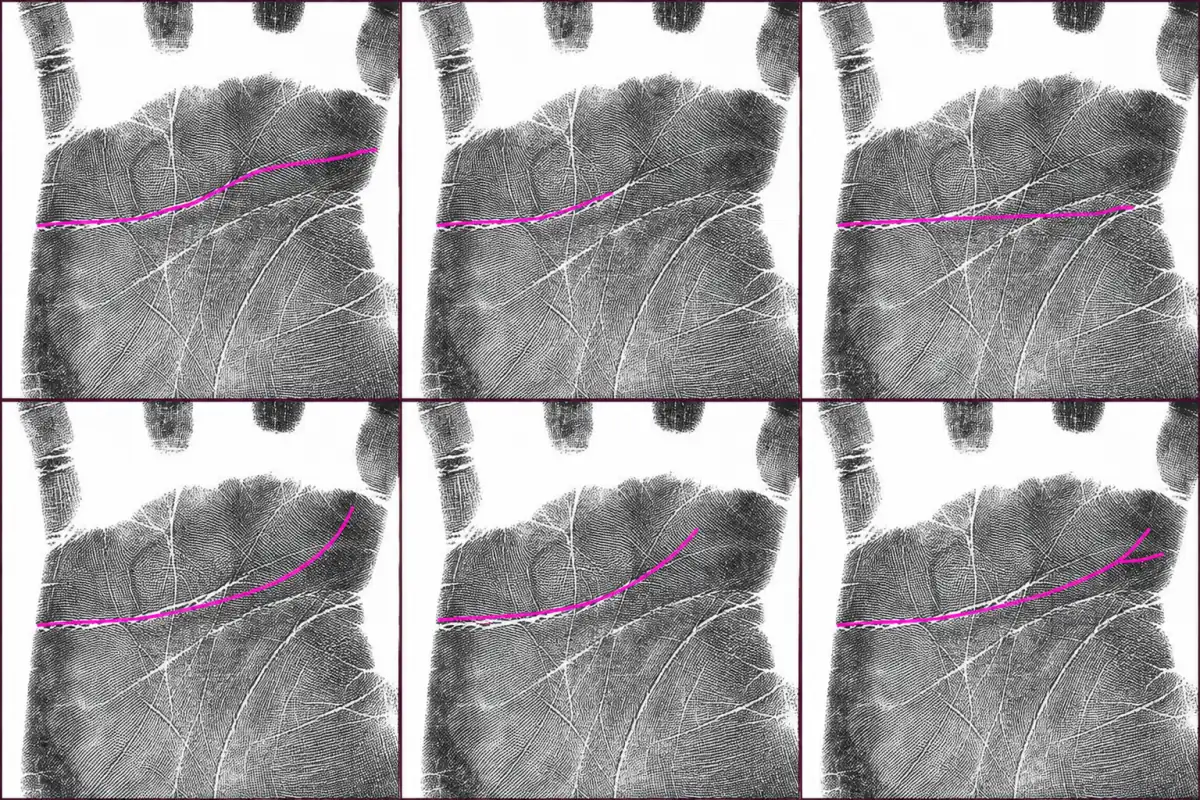
Use an eight-part heart-line-endpoint method: identify the outer-edge origin, trace one continuous parent line, locate its final visible point, name the endpoint zone, judge the overall length, record the curve, assess depth and continuity, then compare branches, Venus, the thumb, relationship lines, and both hands. The endpoint gives an emotional orientation. The rest of the hand shows how that orientation is expressed, protected, changed, or contradicted.
First decide whether you see one endpoint
This guide covers a heart line with one final destination. If the parent divides at one junction and both prongs continue, use the forked-heart-line method. If a small line leaves a continuing parent, it is a branch. If open skin separates two sections, test for a break or faint continuation before naming the ending.
How to locate the heart-line endpoint
The heart line begins at the outer edge of the palm below the little finger and travels inward across the upper palm. Follow it toward the thumb side. Its endpoint is the last traceable part of that parent line, not the deepest nearby crease or the branch that rises highest. The complete heart-line guide helps identify the parent before you isolate its destination.
| Endpoint zone | Where to look | Traditional emphasis |
|---|---|---|
| Under Jupiter | Below the index finger, within the Jupiter mount | Ideals, devotion, optimism, high expectations, meaning |
| Between Jupiter and Saturn | Below the gap between index and middle fingers | Balance between emotional ideals and practical reality |
| Under Saturn | Below the middle finger, within the Saturn mount | Practicality, reserve, reliability, immediate circumstances |
Use the fingers as vertical landmarks, but inspect the palm in a relaxed position. A stretched palm can pull the upper creases toward a different finger. Drop an imaginary vertical line from the center of the index finger for Jupiter and from the middle finger for Saturn. The narrow region between those lines is the balanced intermount destination.
How to verify a single true ending
Trace from the known outer-edge origin inward rather than beginning at the suspected endpoint. Keep following the same groove through crossings. At the last clear section, tilt the hand under soft side light: a fine continuation may extend farther than the first photograph suggests. Confirm that any rising line actually joins the heart line and does not merely cross it.
| Lookalike | Defining difference | How to classify it |
|---|---|---|
| Single endpoint | One parent route finishes at one traceable point | Read the final Jupiter, intermount, or Saturn zone |
| Terminal fork | One parent divides into two connected final prongs | Read both destinations and their relative strength |
| Upward branch | A smaller route leaves while the parent continues | Keep the parent endpoint and branch destination separate |
| Break or faint continuation | The groove stops, then restarts after open skin or overlap | Read continuity before deciding where the line ends |
| Crossing influence line | A second crease passes through without sharing the route | Do not let the crossing redefine the endpoint |
| Girdle of Venus | A separate arc sits higher beneath the finger bases | Read it independently from the heart line |
A true endpoint and a fork answer different questions. One endpoint emphasizes a primary emotional orientation. A fork can combine two simultaneous aims, such as idealism and practical judgment. The forked heart line guide shows the required shared junction and two-prong geometry.
Heart line ending under Jupiter meaning
Jupiter is the area beneath the index finger, traditionally associated with aspiration, values, leadership, self-respect, standards, and the wish to improve. When one heart line rises into this zone, palmists describe an emotional idealist: someone who may seek loyalty, meaning, commitment, shared principles, and a relationship that lives up to a strong inner picture.
This position can express warmth, optimism, generosity, faith in love, and a willingness to devote energy to a bond. Its challenge is the same high standard: a person may idealize a partner, expect emotional life to match an imagined version, or feel disappointed when ordinary relationships remain imperfect. The line's quality decides whether the ideal is carried steadily or with repeated strain.
| Jupiter-ending variation | Traditional reading | Modifier to inspect |
|---|---|---|
| Clear, gently curved line | Expressive idealism with consistent standards | Balanced Jupiter mount and flexible thumb |
| Very steep rise into Jupiter | Strong romantic or emotional expectations | Branches, depth, and relationship-line quality |
| Deep line with firm Jupiter | Conviction, devotion, and strong personal principles | Whether the thumb adds flexibility or rigidity |
| Faint or chained line | Ideals remain present but feelings may be harder to organize | Where clarity improves and whether both hands repeat it |
| Endpoint plus downward branch | High ideals modified by insecurity or inward pressure | Exact branch destination and parent continuity |
An endpoint under Jupiter does not mean someone is destined to marry, spiritually superior, or guaranteed a faithful partner. It describes the symbolic standards through which feelings may be understood. The Jupiter mount guide shows how firmness, apex, markings, and the index finger modify the same area.
Heart line ending between Jupiter and Saturn meaning
An ending beneath the gap between the index and middle fingers is traditionally considered the middle position. Jupiter contributes aspiration and emotional ideals; Saturn contributes judgment, duty, limits, and realism. Palmists therefore read this endpoint as the ability to care deeply while still noticing what daily partnership requires.
This does not mean a person is perfectly balanced in every relationship. A high curve can make the line more demonstrative and romantic; a straighter route can make the same endpoint more contained. A deep line can make the style firm and consistent, while a fine or chained line suggests that emotional responses need more time or context. The endpoint is the destination, not the entire emotional story.
When a line appears to end exactly on the boundary, avoid forcing it into one category. Photograph both hands, map the finger centers, and describe it as a Jupiter–Saturn or intermount ending. A precise location with a qualified reading is more useful than a confident label based on a blurry close-up.
Heart line ending under Saturn meaning
Saturn is the area beneath the middle finger, traditionally linked with responsibility, realism, concentration, limits, and practical experience. A heart line ending within this zone is usually shorter than a Jupiter-ending line. Palmists associate it with a private, immediate, or practical emotional style: valuing reliability, security, consistency, and what a partner actually does.
This ending is sometimes described too harshly as cold or unromantic. A better reading asks where warmth is expressed. A full Venus mount, flexible thumb, clear relationship lines, or a curved and deep heart line can add affection, loyalty, sensuality, and responsiveness. Saturn may place emotion inside duty, provision, or steady presence rather than dramatic display.
| Saturn-ending variation | Traditional reading | Modifier to inspect |
|---|---|---|
| Deep, clear, gently curved line | Steady feelings expressed through practical commitment | Venus, thumb flexibility, and Mercury finger |
| Short, straight, fine line | Private or selective response with limited display | Whether fine continuation extends toward Jupiter |
| Strong line + full firm Venus | Practical affection with physical warmth and loyalty | Relationship lines and life-line influences |
| Chained or repeatedly crossed line | Practical needs complicated by emotional fluctuations | Where the disturbance begins and ends |
| Endpoint with rising branch | A practical baseline with a secondary ideal or aspiration | Whether the parent continues beyond the branch |
Saturn does not predict emotional isolation or an unhappy relationship. The endpoint suggests a practical filter. Its expression depends on curve, strength, hand texture, Venus, the thumb, communication features, and lived circumstances. The Saturn mount guide explains the mount separately from a line ending inside it.
How curve, length, and line quality change the endpoint
Endpoint position and line character must be read as separate variables. Position identifies the destination. Curve shows how directly emotion rises toward expression or stays closer to the upper-palm baseline. Length shows how far the line reaches across the palm. Depth and clarity show how strongly and consistently its pattern appears.
| Feature | What it adds | Question to ask |
|---|---|---|
| High upward curve | More visible expression, romance, or idealistic response | Does it rise gradually or turn sharply only at the end? |
| Straighter route | More contained or controlled emotional expression | Is the line still deep and continuous? |
| Long route | Wider emotional responsiveness or stronger relational reach | Does length come from the parent or a branch? |
| Deep clear groove | A firm, consistent emotional pattern | Does it stay clear through crossings? |
| Fine or faint groove | A subtler, more changeable, or less outward pattern | Does side light reveal a continuation? |
| Chains, islands, or breaks | Periods of complexity, divided attention, or adjustment | Where does clean continuity return? |
For example, a deeply curved Jupiter ending can be strongly expressive and ideal-driven. A straighter Jupiter ending may hold equally high standards while expressing them with more control. A deep Saturn ending can be quietly constant, while a faint chained Saturn ending may show a practical orientation complicated by uncertainty. Always synthesize the attributes rather than letting the endpoint erase them.
Does the endpoint show marriage, loyalty, or relationship outcome?
No single heart-line ending can establish when you will marry, how many relationships you will have, whether a partner is faithful, or whether a bond will last. The endpoint describes a traditional emotional orientation. Relationship questions require the full heart line, its branches and interruptions, Venus, the thumb, Mercury communication features, relationship lines at the hand edge, influence lines, and both palms.
For love questions, first state what the endpoint suggests about expectations and expression. Then check whether other features repeat the same theme. The love and relationship palmistry guide owns the wider synthesis instead of asking one endpoint to predict an entire partnership.
Heart-line endpoints on one hand or both
A similar endpoint on both palms gives that emotional orientation more structural weight. When the active hand ends closer to Jupiter than the less-active hand, ideals, selectivity, or conscious relationship standards may have grown through experience. When the active endpoint sits closer to Saturn, present life may be emphasizing practicality, boundaries, reliability, or immediate needs.
Compare the whole route rather than measuring only the last millimeter. Look for a genuine change in endpoint zone, curve, length, clarity, branches, and nearby marks. Hands rarely match perfectly. The which-hand guide explains active and less-active comparison without using gender rules.
Heart-line endpoint combinations
| Combination | Traditional synthesis | Verify next |
|---|---|---|
| Jupiter ending + full firm Venus | High relationship ideals with warmth and active affection | Thumb flexibility and relationship lines |
| Jupiter ending + stiff thumb | Strong standards may become harder to revise | Head-line flexibility and branch quality |
| Between Jupiter and Saturn + flexible thumb | Ideals and reality can be negotiated adaptively | Mercury finger and clear communication signs |
| Saturn ending + full Venus | Practical emotional style with substantial warmth or sensuality | Heart-line depth and life-line influences |
| Saturn ending + clear straight head line | Feelings may be filtered through practical judgment | Whether the heart line curves or stays straight |
| Endpoint shifts across hands | Emotional priorities or expression may have developed | Which supporting features changed with it |
Worked examples
A deep heart line curves into Jupiter on both hands
The repeated pattern emphasizes idealism, devotion, expressive feeling, and firm relationship standards. A flexible thumb and balanced Jupiter mount can help those ideals adapt to real partnership; a very stiff thumb may make expectations less negotiable.
The less-active hand ends under Jupiter, while the active hand ends between the fingers
The underlying pattern remains idealistic, while the active hand suggests more practical balance has developed. Compare changes in curve, depth, Venus, thumb, and relationship experience before deciding what caused the shift.
A clear heart line ends under Saturn beside a full Venus mount
The endpoint favors reliability, immediate reality, and contained expression, while Venus adds warmth, affection, and physical engagement. The combination is more informative than calling the Saturn ending emotionally cool.
Photo checklist for a heart-line endpoint
- Photograph both full palms from wrist to fingertips.
- Add a close image of the upper palm from the little-finger edge through Jupiter.
- Keep the bases of the index and middle fingers visible as endpoint landmarks.
- Relax the palm and fingers instead of stretching them wide.
- Use soft side light to reveal faint continuations without glare.
- Trace from the outer-edge origin to the final point.
- Check for a fork, branch, break, crossing, or Girdle of Venus.
- Record endpoint zone, overall length, curve, depth, continuity, and color.
- Include the thumb and Venus mount in the full-palm view.
- State hand dominance and the relationship question you want explored.
Read the endpoint inside your complete relationship pattern
A Full Palm Reading maps the heart-line origin, complete route, final endpoint zone, curve, length, depth, branches, Jupiter, Saturn, Venus, thumb, relationship lines, and both palms. It then adds the head, fate, life, Sun, and Mercury lines, mounts, fingers, shape, and texture into one holistic reading focused on your questions.
The complete answer
A heart line ending under Jupiter traditionally emphasizes ideals, devotion, optimism, and high emotional standards. An ending between Jupiter and Saturn blends ideals with practical judgment. An ending under Saturn emphasizes realism, reliability, privacy, and present needs. Verify one true endpoint, then add the complete route, length, curve, depth, continuity, branches, Venus, thumb, relationship features, and both hands. A Full Palm Reading maps every important feature across both palms and combines them into a holistic reading focused on your questions about love, communication, commitment, compatibility, boundaries, timing, purpose, and direction.
A Full Palm Reading
Ask what your heart-line endpoint adds to the whole relationship pattern
Your reading maps the heart-line origin, complete route, final endpoint zone, curve, length, depth, branches, Jupiter, Saturn, Venus, thumb, relationship lines, and both palms, then adds the head, fate, life, Sun, and Mercury lines, mounts, fingers, shape, and texture into one holistic reading focused on your questions.
Your Full Palm Reading maps all the important features—hand shape, skin texture, thumb, fingers, mounts, major and minor lines, markings, and the differences between both palms—and brings them together in a holistic reading focused on your questions.