
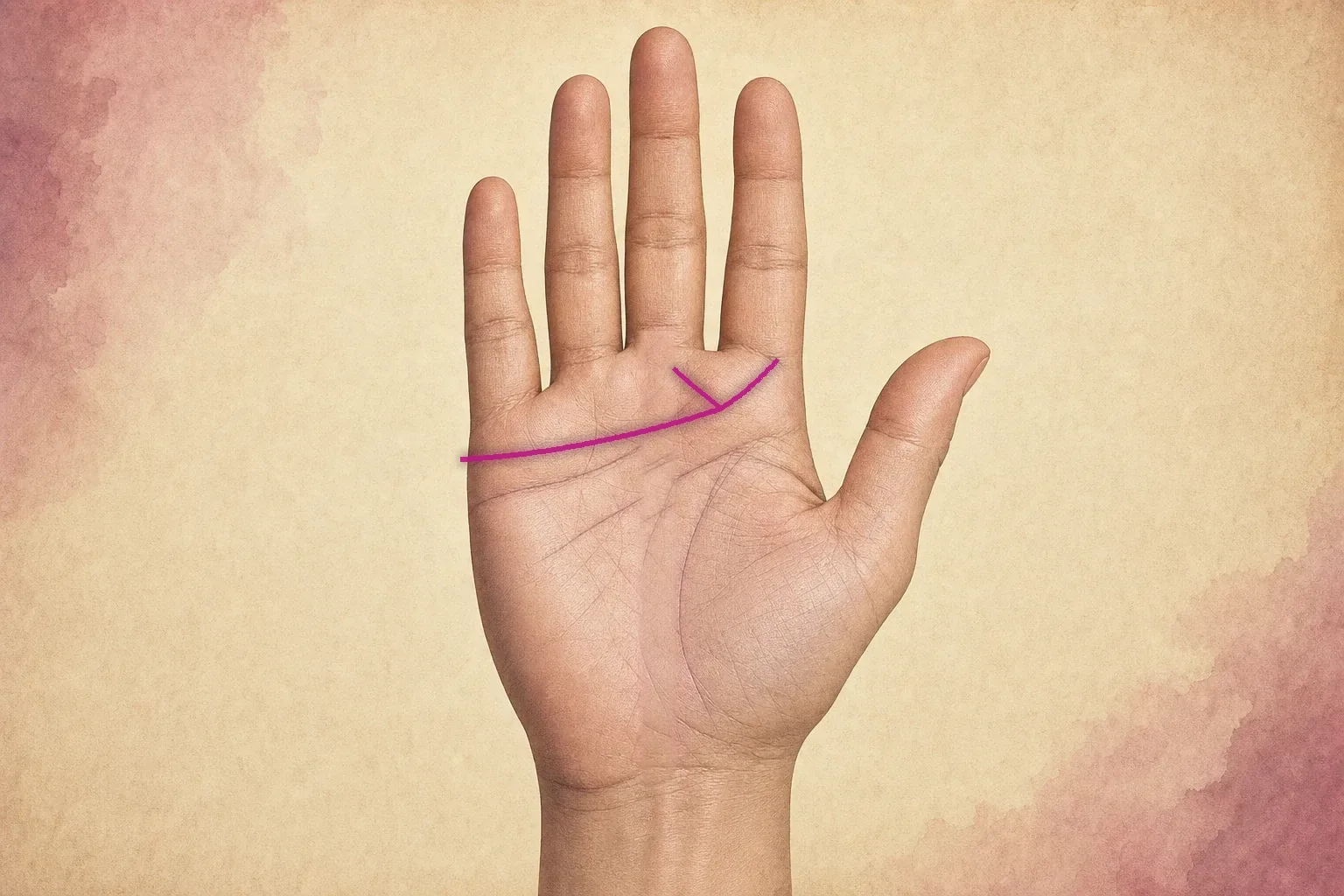
A forked heart line is traditionally read as emotional range: one feeling route can hold two aims, viewpoints, or ways of relating at the same time. A balanced fork toward Jupiter and Saturn is commonly associated with combining ideals and devotion with practical understanding. The direction and strength of each prong matter more than the label. A fork does not prove two partners, divided loyalty, breakup, or divorce.
A forked heart line becomes meaningful only after its parent route, shared junction, both prong destinations, relative strength, opening width, direction, timing, nearby lines, mount development, and both hands are compared. A whole-hand reading can show how ideals, practicality, emotional range, communication, and relationship patterns work together.
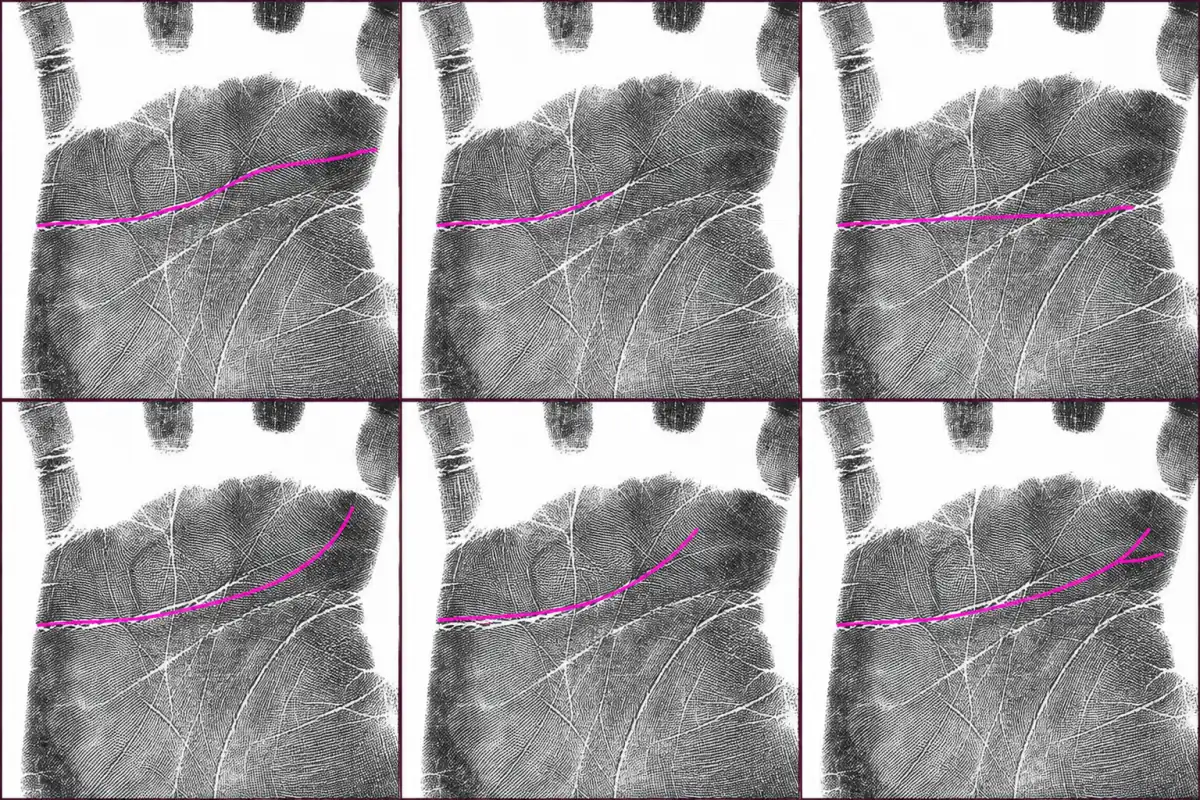
Use a seven-part forked-heart-line method: identify the heart line, confirm one shared parent, locate the single junction, follow both endpoints, compare prong strength, inspect the parent line and nearby features, and compare both hands. Read each prong separately before combining them.
Two branches do not always make an endpoint fork
A true fork replaces the end of one parent line with two prongs. If the heart line continues past an offshoot, the offshoot is a branch. If three prongs share a stem, the shape is a trident. Trace the parent through the junction before interpreting it.
How to identify a true forked heart line
The heart line is the upper major transverse crease, beginning from the outer edge below the little finger and travelling toward the index or middle finger side. The complete heart-line guide maps its normal length, curve, depth, ending zones, and variations.
For a true fork, one parent route reaches one clear junction and becomes exactly two endpoints. Both prongs should have enough length to show direction. A crossing line can create the illusion of a split, while two nearby lines can resemble a fork without sharing a parent.
| Pattern | Classification | Deciding feature |
|---|---|---|
| One parent ends in two prongs | Forked heart line | Single junction and two endpoints |
| Parent continues beyond an offshoot | Heart-line branch | Main route remains intact |
| One parent ends in three prongs | Heart-line trident | Three endpoints share the stem |
| Two independent lines cross near the end | Intersection | No shared split |
| Parent divides and rejoins | Island | Enclosed space and reunion |
| Two prongs visible in one photo only | Image uncertainty | Split disappears under changed light |
The general fork guide explains the shared-junction test across all parent lines. This page owns the heart line's emotional-expression and relationship context.
Read where each heart-line prong ends
Endpoint mounts create the main distinction. Jupiter lies below the index finger and concerns ideals, standards, purpose, and aspiration in traditional palmistry. Saturn lies below the middle finger and concerns responsibility, realism, patience, and sustained commitment. The space between them combines both fields.
| Fork destinations | Traditional emotional theme | What to verify |
|---|---|---|
| Jupiter + Saturn | Ideals and practical understanding operate together | Both endpoints reach their mounts |
| Jupiter + space between mounts | High standards balance with compromise | Index-finger prong is truly distinct |
| Saturn + space between mounts | Realism broadens toward emotional flexibility | Relative prong strength |
| Two prongs within Jupiter | Two idealistic aims or expressions share one value system | Exact endpoints inside Jupiter |
| Two prongs within Saturn | Two practical or duty-based expressions coexist | Whether one is a branch |
| Upper prong Jupiter, lower toward head line | Ideal feeling is balanced by reflection or mental context | Lower endpoint and head-line contact |
Use the Jupiter guide and Saturn guide to verify boundaries, development, finger support, and markings. A prong that misses both mounts and turns toward the head line should be read by its actual destination.
Equal, unequal, narrow, and wide heart-line forks
Relative strength shows which destination carries more weight. Two equal clear prongs support a balanced dual expression. A deep Jupiter prong with a fine Saturn prong emphasizes ideals while keeping some practical perspective. A stronger Saturn prong makes realism or responsibility more dominant.
| Prong relationship | Traditional emphasis | Reading question |
|---|---|---|
| Equal depth and length | Both emotional aims have similar weight | Do both endpoints remain clear? |
| Jupiter prong stronger | Ideals, standards, or devotion lead | Is Jupiter balanced or overdeveloped? |
| Saturn prong stronger | Practicality, duty, or reserve leads | How does the heart-line parent curve? |
| One prong short and fine | A secondary capacity modifies the main style | Is the fine prong stable in both photos? |
| Narrow fork opening | Two viewpoints remain closely coordinated | Where is the true junction? |
| Wide fork opening | Broader emotional range or more divergent aims | Do the prongs reach different mounts? |
Depth, clarity, and length are separate. The line-quality guide helps compare a fine secondary prong with the rest of the same hand.
Compare the opening width only after locating the junction. A fork can look wide because one short prong turns sharply, while two long prongs may stay close for most of their route. Note the angle, length, and destination as separate observations. Then compare the same proportions on the other hand. This prevents a dramatic camera angle or one faint crease from becoming the entire interpretation. When prong strength and width point in different directions, give the deeper continuous prong more weight and use the finer one as a modifier.
Upward and downward heart-line forks
Prongs rising toward finger mounts keep the reading in aspiration, expression, or relationship ideals. A lower prong turning toward the Plain of Mars or head line adds practical reflection, emotional complexity, or tension between feeling and thought. Its endpoint and connection decide the synthesis.
A downward prong does not automatically predict heartbreak. Check whether it is truly an endpoint prong, a branch from the parent line, or another crease crossing underneath. A deep lower prong that touches the head line creates a stronger heart-and-head connection than a short free-ending prong.
| Direction | Traditional emphasis | Confirmation |
|---|---|---|
| Both prongs rise | Emotional range seeks active expression | Mount destinations |
| Upper rises, lower stays level | Ideal aims balance with practical steadiness | Parent-line curvature |
| Upper rises, lower descends | Feeling balances aspiration with reflection or pressure | Lower endpoint |
| Lower prong reaches head line | Emotion and decision-making become directly linked | True junction at the head line |
| One prong curves back | An emotional aim returns toward the parent theme | Whether it forms an island |
| Fork crossed by another line | An outside influence modifies both aims | Crossing-line origin |
Fork position and timing
Most heart-line fork searches concern the terminal split under Jupiter or between Jupiter and Saturn. This ending describes the mature direction of the heart-line style rather than one exact event date. A fork appearing earlier along the route may be placed within a broad proportional stage, but first confirm whether the parent ends there or continues.
A branch along the middle of the heart line belongs to branch timing, while a split that reunites is an island with a start and end. The timing guide explains broad calibration. No endpoint fork alone gives a wedding date, breakup date, or count of relationships.
| Fork position | Traditional use | Limit |
|---|---|---|
| At terminal end under Jupiter/Saturn | Overall emotional direction and range | Not one dated event |
| Near the middle of the route | A choice or divided expression in a broad stage | Parent must truly stop there |
| Near little-finger origin | Early opening pattern has two channels | Distinguish fine source lines |
| Fork begins after a break | A changed emotional route develops two aims | Read the break first |
| Fork appears only on active hand | Range develops through present experience | Compare matched endpoints |
Forked heart line on one hand or both
Traditional readers often treat the less-active hand as underlying capacity and the active hand as present expression. A matching fork on both hands carries more structural weight. A fork appearing only on the active hand can show emotional range or perspective developed through experience. One clearer on the less-active hand may show a capacity expressed through a simpler present route.
| Hand comparison | Traditional synthesis | Verify |
|---|---|---|
| Balanced fork on both | Dual emotional range repeats consistently | Matching destinations |
| Single ending less-active, fork active | Present expression develops broader perspective | Active prong quality |
| Fork less-active, single ending active | Underlying range consolidates into one current emphasis | Which mount receives the active line? |
| Different dominant prong | Values and practical priorities have shifted | Mounts, fingers, and line depth |
| Fork visible in one photo angle | Evidence remains uncertain | Retake both hands |
The which-hand guide explains dominance without using gender rules.
Forked heart-line combinations
| Combination | Traditional synthesis | Read with |
|---|---|---|
| Jupiter-Saturn fork + flexible thumb | Ideals and realism adapt through reason | Thumb opening and second phalanx |
| Balanced fork + clear head line | Emotional range works with defined thought | Head-line ending |
| Strong Jupiter prong + Jupiter branch | Aspiration and high standards repeat | Jupiter development |
| Lower prong + sloping head line | Feeling and imagination share a channel | Moon and line junction |
| Fork + Girdle of Venus | Range combines with heightened emotional sensitivity | Girdle continuity |
| Fork + clear relationship line | Emotional style supports one defined attachment pattern | Relationship-line quality and both hands |
The love and relationship guide combines the heart line with the relationship lines, Venus, Moon, Jupiter, Mercury, thumb, and both hands.
Worked forked heart-line examples
Two equal prongs reach Jupiter and Saturn
The traditional synthesis is emotional breadth that combines ideals with practical understanding. Check the parent line's depth and curve, both mounts, thumb flexibility, and whether the pattern repeats on the active hand.
Deep Jupiter prong and fine Saturn prong
Ideals or standards lead while a subtler realistic perspective remains available. The secondary prong still matters if it is clear and stable under changed light.
One prong rises to Jupiter and one descends toward the head line
Aspiration is balanced by reflection or mental context. Confirm whether the lower prong reaches the head line or ends freely, because direct contact creates a stronger combination.
Three endpoints share the same stem
This is a trident rather than a two-prong fork. Use the trident guide to compare the central and side prongs.
Photo checklist for a forked heart line
- Photograph both full palms under the same soft light.
- Keep all fingers naturally open so the upper palm is not compressed.
- Add a close-up from the little-finger edge to both endpoints.
- Include the index and middle finger bases to verify Jupiter and Saturn.
- Take a second angle to exclude a crossing-line illusion.
- Show the shared junction and both prongs without drawing over them.
- Record which prong is deeper, longer, and clearer.
- State hand dominance and the relationship or emotional question you want explored.
Read both prongs inside the complete relationship pattern
A Full Palm Reading maps the heart-line origin, parent route, fork junction, both destinations, prong strength, width, direction, timing, crossings, combinations, and both palms. It then adds the head line, relationship lines, Venus, Moon, Jupiter, Saturn, Mercury, thumb, fingers, shape, and texture into one holistic reading focused on your questions.
The complete answer
A forked heart line is one parent heart line ending in two prongs. Traditional palmistry reads it as emotional range, with the prong destinations showing the aims being combined. A balanced Jupiter-Saturn fork commonly joins ideals and devotion with practicality and sustained understanding. Verify the shared junction, endpoints, relative strength, opening width, upward or downward direction, parent-line quality, timing position, combinations, and both hands. A Full Palm Reading maps the fork and all important features across both hands and combines them into a holistic reading focused on your questions about love, relationships, commitment, communication, decisions, family, timing, purpose, and direction.
A Full Palm Reading
Ask how both heart-line prongs work across your complete hand
Your reading maps the heart-line origin, parent route, fork junction, both destinations, prong strength, opening width, direction, timing, crossings, and combinations, then adds the head line, relationship lines, Venus, Moon, Jupiter, Saturn, Mercury, thumb, fingers, shape, texture, and both palms into one holistic reading focused on your questions.
Your Full Palm Reading maps all the important features—hand shape, skin texture, thumb, fingers, mounts, major and minor lines, markings, and the differences between both palms—and brings them together in a holistic reading focused on your questions.