
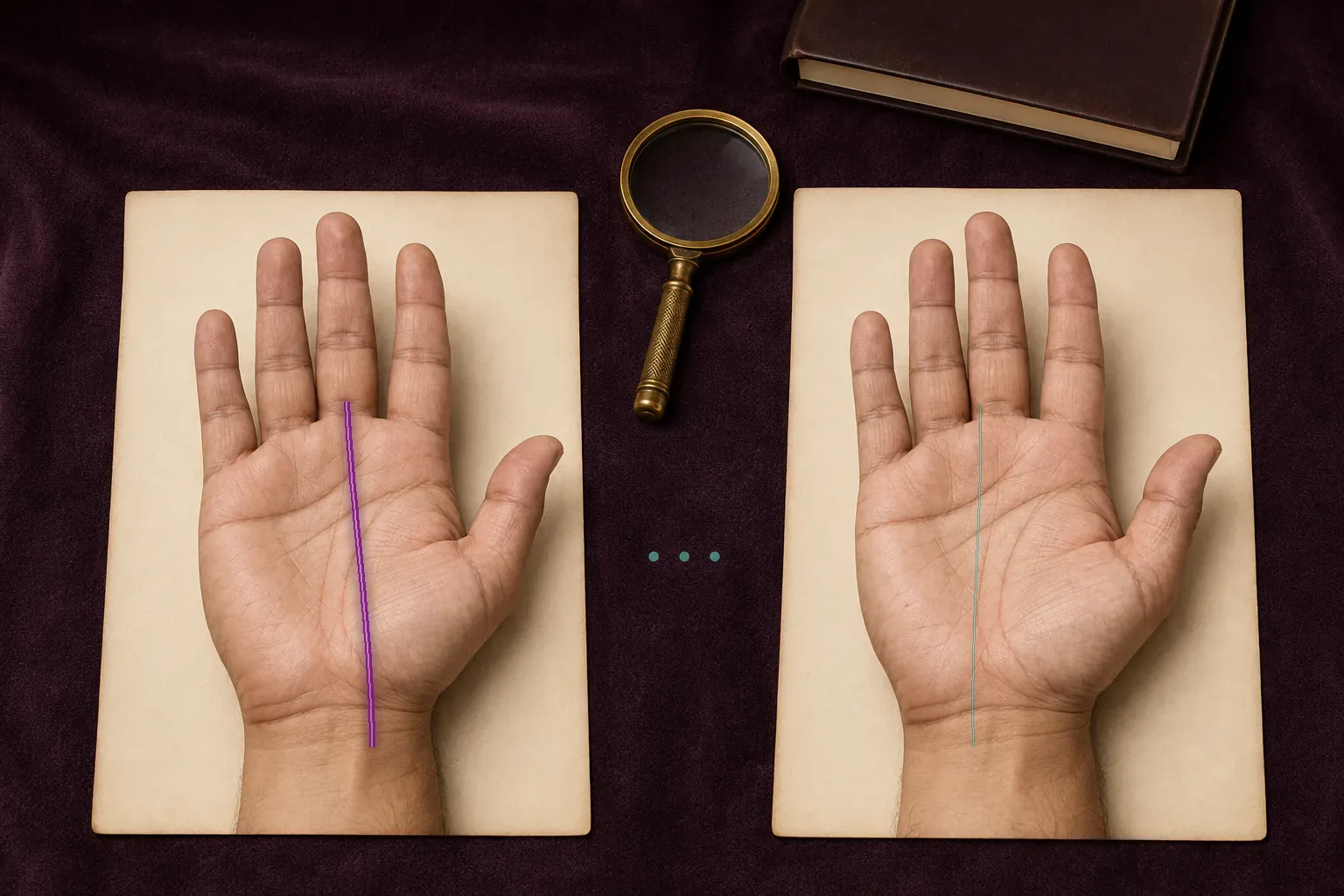
Deep palm lines are traditionally read as strongly established, consistently expressed themes, while faint palm lines are read as subtler, less fixed, developing, or less continuously expressed themes. Depth does not make a line lucky or unlucky, and faintness does not erase it. First identify which line you are viewing, then compare its depth with other lines on the same hand, its clarity and continuity, the section involved, and the matching route on the other palm.
Line quality becomes meaningful only after depth, width, clarity, color, continuity, identity, route, changes, supporting features, and both hands are compared. A whole-hand reading can show which themes are strongly established, developing, flexible, concentrated, or changing across your work, decisions, relationships, and direction.
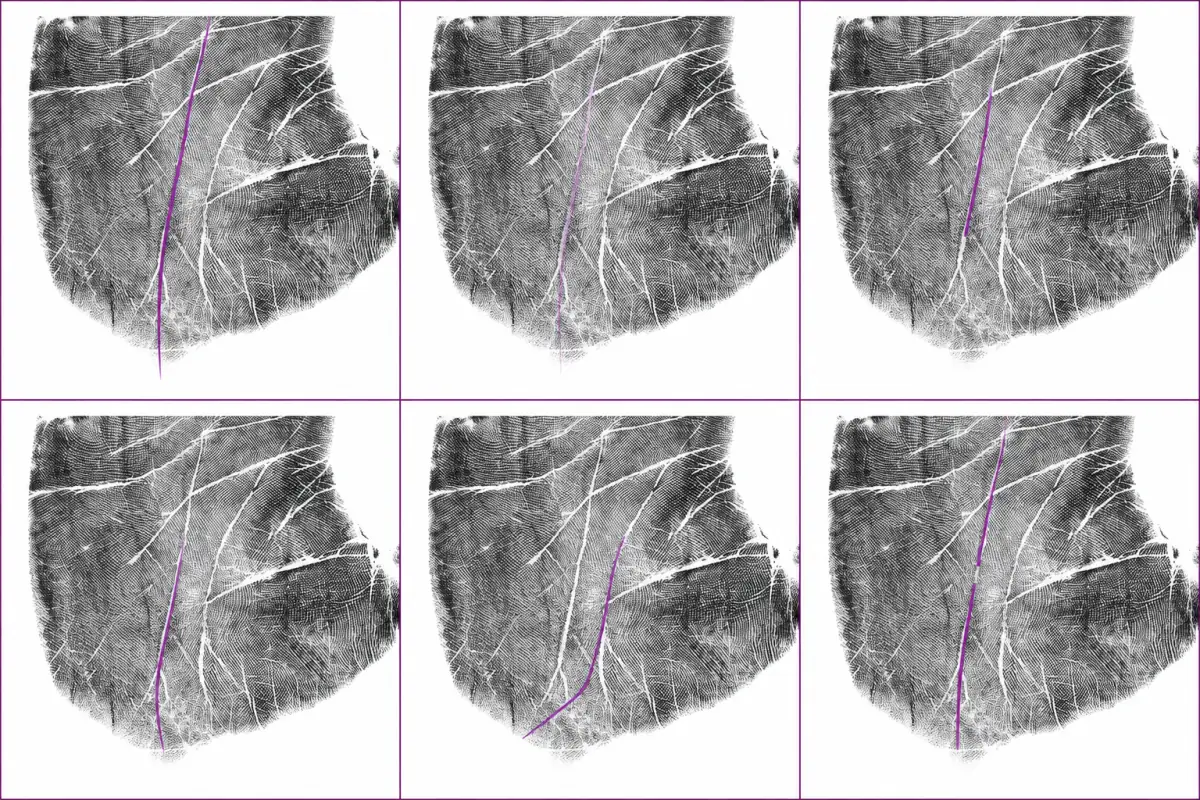
Use a seven-part line-quality reading method: identify the parent line, compare it with the same palm, separate depth from width, check clarity and color, trace continuity, mark any change along the route, and compare both hands. A deep life line and a deep fate line concern different subjects even when their physical quality looks similar.
Compare within the hand before using a label
Hands naturally vary. A line that looks faint beside one person's creases may be one of the clearest lines on another person's palm. Use the surrounding lines as the scale, photograph both hands under the same light, and follow the complete route before interpreting it.
Five line qualities to observe separately
People often use “deep” to mean dark, wide, or obvious and “faint” to mean thin, short, or broken. Those are different observations. Record each one before building meaning. The beginner palm-reading sequence helps locate the major lines first.
| Quality | What to observe | Do not confuse it with |
|---|---|---|
| Depth | How strongly the crease is cut into the palm | Darkness caused by shadow |
| Width | Whether the line is fine, medium, or broad | Depth; a broad line may be shallow |
| Clarity | Whether both edges are clean and easy to trace | Color or photographic contrast |
| Color | How the crease appears relative to nearby skin | Meaning created by light or camera settings |
| Continuity | Whether the route remains visible from start to end | Depth; a faint line can be continuous |
Length and destination also remain separate. A short deep line is strongly marked only for its visible section. A long faint line carries a subtle but traceable theme across a longer route. A gap creates a broken-line question; it should not be described merely as faintness.
What a deep palm line traditionally means
A deep, clean line traditionally emphasizes stability, concentration, or a theme that is easy to express consistently. It attracts attention because it holds its route under different angles of light. Its subject still comes from identity and destination: the life line concerns foundation and vitality traditions, the head line concerns thought and decisions, the heart line concerns emotional expression, and the fate line concerns structure and direction.
Deep does not automatically mean beneficial. A deep line can be rigid, interrupted, chained, crossed, or poorly directed. A clear deep route with a smooth continuation differs from a heavily cut line filled with bars. The combination of quality and geometry creates the reading.
| Deep-line form | Traditional emphasis | What modifies it |
|---|---|---|
| Deep, fine, and clear | Focused, established expression | Line identity and destination |
| Deep and broad | Strong but more forceful or diffuse expression | Edge clarity and surrounding texture |
| Deep with clean continuity | Sustained emphasis across the visible route | Branches and endpoint |
| Deep with a true break | A strongly marked path meets a defined transition | Restart, overlap, and support signs |
| Deep with many crossing bars | The main theme remains strong amid repeated interference | Origins of crossing lines |
| Deep only in one section | Emphasis concentrates in that chapter | Where it strengthens and fades |
What a faint palm line traditionally means
A faint but clear line is traditionally read as a subtle, sensitive, developing, flexible, or less continuously emphasized expression of its subject. It may become easier to see in one section and quieter in another. Faintness alone does not mean weakness, failure, illness, or absence.
Trace the line with side light rather than pressing or drawing over it. If a route remains visible from origin to destination, treat it as present. If only several aligned fragments appear, record a fragmented route. If no section can be found under consistent light, use the relevant missing-line guide, such as the no-fate-line comparison.
| Faint-line form | Traditional emphasis | Verification |
|---|---|---|
| Fine, faint, and clear | Subtle but coherent expression | Trace both edges and full route |
| Faint and diffuse | Theme is less sharply directed | Retake under soft side light |
| Faint at the beginning | Pattern develops gradually | Find where it becomes definite |
| Faint at the end | Emphasis reduces or redirects later | Look for a branch or continuation |
| Faint between two clear sections | A quieter transitional phase | Distinguish fade from open gap |
| Visible on only one hand | Underlying capacity and present expression differ | Use matched photographs |
Depth vs width, clarity, color, and continuity
A deep line can still be fine
A fine line has narrow width. If it is sharply cut and holds a clean edge, it can be deep and fine at the same time. Traditional readers often associate this combination with concentrated, precise expression rather than sheer force.
A broad line can still be shallow
A broad groove occupies more surface space but may have soft, shallow edges. Read it as broad and diffuse rather than automatically deep. Compare nearby skin texture and other major lines to avoid exaggerating the difference.
A dark photograph does not prove a deep line
Direction of light, phone contrast, moisture, and shadow can darken a crease. Depth is better judged from the way the groove holds its form across two angles. Color can be recorded, but it should not replace the structural observations.
A faint line can still be complete
Continuity asks whether the route can be followed; depth asks how strongly it is cut. A complete faint fate line differs from a broken deep fate line. One is subtle and sustained, while the other is strong on either side of a transition.
Deep and faint meanings by major line
| Parent line | When deep and clear | When faint but traceable |
|---|---|---|
| Life line | Foundation and physical engagement are strongly emphasized | Energy or grounding is expressed more subtly or variably |
| Head line | Thinking style and decisions are strongly established | Mental approach is more responsive, developing, or less fixed |
| Heart line | Emotional style and values are clearly expressed | Feeling is present but communicated or organized more subtly |
| Fate line | Structure, responsibility, or direction has a strong route | Direction is present but may be flexible, gradual, or less central |
| Sun line | Expression, satisfaction, or recognition has clear emphasis | A creative or visible outlet develops quietly |
| Mercury line | Communication or applied skill is strongly marked | The skill theme is fine, secondary, or developing |
These are traditional symbolic themes, not fixed outcomes. Read the life line, head line, heart line, or fate line guide for the full route, branches, endpoints, and combinations belonging to each line.
When a line becomes deeper or fainter along its route
A change in quality is more informative than one label applied to the whole line. Mark the exact point where the edges sharpen, the groove deepens, the route broadens, or visibility fades. Then compare that position with crossings, branches, joins, and the major-line timing landmarks.
| Quality change | Traditional reading | Check next |
|---|---|---|
| Faint route becomes deep | Theme consolidates or gains consistent expression | Branch, junction, and timing |
| Deep route gradually becomes faint | Emphasis softens, changes form, or becomes less central | New destination or supporting route |
| Deep line stops at a gap | A defined transition rather than simple fading | Restart and overlap |
| Faint segment restarts clearly | A quieter phase leads into renewed emphasis | Alignment and source of restart |
| Second line strengthens beside it | Support or another route gains importance | Identify the companion line |
| Same change appears on both hands | The pattern carries greater comparative weight | Match positions proportionally |
The palm-line change guide explains how to compare dated photographs without mistaking lighting, hand tension, or camera processing for a new marking. The timing guide uses broad proportional sections rather than exact dates from one point.
Deep or faint lines on one hand or both
Traditional readers often compare the less-active hand as underlying capacity with the active hand as present expression. A line that is deep on both hands carries a more consistent emphasis. A route that is faint on the less-active hand and deep on the active hand may show a quality strengthened through experience. The reverse can show strong underlying capacity expressed differently in the current pattern.
| Hand comparison | Traditional emphasis | Photo control |
|---|---|---|
| Deep on both | Stable theme across capacity and current expression | Match route and endpoint |
| Faint on both | Consistently subtle or flexible theme | Use identical side light |
| Faint less-active, deep active | Quality has strengthened through use or experience | Compare the same section |
| Deep less-active, faint active | Underlying emphasis is currently redirected or quieter | Look for another active-hand route |
| Difference visible in one image only | No reliable comparison yet | Retake palms together |
Use the which-hand guide to compare dominance without relying on gender rules.
Deep and faint line combinations
| Combination | Traditional synthesis | What confirms it |
|---|---|---|
| Deep fate line + clear head line | Structured direction works with a defined thinking style | Junctions and destination |
| Faint fate line + strong Sun line | Expression or satisfaction may organize purpose more than fixed structure | Apollo destination |
| Deep life line + faint head line | Strong engagement combines with a responsive mental approach | Thumb and hand shape |
| Faint heart line + fine hand texture | Subtle emotional expression fits an overall fine pattern | Line clarity and fingers |
| Deep parent + faint rising branch | A stable route develops a quieter possibility | Branch endpoint |
| Faint parent + clear support line | A subtle main theme receives defined reinforcement | Parallelism and timing |
Worked deep and faint line examples
Deep fate line that fades above the head line
Direction is strongly established through the lower route and becomes quieter after a decision landmark. Check for a shifted continuation, Sun line, branch, or second fate route before deciding the structure simply ends.
Fine faint head line that remains complete
The thinking route is subtle but coherent. Compare it with the hand's overall fineness, its slope and endpoint, the thumb, and the active hand rather than reading faintness as lack of intelligence or concentration.
Deep life line with a short faint sister line
The main foundation is strongly marked, while a subtler companion adds reinforcement only during its visible section. Confirm that the second route runs parallel inside Venus using the double-life-line guide.
Line seems dark in one photo and absent in another
The evidence is photographic rather than structural. Retake both palms under diffuse side light, keep the hands equally relaxed, and compare the crease from two angles before assigning any meaning.
Photo checklist for comparing line quality
- Photograph both full palms together under one light source.
- Use soft side light so the depth of a groove creates a controlled edge.
- Keep both palms equally relaxed and the fingers naturally open.
- Take one straight-on image and one slight-angle image.
- Add close-ups at the same camera distance and focus.
- Do not sharpen, increase contrast, or draw over the lines.
- Trace the complete origin, route, and endpoint before comparing depth.
- State which hand is active and which line or question you want examined.
Read line quality inside the complete hand
A Full Palm Reading maps every important line's identity, origin, route, destination, depth, width, clarity, color, continuity, changes, branches, crossings, timing, and appearance on both palms. It then combines those observations with the mounts, fingers, thumb, hand shape, and texture into one holistic reading focused on your questions.
The complete answer
Deep palm lines traditionally show strongly established or consistently expressed themes; faint palm lines show subtler, developing, flexible, or less continuously emphasized themes. Neither quality is automatically good or bad. Compare the line with the same hand, then separate depth from width, clarity, color, continuity, length, and geometry. Identify the parent line, note where its quality changes, and compare the matching route on both hands. A Full Palm Reading maps all of those features across the complete hand and combines them into a holistic reading focused on your questions about work, decisions, relationships, family, energy, change, recognition, timing, purpose, and direction.
A Full Palm Reading
Ask what your strongest and subtlest lines mean together
Your reading maps each important line's depth, width, clarity, color, continuity, origin, route, destination, changes, branches, crossings, and timing, then combines the mounts, fingers, thumb, hand shape, texture, and both palms into one holistic reading focused on your questions.
Your Full Palm Reading maps all the important features—hand shape, skin texture, thumb, fingers, mounts, major and minor lines, markings, and the differences between both palms—and brings them together in a holistic reading focused on your questions.