
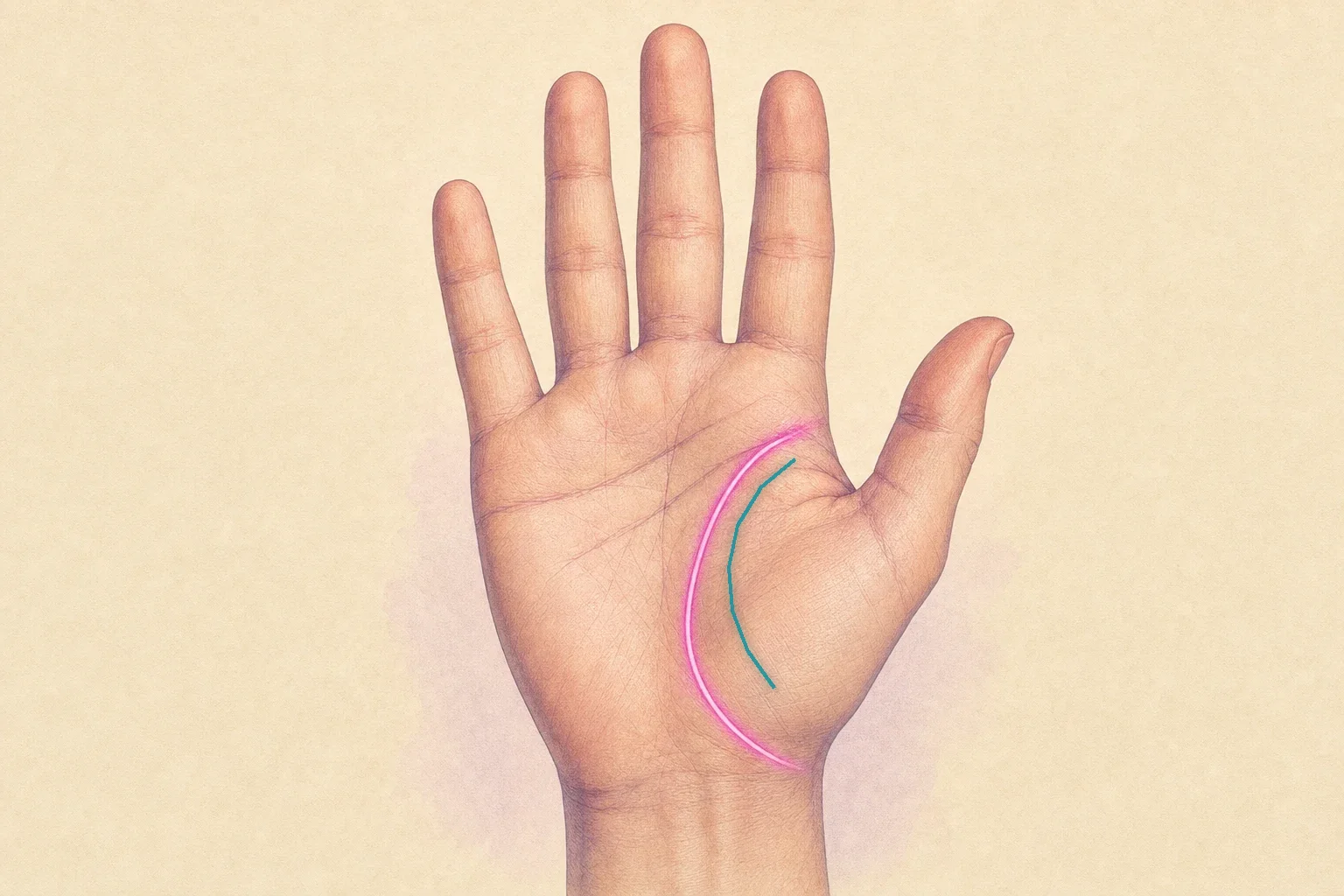
A double life line is a second line that runs close and parallel inside the main life-line arc, between the life line and the thumb mound. It is commonly called a sister life line, inner life line, support line, or Line of Mars. Traditional palmistry reads it as added reserve, reinforcement, resilience, or support during the part of the life line it accompanies. It does not mean two lives, double lifespan, or protection from every difficulty.
A sister life line becomes meaningful only after its location, parallel route, start, end, spacing, relative depth, interruptions, connections, timing, Venus, Mars, and both hands are compared. A whole-hand reading can show whether reserve, support, family, persistence, environment, or recovery modifies the questions you are asking.
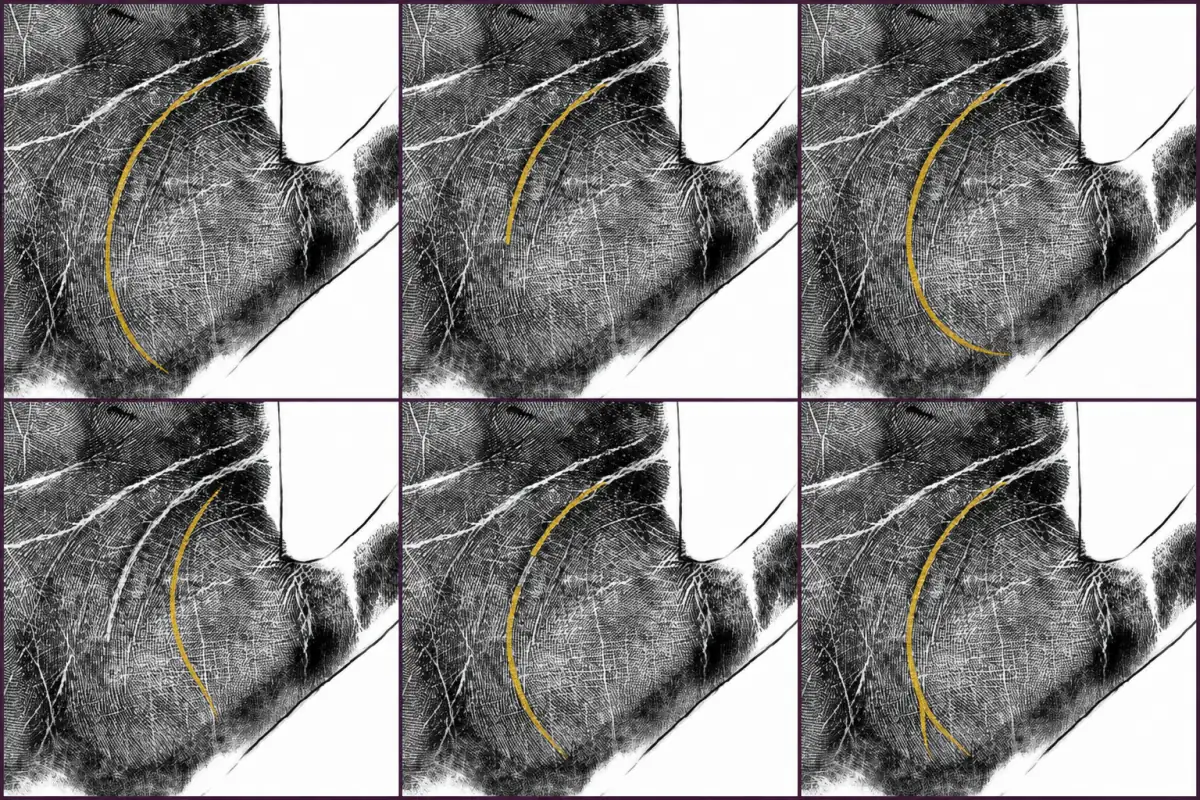
Use a seven-part double-life-line reading method: identify the main life line, confirm a separate parallel route, locate the second line inside Venus, mark where it starts and ends, compare its strength with the parent line, inspect interruptions and connections, and compare both hands. The relationship between the two lines creates the meaning.
Read the companion section, not the label alone
A sister line that supports one short weak section differs from a deep second route shadowing the entire arc. Note exactly which part it accompanies, whether it remains separate, and what happens to the main life line beside it.
How to identify a true double life line
First locate the life line beginning between the thumb and index finger and curving around the Mount of Venus. The companion line sits inside that curve, closer to the thumb, and follows the same general direction for a meaningful distance. It may cover the whole arc or only one part. The complete life-line guide shows the parent route.
| Feature | True sister life line | Common confusion |
|---|---|---|
| Location | Inside the life-line arc on Venus | Fate line in the central palm |
| Direction | Closely follows the life line | Influence line crossing toward the center |
| Length | Runs parallel for a visible section | One short scratch or skin ridge |
| Relationship | Remains a distinct companion | Branch growing from the life line |
| Geometry | Two side-by-side routes | One line splitting into a fork |
| Image stability | Visible in relaxed light from two angles | Shadow, glare, or doubled edge |
If the second line crosses the main line and travels toward the central palm, it is more likely an influence or change line. If both routes share a junction, use the branch guide. If one parent ends in two prongs, use the fork guide. The defining feature here is sustained parallelism.
What a double life line traditionally means
The traditional theme is reinforcement. That can describe inner reserve, recovery, persistence, close support, a protective environment, or additional capacity during the accompanied section. Palmistry cannot identify one specific supporter from the mark alone. Venus, influence lines, the thumb, Mars areas, and the other hand show whether the context leans toward personal resilience, family support, partnership, or practical backup.
| Companion quality | Traditional emphasis | What to compare |
|---|---|---|
| Deep and clear | Strong sustained reserve or reinforcement | Main line depth and thumb |
| Fine but clear | Subtle, responsive support | Overall fineness of the hand |
| Broad or diffuse | Support is present but less consistently directed | Venus firmness and line edges |
| Chained companion | Reinforcement develops through repeated adjustment | Whether it clears later |
| Several short parallels | Support appears in separate stages | Timing zones and repeated context |
| Main and companion equally strong | Two powerful sources of continuity operate together | Origins, endpoints, and connections |
Do not read a strong sister line as invulnerability. Its traditional value lies in the way it modifies the nearby life-line section. A clear companion beside a faint, chained, or interrupted parent is more informative than the same line beside an already deep uninterrupted arc.
Full, partial, upper, middle, and lower sister lines
Mark the companion's start and end against the parent. A full sister line shadows most of the life-line arc. A partial one supports only the section beside it. Upper sections are read nearer the beginning of the life-line route; middle sections concern the central arc; lower sections sit closer to the wrist. Use proportional stages rather than turning one point into an exact birthday.
| Where the sister line runs | Traditional focus | Useful confirmation |
|---|---|---|
| Nearly the full arc | Long-standing reserve or support | Both hands and line consistency |
| Upper life-line section | Early foundation, family setting, or initial resilience | Life-line origin and Venus lines |
| Middle section | Support through a central development or work chapter | Head-line crossing and fate line |
| Lower section | Later foundation, continuity, or changing environment | Moon branches and wrist lines |
| Begins beside a weak section | Reinforcement appears where the parent loses clarity | Exact overlap in timing |
| Ends as parent strengthens | Support becomes less necessary as continuity consolidates | Depth after the endpoint |
Spacing between the two lines
A close, even gap supports the sister-line classification because the companion follows the same life-line arc. A wider gap can still belong to the Mars area, but its relationship must be proved by parallel direction and sustained length. If the route gradually moves toward the central palm, identify its destination; it may be an influence line, a secondary fate route, or another minor crease.
Where the companion begins
A sister line can begin beside the life-line origin, appear only after the upper arc, or emerge beside a disrupted section. An upper start does not automatically identify family support, and a middle start does not name one event. The nearby Venus lines, main-line condition, and both hands supply that context.
Where the companion ends
The endpoint shows which part of the parent route receives reinforcement. A clean stop beside a stronger main line suggests support is no longer emphasized after that section. A companion that continues below a fading or short parent becomes especially important because it carries a visible lower route. If it leaves the parallel course before ending, follow the new destination and classify the change before interpreting it.
The timing guide explains how to use broad sections and known events for calibration. The sister line's length describes duration relative to the life-line route, not years of life.
What breaks, joins, crossings, and repairs add
Compare the two routes at the same level. A sister line can run beside a break, cross behind a weak section, stop before the parent clears, or continue after the parent ends. The broken-lines guide helps separate a true gap from a fade or overlap.
Sister line beside a life-line break
Traditional readers treat the parallel route as support through the interrupted section, especially when it begins before the gap and ends after the main line restarts. The restart's alignment and strength still matter.
Sister line beside a chained or faint section
The companion adds reinforcement while the main line shows fluctuation or reduced clarity. Note whether both lines are affected. Two weak routes differ from one weak parent and one clear companion.
Companion joins the main life line
A line that gradually merges can show support becoming integrated with the main foundation. Verify that the joining route began as a true parallel rather than as a branch entering from Venus.
Crossing lines cut both routes
A bar or influence line intersecting both routes may show one pressure affecting the main pattern and its support. Identify where the crossing begins and ends before deciding which subject it carries.
Double life line on one hand or both
Photograph both hands under the same conditions. Traditional readers often treat the less-active hand as underlying capacity and the active hand as present expression. A sister line on both hands carries more structural weight. One that appears only on the active hand can show developed reserve or present support. One that is clearer on the less-active hand may describe available capacity that is expressed differently now.
| Hand comparison | Traditional emphasis | Check |
|---|---|---|
| Clear companion on both | Consistent reinforcement across background and expression | Matching start and end points |
| Only on active hand | Reserve or support developed through experience | Main-line changes nearby |
| Only on less-active hand | Underlying support is expressed through another current route | Active thumb, Mars, and fate line |
| Longer on active hand | Support extends through more of the present pattern | Photo scale and timing position |
| Visible in one photo angle | Evidence remains uncertain | Retake relaxed palms |
Use the which-hand guide to compare handedness without relying on gender rules.
Double life-line combinations
| Combination | Traditional synthesis | Confirmation |
|---|---|---|
| Sister line + firm flexible thumb | Reserve combines with practical adaptability | Head line and thumb opening |
| Sister beside break + aligned restart | Support spans a transition into renewed continuity | Companion before and after gap |
| Sister line + strong fate line | Personal reserve supports structured purpose or responsibility | Fate origin and destination |
| Sister line + Venus influence lines | Close relationships or family may participate in support | Line origins and crossings |
| Sister line + Moon-bound branch | Reserve supports travel, movement, or a wider environment | Branch endpoint and both palms |
| Partial sister + life line strengthens | Temporary reinforcement accompanies a weaker chapter | Exact section and continuation |
The broader Mars-line guide places the companion line within the Mars zones, while this page owns the specific double-life-line question.
Worked double life-line examples
Fine sister line beside a deep complete life line
The main foundation is already clear, and the companion adds subtle reserve or support. Venus and influence lines help show whether the pattern emphasizes inner persistence or close relationships.
Clear companion spans a break in the main line
Reinforcement remains continuous while the parent route changes. Read the gap, restart alignment, and line strength afterward before describing the transition.
Lower sister line continues after a short life line ends
The companion carries support through the lower route. First verify that it truly runs parallel above the endpoint and is not an unrelated lower crease. The short-life-line guide covers the parent endpoint.
Second line crosses inward toward the fate line
This is more likely an influence or change line than a sister line. Trace the origin and destination rather than forcing a double-life-line label.
Photo checklist for a double life line
- Photograph both full palms, including the complete wrist.
- Use soft light from the side to reveal fine parallel creases.
- Keep the thumb relaxed so Venus is not stretched.
- Add a close-up from the life-line origin through the sister-line endpoint.
- Take a second angle to exclude glare or a doubled edge.
- Show the space between both routes clearly.
- State hand dominance and the question you want the complete hand to answer.
- Avoid drawing over the crease before taking the photograph.
Read reinforcement inside the complete hand
A Full Palm Reading maps the main life line, sister-line start and end, spacing, relative depth, breaks, crossings, branches, timing, Venus, Mars, thumb, fate line, and both palms. That whole pattern shows where support and reserve connect with the questions you are asking.
The complete answer
A double life line is a second crease running close and parallel inside the main life-line arc. It is traditionally called a sister line, inner life line, support line, or Line of Mars and is read as reinforcement, reserve, resilience, or support during the section it accompanies. Verify its location, separation, start, end, depth, spacing, interruptions, connections, and appearance on both hands. It does not double lifespan or guarantee protection. A Full Palm Reading maps both routes and all other important features across both hands and combines them into a holistic reading focused on your questions about work, relationships, family, travel, energy, change, support, timing, purpose, and direction.
A Full Palm Reading
Ask what the second life-line route supports across your hand
Your reading maps the main life line, sister-line start and end, spacing, relative depth, breaks, crossings, branches, timing, Venus, Mars, and both palms, then combines the thumb, head line, fate line, hand shape, and other features into one holistic reading focused on your questions.
Your Full Palm Reading maps all the important features—hand shape, skin texture, thumb, fingers, mounts, major and minor lines, markings, and the differences between both palms—and brings them together in a holistic reading focused on your questions.