
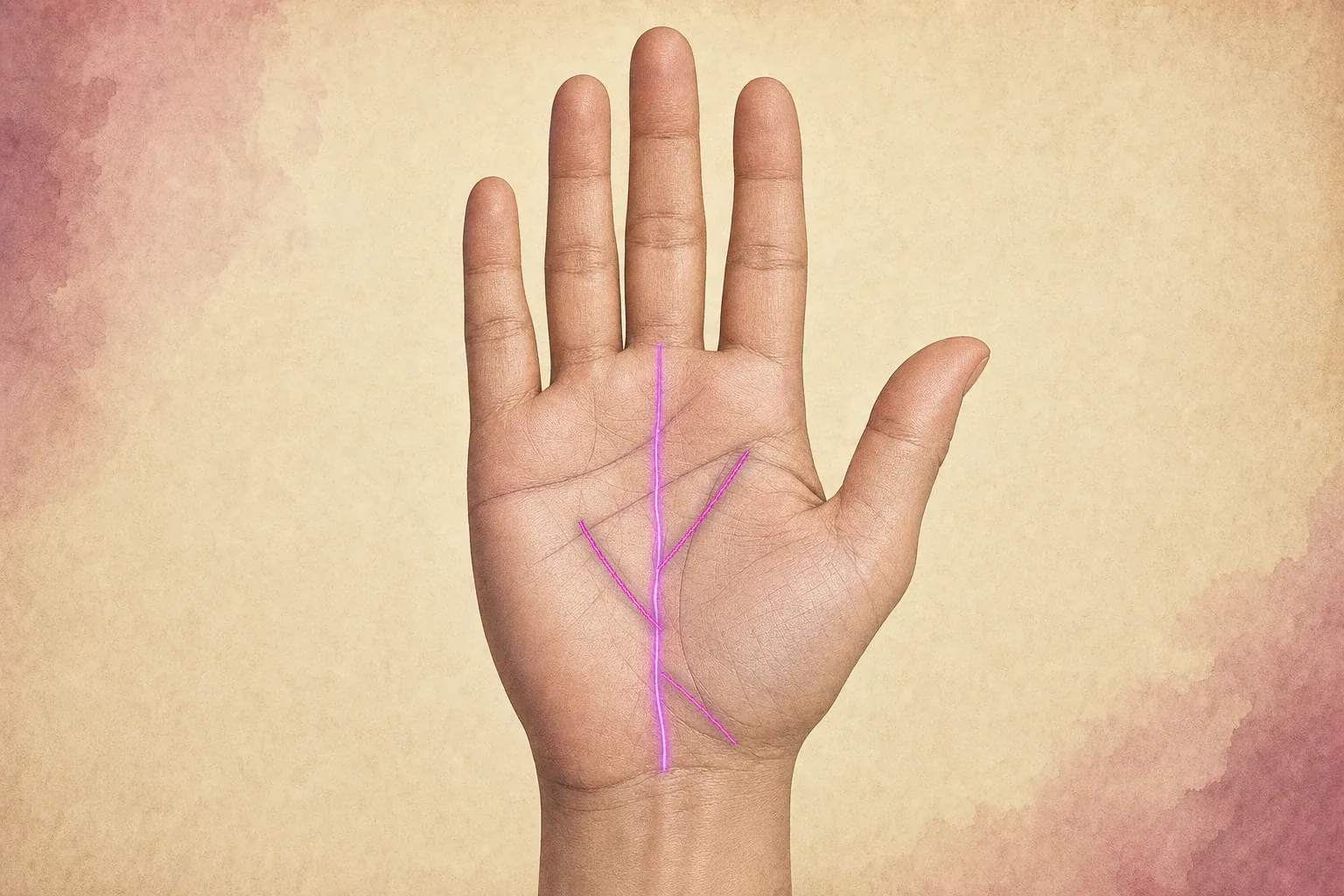
A branch on a palm line is a smaller offshoot that leaves one identifiable parent line while the parent continues beyond the junction. Traditional palmistry reads upward branches as effort, opportunity, growth, or expression toward the mount they reach, while downward branches can show energy redirected toward pressure, support duties, environment, or another lower-palm subject. The parent line supplies the main topic and the destination gives the branch its specific meaning.
A branch becomes meaningful only after its parent line, junction, direction, endpoint, destination mount, relative strength, timing, support signs, and both hands are compared. A whole-hand reading can show how a secondary effort, influence, environment, role, or outlet connects with work, decisions, relationships, travel, family, recognition, purpose, or direction.
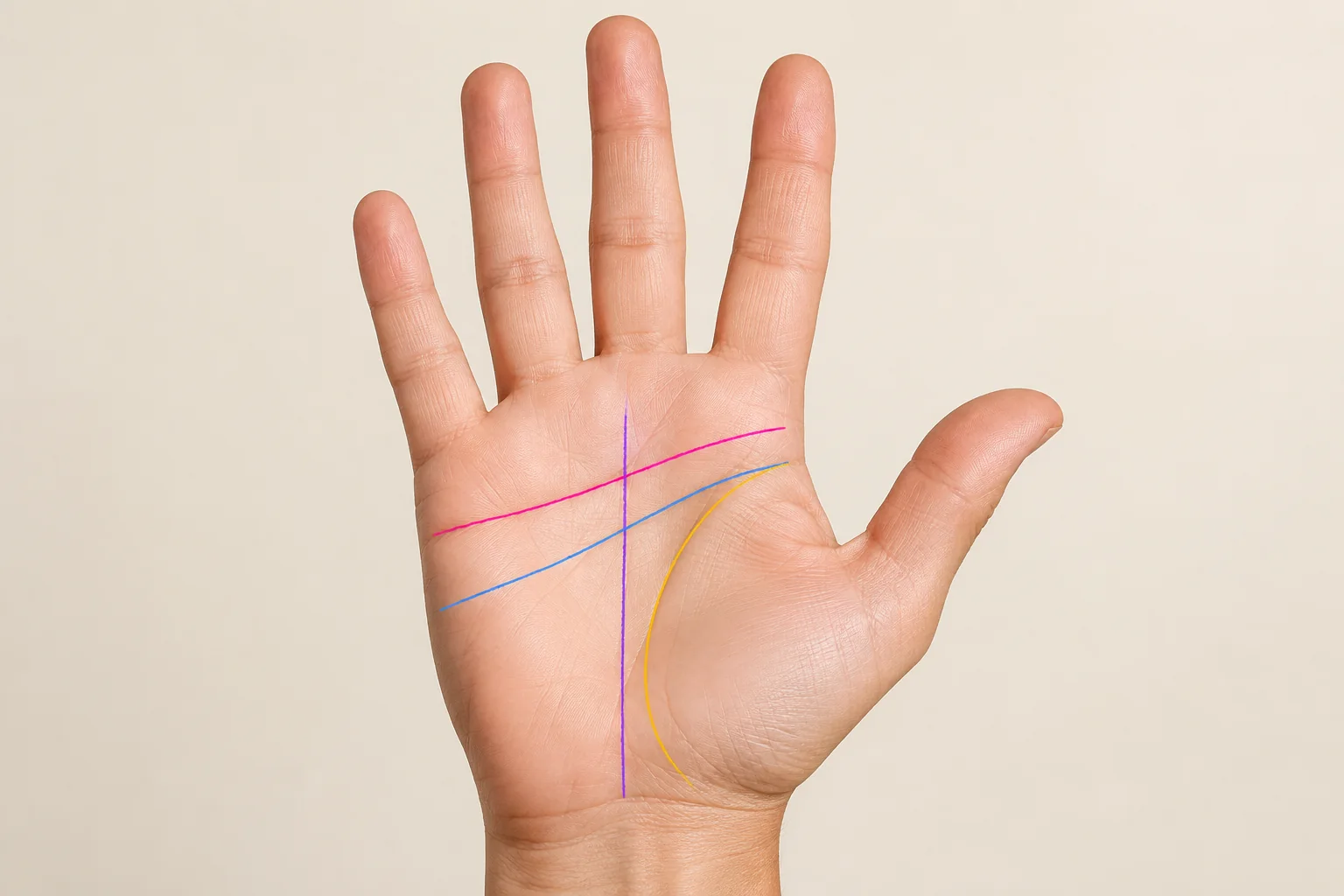
Use an eight-part branch-reading method: identify the parent line, verify that it continues, locate the junction, classify the branch direction, trace the endpoint, compare branch depth with the parent, place the junction along the route, and check both hands. A branch is a symbolic secondary route; it does not guarantee promotion, travel, marriage, loss, or another event.
Read source, direction, and destination as one sentence
A branch from the life line toward Jupiter differs from a fate-line branch toward Jupiter because the sources differ. Name the parent first, follow the offshoot, then add the mount it reaches. “Life line to Jupiter” and “fate line to Apollo” are already more useful than “upward branch.”
How to verify a true branch on a palm line
Trace the parent through the junction. It must remain identifiable after the offshoot leaves. The smaller line must share a clear junction and end elsewhere. If the parent stops and two prongs replace it, the shape is a fork; if two sides rejoin, it is an island.
| Check | True branch | Common confusion |
|---|---|---|
| Parent | Main line enters and continues past the junction | Parent ends in a fork |
| Junction | Offshoot visibly grows from the parent | Independent line crosses it |
| Endpoint | Branch has its own traceable destination | Short scratch fades immediately |
| Ownership | Source line is clear from a wider view | Cropped image hides the origin |
| Stability | Route remains visible under relaxed light | Glare, dry skin, or pressure fold |
Use the forked-lines guide when the parent ends in two prongs. This article owns offshoots along a continuing line, including short upward branches, long destination branches, drooping branches, and lines entering the parent from another area.
Upward, downward, rising, falling, and incoming branches
“Upward” usually means toward the fingers; “downward” means toward the wrist or lower palm. On curved horizontal lines, describe the actual endpoint rather than relying on page orientation. An incoming line from Venus or Moon may carry an influence into the parent instead of leaving it.
| Branch type | Traditional emphasis | Deciding feature |
|---|---|---|
| Upward branch | Effort, opening, ambition, expression, or development | Mount or line reached |
| Downward branch | Energy redirected, pressure, expenditure, or lower-palm concern | Destination and parent strength |
| Long rising branch | More sustained secondary route | Clarity and endpoint |
| Short rising branch | Brief opening, effort, or local emphasis | Nearby timing zone |
| Incoming influence line | Person, environment, or responsibility joins the route | Origin in Venus, Moon, or another line |
| Branch that becomes a major line | Secondary route grows into a lasting subject | Destination, depth, and continuation |
Do not apply “upward good, downward bad” without context. A life-line branch toward Moon can symbolize movement or a wider environment. A heart-line branch toward the head line can show emotion being processed through thought. A downward fate-line branch toward Moon may connect public contact, travel, imagination, or changing environment with direction.
What Jupiter, Saturn, Apollo, Mercury, Moon, Venus, and Mars add
Follow the branch until it stops. The mount map helps verify the endpoint rather than guessing from a short segment.
| Destination | Traditional subject | Questions to ask |
|---|---|---|
| Jupiter | Leadership, ambition, teaching, advancement, ideals | Is the branch clear and supported by the index finger? |
| Saturn | Responsibility, discipline, mastery, long-term consequence | Does it join or parallel the fate line? |
| Apollo | Expression, visibility, fulfillment, recognition | Is there an independent Sun line? |
| Mercury | Communication, business, service, teaching, applied skill | How developed are Mercury and the little finger? |
| Moon | Travel, wider environment, imagination, public influence | Do travel lines or a Moon-origin fate line agree? |
| Venus | Family, affection, close influence, resources, roots | Does the line enter or leave the life line? |
| Mars | Pressure, courage, conflict management, persistence | Is there a parallel Mars support line? |
Branches on the life, head, heart, fate, and Sun lines
| Parent line | Upward branch theme | Downward or incoming theme |
|---|---|---|
| Life line | Effort, ambition, advancement, independent development | Travel, environment, family influence, changing support |
| Head line | Practical outlet, application, communication, constructive decision | Imagination, inward focus, competing thought, emotional influence |
| Heart line | Hope, expression, ideals, affection reaching outward | Feeling drawn into thought, pressure, disappointment, or guardedness |
| Fate line | New role, advancement, leadership, recognition, applied skill | Responsibility entering from family, environment, or another route |
| Sun line | Additional creative or public outlet | Recognition tied to another line, person, or environment |
| Mercury line | Expansion in communication, teaching, service, or business | Skill redirected into practical or supportive work |
Branches from the life line
Upward branches from the life line are traditionally linked with effort, achievement, training, or a stronger independent direction. Jupiter adds advancement or leadership; Saturn adds duty and sustained work; Apollo adds expression or recognition; Mercury adds communication and applied skill. A lower branch toward Moon can show travel, relocation, or two environments when the wider pattern supports it.
Branches from the head line
An upward branch from the head line can show an idea becoming practical, ambitious, expressive, or communicative according to destination. A downward Moon-bound branch can add imagination and association. If the head line itself ends in two routes, read a fork; if the main line keeps going, read a branch.
Branches from the heart line
Upward branches from the heart line traditionally add hope, affection, ideals, or willingness to express feeling. A branch toward Jupiter emphasizes standards or commitment; toward Saturn, realism or responsibility. A downward branch toward the head line can show emotion entering thought or a phase of difficult deliberation. It does not prove disappointment or betrayal.
Branches from the fate line
A rising branch from the fate line adds a secondary direction while the main Saturn route continues. Jupiter may add leadership, Apollo visibility or creative fulfillment, and Mercury business, communication, or specialized skill. An incoming line from Moon can connect public contact or a wider environment; one from Venus can connect family or a close influence with the route.
Branches from the Sun or Mercury line
A Sun-line branch can add another expressive outlet or audience, while a Mercury-line branch can add another communication, teaching, business, or service channel. Verify whether the offshoot belongs to the parent or merely crosses it.
How to time a branch junction
The junction gives the branch's position along the parent line. Use proportional sections and major crossings as broad timing landmarks. A fate-line branch near the head-line crossing is traditionally linked with a decision period; one near the heart-line crossing may involve values or relationships. A life-line branch uses the curved route's broad stages. The timing guide explains why one junction cannot supply an exact date.
| Junction position | Reading focus | Confirmation |
|---|---|---|
| Near origin | Secondary influence begins early in the theme | Source zone and hand comparison |
| Before head-line crossing | Opening develops before a decision landmark | Head-line branch or change |
| At head-line crossing | Thought or choice intersects the route | Identify the true parent line |
| At heart-line crossing | Values or relationships intersect direction | Heart-line condition and endpoint |
| Near parent endpoint | Late additional outlet or final redirection | Destination mount and line clarity |
Compare branches on both hands
Use matched full-palm images and close-ups. Traditional readers often treat the less-active hand as underlying capacity and the active hand as present expression. A branch repeated on both hands carries more structural weight. One that strengthens on the active hand may show a developed outlet; one visible only in a blurred or stretched image needs verification. Compare the parent line too, because a stronger branch on a weak parent differs from a branch on a clear continuing route.
Branch combinations that make the reading more specific
| Combination | Traditional reading | What to verify |
|---|---|---|
| Life branch to Jupiter + fate line strengthens | Effort connects with advancement or responsibility | Jupiter, index finger, timing |
| Fate branch to Apollo + Sun line | Structured work gains expressive or visible outlet | Apollo and branch continuity |
| Head branch to Mercury + clear little finger | Thought becomes communication or applied skill | Mercury lines and thumb |
| Life branch to Moon + travel lines | Movement or wider environment becomes important | Both hands and fate-line origin |
| Heart upward branches + balanced Venus | Warmth or hope finds stable expression | Heart ending and relationship context |
| Downward branch + support line | Pressure is present but continuity remains supported | Parent strength after junction |
Worked branch examples
Fate line continues to Saturn and sends a branch to Apollo
The main route keeps its responsibility theme while the Apollo branch adds visibility, expression, or fulfillment. A separate Sun line and balanced Apollo mount strengthen the secondary outlet.
Life line sends a long branch toward Moon
The branch connects lifestyle with travel, public contact, imagination, or a wider environment. Travel lines, a Moon-origin fate line, and both hands distinguish occasional movement from relocation.
Head line sends a short upward branch to Mercury
The thought pattern gains an applied communication outlet. Mercury development, the little finger, thumb, and actual work or study context show whether the route concerns teaching, analysis, business, or specialist skill.
Heart line has downward branches on one hand
Retake matched images first. If they remain, read the branches through thought, pressure, or guarded expression and compare the clear parent continuation. They do not determine a relationship outcome.
Photo checklist for branches on palm lines
- Photograph both full palms in soft neutral light.
- Add a close-up showing the parent before and after each junction.
- Keep every branch endpoint and destination mount visible.
- Relax the hand and repeat the photograph at a second angle.
- Separate outgoing branches from incoming influence lines.
- State hand dominance and the work, relationship, travel, family, or decision question.
- Trace the routes visually without drawing over the original image.
Read each offshoot inside the complete hand
A Full Palm Reading maps the parent line, junction, branch direction, endpoint, destination mount, relative strength, timing, support signs, and both hands. That complete pattern can show how a secondary effort, influence, environment, role, or outlet connects with your question.
The complete answer
A branch on a palm line is a smaller route leaving one parent line while the parent continues beyond the junction. Traditional palmistry reads the source line first, then the branch's direction, length, depth, endpoint, destination mount, timing, and supporting features. Upward branches often emphasize development toward Jupiter, Saturn, Apollo, or Mercury; downward and incoming routes can connect the parent with Moon, Venus, Mars, environment, family, or pressure. Life-line branches concern lifestyle and movement, head-line branches thought and application, heart-line branches emotional expression, and fate-line branches roles and direction. A Full Palm Reading maps every branch and all other important features across both hands and combines them into a holistic reading focused on your questions about work, relationships, decisions, travel, family, recognition, purpose, timing, and direction.
A Full Palm Reading
Ask where each branch leads across your complete hand
Your reading maps the parent line, branch junction, direction, endpoint, destination mount, relative strength, timing, and support signs, then adds the fingers, hand shape, texture, and both palms into one holistic reading focused on your questions about work, decisions, relationships, travel, family, recognition, purpose, and direction.
Your Full Palm Reading maps all the important features—hand shape, skin texture, thumb, fingers, mounts, major and minor lines, markings, and the differences between both palms—and brings them together in a holistic reading focused on your questions.