
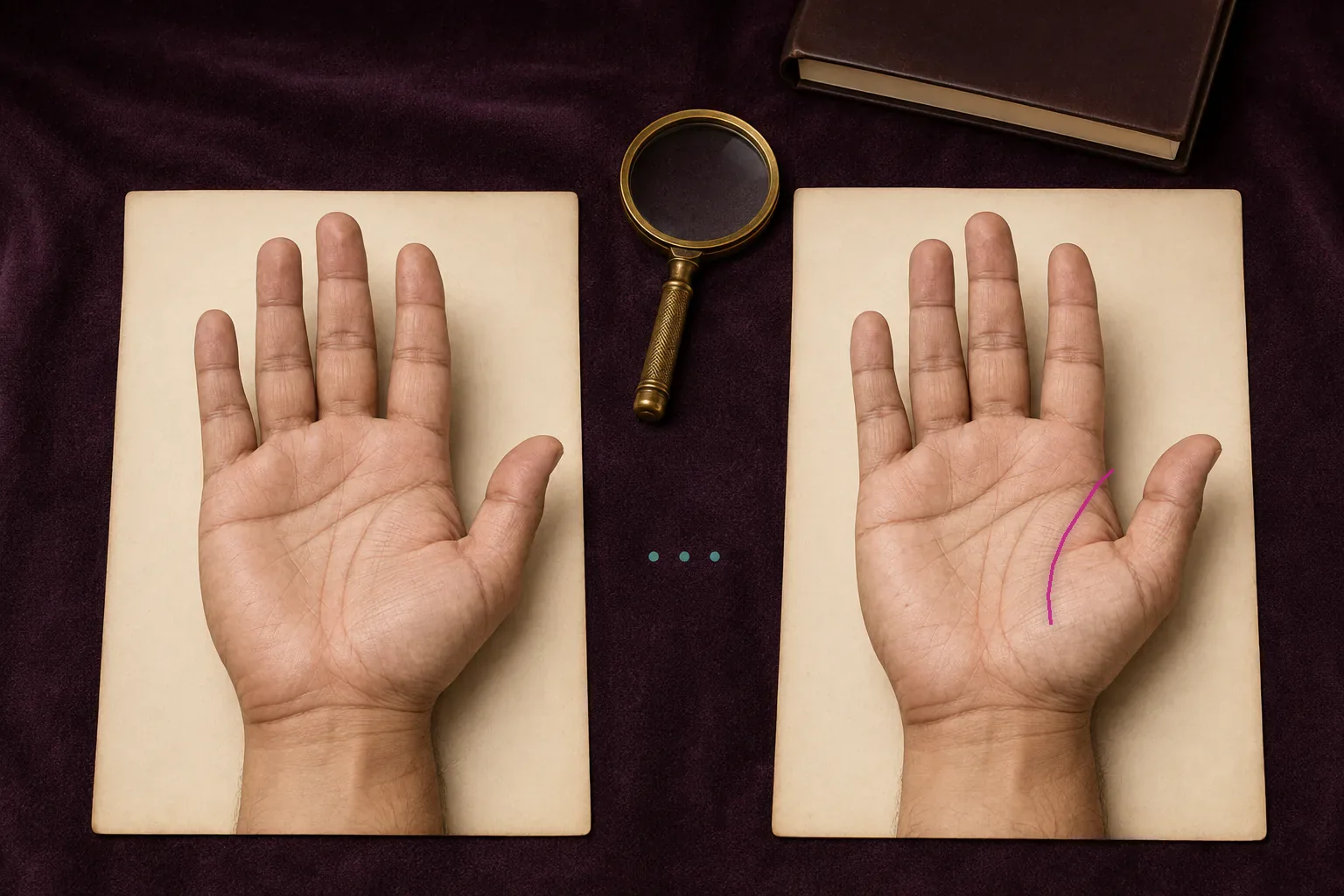
A short life line does not mean a short life. In traditional palmistry, the life line is read for the style and continuity of vitality, grounding, support, environment, and major changes. A line that ends around the middle of the palm is interpreted through its depth, clarity, arc, exact endpoint, nearby continuation, branches, support lines, and the pattern on the other hand. Length alone cannot supply a lifespan or an age of death.
A short life line becomes meaningful only after its true endpoint, depth, clarity, arc, faint continuation, restart, support lines, branches, crossings, timing, and both hands are compared. A whole-hand reading can show how grounding, energy, environment, and change connect with work, relationships, travel, family, purpose, or direction.
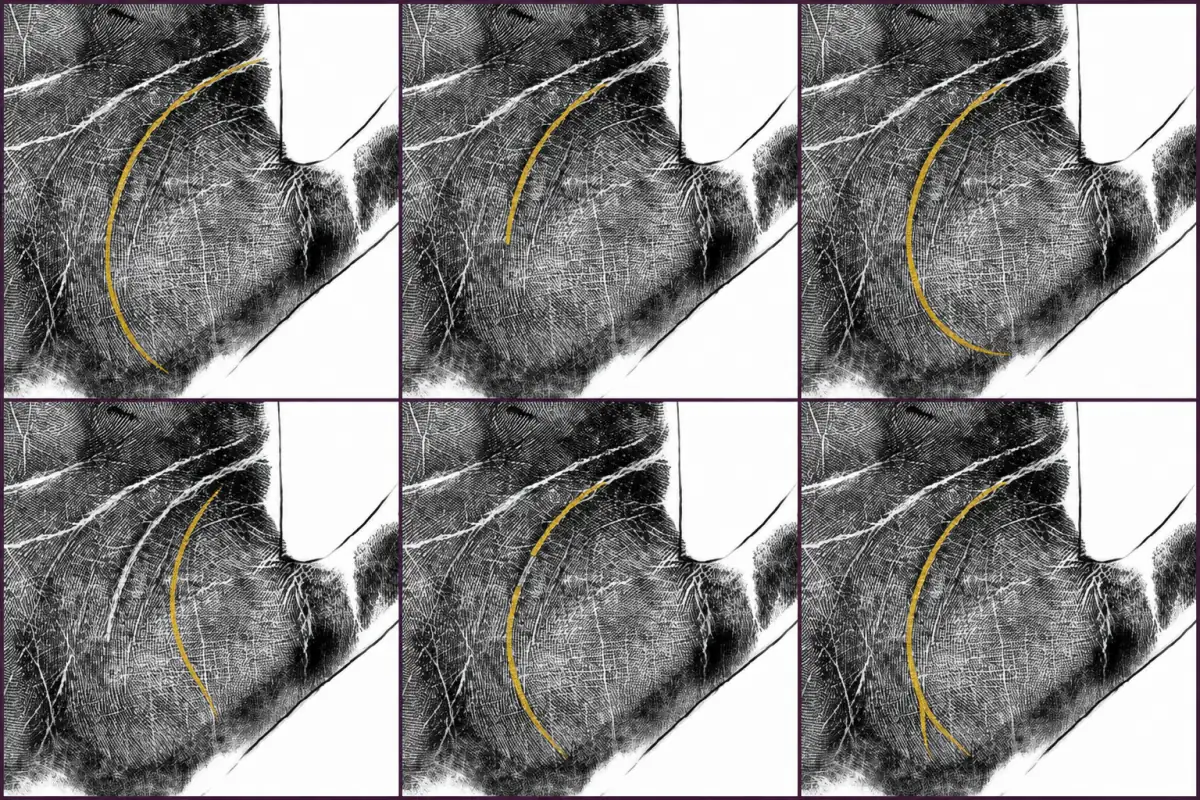
Use a seven-part short-life-line reading method: verify the route, find the true endpoint, compare depth and clarity, measure the arc around Venus, look for a restart or sister line, inspect branches and crossings, and compare both hands. This sequence separates a genuinely short line from a faint continuation, break, shifted overlap, photograph problem, or different crease.
First answer the question the line actually raises
The useful question is not “How long will I live?” It is “How does this life-line route end, and what carries the pattern afterward?” A clear endpoint, faint continuation, parallel Mars line, outward branch, and shifted restart each create a different traditional reading.
How to verify that your life line is genuinely short
Find the crease beginning between the thumb and index finger and curving around the thumb mound, or Mount of Venus. Trace it with your eye rather than a pen. A genuinely short life line stops before the lower Venus area or wrist and has no identifiable continuation on the same route. The complete life line guide shows the standard origin and arc.
| What you see | How to classify it | Why it differs |
|---|---|---|
| Clear line stops in the middle palm | Genuinely short life line | No traceable lower continuation |
| Line becomes pale but remains visible | Fading continuation | The same route continues at lower contrast |
| Open gap followed by another segment | Broken life line | A later route restarts after interruption |
| Second segment begins before the first ends | Overlapping continuation | One route transfers into another |
| Fine parallel line follows the inner arc | Sister or Mars support line | A second route accompanies the life line |
| Line appears cut off at the photograph edge | Incomplete evidence | The wrist or lower palm is missing |
Soft light from the side often reveals a continuation hidden by direct flash. Compare a relaxed palm with a gently opened one; stretching the thumb can flatten the lower arc. Do not use one compressed screenshot or a high-contrast filter to decide where the line ends.
What a short life line traditionally means
Traditional readers treat a short route as a concentrated or self-contained life-line pattern. The person's grounding may depend less on one continuous environment or routine and more on choices, other lines, or changing sources of support. A clear short line can still show decisive energy through the section it covers. A weak, broad, or chained short line emphasizes variability in that section; it does not turn length into a prediction.
| Short-line quality | Traditional emphasis | What to compare |
|---|---|---|
| Deep and clear | Concentrated, direct, firmly expressed grounding | Endpoint and supporting fate line |
| Fine and clear | Responsive, economical, adaptable use of energy | Overall line texture on the hand |
| Broad and shallow | Diffuse or inconsistently directed support | Mount firmness and line continuation |
| Chained before ending | Repeated adjustment within the visible section | Where the chain clears or another line assists |
| Short with strong upward branches | Focused development through specific outlets | Destination mounts |
| Short with outward Moon branch | Environment, movement, or a wider setting becomes important | Travel lines and fate-line origin |
Read depth relative to the other lines on the same palm. If every crease is fine, a fine life line may be normal for that hand. If the life line alone fades while the head, heart, and fate lines remain sharply cut, the contrast deserves more weight.
The endpoint changes the interpretation
Locate exactly where the line stops. An endpoint under the middle of Venus differs from one turning toward the wrist, joining another route, or releasing a branch toward Moon. Use the Mount of Venus guide to map the inner boundary and the Mount of Moon guide for the lower outer palm.
| Endpoint pattern | Traditional reading focus | Next feature |
|---|---|---|
| Clean stop inside Venus boundary | A concentrated self-support pattern | Head line, thumb, and fate line |
| Stop beside a strengthening fate line | Structure or purpose carries more of the later pattern | Fate origin and destination |
| Stop while Mars line continues | Parallel resilience, support, or reserve remains active | Length of the companion route |
| Stop after branch toward Moon | Movement or environment redirects the theme | Branch endpoint and travel signs |
| Stop before shifted lower restart | Transition into a changed foundation or route | Gap, overlap, and new alignment |
| Stop at a strong crossing line | Another subject intersects the life-line flow | Ownership and destination of the crossing |
The endpoint is a location, not a clock by itself. Proportional timing methods use the whole curve and supporting events as broad calibration. The palmistry timing guide explains why a short line cannot yield one precise age.
What carries the pattern after a short life line?
Look beyond the endpoint instead of stopping the reading there. A parallel line inside Venus, a shifted continuation, a fate line rising from the lower palm, a clear head line, or an outward branch can carry related themes. The shape and destination decide whether it is support, replacement, redirection, or a separate subject.
Sister or Mars line
A fine line running close and parallel inside the life-line arc is traditionally read as reinforcement during the section it accompanies. It is not a second lifespan. Trace its start and end, especially if it continues below the primary endpoint. The Mars-line guide covers location and variations.
Shifted or overlapping continuation
A later segment following a similar curve may continue the life-line subject through a changed route. A gap creates a broken-line pattern; an overlap suggests a transition that begins before the earlier route finishes. Use the broken-lines guide to verify the geometry.
Branch leaving before the endpoint
A branch toward Jupiter, Saturn, Apollo, Mercury, or Moon adds its destination theme while the short parent route remains the source. Follow the offshoot to its actual endpoint using the palm-line branches guide.
Head line, thumb, and fate line
A firm thumb and clear head line can emphasize deliberate choices and follow-through. A fate line can add structure, responsibility, or a developing direction. These features do not “replace” the life line literally; they explain how will, decisions, and external structure participate in the complete hand.
What a short life line means on one hand or both
Photograph both palms in the same light and position. Traditional readers often treat the less-active hand as underlying capacity and the active hand as present expression. A short line repeated with similar quality and endpoint on both hands has more structural weight. A short line on one palm and a longer, clearer continuation on the active hand can be read as developed stability or a changed approach to support. The reverse can suggest a present pattern that uses energy or grounding differently from the background tendency.
| Hand comparison | Traditional emphasis | Verification |
|---|---|---|
| Short on both, same endpoint | Consistent concentrated pattern | Compare depth and supporting routes |
| Short less-active, longer active | Developed continuity or support | Check whether the lower route is truly the life line |
| Long less-active, short active | Current redirection or changed grounding | Look for fade, break, branch, or overlap |
| Short with Mars line on one hand | Support expressed more strongly in that hand | Trace the companion line's full length |
| Difference appears only in photos | Lighting or hand-position issue | Retake matched images |
The two-hand comparison guide explains dominance without relying on gender rules. Handedness, repeated geometry, and current expression are more useful than “left means fate, right means future.”
Short life-line combinations that add useful context
| Combination | Traditional synthesis | Check before reading |
|---|---|---|
| Short clear life line + firm thumb | Concentrated energy with deliberate follow-through | Thumb flexibility and head line |
| Short life line + full Mars support | Primary route is reinforced by sustained reserve or support | True parallel geometry |
| Short line + clear fate line from wrist | Purpose or external structure carries strong weight | Fate destination at Saturn |
| Short line + Moon-bound branch | Environment, travel, or broader contact redirects grounding | Branch source and both hands |
| Short chained line + later restart | Adjustment leads into a changed foundation | Chain boundary, gap, and new route |
| Short line + wide firm Venus | Compact route sits within substantial relational or physical grounding | Venus firmness and texture |
Worked short life-line examples
Clear line ends at mid-Venus with a lower parallel line
The main life-line route is concentrated, while the companion line adds support through the lower section. Its length and clarity show how long that reinforcement remains relevant within the traditional timing map.
Life line seems short but fades into the lower palm
This is a changing-quality line rather than a clean endpoint. Compare the faint section with every other line on the same hand and retake the palm under side light before interpreting the fade.
Short life line sends a strong branch toward Moon
The branch connects the life-line subject with movement, public contact, imagination, or a wider environment. Travel lines, fate-line origin, and the other hand show whether that secondary route repeats.
Short line on the active hand with a shifted restart
Read the gap or overlap as a transition in present expression. The new segment's alignment, depth, arc, and destination matter more than the first segment's length alone.
Photo checklist for a short life line
- Photograph both full palms, including the entire wrist.
- Use soft neutral light from slightly to the side.
- Keep the thumb relaxed so the Venus mound is not stretched flat.
- Add one close-up from the origin to the apparent endpoint.
- Take a second angle to reveal any faint continuation.
- Include the lower palm so a Mars line, restart, or branch is visible.
- State which hand is active and the question you want the complete hand to answer.
- Avoid sharpening filters that invent or erase fine creases.
Read the endpoint inside the complete hand
A Full Palm Reading maps the life-line origin, arc, depth, endpoint, faint continuation, support lines, branches, crossings, timing, Mount of Venus, thumb, head line, fate line, and both palms. That whole pattern shows how grounding and change connect with the questions you are actually asking.
The complete answer
A short life line is a life-line route that ends before the lower Venus area or wrist without a traceable continuation. It does not measure lifespan. Traditional palmistry interprets its depth, clarity, arc, endpoint, sister line, restart, branches, crossings, nearby mounts, supporting major lines, and appearance on both hands. A deep clear short line differs from a faint one; a true endpoint differs from a break or fade; a Mars line differs from a second life story; and a Moon-bound branch differs from a line that simply stops. A Full Palm Reading maps all these features across both hands and combines them into a holistic reading focused on your questions about work, relationships, travel, family, energy, change, timing, purpose, and direction.
A Full Palm Reading
Ask what carries the pattern beyond your life-line endpoint
Your reading maps the life-line origin, arc, depth, endpoint, faint continuation, restart, support lines, branches, crossings, timing, and Mount of Venus, then adds the thumb, head line, fate line, hand shape, and both palms into one holistic reading focused on your questions.
Your Full Palm Reading maps all the important features—hand shape, skin texture, thumb, fingers, mounts, major and minor lines, markings, and the differences between both palms—and brings them together in a holistic reading focused on your questions.