
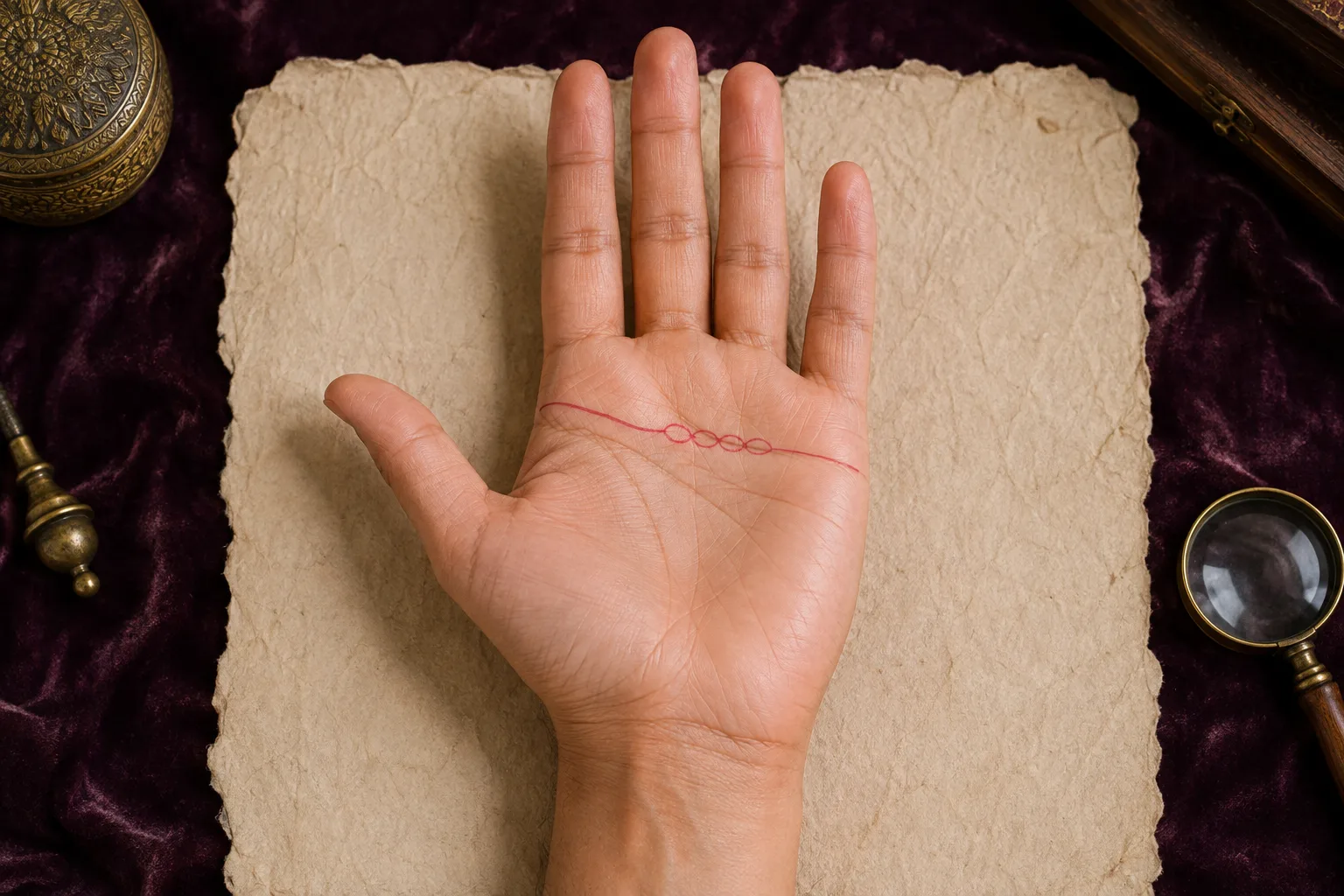
In traditional palmistry, a chained Heart line is an upper-palm Heart-line parent formed partly or largely from several small linked oval loops. The texture is associated with emotional sensitivity, complex or changing responses, and feelings that may take time to organize or express consistently. It does not predict betrayal, divorce, unstable relationships, or an inability to love.
A chained Heart line becomes personal only after the true outer-edge parent, repeated linked-loop geometry, affected span, mount location, clear sections, length, curve, depth, island, feathering, crossing, break, fork and Girdle tests, Venus, Head, thumb, relationship lines, real behavior, and both palms are compared. A whole-hand reading can show how sensitivity, trust, expression, boundaries, and relationship patterns work together.
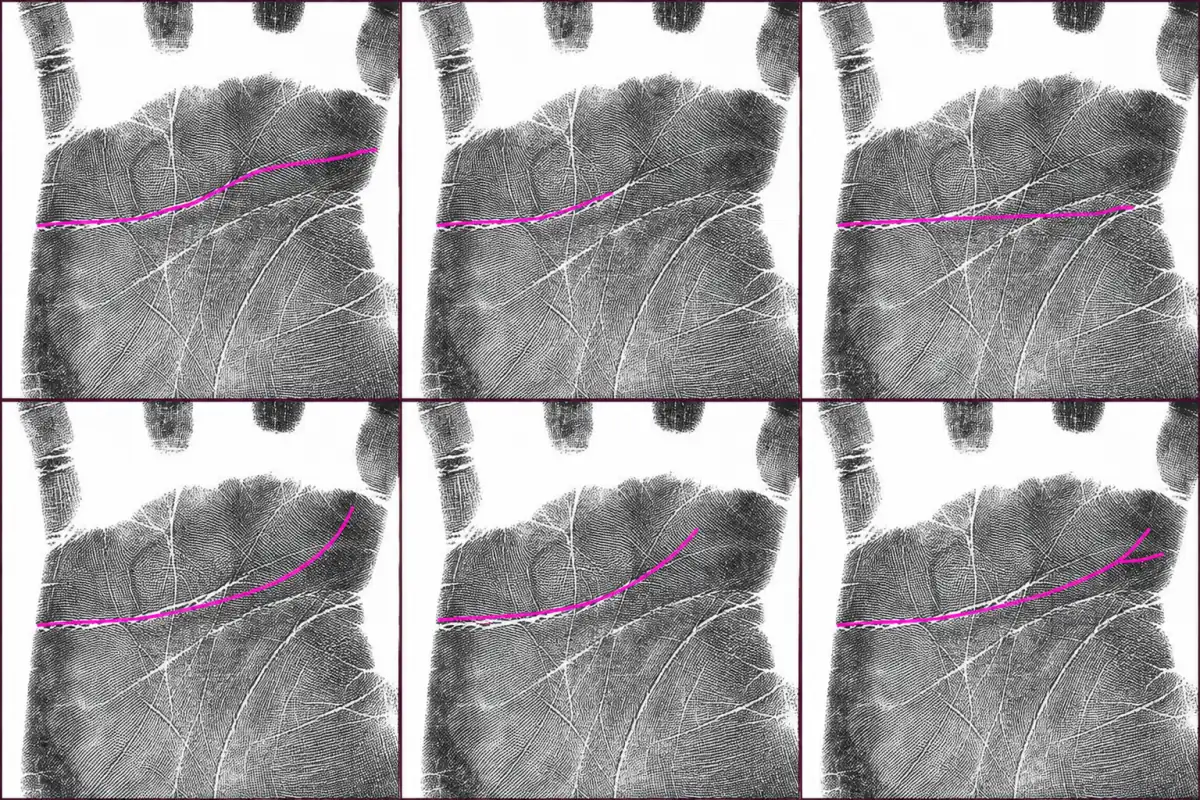
First confirm that the loops belong to the Heart line and connect in sequence. One enclosed oval is an island; open skin is a break; loose feathering is a group of branches; and the Girdle of Venus is a separate arc above the Heart line. Then add location, length, curve, depth, clear sections, Venus, Head, thumb, relationship lines, real behavior, and both palms.
Locate the Heart-line parent
The Heart line enters from the little-finger edge and crosses the upper palm beneath the finger bases. Follow that parent toward its endpoint below Saturn, Jupiter, or the space between them. The loops must interrupt or form this same route.
Use side light and a relaxed palm. Chaining looks like two fine strands repeatedly separating and rejoining, creating adjacent enclosed spaces. The loops may cover one short section or much of the line. Record how many, where they sit, and whether the route becomes clear before and after them.
A chain is a texture, not a relationship forecast
The linked pattern traditionally describes how emotional energy is processed or expressed. It cannot tell you that a partner will cheat, that a bond will end, or how many relationships you will have.
Use a ten-part chained-Heart-line method
- Relax the hand. Avoid stretching the upper palm until fine creases disappear.
- Find the outer origin. Confirm the parent enters from the little-finger edge.
- Trace the complete route. Follow it beneath the fingers to its true endpoint.
- Find repeated closed loops. Look for adjacent ovals made by the parent dividing and rejoining.
- Count the affected span. Record a short section, several sections, or most of the line.
- Exclude one island. A single enclosed oval is a local marking rather than a chain.
- Exclude lookalikes. Check for crossing creases, feathering, breaks, forks, and the Girdle of Venus.
- Record clear sections. Compare depth and continuity before and after the linked texture.
- Add supporting features. Read Venus, Head, thumb, relationship lines, hand texture, and behavior.
- Compare both palms. Use matched images and actual relationship history as context.
| What you see | Geometry test | Classification |
|---|---|---|
| Several adjacent closed loops within one Heart parent | The strands repeatedly divide and rejoin | Chained Heart line |
| One isolated enclosed oval | The parent divides once and rejoins once | Island on the Heart line |
| Open skin between two segments | No strand connects the pieces | Broken Heart line |
| Many fine open strokes at the edge | The strokes do not form closed loops | Feathering or branches |
| One parent divides into two terminal arms | Both arms begin at one junction | Forked Heart line |
| A separate arc sits above the Heart line | It crosses the mounts below the fingers | Girdle of Venus |
What a chained Heart line traditionally means
Chaining is traditionally read as emotional sensitivity and variable flow. A person may register tone, atmosphere, and changes in closeness quickly, while needing more time to sort one feeling from another. Expression may be vivid in one setting and guarded in another.
The same sensitivity can support empathy, nuance, responsiveness, and artistic feeling when boundaries and communication are strong. Under pressure, it may show mixed signals, repeated reconsideration, or difficulty stating what is needed. The line does not choose which expression occurs; the rest of the hand and lived behavior provide that context.
The general chained-lines guide explains the texture across every major line. This page owns the emotional and relationship context of a chain located specifically on the Heart line.
Location changes the traditional reading
Read the chained span beneath the mounts above it. Location adds the subject being emphasized, while the linked texture continues to describe fluctuation or complexity. Treat timing along the Heart line as broad symbolic sequencing rather than a calendar promise.
| Chained section | Traditional focus | Useful question |
|---|---|---|
| Near the little-finger origin | Early trust, communication, and first emotional signals | What helps you say what you feel? |
| Below Apollo | Affection, visibility, appreciation, and romantic expression | How much reassurance feels useful? |
| Below Saturn | Duty, caution, boundaries, and emotional responsibility | When does protection become distance? |
| Near Jupiter | Ideals, standards, hopes, and expectations in love | Which expectations are shared openly? |
| Across most of the line | A broadly sensitive or changeable emotional processing style | What creates steadiness across relationships? |
Clear sections show how the pattern changes
A clear, deep route before the chain suggests a more settled pattern entering a variable section. A strong line after the chain traditionally shifts the emphasis toward increasing clarity or more consistent expression. If the route stays fine or chained throughout, compare skin texture, Venus, Head, and actual communication before making a strong statement.
Do not merge a chain with a break. Linked loops remain connected. A true gap has open skin between separate segments; see the broken Heart-line guide. A fork also has one junction and distinct arms rather than repeated rejoining loops.
Supporting features for a complete relationship reading
The Mount of Venus adds warmth, attachment, sociability, and available energy. A full, resilient Venus area can make sensitivity more openly affectionate. The Head line shows how feeling is organized through thought. A clear Head route may help name and structure complex feelings, while a strongly imaginative route may add association and inner narrative.
The thumb adds will, flexibility, and boundaries. Jupiter adds ideals and standards. Relationship lines at the hand edge may show significant-bond formations in traditional reading, but they do not count partners or marriages. The love and relationship guide connects these features without treating one mark as an outcome.
Use behavior to complete the interpretation
Ask whether feelings are communicated directly, whether reassurance becomes mutual, how boundaries are handled, and what restores steadiness after uncertainty. These answers matter more than a dramatic label.
What if only one palm has a chained Heart line?
Compare matched photographs and identify the active hand by actual use. Palmists often read the less-used hand as background disposition and the active hand as developed expression. This is a reading convention rather than a scientific rule.
More chaining on the active hand may suggest that current experience has made emotional processing more layered or reactive. A clearer active-hand route may suggest more consistent expression or firmer boundaries. First rule out lighting, dry skin, and crossing creases.
Worked examples
Example 1: a short chained section with clear line after it
The linked span suggests a bounded stretch of emotional complexity, while the clear continuation emphasizes renewed consistency. The reading stays open until real relationship history is considered.
Example 2: chaining across most of the line with full Venus
The line adds broad sensitivity and variable expression, while Venus adds warmth and attachment. The synthesis is emotionally responsive and affectionate, with communication and boundaries providing balance.
Example 3: apparent chain made by crossing creases
Side light shows one clear Heart parent crossed by unrelated fine lines. Because the spaces do not form a sequence of closed linked loops, classify the pattern as crossings rather than chaining.
Example 4: one large oval below Saturn
One closed shape is an island, not a chain. Read its local Saturn position and the line before and after it separately instead of applying a whole-line sensitivity label.
Example 5: clearer active-hand Heart line
Matched images confirm fewer loops on the active palm. A traditional reader may explore whether experience, communication, or boundaries have helped feelings become easier to organize and express.
Photo checklist
- Capture both palms from the same height and angle.
- Include the little-finger edge and the full upper palm.
- Use bright indirect light plus one gentle side-light image.
- Relax the hand without stretching the finger bases.
- Confirm every loop closes and connects with the Heart parent.
- Record the chained span and clear sections separately.
- Check for an island, break, fork, feathering, or Girdle.
- Avoid glare, filters, smoothing, and source-photo annotations.
Frequently asked questions
Is a chained Heart line bad?
No. Traditional palmistry treats it as a sensitive, complex, or variable emotional texture. Whether that becomes empathy, mixed expression, or both depends on context and behavior.
Does it mean relationship problems?
It may prompt questions about communication, reassurance, and changing responses. It cannot predict conflict, betrayal, separation, or the quality of a specific relationship.
What is the difference between a chain and an island?
A chain contains several adjacent linked loops. An island is one enclosed oval where the parent divides and rejoins once. The island guide explains the single-mark test.
Can only part of the Heart line be chained?
Yes. Record the affected section and compare the line before and after it. Partial chaining should not be applied automatically to the whole emotional pattern.
Does chaining show a health condition?
No. A palm line cannot diagnose heart, eye, nervous-system, or mental-health conditions. Use appropriate clinical care for health questions.
Which hand should I read?
Read both. Compare the same parent, loop pattern, location, clear sections, supporting features, and real behavior, then use handedness as context.
The complete answer
A chained Heart line contains several small connected oval loops within the upper-palm Heart-line parent. Traditional palmistry associates the texture with emotional sensitivity, complexity, and changing expression, not inevitable heartbreak or relationship failure. Verify repeated closed loops against one island, feathering, crossings, a break, fork, and Girdle of Venus. Then add the chained span, mount location, clear sections, length, curve, depth, Venus, Head, thumb, Jupiter, relationship lines, hand texture, real behavior, and both palms. A Full Palm Reading maps all the important features across both hands and combines them into a holistic reading focused on your questions about sensitivity, trust, communication, boundaries, attachment, compatibility, and changing relationship patterns.
A Full Palm Reading
Ask how your chained Heart line fits your complete relationship pattern
Your reading maps the true Heart-line parent, repeated linked-loop geometry, affected span, mount location, clear sections, length, curve, depth, island, feathering, crossing, break, fork and Girdle tests, Venus, Head, thumb, relationship lines, real behavior, and both palms, then adds every other important line, mount, finger, marking, shape, and texture into one holistic reading focused on your questions.
Your Full Palm Reading maps all the important features—hand shape, skin texture, thumb, fingers, mounts, major and minor lines, markings, and the differences between both palms—and brings them together in a holistic reading focused on your questions.