
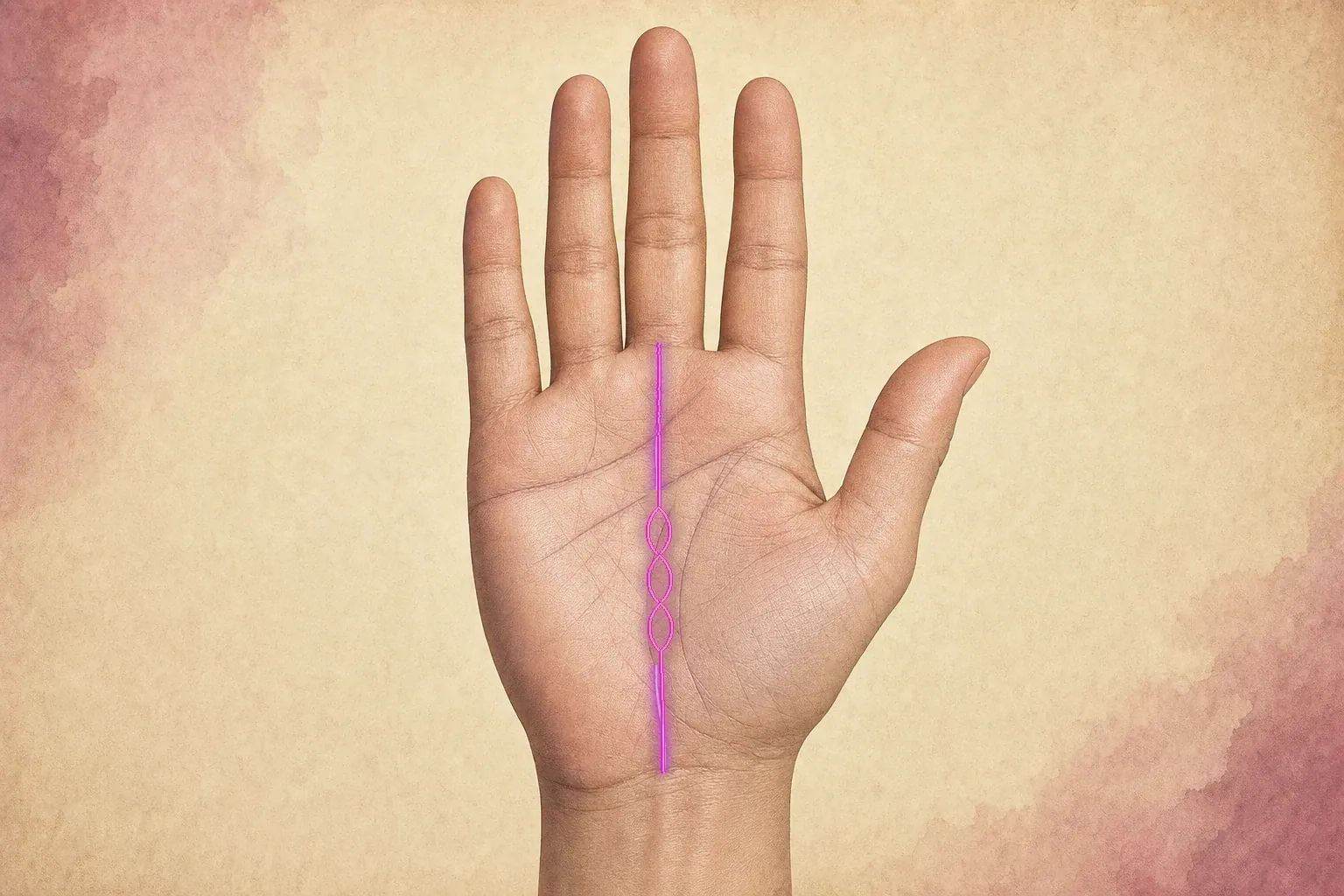
A chained palm line is one parent line made from several small connected loops, linked islands, or repeated wave-like sections instead of one clear crease. Traditional palmistry reads the chain as repeated division, fluctuation, adjustment, or reduced clarity in the parent line's subject. On the head line it concerns thought and decisions; on the heart line, emotional expression; on the life line, lifestyle and sustained energy; and on the fate line, work, responsibility, and direction.
A chain becomes meaningful only after its parent line, linked-loop geometry, start and end, length, clarity, crossings, support signs, continuation, timing, and both hands are compared. A whole-hand reading can show where repeated adjustment sits within work, decisions, relationships, family, recognition, purpose, or direction.
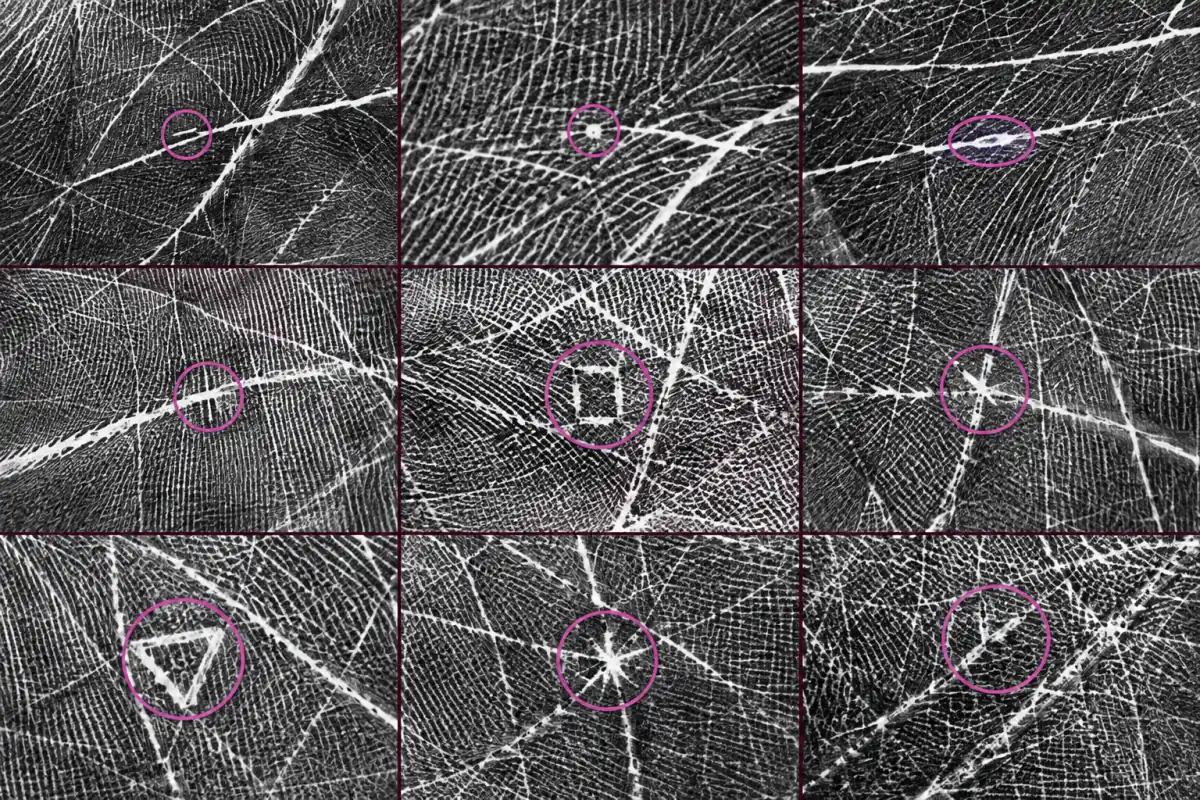
Use a seven-part chained-line reading method: identify the parent line, verify repeated linked loops, mark where the chain starts and ends, compare loop size, inspect crossings and support signs, follow the line afterward, and compare both hands. A chain is a symbolic line condition. It does not diagnose illness, prove emotional instability, or determine a fixed future.
A chain extends the logic of one island
A single island shows one split-and-rejoin section. A chain repeats that geometry along the same route. The clear line before the chain shows what enters the pattern, while the line after it shows whether the subject becomes steadier, remains diffuse, or changes direction.
How to verify a chained palm line
Trace the parent line without lifting your attention from it. A true chain has at least two adjacent loop-like sections sharing the same route. Each link may be narrow, irregular, or partially open, but the overall line should visibly divide and reconnect several times. Scattered fine creases beside a line do not create a chain.
| Check | True chain | Common false positive |
|---|---|---|
| Parent | One major or minor line carries the full pattern | Several unrelated creases |
| Repetition | Two or more linked loops or waves | One isolated island |
| Direction | Links follow the parent line's route | Cross-hatched lines form a mesh |
| Edges | Loop sides remain visible in two light angles | Dry skin, glare, or blurred texture |
| Continuation | Line can be followed before or after the chain | No identifiable parent route |
If only one enclosed split appears, use the island guide. When a grid of crossing strokes creates multiple cells, use the wider marks-and-symbols guide and identify a grille instead.
Chain versus island, grille, feathering, broken line, and sister line
| Formation | Geometry | How it differs |
|---|---|---|
| Chain | Repeated linked loops along one route | Several divisions and reunions |
| Island | One parent splits once and rejoins | One enclosed section only |
| Grille | Several independent lines cross into a mesh | No single parent owns every cell |
| Feathering | Many fine hairs leave a line | Open offshoots rather than closed links |
| Broken line | Open gaps separate segments | No repeated linked continuity |
| Sister line | Second route runs beside the parent | Parallel support rather than alternating loops |
| Tassel | Line ends in several fine strands | Frayed endpoint rather than mid-line chain |
A chain may be regular like small necklace links or irregular like a wavering braided crease. Regularity changes the strength of the evidence, not the parent subject. Do not promote ordinary skin texture into linked islands unless the route remains clear in close-up.
Chain at the start, middle, or end of a palm line
Mark the first and last link. A chain at the beginning describes the foundation or earlier section of the theme; a middle chain describes a contained phase; a chain at the end shows diffusion near the line's destination. Use broad proportional timing rather than counting each loop as a separate year.
| Position | Traditional focus | What to inspect |
|---|---|---|
| At the origin | Theme begins through adjustment or divided inputs | Source lines and family zone |
| Before a crossing | Complexity builds before a decision or values landmark | Head- or heart-line crossing |
| Across a crossing | Two subjects may become entangled | Which parent actually forms the loops? |
| Middle section | Repeated adjustment within a bounded phase | Clear start and end of chain |
| At the endpoint | Route becomes diffuse near its destination | Mount, branches, and alternate ending |
| Whole line | Fluctuation is structural rather than local | Hand texture, thumb, fingers, both hands |
Chained life, head, heart, fate, Sun, and relationship lines
| Parent line | Traditional chain theme | Context to add |
|---|---|---|
| Life line | Variable pace, unsettled routines, divided demands, or changing support | Venus, Mars line, branches, continuation |
| Head line | Many competing thoughts, wavering focus, or repeated reconsideration | Slope, depth, thumb, Mercury, clear section after |
| Heart line | Complex feelings, changing expression, guardedness, or emotional sensitivity | Ending, branches, Venus, relationship lines |
| Fate line | Repeated adjustment in work, role, duty, identity, or direction | Origin, destination, crossings, Sun line |
| Sun line | Variable recognition, creative confidence, visibility, or satisfaction | Apollo, fate line, clearer upper route |
| Mercury line | Changing communication, business, service, or applied-skill rhythm | Mercury mount, head line, texture |
| Relationship line | Repeated uncertainty or adjustment within a close bond | Heart line, forks, influence lines, actual context |
Chained life line
A chained life line does not determine lifespan or diagnose health. It is traditionally read as a phase of variable energy, changing routines, family demands, or unsettled support. A clear continuation, parallel Mars line, upward branch, and stable fate line show how the pattern becomes more organized.
Chained head line
On the head line, repeated links suggest many simultaneous thoughts, reconsideration, uncertainty, or concentration divided among competing demands. A stronger straight section afterward suggests focus consolidates; a Moon-bound continuation changes the mode toward imagination and association. Avoid treating the mark as a mental-health diagnosis.
Chained heart line
A chained heart line traditionally points to emotional complexity, sensitivity, changing expression, or difficulty reducing feelings to one clear response. The endpoint under Jupiter, Saturn, or between them still shows emotional standards. Clear upward branches, Venus, thumb openness, and relationship lines refine the reading.
Chained fate line
A chained fate line can symbolize repeated role changes, divided responsibility, uncertain identity, or a direction that develops through several adjustments. A clear Saturn-bound line after the chain suggests consolidation. A new Sun or Mercury route identifies expression, recognition, communication, business, or applied skill as part of the next phase.
Chained Sun, Mercury, or relationship line
A Sun-line chain concerns variable visibility, confidence, or fulfillment. A Mercury-line chain concerns communication and applied work. A chained relationship line belongs to the way a bond is experienced or expressed and cannot establish a breakup, marriage, or partner outcome without the heart line, both hands, and real context.
What chain length, loop size, depth, and continuation change
| Condition | Traditional emphasis | Reading question |
|---|---|---|
| Two small links | Short contained adjustment | Does the line clear quickly? |
| Long row of links | Sustained fluctuation or repeated division | Where does the chain finally end? |
| Even links | Recurring pattern with similar intensity | Do crossings repeat? |
| Large then smaller links | Complexity gradually narrows | Is the continuation clearer? |
| Small then larger links | Division becomes more pronounced | What arrives near the larger section? |
| Deep clear loops | Pattern carries stronger symbolic weight | Does it repeat on the other hand? |
| Faint irregular waves | Weak evidence or fine skin texture | Retake matched photographs |
Timing belongs to the full chained section, not to each individual link. Use the palmistry timing method to place its beginning and end within a broad window, then seek confirmation on another line.
Compare a chained line on both hands
Use matched lighting, pose, and camera distance. Traditional readers often use the less-active hand for the underlying pattern and the active hand for present expression. A chain on both hands carries more structural weight. A clearer active-hand continuation may suggest the theme is managed more steadily; a chain that appears only in one image may be a visibility problem. Check older photographs with the matched-photo method.
Chained-line combinations that make the reading more specific
| Combination | Traditional reading | Confirmation |
|---|---|---|
| Life chain + Mars support | Variable lifestyle phase with parallel resilience | Same section and clear continuation |
| Head chain + firm thumb | Many thoughts with capacity for decision and follow-through | Clear later head line |
| Heart chain + upward branches | Emotional complexity with hopeful or expressive outlets | Branch destinations and Venus |
| Fate chain + Sun line begins | Uncertain role while expression or recognition develops | Sun-line source and clarity |
| Chain inside a square | Traditional containment around repeated difficulty | Four closed sides and line afterward |
| Chain followed by a break | Repeated adjustment culminates in redirection | Replacement route and destination |
Worked chained-line examples
Head line chained at the start, clear through the middle
The thinking pattern begins with repeated adjustment, then consolidates. A firm thumb and balanced Mercury area show how decisions and communication become more organized.
Heart line chained near the Mercury side
The earlier emotional section appears sensitive or complex. A clear route ending between Jupiter and Saturn suggests later expression becomes more balanced between ideals and realism.
Fate line chained below the head line, clear above it
Work or direction develops through several adjustments before a decision landmark, then strengthens. The destination and a supporting Sun line show what the clearer route emphasizes.
Life-line chain on only one photograph
Retake both palms before interpreting it. Pressure, glare, skin dryness, and focus can turn fine crossing texture into apparent links.
Photo checklist for a chained palm line
- Photograph both full palms in soft neutral light.
- Add a close-up showing the parent line before and after the chain.
- Keep the hand relaxed so linked loops remain natural.
- Take a second angle to separate loops from crossing texture.
- Include the line's origin, destination, and major crossings.
- State hand dominance and the work, relationship, decision, family, or direction question.
- Do not sharpen the image until fine creases become false enclosures.
Read the linked section inside the complete hand
A Full Palm Reading maps the parent line, each linked section, chain length, crossings, support signs, continuation, timing, mounts, fingers, and both hands. That complete pattern can show where repeated adjustment sits within the question you are asking.
The complete answer
A chained palm line contains repeated linked loops or small islands along one identifiable parent route. Traditional palmistry reads it as fluctuation, divided attention, or repeated adjustment in that line's subject: lifestyle and support on the life line, thought and decisions on the head line, emotional expression on the heart line, work and direction on the fate line, and visibility or communication on the Sun and Mercury lines. The chain's start, end, length, loop size, clarity, crossings, support signs, continuation, and presence on both hands matter more than the label alone. A Full Palm Reading maps the chain and all other important features across both hands and combines them into a holistic reading focused on your questions about work, relationships, decisions, family, recognition, purpose, timing, and direction.
A Full Palm Reading
Ask what the full chained section means across your complete hand
Your reading maps the parent line, linked loops, chain length, start and end, clarity, crossings, support signs, continuation, and timing, then adds the mounts, fingers, hand shape, and both palms into one holistic reading focused on your questions about work, decisions, relationships, family, recognition, purpose, and direction.
Your Full Palm Reading maps all the important features—hand shape, skin texture, thumb, fingers, mounts, major and minor lines, markings, and the differences between both palms—and brings them together in a holistic reading focused on your questions.