
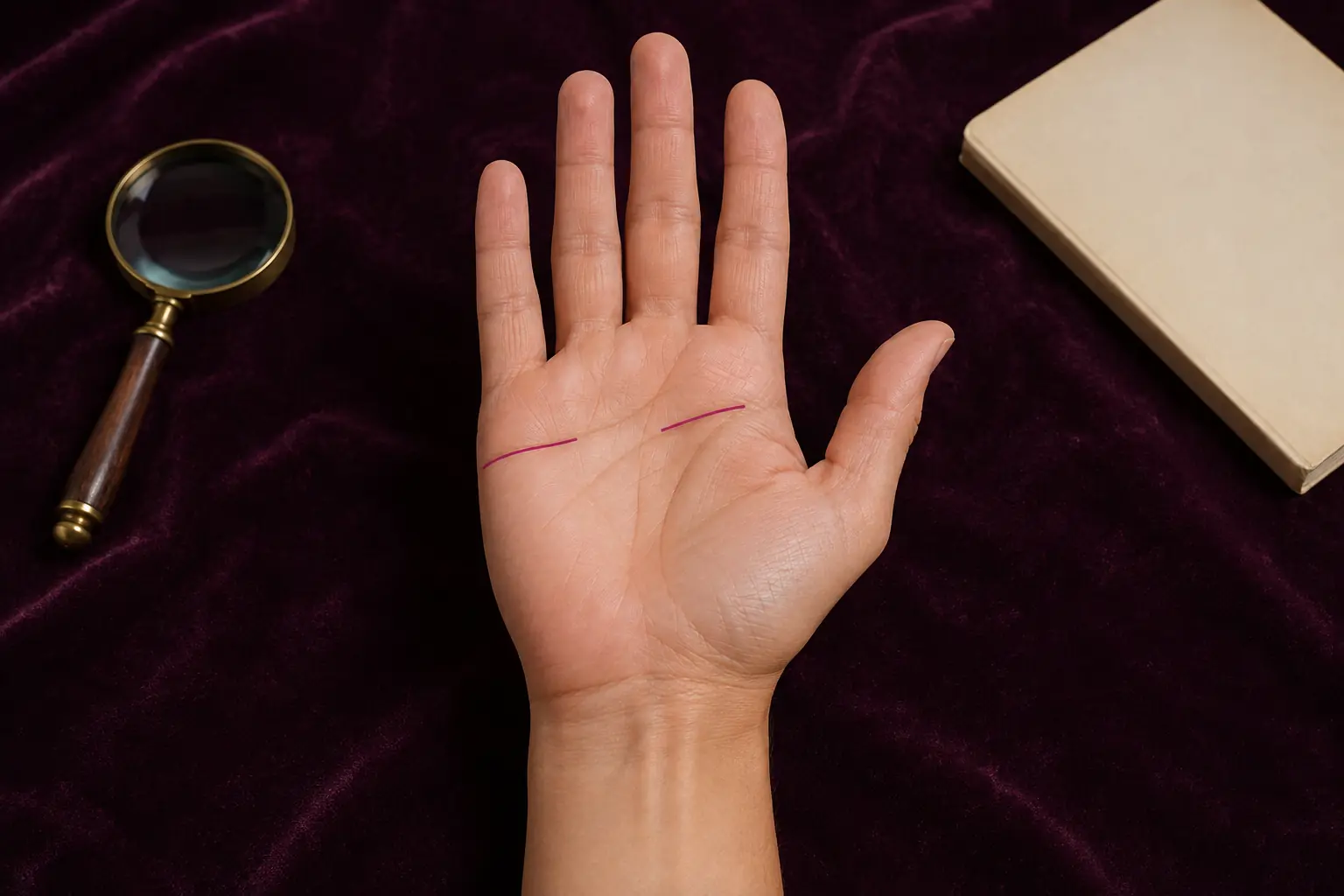
In traditional palmistry, a broken heart line is a visible area of empty skin between two sections that belong to the same upper horizontal line. The gap is commonly read as a change in emotional continuity, attachment, trust, expression, priorities, or the way a relationship chapter is experienced. The second segment shows what develops after the interruption, so a restart can describe recovery, new boundaries, a different way of relating, or a later emotional chapter. One break does not prove heartbreak, betrayal, divorce, or permanent loneliness.
A heart-line break becomes meaningful only after the complete outer-edge parent, true empty gap, inner restart, mount location, alignment or overlap, strength and direction after the gap, faintness and island tests, broad timing, Head and relationship lines, Venus, Jupiter, Saturn, Mercury, thumb, and both palms are compared. A whole-hand reading can show how feelings, trust, expression, boundaries, attachment, and relationship change work together.
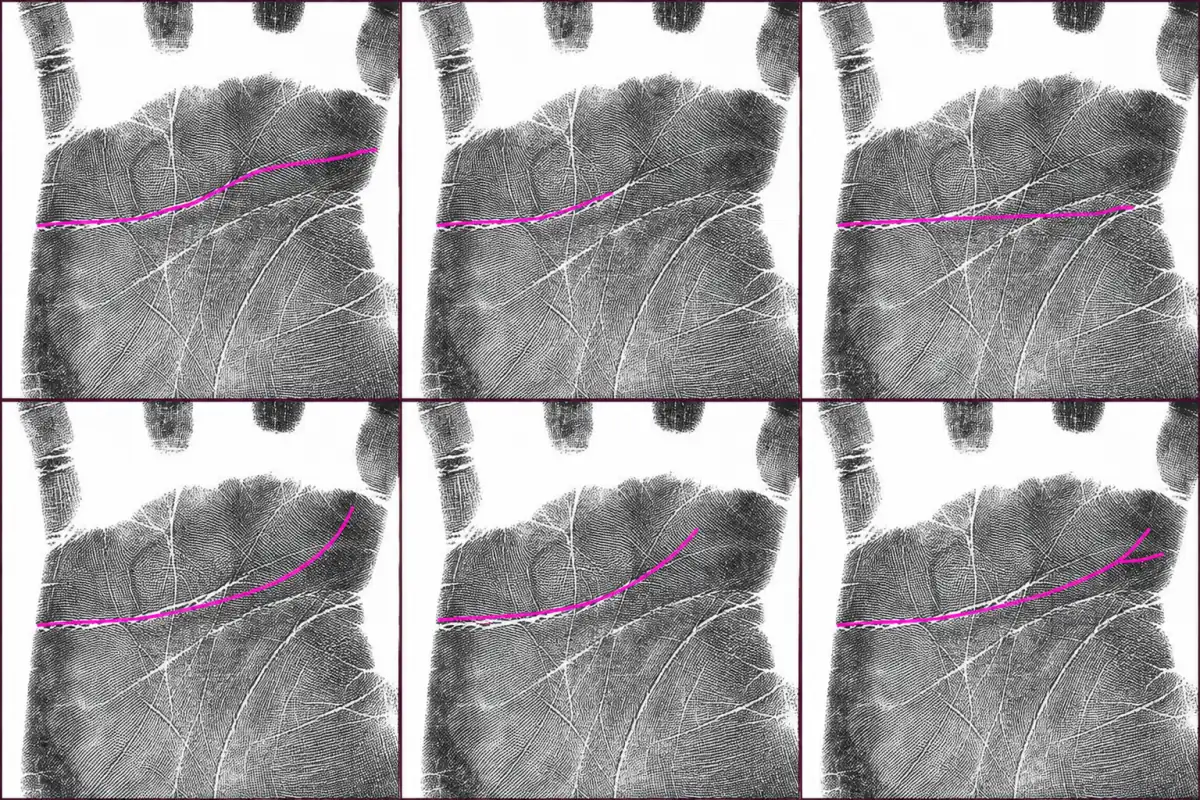
Use a ten-part broken-heart-line method: locate the outer-edge origin below the little finger, trace the first section, confirm genuinely empty skin, trace the inner continuation backward, exclude faintness and islands, record the mount below the gap, compare alignment or overlap, judge the strength and direction of the restart, add the Head line and relationship features, then compare both palms and the person's real history. This sequence answers more than a frightening label attached to one mark.
A gap is a transition, not a verdict on love
The heart line is traditionally read for emotional style, affection, expectations, boundaries, and relationship experience. A break shows discontinuity within that symbolic system. It cannot identify a partner, prove what someone feels, or guarantee a breakup. Location, continuation, repeated signs, and lived context decide which question the mark can help explore.
Where the heart line is and how a break looks
The heart line normally begins at the outer edge of the palm below the little finger. It crosses the upper palm beneath the finger mounts and ends toward the index-finger side. Depending on the hand, it may be curved or relatively straight, deep or fine, long or short. Start at the outer edge because a strong Head line can be mistaken for a low heart line when the two run close together.
A true break requires three visible elements: a parent segment arriving from the outer edge, an area with no continuing groove, and another plausible segment continuing toward Jupiter or Saturn. Trace the second section backward from its endpoint. If it belongs to the same horizontal route and the gap stays empty in more than one lighting angle, the broken-line classification gains weight.
| What you see | Visual test | Best classification |
|---|---|---|
| Two related horizontal segments with empty skin between | No groove survives through the gap | Clean break and restart |
| Segments run beside each other for a short distance | The new route begins before the older route ends | Overlapping transition |
| A shallow groove remains through the pale section | The parent stays traceable in neutral or side light | Faint or weakened heart line |
| Line divides around a closed oval and rejoins | Two sides enclose one complete space | Island, not a break |
| Several linked ovals replace a clean route | The parent forms repeated enclosed sections | Chained heart line |
| One parent ends in two connected prongs | Both arms share a visible junction | Forked heart line |
| A separate arc sits above the heart line | It runs between the finger bases and heart line | Possible Girdle of Venus |
How to verify that the heart-line gap is real
Photograph the relaxed hand directly overhead in bright indirect light, then add one gentle side-lit frame. Flash glare can erase a shallow bridge. A strong side shadow can turn texture into a dark segment. Compare the unedited photographs before enlarging the mark.
- Find the little-finger edge and the highest major transverse line entering from it.
- Trace that parent toward the center until it visibly stops.
- Inspect the suspected gap for a fine continuous groove.
- Trace the candidate continuation backward from the index-finger side.
- Confirm that the pieces share one plausible heart-line level and direction.
- Check for overlap, an island edge, a crossing bar, or a chain.
- Identify which finger mount sits above the gap.
- Compare depth, curve, and direction before and after it.
- Trace the Head line separately so the two are not confused.
- Repeat the sequence on the other palm.
The general broken-lines guide covers the geometry of gaps, overlaps, shifted continuations, bridges, sister lines, and enclosing squares. This article owns the heart-line question: how the interruption sits within emotional expression, attachment, values, and relationship experience.
What a heart-line break means by location
After confirming the gap, identify the mount above it. The mount does not name an event; it describes the kind of emotional issue palmists traditionally explore around that point. Trace the full line first, because hand angle can make a Saturn-area break look like an Apollo-area break.
| Gap zone | Traditional emotional theme | Useful questions |
|---|---|---|
| Below Mercury, near the little finger | Communication, disclosure, responsiveness, or an early stage in relating | Were feelings difficult to express or discuss? |
| Below Apollo, under the ring finger | Appreciation, affection, visibility, romance, or confidence in being valued | Did recognition or warmth change? |
| Below Saturn, under the middle finger | Responsibility, reserve, disappointment, realism, duty, or boundaries | Did commitment become heavier or more cautious? |
| Between Saturn and Jupiter | Balancing practical limits with emotional ideals | Did expectations become more realistic or better defined? |
| Below Jupiter, near the index finger | Standards, devotion, respect, ideals, or the desired form of partnership | Did values or expectations change? |
Mount location should modify the sequence rather than replace it. A gap under Saturn followed by a strong Jupiter-directed continuation can be read as reserve or disappointment followed by clearer standards and a more intentional bond. The same gap with a weak downward restart needs a different reading.
Read the continuation after the break
The restart shows how the emotional pattern reorganizes. Compare its depth, clarity, curve, endpoint, and direction with the outer segment. A deeper and cleaner continuation traditionally suggests greater clarity, stronger boundaries, renewed trust, or a more settled way of expressing affection. A faint restart may show caution, privacy, or gradual rebuilding. A chained restart can describe mixed signals or a period when feelings remain difficult to organize.
| Restart pattern | Balanced traditional reading | What to check next |
|---|---|---|
| Aligned and equally strong | Continuity returns in a recognizable emotional style | Gap width, supporting lines, and real events |
| Deeper and clearer than before | Later feelings or boundaries become more definite | Endpoint, Jupiter, Venus, and active hand |
| Higher toward the finger bases | Standards, idealism, or emotional selectivity may increase | Which mount receives the endpoint? |
| Lower toward the Head line | Practical reasoning, caution, or emotional burden may gain influence | Does it touch, cross, or remain separate from Head? |
| Overlaps the earlier segment | A gradual handover, ongoing attachment, or support through change | Which segment becomes dominant? |
| Forks after restarting | The later pattern holds two expressions or priorities | Trace both destinations using the forked-heart guide |
A lower restart that approaches the Head line does not mean a person lacks feeling. It can symbolize more analysis, caution, practical decision-making, or the need to protect emotional energy after change. If the two major lines actually join, read the combined formation separately rather than assuming the gap caused it.
What the Head line and relationship signs add
The Head line shows how thinking and judgment interact with the emotional transition. A clear, steady Head line can support reflection and deliberate decisions. A Head-line change at a similar level may connect emotional experience with new beliefs, plans, communication habits, or boundaries. Avoid medical or mental-health conclusions from either line.
The relationship lines at the outer edge below the little finger can show whether partnership patterns repeat the same change. A fork, break, or overlap there may strengthen a relationship-transition interpretation, but it still does not prove separation. A strong relationship line beside a broken heart line may suggest the bond continues while the person's way of expressing or processing emotion changes.
Venus adds warmth, attachment, closeness, and family influence. Jupiter adds standards and commitment; Saturn adds responsibility and reserve; Mercury adds communication. A support line bridging the gap, a square around it, or overlapping segments can traditionally show continuity or resources through the difficult section. Verify the geometry before calling a mark protective.
For a complete outcome question, use the love and relationship palm-reading map. It combines Heart, relationship and Fate lines with Venus, Jupiter, Mercury, thumb, hand shape, and both palms instead of turning one interruption into a conclusion about a specific relationship.
How to estimate timing on a broken heart line
Heart-line timing varies by tradition and should stay broad. Begin at the outer edge below Mercury and move inward toward Jupiter. The outer section is treated as earlier, the middle section as a broad adult middle, and the inner Jupiter-side section as later. Mount zones provide more stable landmarks than assigning a precise age to every millimeter.
- Mark where the outer segment stops.
- Mark where the inner continuation becomes clear.
- Name the mount above each point.
- If the gap is wide, keep separate stop and restart ranges.
- Compare a relationship-line or Fate-line change at a similar broad stage.
- Calibrate the sequence with a known relationship, family, relocation, or responsibility change.
- Repeat the estimate on the other palm and report a range, not an exact date.
The palmistry timing guide explains proportional sections and cross-line calibration. A heart-line gap cannot reliably date a breakup, marriage, reunion, betrayal, or new relationship.
What a broken heart line means in both palms
Photograph both hands under matching light and state which hand is dominant. A common modern method treats the less-active hand as background pattern and the active hand as current development. Use that convention to compare visible differences without turning it into a gender rule.
| Two-hand pattern | Traditional comparison | Useful follow-up |
|---|---|---|
| Similar break at a similar mount in both palms | The emotional transition theme repeats strongly | Compare restart quality and the real chapter it resembles |
| Break only in the dominant hand | Current experience or choices may have changed expression | Present trust, boundaries, communication, and relationships |
| Break only in the non-dominant hand | An underlying discontinuity may be handled more continuously now | What helped the active-hand route become clearer? |
| Restart stronger in the dominant hand | Later emotional organization may be developing | Name the boundary, relationship, or practice that changed |
| One clean gap and one overlap | The same transition may include more continuity in one expression | Compare support signs and timing zones |
The two-hand comparison guide explains why the difference matters. The aim is to find development and context, not to label one palm as the bad relationship hand.
Five worked examples
1. Narrow Saturn-area gap with a clear restart
The heart line stops below Saturn and resumes on the same level with similar depth. The Head line stays clear and the relationship line continues. Traditionally, this may describe a period of reserve, duty, or disappointment followed by renewed emotional continuity rather than a guaranteed separation.
2. Overlap followed by a Jupiter-directed ending
The incoming section overlaps a new upper route briefly, then the continuation rises toward Jupiter. The pattern can suggest ongoing attachment through a transition and later emphasis on respect, commitment, or clearer standards. Jupiter development and the active hand show whether that later route is well supported.
3. Lower restart toward the Head line
After a clean gap under Apollo, the inner segment restarts lower and approaches the Head line. This can be read as practical judgment, caution, or emotional decisions becoming more deliberate after a change. It does not prove coldness. Compare the Head line, Mercury, thumb, and actual communication pattern.
4. Faint section mistaken for a break
A direct photograph shows an apparent gap, but gentle side light reveals a shallow connecting groove. The line weakens and recovers rather than breaking. This shifts the reading from a distinct interruption toward a period of reduced clarity, guarded expression, or mixed emotional emphasis.
5. Heart-line island mistaken for two fragments
The parent divides around a narrow oval and rejoins. Because the sides enclose a complete space, it is an island rather than a break. Traditional palmistry may read a complicated, divided, or uncertain phase; the continuing parent gives it a different structure from empty space.
Photo checklist for a heart-line break
- Photograph both full palms from wrist through fingertips.
- Add a straight overhead image with the hand relaxed.
- Use bright indirect light without flash glare.
- Take a second image with gentle side light across the upper palm.
- Include the outer little-finger edge where the heart line begins.
- Capture the index-finger side so the endpoint remains visible.
- Take a close-up centered on the gap and mount above it.
- Do not sharpen, smooth, trace, or increase contrast on the original.
- Trace the parent, empty area, restart, and nearby Head line on a duplicate.
- State hand dominance and whether the question concerns feelings, boundaries, trust, repair, separation, or a new chapter.
Frequently asked questions
Does a broken heart line mean heartbreak?
It can be interpreted as a change in emotional continuity or relationship experience, but it does not prove heartbreak or identify a cause. The location, restart, supporting features, both palms, and real history are needed.
Does it mean divorce or separation?
No single heart-line break guarantees either outcome. Compare the relationship and Fate lines, Venus, communication features, continuation after the gap, and the actual relationship. The heart line may change even while a bond continues.
Is an overlap better than a clean gap?
An overlap preserves visible continuity and is traditionally read as a handover, continuing attachment, or support through change. It is not automatically better; compare the strength and direction of both segments.
What if the line is stronger after the break?
A clearer restart can suggest later emotional clarity, firmer boundaries, renewed trust, or a more definite way of relating. Its endpoint and the active hand show where that development is directed.
What if the restart slopes toward the Head line?
The reading may emphasize caution, analysis, practical decisions, or feelings shaped by responsibility. Confirm whether the two lines touch or stay separate and avoid turning the formation into a mental-health claim.
Can the gap show the age of a breakup?
It provides only a broad zone. Use mount landmarks, known events, related line changes, and both palms to estimate a range. It cannot reliably predict an exact breakup or reunion date.
What if only one hand has the break?
Compare background pattern with current expression. The dominant hand may show a change developed through experience, or it may show greater continuity than the less-active hand. Restart strength and actual history decide which description fits.
Can the heart line change?
Fine crease visibility can differ with lighting, dryness, hand position, pressure, and longer-term use. Keep matched photographs before deciding that a new gap or continuation has appeared.
The complete answer
A broken heart line is genuinely empty skin between two related sections of the upper horizontal line that begins below the little finger. Traditional palmistry reads the break as a transition in emotional continuity, attachment, trust, expression, priorities, or relationship experience. Verify the parent and restart in neutral and side light, distinguish the gap from faintness, an island, chain, crossing, fork, or Girdle of Venus, then compare its mount location and the strength, direction, and endpoint of the continuation. Add the Head and relationship lines, Venus, Jupiter, Saturn, Mercury, thumb, broad timing, real history, and both palms. A Full Palm Reading maps all the important features across both hands and combines them into a holistic reading focused on your questions about love, feelings, trust, communication, boundaries, repair, separation, timing, and the relationship path ahead.
A Full Palm Reading
Ask what changes across your heart-line gap
Your reading maps the complete Heart-line parent, true empty gap, inner restart, mount location, alignment or overlap, strength and direction after the gap, faintness and island tests, broad timing, Head and relationship lines, Venus, Jupiter, Saturn, Mercury, thumb, and both palms, then adds every other important line, mount, finger, marking, shape, and texture into one holistic reading focused on your questions.
Your Full Palm Reading maps all the important features—hand shape, skin texture, thumb, fingers, mounts, major and minor lines, markings, and the differences between both palms—and brings them together in a holistic reading focused on your questions.