
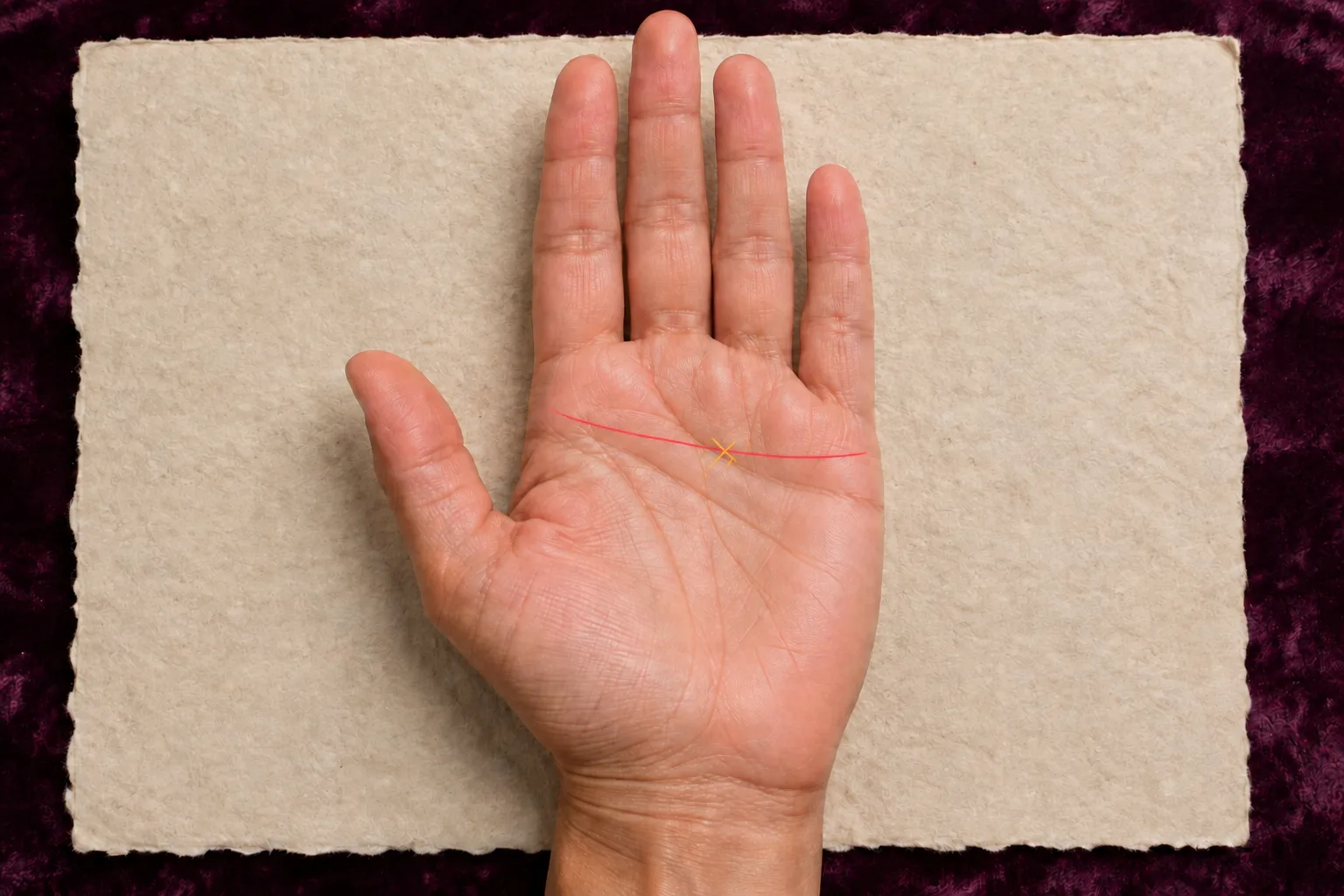
A cross on the Heart line is a compact X made by two short strokes whose central intersection sits directly on a verified Heart-line parent. Traditional palmistry uses it to explore a concentrated emotional conflict, important relationship decision, clash between feeling and expectation, or turning point in expression. It does not prove heartbreak, betrayal, divorce, heart disease, or permanent loneliness. Verify the X, arm origins, mount position, Heart-line path, clarity before and after, Venus, Head, relationship lines, real behavior, timing, and both palms.
A cross on the Heart line becomes personal only after the complete little-finger-edge parent, exactly two short intersecting strokes, central contact, arm origins, mount position, endpoint, curve, clarity before and after, cutting-line, Fate or Sun crossing, Mystic-Cross, star, branch, island, break, Girdle and texture tests, Venus, Head, thumb, relationship lines, timing, real behavior, and both palms are compared. A whole-hand reading can show how love, trust, communication, boundaries, responsibility, and fulfillment work together.
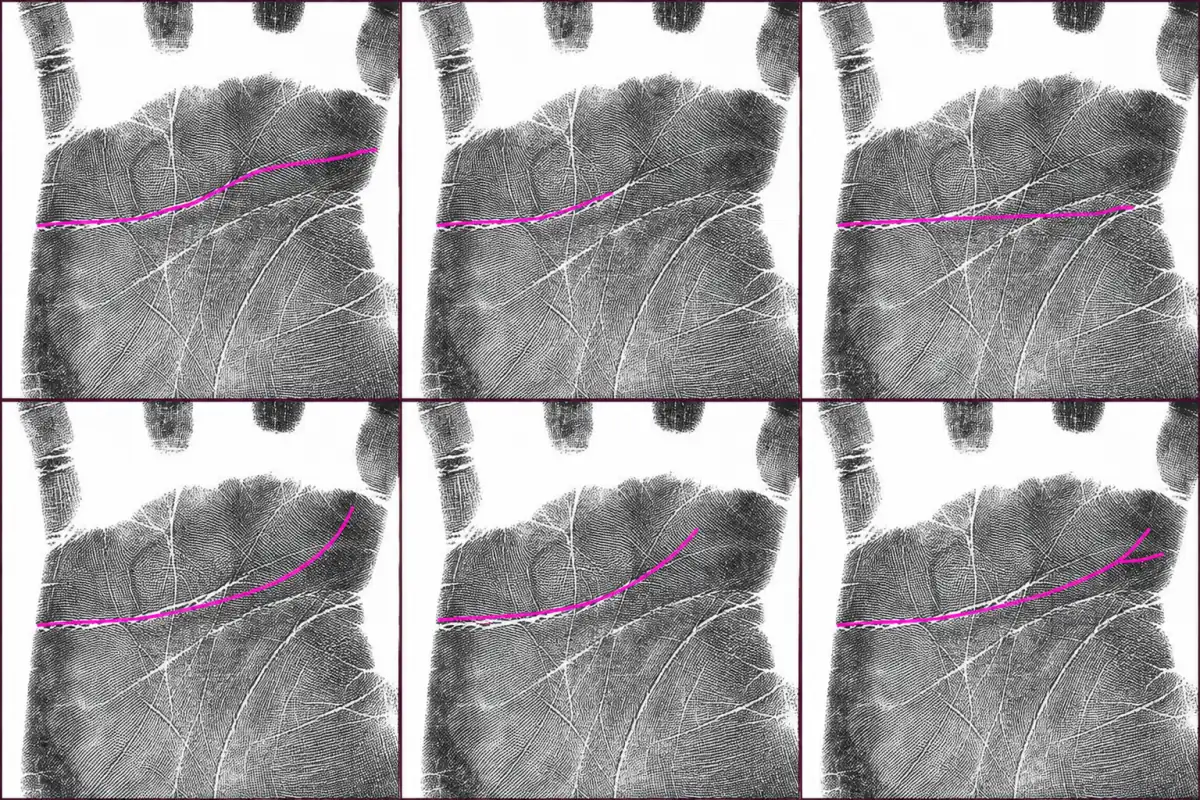
The Heart line enters from the outer edge below the little finger and crosses the upper palm toward Jupiter or Saturn. Traditional readers use its complete path for emotional investment, expression, ideals, trust, boundaries, and relationship style. A cross is one local marking within that pattern, not a verdict on love.
How to identify a true cross on the Heart line
Use the complete Heart-line guide to find the parent. The upper palm contains branches, the Girdle of Venus, vertical lines from Fate and Sun, and fine texture that easily creates false X shapes.
- Trace one Heart-line parent from the little-finger edge to its true endpoint.
- Find two short strokes that visibly cross rather than merely meet.
- Confirm one central intersection with four arms.
- Place the center on Heart, not below it in the quadrangle.
- Trace every arm to exclude a longer Fate, Sun, influence, or branch line.
- Mark the mount zone below Mercury, Apollo, Saturn, or Jupiter.
- Record the Heart-line path, endpoint, curve, depth, and clarity.
- Inspect before and after for a break, island, chain, fork, or branch.
- Add Venus, Head, thumb, and relationship lines as context.
- Compare both palms under matched light.
This is the ten-part Heart-line-cross method: parent, two strokes, center, contact, arm origins, mount zone, complete path, continuation, support, and both palms. An independent X between Head and Heart belongs to the Mystic Cross guide.
Cross, one cutting line, Mystic Cross, star, island, break, or Girdle?
| Formation | What to trace | Why it differs |
|---|---|---|
| Cross on Heart line | Two short strokes intersect at one center touching Heart | A compact four-armed X at one point |
| One cutting line | A single longer vertical or diagonal line crosses Heart | No second short stroke creates a separate X |
| Mystic Cross | An independent X sits below Heart and above Head | Its center does not touch Heart |
| Star | At least three strokes converge at a compact center | Six or more arms rather than four |
| Branch | One stroke grows from Heart at a shared junction | It does not cross through another short stroke |
| Island | The parent splits, encloses one space, and reunites | A closed oval rather than an intersection |
| Break | Related segments sit around genuinely empty skin | The parent stops rather than being crossed |
| Girdle of Venus | A separate arc or fragments sit above Heart under the fingers | A different upper-palm route |
The Heart-line island guide owns a closed split and reunion, while the broken Heart-line guide owns empty skin between related segments.
What a cross on the Heart line traditionally means
A cross concentrates the Heart-line subject at one point. Traditional readers explore a clash between feeling and expectation, an important boundary, divided loyalty, a relationship decision, a period of guarded expression, or an encounter that changes emotional standards. The mark may describe an inner conflict, not necessarily an external relationship event.
The arms can modify the inquiry. A longer arm from Venus can bring close family or attachment into the picture. A genuine Fate connection can connect values with work or duty. A Sun connection can connect emotional fulfillment with visible output or recognition. Trace each route before choosing a story.
The X cannot prove cheating, divorce, rejection, abuse, a breakup date, or what another person feels. It also cannot diagnose heart disease or emotional illness. Real behavior, conversations, agreements, symptoms, and evidence remain the reliable basis for action. Palmistry can organize reflective questions around the visible formation.
| Common fear | What the mark establishes | Useful question |
|---|---|---|
| “It guarantees heartbreak” | Only a compact X touches one point on Heart | Which real emotional decision or conflict fits? |
| “My partner will betray me” | A crease cannot reveal another person's conduct | What do consistency, honesty, and boundaries show? |
| “It predicts divorce” | No relationship outcome follows from one mark | How clear is the Heart line after the X? |
| “It means heart disease” | Palm geometry is not a diagnostic test | What does qualified medical assessment show? |
| “I will be alone” | The X is local, not a lifelong sentence | How do Venus, endpoint, branches, and behavior combine? |
What the mount above the cross changes
Mount position sets the traditional emotional domain. Boundaries overlap, so follow the vertical axis from the cross toward the finger above it.
| Position | Traditional focus | Question to test |
|---|---|---|
| Below Mercury | Communication, trust in words, negotiation, emotional explanation | Which conversation or agreement needs clarity? |
| Below Apollo | Affection and recognition, pride, audience, shared enjoyment | Do love and feeling valued align? |
| Below Saturn | Responsibility, seriousness, restraint, consequence, duty | Which obligation weighs on expression? |
| Below Jupiter | Ideals, commitment, standards, leadership, respect | Which expectation or future goal conflicts? |
| Near the endpoint | Core emotional style and relationship standards | Is the X truly on the parent or on a terminal branch? |
| Near the outer start | Early expression, sensitivity, first response to connection | What pattern appears at the beginning of closeness? |
What the Heart line after the cross changes
Trace the route in its normal direction from the little-finger edge toward the thumb side, while also comparing quality on both sides of the X.
- Clear continuation: a concentrated conflict is followed by coherent feeling or expression.
- Deeper continuation: standards, trust, or commitment may consolidate afterward.
- Fainter continuation: expression may become quieter, guarded, or still uncertain.
- Break beside the X: the cross and interruption combine into a larger transition.
- Island after it: one conflict point is followed by a bounded divided phase.
- Chain after it: one turning point is followed by a longer variable emotional rhythm.
- Upward branch: hope, expression, or engagement may rise.
- Downward branch: thought, responsibility, or disappointment may draw energy inward.
The chained Heart-line guide keeps repeated linked loops separate from one X.
What Venus, Head, thumb, relationship lines, Fate, and Sun add
Venus adds warmth, attachment, affection, home, and appetite for connection. The Head line shows how feelings are processed and communicated. The thumb adds will, reason, flexibility, and boundaries. Relationship lines at the outer edge can add focused partnership themes, but they do not count partners or guarantee events.
Fate adds work, duty, and life structure. Sun adds recognition, joy in expression, and fulfillment. These vertical lines matter only when their paths truly connect with the cross or Heart-line area.
| Supporting feature | Traditional contribution | What to verify |
|---|---|---|
| Balanced Venus | Warmth and attachment support the emotional pattern | Proportion, firmness, lines, and real behavior |
| Clear Head line | Reflection and communication help process the conflict | Direction, clarity, branches, and choices |
| Flexible balanced thumb | Will and reason can adjust without losing boundaries | Both phalanges, set, flexibility, and conduct |
| Clear relationship line | Partnership focus may be steady beside the local Heart conflict | True edge location and continuation |
| Fate connection | Duty or work structure enters the emotional decision | A genuine Saturn-bound route |
| Sun connection | Recognition or fulfillment interacts with values | A genuine Apollo-bound route |
How to time a Heart-line cross
Heart-line timing is proportional and conventions differ. Use the little-finger edge as one end and the final endpoint as the other, then place the X center along that individual route. Mount position and known relationship or emotional milestones help calibration. Report a broad phase, not an exact date.
- Trace the complete Heart-line parent.
- Confirm the two-stroke X and central contact.
- Place the center proportionally along the route.
- Add the mount above it and any true vertical connection.
- Compare clarity, branches, islands, chains, or breaks around it.
- Calibrate with known changes in values, boundaries, or relationships.
- Compare the other palm and report a range.
The timing guide explains the limits. The X cannot date betrayal, breakup, marriage, illness, or a new relationship.
What the cross means in one palm or both
Compare matched photographs and state dominance. A common modern convention reads the less-active hand as background and the active hand as current development. Match the same Heart-line region, not merely any two X shapes.
- Similar cross in both palms: the concentrated emotional theme repeats strongly.
- Cross mainly in the active hand: current choices or relationship conditions may shape it.
- Cross mainly in the less-active hand: a background conflict may be handled differently now.
- Clearer active continuation: present expression or boundaries may be more coherent.
- Different mount positions: treat them as distinct themes before linking them.
Five worked examples
1. Cross below Saturn with clear continuation
One compact X touches Heart below the middle finger, and the line remains deep toward Jupiter. A serious emotional decision or duty may be followed by clearer standards or commitment.
2. Apparent X made by the Fate line
One vertical arm continues toward Saturn from the lower palm. Read a Fate-Heart crossing involving work, duty, and values before claiming an independent cross.
3. Cross below Mercury with balanced Venus
The X sits near the outer Heart line while Venus is full but not overmarked. A concentrated communication or trust decision may fit, supported by warmth and willingness to connect.
4. Cross followed by an upward branch
The Heart line stays clear after the X and later sends a branch upward. Traditional synthesis explores conflict followed by renewed hope, openness, or higher standards. Behavior must support the interpretation.
5. Heart-line cross in one hand and Mystic Cross in the other
The active-hand X is centered on Heart; the less-active-hand X floats between Head and Heart. They are different formations and should not be combined into one prediction.
Photo checklist for a Heart-line cross
- Capture the whole palm from wrist to fingertips.
- Keep the little-finger edge, Heart, Head, mounts, and vertical routes visible.
- Use bright indirect light and one side-lit close-up.
- Trace the complete Heart-line parent before marking the X.
- Confirm two short strokes, four arms, and one centered intersection.
- Trace every arm to exclude Fate, Sun, branches, and influences.
- Record mount position and clarity before and after.
- Separate Mystic Cross, star, island, break, Girdle, and random texture.
- Keep one unmarked original and annotate only a duplicate.
- Photograph both palms at the same distance and exposure.
Frequently asked questions
Does a cross on the Heart line guarantee heartbreak?
No. It traditionally highlights a concentrated emotional conflict or decision. Continuation, supporting features, real behavior, and both palms determine the fuller reading.
Does it mean my partner will cheat?
No crease can prove another person's intentions or conduct. Use evidence, consistency, communication, and boundaries.
Does it predict divorce?
No. A cross is not a relationship outcome. Compare the whole Heart line, Venus, Head, relationship lines, behavior, and both hands.
Does it mean heart disease?
No. Palm lines do not diagnose cardiovascular or other medical conditions.
Is a cross below the Heart line a Mystic Cross?
It may be if it is independent in the quadrangle between Head and Heart. A Heart-line cross must have its center touching Heart.
What if the line becomes stronger after the X?
A deeper continuation traditionally suggests clearer feeling, expression, standards, or boundaries after the concentrated conflict.
Can the cross show an exact relationship date?
No. Use proportional position and known milestones to describe a broad phase.
Can the cross change?
Fine-line visibility varies with light, skin condition, hand position, and camera angle. Compare matched dated photographs before deciding its geometry changed.
The complete answer
A cross on the Heart line is one compact X made by two short strokes whose center touches a verified Heart-line parent. Traditional palmistry associates it with a concentrated emotional conflict, relationship decision, divided expectation, boundary, or turning point in expression, not guaranteed heartbreak, betrayal, divorce, illness, or loneliness. Verify the parent, two strokes, central intersection, exact contact, arm origins, mount position, complete path, and continuation against one cutting line, Fate or Sun crossing, Mystic Cross, star, branch, island, break, Girdle, and random texture. Then add Venus, Head, thumb, relationship lines, Fate, Sun, timing, real behavior, and both palms. A Full Palm Reading maps all important features across both hands and combines them into a holistic reading focused on your questions about love, trust, communication, boundaries, commitment, timing, and what becomes clearer afterward.
A Full Palm Reading
Ask how your Heart-line cross fits your complete relationship pattern
Your reading maps the complete little-finger-edge Heart parent, exactly two short intersecting strokes, central contact, arm origins, mount position, endpoint, curve, clarity before and after, cutting-line, Fate or Sun crossing, Mystic-Cross, star, branch, island, break, Girdle and texture tests, Venus, Head, thumb, relationship lines, timing, real behavior, and both palms, then adds every other important line, mount, finger, marking, shape, and texture into one holistic reading focused on your questions.
Your Full Palm Reading maps all the important features—hand shape, skin texture, thumb, fingers, mounts, major and minor lines, markings, and the differences between both palms—and brings them together in a holistic reading focused on your questions.