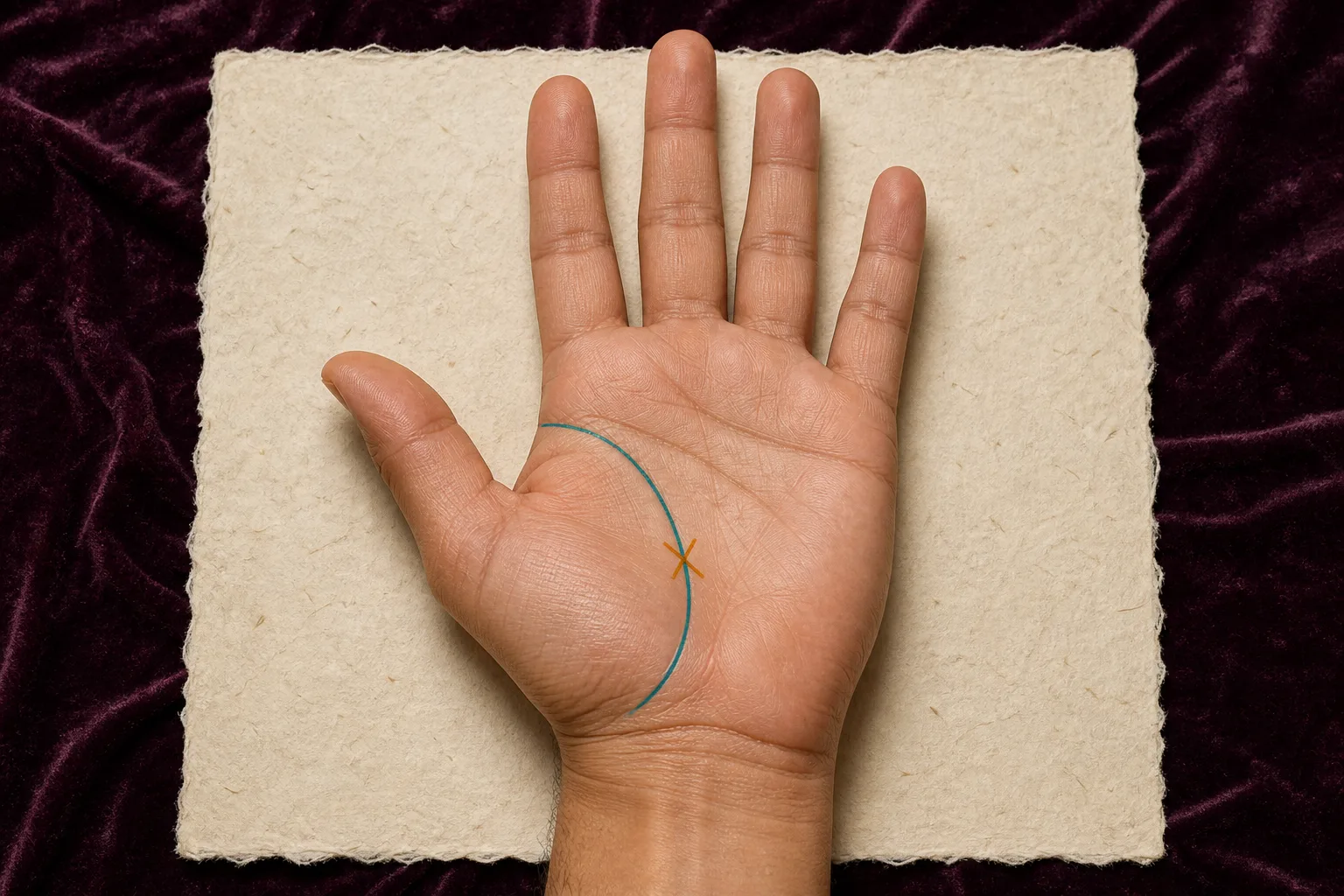
A cross on the Life line is a small X made by two short strokes whose intersection touches or sits directly on a verified Life-line arc. In traditional palmistry it draws attention to a concentrated challenge, decision, outside pressure, or change in pace at that part of the line. It does not predict death, an accident, illness, tragedy, or shortened life. Confirm the X, its exact relationship to the Life line, the line before and after it, Venus-origin influences, Mars support, Head, Fate, real events, broad timing, and both palms.
A cross on the Life line becomes personal only after the complete Life-line parent, exactly two short intersecting strokes, central contact, arm origins, exact arc position, clarity before and after, cutting-line, Venus-influence, star, branch, break, square, triangle, grille and texture tests, Venus, Mars support, Head, Fate, branches, timing, real transitions, and both palms are compared. A whole-hand reading can show how pace, resilience, home, responsibility, movement, support, and change work together.
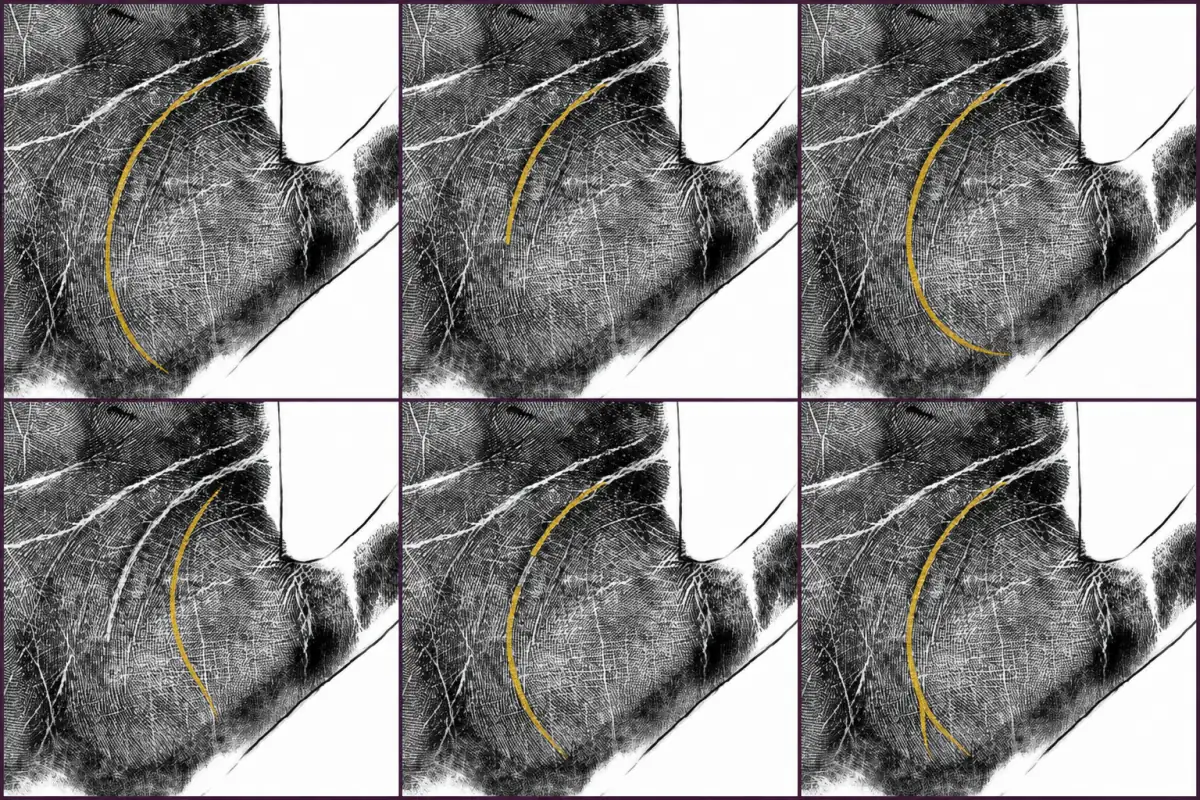
The Life line begins near the thumb-index web and curves around the Mount of Venus toward the wrist. It is traditionally read for vitality, pace, resilience, home base, major changes, and how a person uses support. Its length does not measure lifespan. A cross is a local marking within that larger pattern, so it cannot replace the complete line.
How to identify a true cross on the Life line
Begin with the complete Life-line guide. The area inside and across the Life line often contains family, influence, stress, and fine skin creases. Many apparent X marks are simply two unrelated lines seen in a tight crop.
- Trace the Life-line parent from the thumb-index start around Venus toward the wrist.
- Find two short strokes that cross each other rather than merely touch.
- Confirm one central intersection with four visible arms.
- Place that intersection on or immediately touching the Life line.
- Trace each arm to see whether it is truly short or belongs to a longer influence.
- Mark the exact arc position from upper, middle, or lower Life line.
- Inspect the parent before and after for depth, clarity, breaks, islands, or chaining.
- Check Mars support inside the Life line and Fate connections outside it.
- Exclude a star, branch, bar, grille, triangle, and crossed-line illusion.
- Compare both palms with the same light and hand position.
This is the ten-part Life-line-cross method: parent, two strokes, central intersection, contact, arm origins, arc position, continuation, support, lookalikes, and both palms. The general cross and X guide retains the meaning of crosses on mounts and elsewhere in the palm.
Cross, one cutting line, star, branch, break, or square?
| Formation | What to trace | Why it differs |
|---|---|---|
| True cross on Life line | Two short strokes intersect at one center on or touching the Life-line parent | A distinct four-armed X at one point |
| One cutting line | A single longer influence crosses the Life line | No second short stroke creates an independent X |
| Venus influence line | A route begins inside the thumb mound and continues across the Life line | Its origin and destination carry the meaning |
| Star | Three or more strokes meet or cross at one compact center | More than four arms radiate from the point |
| Branch | One stroke grows from the Life-line parent at a shared junction | It does not cross through another short stroke |
| Break | Related Life-line segments sit around genuinely empty skin | The parent stops instead of being crossed |
| Square | Four connected sides enclose a visible space | An enclosure rather than a central intersection |
| Random texture | Faint creases appear only under one angle or magnification | No stable, compact geometry in the whole-hand view |
If one arm runs from Venus toward Fate, treat it first as an influence line. If the Life line itself stops, use the broken Life-line guide. If several strokes converge, count the distinct arms before deciding whether the mark is a star.
What a cross on the Life line traditionally means
A cross concentrates attention at one point. Traditional readers explore an obstacle, decisive encounter, family pressure, demanding transition, temporary reduction in pace, or event that changes how energy and support are used. The Life-line domain keeps the inquiry broad: the mark may relate to home, responsibilities, relocation, recovery, routine, or a personal turning point rather than one predetermined event.
The X does not tell you whether the cause is internal or external. Its arms may provide clues: a long arm from Venus can point toward family or close relationships in traditional practice, while a connection toward Fate can bring work structure or duty into the picture. These are hypotheses to compare with the person's actual history and question.
Fear-based claims go beyond what the geometry supports. A cross cannot announce death, calculate longevity, prove an accident, diagnose disease, or guarantee disaster. Read what happens to the Life line after the contact. A clear continuation makes the challenge bounded; a weaker continuation asks what ongoing demand or routine changed; a nearby Mars line adds traditional support.
| Common fear | What the mark actually establishes | Useful question |
|---|---|---|
| “It is a death sign” | Only two short strokes intersect near the Life line | What change in pace or support fits this part of life? |
| “It predicts an accident” | No event type follows from the X alone | Do the arms belong to a longer influence or route? |
| “It means serious illness” | A crease is not a diagnostic result | What do real symptoms and qualified care show? |
| “My life will be short” | Life-line length and marks do not measure lifespan | How clear is the continuing arc? |
| “Bad luck is permanent” | The cross occupies one local point | What changes above or below it? |
What a cross at the start, middle, or end of the Life line changes
Location supplies sequence rather than a fixed event. The upper arc is earlier, the middle arc follows, and the lower arc is later. Hand size, curve, and start vary, so do not copy exact ages from a diagram.
| Cross position | Traditional focus | Question to test |
|---|---|---|
| At the Life-line start | Early environment, family influence, caution, formation of independence | Which early condition shaped confidence or pace? |
| Upper arc | Education, first responsibilities, leaving home, early adult adjustment | What demanded a different routine or support system? |
| Middle arc | Established responsibilities, home, work-life pressure, major transition | Which role or change concentrated demands? |
| Lower arc | Later priorities, relocation, changing energy allocation, family duty | What becomes more selective or differently supported? |
| Inside Venus beside the line | Close relationship, family, home, or private emotional influence | Does the center actually touch the Life line? |
| Outside the line toward Mars | External pressure, conflict, assertion, or practical challenge | Is this a separate Mars marking instead? |
What the Life line after the cross changes
The continuing arc is the strongest modifier. Follow it all the way toward the wrist instead of ending the reading at the X.
- Clear continuation: a concentrated challenge is followed by restored rhythm or adaptation.
- Deeper continuation: the later phase may feel more grounded, decisive, or supported.
- Fainter continuation: pace may become quieter, more selective, or still under demand.
- Break after the cross: the X and the later interruption are separate formations.
- Island after the cross: one event-like point is followed by a bounded divided phase.
- Chain after the cross: a concentrated point is followed by a longer variable rhythm.
- Upward branch after it: ambition, effort, or engagement may increase.
- Moonward branch after it: movement, distance, environment, or independence may become relevant.
The dedicated Life-line island and chained Life-line guides keep those later textures distinct.
What Venus, Mars, Head, Fate, and branches add
Venus describes attachment, home base, warmth, appetite for life, and close influence. Trace any arm that enters from inside the Life-line arc. Inner Mars, located beside the Life line, contributes steadiness and resistance in traditional reading. A parallel sister or Mars line can add support across the same span; it does not erase the cross.
The Head line adds decisions, planning, and interpretation of the event. Fate adds work structure and outside responsibility. Upward branches can show effort or new engagement, while downward or Moonward branches can bring changes in environment and energy allocation. The sister and Mars line guide helps verify a true parallel support line.
| Supporting feature | Traditional contribution | What to verify |
|---|---|---|
| Clear Mars line | Support, recovery, protection, or backup through the same span | A distinct parallel route inside the Life line |
| Strong Head line | Planning and judgment help manage the change | Direction, depth, breaks, and real decisions |
| Fate connection | Work, duty, or structure participates in the turning point | A true Saturn-bound route rather than a random bar |
| Venus-origin arm | Family, home, attachment, or a close person may influence the phase | Trace the arm to its real origin |
| Clear upward branch | Renewed effort, confidence, or goal-directed movement | A shared branch junction after the X |
| Moonward branch | Movement, travel, relocation, or environmental change | A branch that genuinely reaches the outer palm |
How to estimate timing without inventing an exact age
Use proportional placement on the complete Life-line arc. Mark the start, the cross center, and the endpoint; then compare the cross with known changes in home, responsibility, routine, movement, or support. Report a broad phase. Exact ages copied from another hand create false precision.
- Photograph the complete arc without foreshortening.
- Confirm the X center actually touches the parent.
- Place the center proportionally between start and endpoint.
- Compare nearby Head, Fate, Venus influences, branches, and Mars support.
- Calibrate against one or two known life transitions.
- Repeat on the other palm.
- State a broad phase and the evidence used.
The timing guide explains the limits. The X cannot provide a date for death, illness, accident, marriage, relocation, or career change.
What the cross means in one palm or both
Use matched photographs and state hand dominance. A common modern convention reads the less-active hand as background and the active hand as present development. The comparison is useful only when the geometry and proportional position genuinely match.
- Similar cross in both palms: the concentrated Life-line theme repeats strongly.
- Cross mainly in the active hand: present choices, duties, or conditions may be shaping the phase.
- Cross mainly in the less-active hand: a background pressure may be expressed differently now.
- Clearer active continuation: present adaptation or support may be stronger.
- Different positions: treat them as separate markings before proposing one shared event.
Five worked examples
1. Middle cross with a clear continuing Life line
One compact X touches the middle arc, and the Life line remains deep below it. Traditional synthesis treats this as a concentrated challenge or decision followed by restored pace. Actual history distinguishes a home change from work pressure or family duty.
2. Upper cross whose long arm begins on Venus
The apparent X includes one longer line entering from the thumb mound. The reading starts with close influence, family, or home rather than treating the mark as an isolated symbol. Trace the other arm and the Life-line continuation.
3. Cross with a parallel Mars line
A small X touches the Life line while a separate inner line parallels the affected span. Traditional readers add support, recovery, or backup to the challenge theme. The parallel must remain independent and continuous enough to qualify.
4. Cross followed by a Moonward branch
The Life line continues after the X and later sends a branch toward the outer lower palm. The concentrated issue and the later movement or environment theme form a sequence; the cross alone does not predict relocation.
5. Cross in one hand and ordinary crossing texture in the other
The active palm shows two short centered strokes, while the less-active palm has only one longer cutting line. These are not the same formation. Read current concentrated pressure separately from the background influence pattern.
Photo checklist for a Life-line cross
- Capture the whole palm from wrist to fingertips.
- Keep the thumb-index web, Venus mount, complete Life line, and wrist visible.
- Use bright indirect light plus one gentle side-lit close-up.
- Trace the Life-line parent before marking the X.
- Confirm exactly two intersecting strokes and one central meeting point.
- Trace every arm to determine whether it belongs to a longer influence.
- Record the line's clarity before and after the center.
- Separate a bar, star, branch, break, square, triangle, grille, and random texture.
- Keep one unmarked original and annotate only a duplicate.
- Photograph both palms at the same distance and exposure.
Frequently asked questions
Does a cross on the Life line mean death?
No. Neither a cross nor the Life line measures lifespan. Traditional reading treats it as a concentrated challenge or change in pace and then reads the continuation.
Does it predict an accident?
No specific event follows from an X. Trace the arms, nearby lines, actual history, and what the Life line does afterward.
What if only one line cuts the Life line?
That is a cutting or influence line, not a complete cross. Its origin and destination carry more information than an X interpretation.
What is the difference between a cross and a star?
A cross has two intersecting strokes and four arms. A star has at least three strokes or six radiating arms meeting at one compact center.
What does a cross inside the Life line mean?
If it sits on Venus without touching the parent, traditional readers explore close relationships, family, or home. Confirm its address before using the Life-line meaning.
What if the Life line is strong after the cross?
A clear continuation traditionally suggests that the challenge is bounded and the person's pace or support becomes coherent again.
Can the cross show an exact age?
No. Use proportional location, calibrate with known events, compare both hands, and report a broad phase.
Can a cross appear or disappear?
Fine creases and their visibility can change with skin condition, use, lighting, and camera angle. Compare matched dated photographs before deciding the mark changed.
The complete answer
A cross on the Life line is one compact X formed by two short strokes whose center touches a verified Life-line arc. Traditional palmistry uses it to explore a concentrated challenge, decision, outside pressure, or change in pace, not death, accident, disease, tragedy, bad luck, or lifespan. Verify the Life-line parent, two strokes, four arms, central intersection, exact contact, arm origins, arc position, and clear continuation against one cutting line, a Venus influence, star, branch, break, square, grille, and random texture. Then add Venus, Mars support, Head, Fate, branches, broad timing, real transitions, and both palms. A Full Palm Reading maps all important features across both hands and combines them into a holistic reading focused on your questions about pace, resilience, home, work, relationships, major changes, timing, and what happens after the mark.
A Full Palm Reading
Ask how your Life-line cross fits your complete pattern of change and support
Your reading maps the complete Life-line parent, exactly two short intersecting strokes, central contact, arm origins, exact arc position, clarity before and after, cutting-line, Venus-influence, star, branch, break, square, triangle, grille and texture tests, Venus, Mars support, Head, Fate, branches, timing, real transitions, and both palms, then adds every other important line, mount, finger, marking, shape, and texture into one holistic reading focused on your questions.
Your Full Palm Reading maps all the important features—hand shape, skin texture, thumb, fingers, mounts, major and minor lines, markings, and the differences between both palms—and brings them together in a holistic reading focused on your questions.