
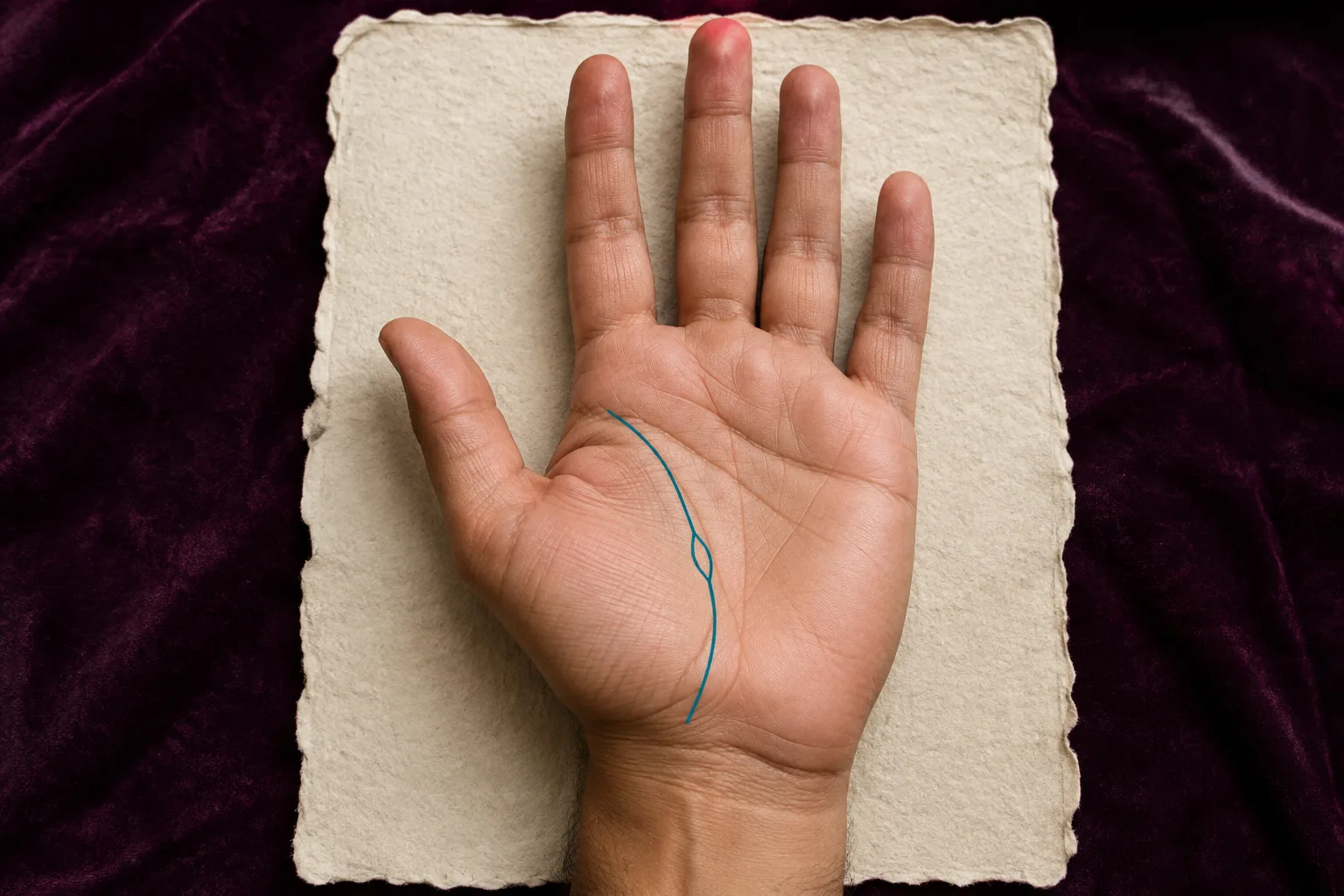
An island on the Life line is one closed oval formed when the verified Life-line parent divides into two strands and then reunites. Traditional palmistry reads that enclosed section as a bounded phase or recurring theme of divided pace, reduced reserves, competing demands, or unsettled support. It does not determine lifespan, predict death, or diagnose illness. Its exact location, proportional length, the depth of the line before and after it, nearby support lines, real circumstances, and the other palm matter more than the island alone.
One Life-line island becomes personal only after the true thumb-index parent, single closed split-and-reunion geometry, exact arc position, proportional size, depth, clarity before and after, branch, sister or Mars line, crossing, chain, break, overlap and fork tests, Venus, Mars support, Fate, Moon branches, timing, real lifestyle demands, and both palms are compared. A whole-hand reading can show what divided pace or support and what becomes steadier afterward.
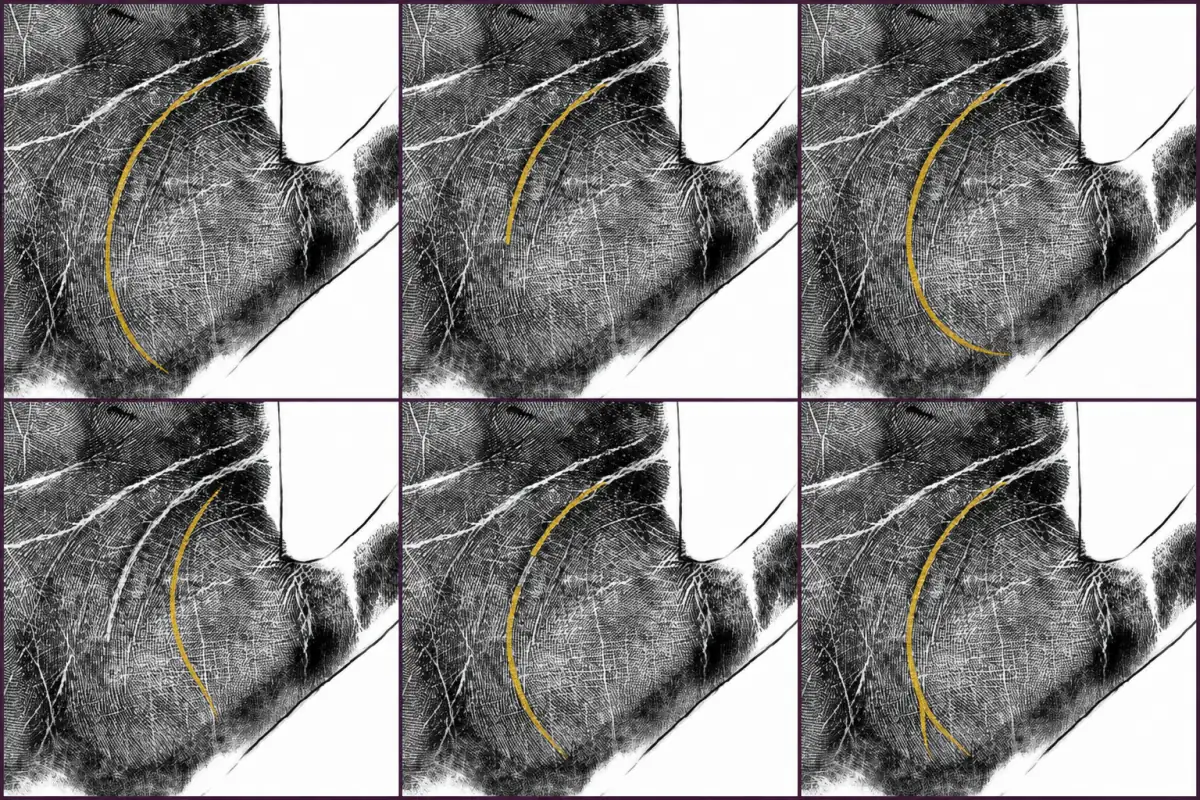
The visual sequence gives the most useful interpretation: one route approaches, divides around a closed space, joins again, and continues. The opening can describe when a demanding chapter begins; the two sides can represent attention or resources running in parallel; the reunion can describe consolidation. A clear continuation is therefore essential evidence. Reading only the oval and ignoring what follows creates an incomplete and unnecessarily alarming answer.
If you have found a loop around the thumb, begin with identification rather than meaning. Natural palm texture can create eye shapes that disappear when the hand relaxes or the light moves. Trace the complete Life line from the thumb-index web around the Mount of Venus before deciding the oval belongs to it.
How to identify a true island on the Life line
The Life line begins near the web between the thumb and index finger, curves around the fleshy thumb ball called the Mount of Venus, and travels toward the wrist. It does not need to be the deepest crease or extend to the bracelet lines. Identify that parent first, then look for one local split and reunion within its path.
- Find the origin. Start at the thumb-index web instead of tracing upward from an attractive loop.
- Follow one parent arc. Confirm that the route curves around Venus toward the wrist.
- Locate the opening. The single parent must divide into exactly two connected sides.
- Confirm a closed space. Both sides should enclose a visible oval or almond shape.
- Find the reunion. The two sides must reconnect with each other.
- Trace the outgoing line. One Life-line route should continue below the reunion.
- Check side light. Angled light helps distinguish real grooves from skin color or shadow.
- Relax the thumb. Stretching the hand can open, flatten, or invent small shapes.
- Compare scale. Judge the island as a proportion of the full arc, not from a magnified crop.
- Repeat on the other palm. Similar geometry or a clearer alternative can change the reading.
This is the ten-part island-on-Life-line method: origin, parent arc, opening, closed space, reunion, outgoing route, side light, relaxed hand, proportional scale, and both-palm comparison. If any of the first six geometry checks fails, record what is visible without forcing an island label.
Island, break, branch, sister line, chain, or crossing?
Most mistaken islands are ordinary intersections or short parallel creases. The difference is structural. A genuine island belongs to one parent line at both ends. The general island guide explains the same split-and-reunion test across every major line.
| Formation | What to trace | Why it differs |
|---|---|---|
| One Life-line island | One parent splits, encloses one space, reunites, and continues | A local divided section within one route |
| Break | The groove stops and leaves a genuine empty gap before a restart | No closed oval and no two connected sides |
| Side branch | One offshoot leaves while the parent continues | The offshoot does not return to the parent |
| Sister or Mars line | A separate inner parallel route runs beside the Life line | It can support a span without forming one local oval |
| Chain | Several adjacent linked loops repeat along the parent | A continuous texture rather than one bounded island |
| Crossed-line eye | Unrelated fine lines cross around an intact central groove | The Life-line parent never divides |
| Overlap | One route fades while another starts beside it | The two traces may cross without enclosing a joined oval |
| Fork | One parent divides into prongs that stay separate | There is no reunion |
A loop near the Life-line origin also needs special care because the Head and Life lines may begin together and then separate. Their shared beginning can produce a small triangular or oval-looking space. Trace both complete parents. If one side becomes the Head line across the palm, the shape is a joined-line configuration rather than a Life-line island.
What an island traditionally means
In modern symbolic reading, a Life-line island can describe a period when normal pace, stability, attention, or support is divided. That could fit overlapping work and family duties, adapting to a new home, caring for another person, rebuilding routines, prolonged uncertainty, or managing two demanding roles. The hand does not identify the event for you. The person's actual history and question supply the context.
Older palmistry sources often used health-heavy language for Life-line islands. A useful current reading keeps the traditional idea of reduced or divided vitality as a metaphor for pace and reserves, while refusing to turn a crease into a diagnosis. The Life line is a symbolic name. Its length, interruptions, and islands cannot establish a disease, medical outcome, date of death, or lifespan.
One island is also different from a lifelong condition. Its opening and closing create boundaries. If the parent resumes clearly, the visible pattern itself emphasizes continuity after division. If the outgoing route is faint, broken, displaced, supported, or strongly branched, read that later geometry separately.
Meaning by location on the Life-line arc
Location adds a broad life chapter and nearby themes. It does not create an exact age by itself. First divide the visible arc proportionally; then use recognizable Head-line crossings, influence lines, Fate changes, and known events for calibration.
| Island position | Traditional focus | What to verify |
|---|---|---|
| At the shared Head-Life origin | Early environment, caution, family structure, or an unsettled start | Whether the second side is actually the Head line |
| Upper arc below Jupiter | Early independence, education, expectation, family demand, or forming routines | Head-line start, Jupiter branches, Venus influence lines |
| Middle arc beside Venus | Established responsibilities, home, work-life pace, caregiving, or competing commitments | Fate changes, Venus crossings, Mars support, outgoing depth |
| Lower arc | Later reorganization of home base, priorities, stamina, or environment | Moon branches, Fate continuation, bracelets, line clarity |
| Near the wrist | A late section of the symbolic arc or a transition in roots and routine | Whether ordinary wrist creases create the apparent closure |
Do not assign a dramatic event merely from position. An upper island does not prove a difficult childhood, and a lower island does not predict illness in later life. Treat the zone as a prompt: what was drawing on time, stability, attention, family support, or physical routine during that broad chapter?
The line before, through, and after the island
Read the three sections as a sequence. A deep incoming line can show an established rhythm before the divided phase. Unequal island sides may suggest one route or demand dominates the other. A deep, clean reunion and outgoing line traditionally indicate consolidation. A faint continuation suggests that the new rhythm is still developing, while a displaced restart can connect the chapter with a change of environment or priorities.
- Clear before, clear after: a bounded interruption within an otherwise steady pattern.
- Faint before, deeper after: structure or reserves appear stronger after the island closes.
- Deep before, faint after: the later pace may need more deliberate support or simplification.
- Mars line beside the island: resilience, backup, or practical support is added to the same span.
- Moon branch after the island: movement, travel, relocation, or wider environments may follow consolidation.
- Break after the island: a divided phase and a later interruption are two distinct formations.
- Fork after the island: one bounded phase closes before two continuing directions appear.
The broken Life line guide handles a genuine gap, while the double Life line guide explains a sustained parallel route. Keep those geometries separate even when they appear close together.
What Mars, Venus, Fate, Head, and Moon add
A sister line inside the Life-line arc is often called the Mars line. Traditional readers treat it as reinforcement, resilience, or available support. If it runs beside an island, ask what person, skill, routine, financial buffer, home structure, or inner reserve helped carry the demanding span. It does not cancel the island or guarantee protection. Read the Mars line from its own origin, length, depth, and relationship with the parent.
The Mount of Venus adds vitality, attachment, family life, affection, comfort, and social warmth. Dense influence lines crossing from Venus can connect the island with relationships or domestic demands, but a crossing does not identify a person or event automatically. The Head line adds planning and decision style. The Fate line adds work, structure, and responsibility. A Moon-directed branch can add travel, relocation, imagination, or a wider environment.
Hand shape, thumb set, skin texture, and overall line quality show how the person tends to respond. A firm thumb and clear Head line can add deliberate choices; a flexible hand and strong Moon can add adaptation; a clear Fate continuation can add renewed structure. No single supporting feature proves what happened. Repeated themes across independent features create the stronger reading.
How to estimate timing without inventing an exact age
Life-line timing is proportional and varies by system. The origin represents the beginning of the symbolic sequence and the wrist end represents later sections, but hands differ in shape and line length. Treat the opening and reunion as a range rather than two exact birthdays.
- Photograph the complete arc so its proportions are visible.
- Mark the island's opening and reunion.
- Place both points as fractions of the full verified parent.
- Compare the Head-line origin, major influence lines, Fate changes, and Moon branches.
- Calibrate with a known move, caregiving phase, workload change, family transition, or routine shift.
- Check whether the same span appears in the other palm.
- Report a broad period and the evidence used.
The palmistry timing guide explains proportional mapping and calibration. An island cannot predict the exact date of illness, recovery, relocation, marriage, work change, or any other event.
What the island means in one hand or both
Photograph both palms under matched light and state which hand is used most. A common modern convention treats the less-active hand as background tendencies and the active hand as current development. Use that as a comparison framework, then check it against lived experience instead of treating one hand as a fixed past and the other as guaranteed future.
| Two-hand pattern | Traditional comparison | Useful question |
|---|---|---|
| Similar island at a similar level in both | The divided rhythm repeats strongly | Which sustained demand fits that broad chapter? |
| Island only in the active hand | Current circumstances may have shaped the pressure | What present role divides pace or support? |
| Island only in the less-active hand | An underlying pattern may be handled differently now | What changed in the active hand and in daily life? |
| Shorter island in the active hand | The divided phase may be more contained in current expression | Which boundary, habit, or support reduced it? |
| Clearer outgoing active Life line | Later rhythm may be consolidating | What became steadier after the demanding period? |
The two-hand reading guide explains dominance and change. Differences between palms can reveal more than the island's presence alone.
Five worked examples
1. Small middle-arc island with a deep continuation
One narrow oval closes beside the middle of Venus, and the Life line resumes at equal or greater depth. This can fit a bounded chapter of competing work and home demands followed by a steadier routine. Fate and Venus show where those demands clustered.
2. Upper island with a parallel Mars line
The island sits early on the arc while a clear inner sister line runs beside it. Traditional reading combines a demanding early phase with reinforcement or support. The hand cannot identify the helper; family history, routines, skills, and actual resources provide the useful answer.
3. Lower island followed by a Moon branch
The island closes on the lower arc and one branch then moves toward Moon while the parent continues. This can describe divided pace consolidating before travel, relocation, or a broader environment becomes important. It does not prove permanent foreign settlement.
4. Head-line separation mistaken for an island
At the origin, two sides seem to enclose a small space. Tracing shows the upper side continues across the palm as the Head line and never returns to the Life parent. Record joined and separated origins; there is no verified Life-line island.
5. Crossing creases mistaken for a loop
Two fine Venus lines intersect an intact Life groove and create an eye under flat light. Side lighting shows the central parent remains single. Read the influence lines separately and avoid turning their crossing into an island period.
Photo checklist for a Life-line island
- Photograph both palms from fingertips through wrists.
- Keep the thumb-index web and full Venus arc visible.
- Use bright indirect light plus one gentle side-lit close-up.
- Relax the thumb and fingers instead of stretching the palm.
- Trace the Life line from its actual origin to its endpoint.
- Confirm one incoming route, two island sides, one reunion, and one outgoing route.
- Check the Head line, Mars line, Venus crossings, Moon branches, Fate line, and wrist creases.
- Keep one unmarked original and annotate only a duplicate.
- State hand dominance and the life chapter or question you want explored.
Frequently asked questions
Does an island on the Life line mean illness?
No diagnosis can be made from a palm crease. In a symbolic reading, use the island to explore a bounded phase of divided pace, reduced reserves, competing responsibility, or changed routine, then compare the complete hand and real circumstances.
Does it shorten lifespan or predict death?
No. The Life line does not measure years of life, and an island cannot predict death. Its visual sequence continues after the two sides reunite.
What does an island at the beginning mean?
Traditional readers explore early environment, family structure, caution, adaptation, or unsettled routines. First confirm that the apparent second side is not the Head line separating from a joined origin.
What does an island in the middle mean?
The middle arc can be explored through established adult routines, home, work-life demands, caregiving, or competing commitments. Fate, Venus influence lines, Mars support, known events, and the outgoing Life line identify the useful context.
What if the Life line becomes stronger after the island?
A deeper continuation traditionally suggests that pace, support, or stability becomes more coherent after the divided section. Ask which decision, boundary, routine, move, relationship, or practical resource fits the change.
Does a Mars line cancel the island?
No. It adds a separate traditional theme of reinforcement or resilience during some or all of the span. Compare the exact overlap and the strength of both routes.
Can the island show an exact age?
No. Use its opening and reunion as proportional points, calibrate with other features and known events, and report a broad range.
Can an island change over time?
Fine crease visibility changes with lighting, skin condition, hand position, and image quality. Compare matched photographs before deciding that the oval has opened, closed, or become clearer.
The complete answer
An island on the Life line is one closed oval formed when the verified thumb-index parent divides and reunites along its arc around Venus. Traditional palmistry associates it with a bounded period or theme of divided pace, reduced reserves, competing demands, unsettled support, or reorganized routines, not illness, shortened lifespan, or death. Verify the origin, complete parent arc, opening, two connected sides, closed space, reunion, and outgoing route against a Head-line separation, branch, sister or Mars line, crossed-line eye, chain, break, overlap, and fork. Then add its upper, middle, or lower location; proportional size; depth and clarity before and after; Mars support; Venus influence lines; Fate; Head; Moon branches; broad timing; real life context; and both palms. A Full Palm Reading maps all the important features across both hands and combines them into a holistic reading focused on your questions about pace, stability, home, support, responsibility, change, timing, and what becomes steadier after a divided phase.
A Full Palm Reading
Ask how your Life-line island fits your complete vitality pattern
Your reading maps the true thumb-index Life-line parent, one closed split-and-reunion island, exact arc position, proportional size, depth, clarity before and after, branch, sister or Mars line, crossing, chain, break, overlap and fork tests, Venus, Mars support, Fate, Moon branches, timing, real lifestyle demands, and both palms, then adds every other important line, mount, finger, marking, shape, and texture into one holistic reading focused on your questions.
Your Full Palm Reading maps all the important features—hand shape, skin texture, thumb, fingers, mounts, major and minor lines, markings, and the differences between both palms—and brings them together in a holistic reading focused on your questions.