
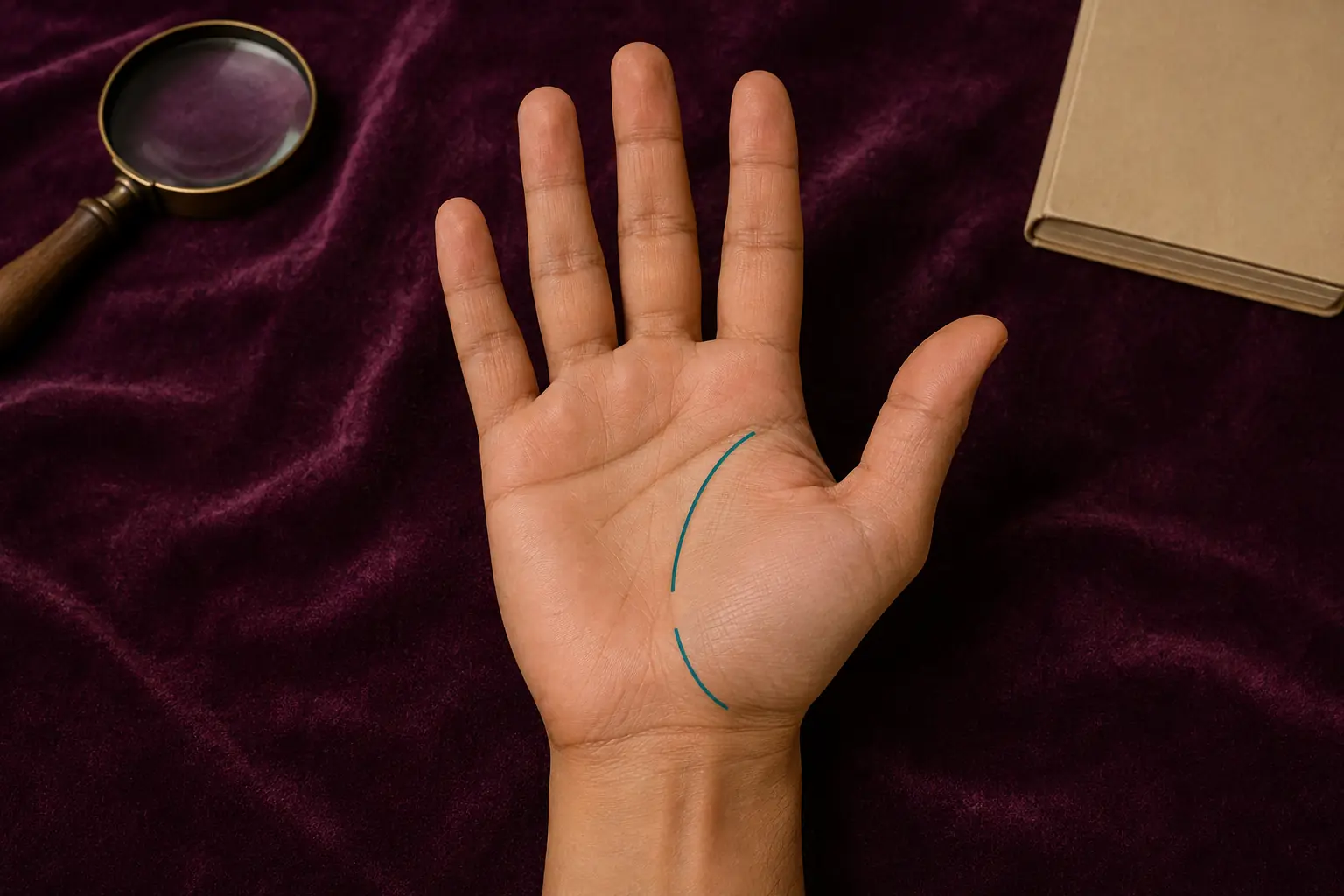
In traditional palmistry, a broken life line is an empty gap between two sections that belong to the same curved route around the base of the thumb. It is usually interpreted as a distinct transition in vitality, daily rhythm, home base, environment, independence, or the way a person uses their energy. If a clear second segment resumes after the gap, the restart matters as much as the interruption. A broken life line does not predict death, does not reveal how long someone will live, and should never be used to diagnose illness.
A life-line break becomes meaningful only after the complete thumb-side arc, true empty gap, lower restart, alignment or displacement, strength before and after, overlap and faintness tests, islands, bars, broad timing, sister or Mars support, Venus, Moon, Fate, Head, and both palms are compared. A whole-hand reading can show how home, environment, pace, resilience, transition, and direction work together.
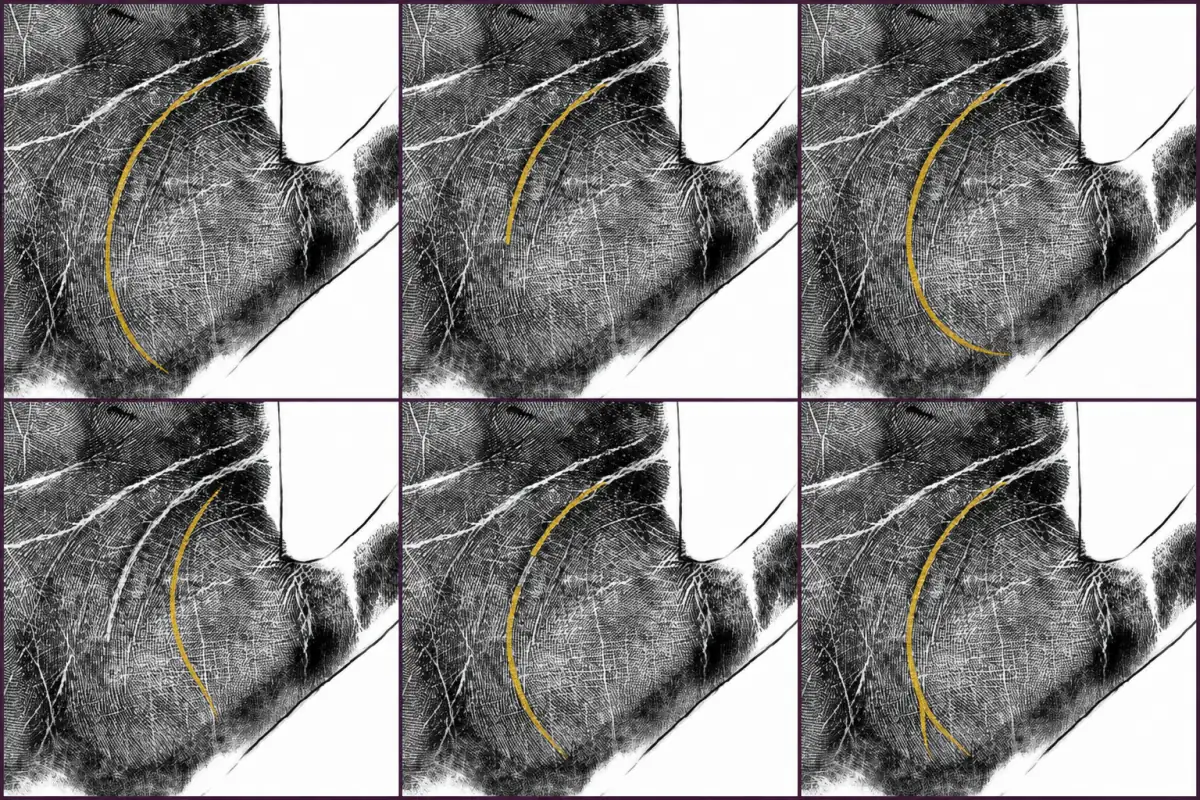
Use a ten-part broken-life-line method: locate the complete thumb-side arc, trace the upper segment, confirm genuinely empty skin, trace the lower continuation backward, test whether the pieces align or overlap, exclude faintness and islands, compare depth before and after the gap, look for a parallel support or Mars line, place the gap in a broad section rather than claiming an exact age, and compare the same route in both palms. Only then connect the formation with the person's real history and question.
A break is about continuity, not lifespan
The life line is traditionally read for embodied energy, pace, attachment to home and familiar surroundings, major transitions, and recovery patterns. Its length or interruption cannot tell you the date or cause of death. The useful question is: what changes at the gap, and how does the line continue afterward?
Where the life line is and how a break looks
The life line begins near the web between the thumb and index finger. It curves downward around the Mount of Venus—the padded thumb base—and normally heads toward the wrist. It is not the straight horizontal Head line across the middle of the palm or the vertical Fate line near the center.
Start at the upper origin and follow the same groove slowly. A true break appears when that parent route stops, a section of skin has no connecting groove, and another plausible life-line segment resumes below. Reverse the trace from the wrist upward. Both pieces should follow the same Venus-surrounding family of curves. Two unrelated creases that merely point toward one another do not automatically form a broken life line.
| What you see | Decisive visual test | Best classification |
|---|---|---|
| Empty space between aligned curved segments | No groove survives through the gap in neutral or side light | Clean break and restart |
| Two segments run beside each other briefly | The upper section begins before the lower one fully ends | Overlapping transition |
| One shallow groove remains | The parent can still be traced through the pale section | Faint or weakened life line |
| Line divides around a closed oval and rejoins | Two sides enclose a complete space | Island, not a break |
| A short stroke cuts the parent | The life-line groove continues beneath or beyond it | Crossbar or interference line |
| Parent continues while an offshoot leaves it | One route remains unbroken after the junction | Branch, not a break |
How to verify a true break
Life lines contain changes in depth, small crossing creases, and shadows from the thumb pad. Photograph the relaxed hand directly above in bright indirect light, then take a second photograph with gentle side light. A flash can erase a fine bridge; harsh side light can manufacture a dramatic gap. Compare unedited images before tracing anything.
- Find the origin between the thumb and index finger.
- Trace the upper parent until it visibly stops.
- Inspect the suspected gap at normal size and close range.
- Confirm that no faint groove, island edge, or overlapping segment bridges it.
- Find the lower candidate near Venus or the wrist and trace it upward.
- Check that both segments follow one plausible life-line arc.
- Record whether the lower restart shifts inward toward Venus or outward toward Moon.
- Compare depth, clarity, and length before and after the gap.
- Look for a parallel inner support line through the interrupted zone.
- Repeat the same sequence on the other palm.
The generic broken-lines guide explains how gaps, overlaps, shifted continuations, islands, squares, and sister lines behave across different parent lines. On the life line, location around Venus and the character of the lower restart supply the specific meaning.
What a broken life line traditionally means
A break changes continuity. Traditional readers may connect it with leaving a familiar environment, a demanding adjustment, a change in household, a new level of independence, relocation, a major shift in responsibility, recovery after an exhausting period, or a reset in pace and priorities. The palm does not select one event from that list. The line above and below the gap, supporting features, both hands, and known history determine which interpretation fits.
The old habit of turning every life-line interruption into danger is too crude to be useful. A move abroad, departure from a family setting, career pivot, caregiving chapter, new routine, or chosen reinvention can all disrupt continuity without being a catastrophe. When a clear lower segment resumes, the geometry itself describes continuation after change.
| Formation | Balanced traditional direction | Question to ask |
|---|---|---|
| Narrow aligned gap | A defined interruption followed by a familiar route | What paused or changed temporarily? |
| Wide empty gap | A more substantial change in foundation or circumstances | What separated the earlier and later chapters? |
| Overlapping segments | Transition with preparation, support, or gradual handover | Which old structure remained while the new one formed? |
| Restart displaced outward | A changed environment, wider world, travel, or new independence may gain emphasis | Did the later chapter involve movement or unfamiliar settings? |
| Restart displaced inward | Home, family, private life, or conserving energy may gain emphasis | Did responsibilities or priorities turn closer to home? |
| Parallel support spans the gap | Resources or resilience remain available through transition | What person, habit, skill, or structure helped maintain continuity? |
Read the restart before deciding whether the sign is difficult
The lower continuation tells you what the pattern becomes. Compare it with the upper section under the same light. A deeper, cleaner restart is traditionally read as stronger organization, renewed stamina, or a more settled foundation after the change. A similar aligned restart suggests continuity returning in a recognizable form. A faint or chained continuation suggests that adjustment develops gradually.
Direction matters. A restart closer to the thumb narrows the Venus enclosure and may emphasize selectivity, conservation, family obligations, or a more contained lifestyle. A restart farther toward the outer palm can enlarge the arc and add exploration, mobility, social range, or a changed environment. These are tendencies in the traditional system, not proof of a particular move or event.
Also follow the upper segment before the gap. If it grows faint gradually, the change may build over time. If it stops cleanly, the transition may feel more decisive. If it forks immediately before the gap, two competing directions may precede the interruption. If the lower segment begins with several fine strands that later combine, the new chapter may take time to consolidate.
What a support line or Mars line adds
A second line running close and roughly parallel inside the life-line arc is often called a sister life line, inner life line, or Mars line. When it remains clear beside the broken section, traditional readers treat it as support during the transition. That support can be interpreted broadly: resilience, disciplined habits, family backing, practical help, a protective environment, or an additional reserve of effort.
Verify the companion rather than assuming every Venus crease is protective. It should run in the same general direction for a meaningful distance. A short crossing stroke, a line coming from Venus into the life line, or an overlapping restart belongs to a different formation. The double life-line guide shows how to distinguish a true parallel route from fragments and influences.
A square enclosing the gap is also traditionally treated as a containing or protective formation. Confirm four connected sides around the interrupted area; random crossings do not make a square. These signs do not guarantee safety or cancel real-world risk. They show that the symbolic reading includes resources and continuation, not only disruption.
What the Fate, Head, and Moon features add
A Fate-line change at a similar level can connect the life-line transition with work, duty, education, or a new direction. A steady Fate line while the life line changes may suggest that external responsibilities continue even as the person's environment or use of energy shifts. A branch toward Moon, travel lines on the outer lower palm, or a wider lower restart can add movement and relocation themes.
The Head line adds planning and judgment. A clear Head line can show an organized response to change; a change in its direction at a comparable stage may suggest new priorities or a different way of making decisions. Venus shows home, attachment, and close relationships. The thumb adds will, adaptability, and practical follow-through. Repetition across these features matters more than one isolated gap.
How to estimate the timing of a life-line break
Life-line timing is approximate. Divide the arc into broad sections and calibrate it with known events rather than assigning a precise age from a chart. The upper section near the origin represents an earlier phase, the middle curve around Venus a broad adult middle, and the lower section toward the wrist a later phase. Hand size, line shape, and system differences make exact-year claims unreliable.
- Verify the upper stopping point and lower restart separately.
- Place each point proportionally along the complete arc.
- If the gap is wide, record a start range and a restart range rather than one date.
- Compare a Fate-line, Head-line, or travel-line change at a similar broad level.
- Use a known move, household change, work shift, or recovery period to calibrate the scale.
- Repeat the estimate on the other palm and keep only the range the evidence supports.
The palmistry timing guide explains proportional zones and cross-line calibration. A gap cannot give the date of an illness, accident, move, relationship event, or death.
What a broken life line means in the left and right hands
Compare both palms and state which hand is dominant. Under a common modern convention, the less-active hand supplies background tendencies and the active hand shows how the pattern is currently expressed. Treat that as a comparison method rather than a fixed law or a gender rule.
| Two-hand pattern | Traditional comparison | Useful focus |
|---|---|---|
| Similar break at a similar level in both palms | The transition theme repeats strongly | Compare which restart is clearer and what real chapter fits |
| Break only in the dominant hand | Current choices or circumstances may have altered continuity | Present environment, pace, responsibilities, and recovery |
| Break only in the non-dominant hand | An underlying pattern may be expressed more continuously now | What current structures or choices changed the route? |
| Restart stronger in the dominant hand | The later path may be becoming more organized | Habits, support, independence, and new foundations |
| Support line only in one palm | Resources may be more available in that expression of the pattern | Name the practical support rather than treating it as magic protection |
The two-hand method prevents a common error: finding the more alarming palm and ignoring the hand that shows continuation, support, or a changed route.
Five worked examples
1. Narrow gap with a strong aligned restart
The life line stops briefly around the middle of Venus and resumes on the same curve with equal depth. The Fate line remains steady. This supports a defined interruption followed by return to a familiar structure. Ask about a temporary move, pause, responsibility, or change in routine rather than predicting danger.
2. Overlap through a relocation chapter
The upper segment continues faintly while a new lower segment begins slightly outward, creating a short overlap. A life-line branch also reaches Moon and the Fate line changes origin. The pattern gives relocation or a new environment more weight, with some continuity between the old and new bases.
3. Break supported by an inner parallel line
The main arc contains a clean gap, but a close sister line stays clear beside it and the restart becomes deeper. Traditionally, the change includes support and reorganization. Real history might identify the support as family, treatment, disciplined recovery, savings, training, or a dependable routine; the palm alone cannot name it.
4. Faintness mistaken for a break
Overhead light makes the middle life line disappear, but side light reveals one shallow connecting groove. This is reduced line quality rather than an empty gap. Read the gradual weakening and recovery, then compare skin dryness, pressure, and the other hand before attaching a story.
5. Island mistaken for two broken pieces
The parent divides around a narrow oval and rejoins. Because the sides enclose a complete space, the formation is an island. Traditional readers may connect it with a prolonged complicated or divided phase, while a clean break describes absence between two sections. The distinction changes both meaning and timing.
Photo checklist for a broken life line
- Photograph both full palms from fingertips through wrists.
- Keep the hand relaxed and the camera directly overhead.
- Use bright indirect light without flash glare.
- Add one gently side-lit photo to reveal faint bridges and overlaps.
- Capture a sharp close-up of the gap and the surrounding Venus mount.
- Keep the thumb in a similar relaxed position in both-hand photos.
- Do not sharpen, smooth, trace, or raise contrast in the original image.
- Trace the upper segment, empty area, lower restart, and support line on a duplicate only.
- Include the central Fate line and lower outer Moon area if timing or relocation matters.
- State hand dominance and the question you want the pattern to address.
Frequently asked questions
Does a broken life line mean early death?
No. Palm creases cannot determine lifespan or predict death. In palmistry, a verified gap is read symbolically as a transition in continuity, environment, pace, energy use, or personal foundation. The restart and complete hand decide how that transition is described.
Is a broken life line always bad?
No. It may coincide with a demanding interruption, but it can also fit chosen relocation, independence, a new household, changed priorities, recovery, or reinvention. A strong restart, overlap, support line, or clearer active-hand pattern can shift the emphasis toward adaptation.
What if the line overlaps after the break?
Overlapping segments preserve some continuity. Traditional readers often treat them as a gradual handover, preparation, or support between chapters. Compare how long the overlap lasts and which section becomes stronger.
What if the new segment shifts outward?
An outward restart enlarges the Venus enclosure and can add independence, wider surroundings, travel, or relocation. Confirm the route remains part of the life line and compare Moon marks, Fate changes, and actual history.
Can a Mars line protect a broken life line?
A clear inner parallel line is traditionally read as support through the interrupted zone. It may symbolize resilience, help, or an additional reserve. It does not guarantee protection from real-world events and should be verified as a genuine parallel route.
Can the gap show an exact age?
No. Its proportional position suggests a broad phase. Use known events, nearby line changes, and both palms to calibrate a range rather than claiming an exact year.
What if only one hand has the break?
The difference is part of the reading. Compare the active and less-active hands, restart strength, support signs, and lived changes. One hand may show a background interruption while the other shows greater continuity, or current circumstances may create the reverse.
Can palm lines change over time?
Fine line visibility can vary with light, dryness, hand position, and use, and smaller creases may appear different over time. Keep matched photographs before deciding that a gap has formed or closed.
The complete answer
A broken life line is a genuine empty gap between two related sections of the curve around the thumb pad. Traditional palmistry reads it as a change in continuity, environment, energy pattern, daily structure, independence, or personal foundation—not as a prediction of death or lifespan. Verify the parent line in neutral and side light, distinguish the gap from faintness, an island, crossbar, branch, or overlap, then compare the strength and direction of the restart. Add any sister or Mars line, Venus, Moon, Fate and Head features, broad timing, real history, and both palms. A Full Palm Reading maps all the important features across both hands and combines them into a holistic reading focused on your questions about change, home, relocation, resilience, recovery, responsibilities, timing, and the path that follows the interruption.
A Full Palm Reading
Ask what changes across your life-line gap
Your reading maps the complete Life-line arc, true empty gap, lower restart, alignment or displacement, strength before and after, overlap and faintness tests, islands, bars, broad timing, sister or Mars support, Venus, Moon, Fate, Head, thumb, and both palms, then adds every other important line, mount, finger, marking, shape, and texture into one holistic reading focused on your questions.
Your Full Palm Reading maps all the important features—hand shape, skin texture, thumb, fingers, mounts, major and minor lines, markings, and the differences between both palms—and brings them together in a holistic reading focused on your questions.