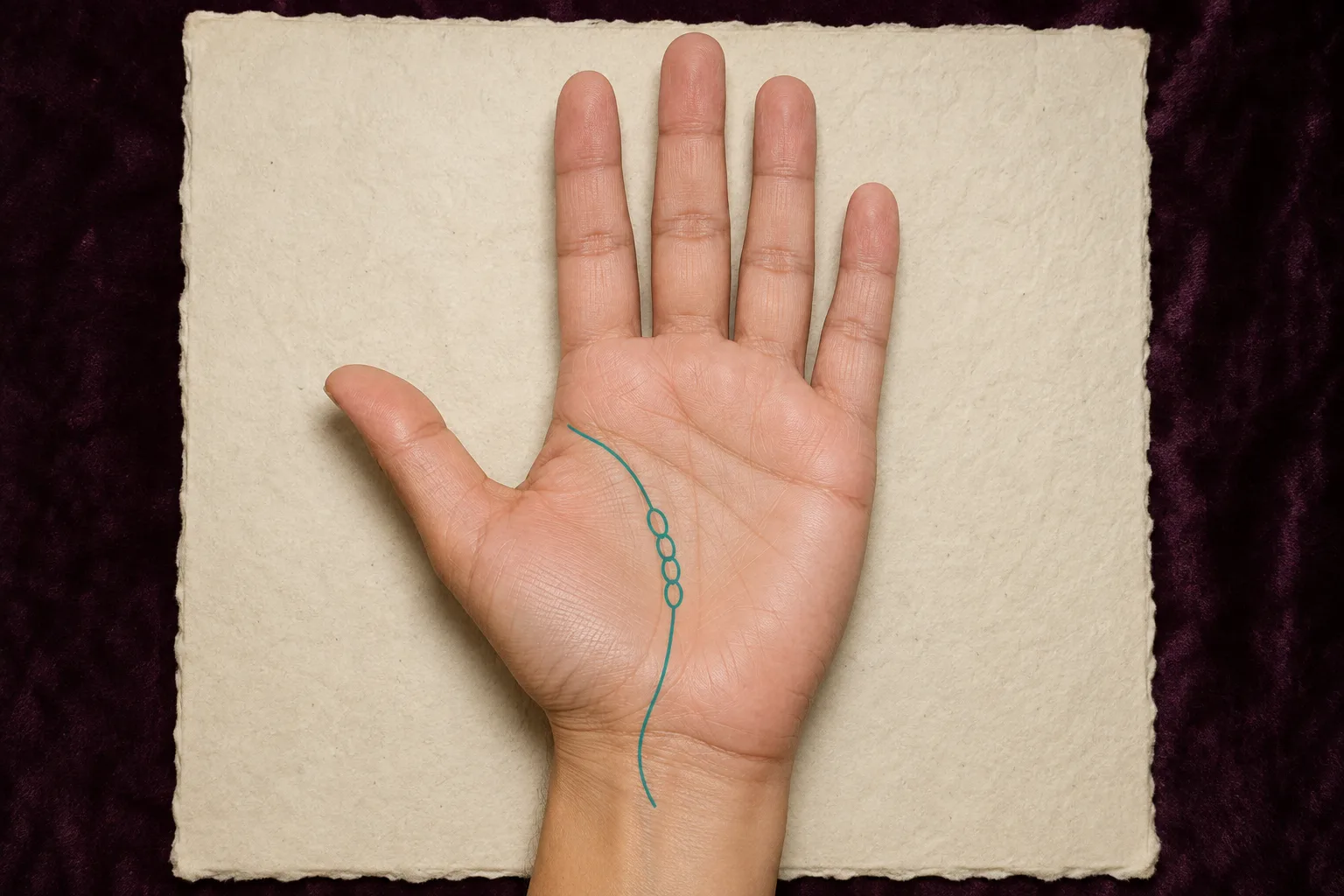
A chained Life line contains several adjacent closed loops made when one verified Life-line parent repeatedly divides and rejoins. In traditional palmistry, the chained span is read as a period or area of variable pace, uneven reserves, recurring demands, or changing routines. It does not diagnose illness, measure vitality scientifically, or reveal lifespan. First prove the repeated linked-loop geometry; then read how much of the line is affected, whether it becomes clear, the Mars support line, Venus, the Head and Fate lines, real habits, and both palms.
A chained Life line becomes personal only after the true thumb-index parent, repeated linked-loop geometry, affected span, clear sections, depth, island, crossing, sister or Mars line, break, overlap and branch tests, Venus, Mars support, Head, Fate, Moon branches, timing, real routines, and both palms are compared. A whole-hand reading can show how pace, support, home, responsibility, movement, and recovery work together.
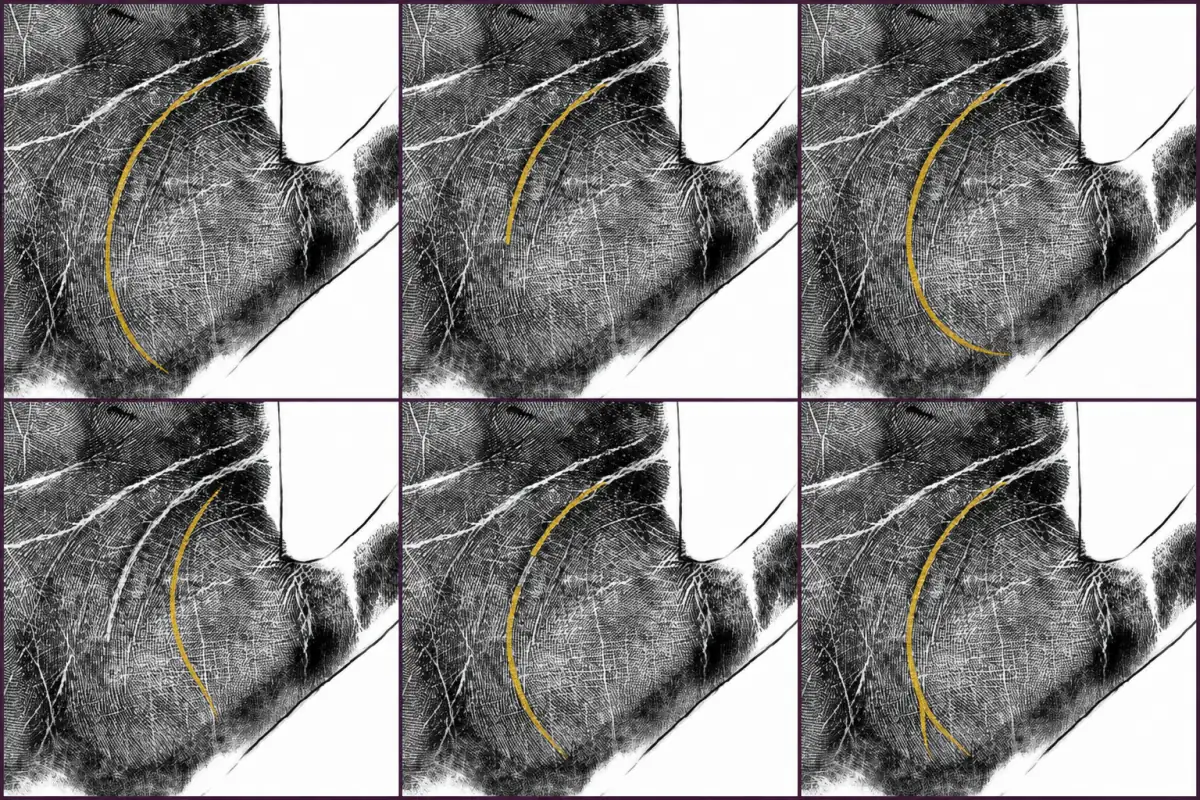
The Life line begins near the web between the thumb and index finger, curves around the Mount of Venus, and travels toward the wrist. Its length does not equal the length of a life. Its traditional subject is how a person meets life through pace, engagement, recovery, home base, and major changes. A chain is one texture within that parent. It should never be read apart from the complete route.
The most useful sequence is visual: one route enters, forms a run of linked loops, then either becomes one line again or continues in the same texture. The chain's start and finish define the affected span. The line before and after it shows whether the variable phase is bounded, improving, deepening, or still unresolved.
How to identify a true chained Life line
Start with the complete Life-line route. Many close-up photographs capture crossed skin texture without proving that the loops belong to the Life line. Trace from the thumb-index web to the wrist before naming any section.
- Verify the parent. Follow one route from the thumb-index web around Venus toward the wrist.
- Find the first split. The parent must divide into two connected sides.
- Confirm the first reunion. Those sides must close one visible loop.
- Trace repetition. A second and usually third loop must continue immediately beside it.
- Count only closed loops. Crossings, branches, and open diamonds do not belong in the count.
- Mark the affected span. Record where repeated looping begins and ends.
- Trace the continuation. Check whether one clear parent resumes after the last loop.
- Relax and relight the palm. Confirm the geometry in even light and gentle side light.
- Compare nearby routes. Separate the chain from a Mars line, influence lines, and ordinary Venus texture.
- Repeat on the other hand. Use matched photographs and state hand dominance.
This is the ten-part chained-Life-line method: parent, first split, first reunion, repetition, closed-loop count, affected span, continuation, lighting, nearby-route comparison, and both palms. If there is only one closed oval, use the Life-line island guide. If none of the shapes closes, describe the actual texture instead of forcing a chain label.
Chain, island, break, Mars line, overlap, or crossed texture?
A chain is easy to overcall because the Venus mount contains many fine influence creases. The parent must make the sides of several adjacent loops. Lines that merely cross it do not create a chain.
| Formation | What to trace | Why it differs |
|---|---|---|
| Chained Life line | One parent repeatedly splits and rejoins into several linked closed loops | An extended repeated texture |
| One island | One split, one closed oval, one reunion | A single bounded formation |
| Break | The parent stops and leaves a genuine empty gap | No connected sides around a closed space |
| Sister or Mars line | A second route runs inside and roughly parallel to the Life line | It supports or accompanies the parent rather than repeatedly rejoining it |
| Overlap or restart | One route fades as another begins beside it | Two sections may overlap without creating closed loops |
| Crossed texture | Fine Venus lines cut across the parent | The crossing strokes do not become both sides of each loop |
| Feathered or wavy line | Small open branches or an undulating route | The shapes remain open |
The general chained-lines guide explains the cross-line texture test. The broken Life-line guide covers a true interruption, while the double Life-line guide covers a distinct parallel route. Those formations need their own meanings.
What a chained Life line traditionally means
Traditional readers associate a chained span with an uneven rhythm: energy or attention may be available in bursts, daily demands may repeat, routines may need frequent adjustment, or the person may be unusually responsive to their environment. Some older palmistry language treats chains as evidence of poor health. A palm crease cannot diagnose a condition, identify a cause, or replace medical assessment. The responsible symbolic question is narrower: where does life feel variable, what consumes reserves, and what restores a steadier pace?
The pattern can describe temperament as well as circumstances. A sensitive, highly engaged person may take in many demands at once. A long period of caregiving, inconsistent sleep, travel, work transitions, family pressure, or changing homes can also fit a variable rhythm. The hand cannot decide which explanation is true. Compare the line with the person's history, present routines, and question.
Depth matters. Deep, clean loop edges suggest a strongly expressed repeating pattern. Fine shallow loops can describe a subtler sensitivity or may simply require better photography. A chain running through a strong parent is different from a faint Life line made mostly of fragile loops. Do not use one adjective for both.
Chaining at the beginning, middle, lower arc, or full line
Location gives broad sequence within the Life-line story. The upper arc is earlier, the middle arc is associated with established adult rhythm, and the lower arc is later. These are proportional zones, not fixed ages.
| Chained location | Traditional focus | Useful question |
|---|---|---|
| At the origin | Early environment, sensitivity, family rhythm, adaptation, or cautious beginnings | Which early routines or responsibilities shaped your pace? |
| Upper arc only | Variable early independence, education, confidence, or first major transitions | What became steadier after the early adjustment? |
| Middle arc | Work-life balance, home demands, caregiving, or competing adult commitments | Which repeated demand divides your reserves? |
| Lower arc | Later changes in home base, priorities, travel, or recovery rhythm | What support makes the next chapter sustainable? |
| Most of the line | A persistent variable style rather than one bounded phase | Which long-term habits protect consistency? |
| One short isolated section | A concentrated phase of uneven pace | What changed where the chain begins and ends? |
At the origin, first separate a real chain from the Head line joined to the Life line. A shared origin can create a narrow enclosed shape when the two major lines separate. That is one relationship between two lines, not several repeating Life-line loops.
What the Life line after the chain changes
The outgoing line often carries the clearest practical message. Trace it from the final reunion to the wrist without skipping faint sections.
- Clear line after a short chain: a variable phase gives way to a steadier rhythm or more coherent support.
- Deeper line after the chain: engagement, confidence, boundaries, or routine may consolidate.
- Faint continuation: the variable pace may continue in a quieter form and needs context from habits and support.
- Mars line beside the chain: a separate theme of reinforcement, resilience, or help accompanies some of the affected span.
- Branch toward the Moon after it: movement, travel, relocation, or a wider environment may become relevant.
- Break after it: read the chain and later interruption as two stages.
- Fork near the wrist: the variable phase is followed by two directions, environments, or priorities.
A clear continuation does not “cancel” the chain. It completes its sequence. The reading becomes: variable across this span, then clearer afterward. Ask what boundary, decision, schedule, relationship, resource, move, or habit fits that change.
What Venus, Mars, Head, Fate, and Moon features add
The Mount of Venus adds warmth, family, attachment, appetite for life, and social involvement. A full, well-toned Venus mount can show strong engagement even when the Life line has an uneven section. Dense influence lines can point toward many relational demands, but they must be traced independently from the loop edges.
The Mars line runs inside the Life line and traditionally adds reinforcement. The Head line adds planning, stress response, and decision style. Fate shows structure, work, duty, and changes in direction. Branches toward the Moon add movement, travel, imagination, or change of environment. None of these features proves a health event; together they help identify whether the symbolic pattern is more connected with routine, responsibility, home, decision-making, or mobility.
| Supporting feature | What it can add | What to verify |
|---|---|---|
| Clear Mars line | Reinforcement or practical support | Does it overlap the same chained span? |
| Full Venus mount | Warmth, engagement, family and social energy | Is the mount firm and proportionate rather than read from line density? |
| Clear Head line | More coherent planning or mental direction | Does it remain strong through a similar broad phase? |
| Fate-line change | Work or responsibility may contextualize variable pace | Is the change independently visible near a comparable proportion? |
| Moonward branch | Travel, relocation, imagination, or environmental change | Does it actually leave the Life line toward the outer lower palm? |
| Clear lower Life line | A steadier later rhythm | Does one parent continue cleanly after the last loop? |
How to time a chained Life-line span
Life-line timing is proportional and approximate. The beginning near the thumb-index web is earlier and the wrist end is later. There is no universal millimeter-to-year scale because hands and line paths differ.
- Trace the full Life-line parent from origin to endpoint.
- Mark the first point where repeated loops begin.
- Mark the last reunion where one route resumes.
- Place those points proportionally along the whole arc.
- Compare the Head-line area, Fate-line changes, Mars support, and Moon branches.
- Calibrate against a known major change in routine, home, work, or responsibility.
- Repeat on the other palm and report a broad phase or range.
The palmistry timing guide explains calibration. A chained section cannot produce an exact diagnosis date, death date, or fixed future event. Use timing to organize a story, not manufacture certainty.
What a chained Life line means in one hand or both
Compare both palms under the same light and state which hand is dominant. A common modern convention treats the less-active hand as background tendencies and the active hand as current development. Use this as a comparison tool, then test it against actual experience.
| Two-hand pattern | Traditional comparison | Question to explore |
|---|---|---|
| Similar chain in both hands | The variable-rhythm theme is strongly repeated | Which recurring demands or sensitivities have remained consistent? |
| Chain mainly in the active hand | Present choices or circumstances may be shaping the rhythm | What has changed in work, home, sleep, boundaries, or responsibility? |
| Chain mainly in the less-active hand | A background tendency may be expressed differently now | Which learned habit or support creates more consistency? |
| Shorter chain in the active hand | The variable phase may be more contained in current expression | What reduced the affected span? |
| Clearer continuation in the active hand | Current rhythm may be consolidating | Which practical change made life feel steadier? |
Five worked examples
1. Chained origin with a clear upper arc
Several loops appear near the thumb-index origin, but one deep Life line continues around Venus. This can be explored through a sensitive or changeable early environment followed by increasing stability. First ensure the first apparent loop is not created by the Head line separating from a joined origin.
2. Short middle chain with a Mars line beside it
A clear Life line becomes chained through one short middle span while a distinct inner Mars line runs beside the same area. Traditional synthesis may describe repeated adult demands accompanied by resilience, practical help, or deliberate recovery. Real schedules and responsibilities identify the useful context.
3. Middle chain followed by a deeper line
The loops stop and the lower route becomes deeper. Read the change itself: a variable phase followed by steadier engagement or routine. Ask which boundary, move, work change, family arrangement, or health-supporting habit fits the improvement without attributing a diagnosis to the palm.
4. Long fine chain with a strong Head line
Much of the Life line is finely chained while the Head line is clear and well directed. The traditional reading can combine physical or environmental sensitivity with coherent planning. The person may manage a naturally variable pace through structure rather than having a single difficult period.
5. Chain in one palm and clear line in the other
The less-active palm shows repeated loops, while the active palm has a cleaner route through a comparable span. This can be explored as an underlying sensitivity handled with more consistent routines or support. It does not prove the line changed; matched dated photographs are needed for that claim.
Photo checklist for a chained Life line
- Photograph the whole palm before taking a close-up.
- Keep the thumb-index web, Venus mount, full Life-line arc, and wrist visible.
- Relax the thumb and fingers so skin tension does not create false loops.
- Use bright indirect light and one gentle side-lit angle.
- Trace one parent from origin to endpoint before counting loops.
- Confirm at least two adjacent closed split-and-reunion shapes.
- Mark where the chain begins, ends, and returns to one route.
- Check for a distinct Mars line and crossing Venus influence lines.
- Photograph both palms at the same distance and exposure.
- Keep an unmarked original; annotate only a duplicate.
Frequently asked questions
Does a chained Life line mean poor health?
No medical conclusion can be drawn from palm lines. Traditional readers use the chain symbolically for variable pace, uneven reserves, sensitivity, or recurring demands, then compare routines and the complete hand.
Does it mean a short life or early death?
No. Life-line length and texture do not determine lifespan, and a chain cannot predict death. Read the pattern as a symbolic sequence, especially what the line does after the loops.
What is the difference between a chain and an island?
An island is one closed oval. A chain has several adjacent closed loops made by repeated splits and reunions within the same parent line.
What does a chained Life line at the beginning mean?
Traditional reading explores a variable early environment, sensitivity, family demands, adaptation, or cautious engagement. Confirm that the Head line is not creating the apparent shape at a joined origin.
What if the Life line becomes clear after the chain?
A clear continuation traditionally suggests a steadier rhythm, stronger boundaries, or more coherent support after the affected span. Connect that change with actual events and habits.
Does a Mars line cancel a chained Life line?
No. A separate inner Mars line adds a traditional theme of reinforcement or resilience. Compare how much of the chained span it accompanies.
Can chaining show an exact age?
No. Its beginning and end can be placed proportionally along the Life line and calibrated with known events, but the result should remain a broad range.
Can a chained Life line change over time?
Fine crease visibility varies with lighting, skin condition, hand position, and photography. Compare dated images made under matched conditions before deciding that the loops have changed.
The complete answer
A chained Life line is a verified thumb-index parent that repeatedly divides and rejoins into several adjacent closed loops along its arc around Venus. Traditional palmistry associates the affected span with variable pace, uneven reserves, recurring demands, sensitivity, or changing routines, not medical diagnosis, shortened lifespan, or death. Verify the complete parent, first split and reunion, repeated closed loops, affected span, and outgoing route against one island, crossed texture, a break, overlap, feathering, and a sister or Mars line. Then add the chain's upper, middle, lower, or full-length position; depth; clarity before and after; Mars support; Venus; Head; Fate; Moon branches; broad timing; real routines; known events; and both palms. A Full Palm Reading maps all the important features across both hands and combines them into a holistic reading focused on your questions about pace, home, support, responsibility, change, timing, and what helps life become steadier.
A Full Palm Reading
Ask how your chained Life line fits your complete vitality pattern
Your reading maps the true thumb-index Life-line parent, repeated linked-loop geometry, affected span, clear sections, depth, island, crossing, sister or Mars line, break, overlap and branch tests, Venus, Mars support, Head, Fate, Moon branches, timing, real routines, and both palms, then adds every other important line, mount, finger, marking, shape, and texture into one holistic reading focused on your questions.
Your Full Palm Reading maps all the important features—hand shape, skin texture, thumb, fingers, mounts, major and minor lines, markings, and the differences between both palms—and brings them together in a holistic reading focused on your questions.