
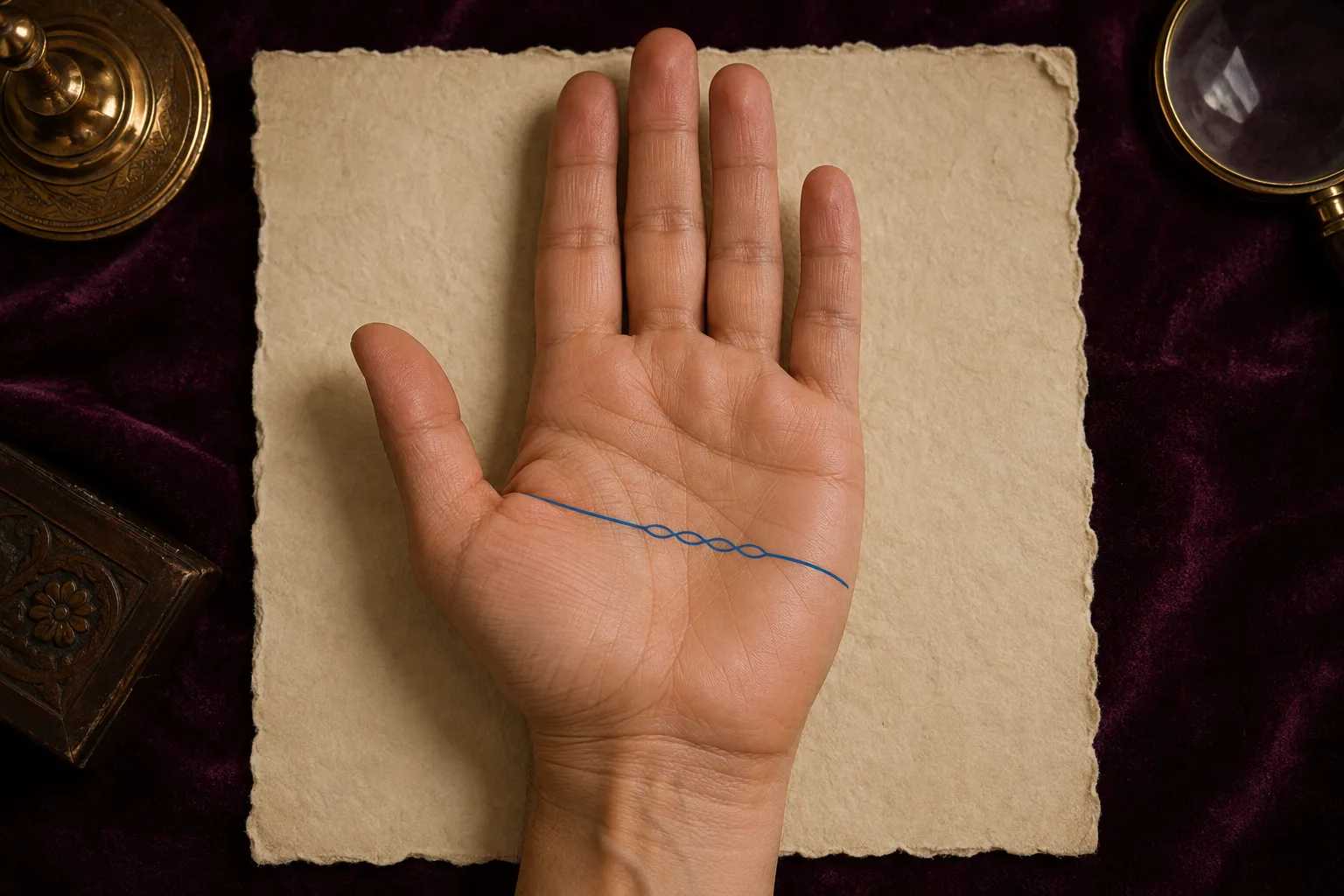
In traditional palmistry, a chained Head line is a middle-palm Head-line parent formed partly or largely from several small linked oval loops. The texture is associated with a changing rhythm of concentration, repeated reconsideration, or thought that moves through several small stages before reaching clarity. It does not mean low intelligence, poor mental health, a neurological condition, or inability to make decisions.
A chained Head line becomes personal only after the true thumb-side parent, repeated linked-loop geometry, affected span, straight or Moonward direction, clear sections, length, depth, island, crossing, faintness, break, fork and branch tests, Life-line start, thumb, fingers, Mars, Mercury, Fate, real decisions, and both palms are compared. A whole-hand reading can show how concentration, learning, judgment, communication, and follow-through work together.
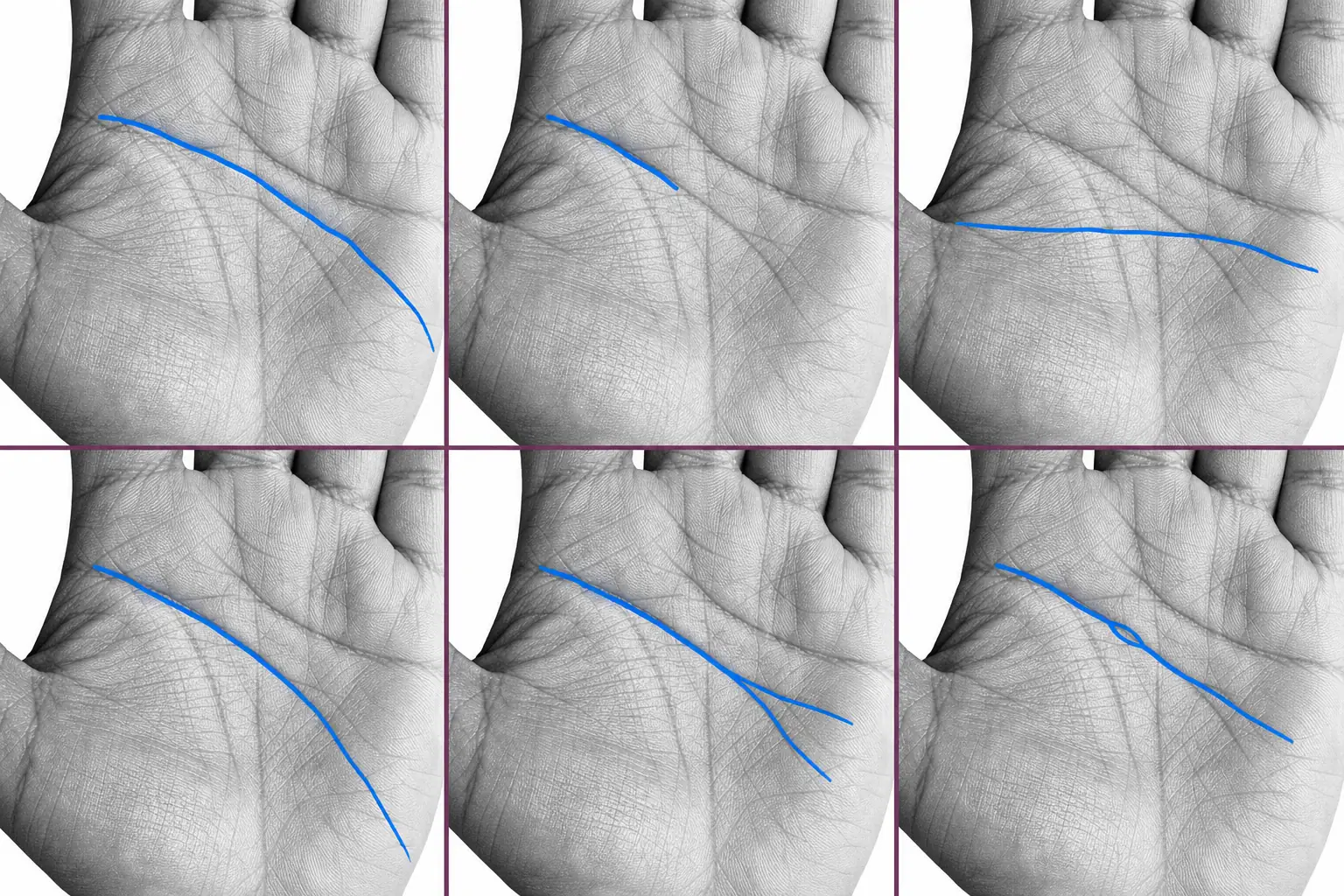
Confirm that the loops belong to the Head line and connect in sequence. One enclosed oval is an island; open skin is a break; multiple crossing creases do not make a chain; and a fork divides once without repeatedly rejoining. Then add the chained span, straight or Moonward direction, length, depth, clear sections, Life-line start, thumb, fingers, Mars, Mercury, Fate, real habits, and both palms.
Locate the Head-line parent
The Head line usually begins near the Life line between the thumb and index finger and crosses the middle palm below the Heart line. It may begin joined to Life, touch it briefly, or start separately. Trace the strongest coherent parent from that inner origin toward its own endpoint.
Chaining looks like two fine strands repeatedly separating and rejoining to create adjacent closed spaces. The loops may cover a short section or much of the line. Use neutral and side lighting to confirm that each oval closes and that the sequence remains attached to the true parent.
A chained Head line cannot diagnose the mind
Palmistry uses the texture as a symbolic description of processing rhythm. It cannot measure intelligence, attention, memory, anxiety, depression, neurological health, or any other clinical condition.
Use a ten-part chained-Head-line method
- Relax the hand. Avoid stretching the palm until fine strands disappear.
- Find the thumb-side origin. Confirm the parent begins beside or with the Life line.
- Trace the complete route. Follow it through the middle palm to its true endpoint.
- Find repeated closed loops. Look for adjacent ovals made by the parent dividing and rejoining.
- Measure the affected span. Record whether one section or most of the line is chained.
- Exclude a single island. One enclosed oval is a local marking, not a chain.
- Exclude other lookalikes. Check for crossings, feathering, forks, branches, and breaks.
- Record direction and clear sections. Note straightness or slope and compare line quality before and after.
- Add supporting features. Read the thumb, fingers, Mars, Mercury, Fate, Heart, and hand shape.
- Compare both palms and behavior. Test the traditional interpretation against real decisions, learning, and work.
| What you see | Geometry test | Classification |
|---|---|---|
| Several adjacent closed loops within one Head parent | The strands repeatedly divide and rejoin | Chained Head line |
| One isolated enclosed oval | The parent divides once and rejoins once | Island on the Head line |
| Open skin separates two related segments | No strand connects the pieces | Broken Head line |
| Fine unrelated creases cross the route | The spaces do not close in sequence | Crossings or crossbars |
| One parent divides into two terminal arms | The arms do not repeatedly rejoin | Forked Head line |
| The route is thin but remains single | No linked loops are visible | Faint Head line |
What a chained Head line traditionally means
Traditional palmistry reads chaining as variation in mental flow. Attention may move in short cycles, a question may be reviewed several times, or clarity may develop through successive adjustments instead of one uninterrupted process. The person may notice many small factors before settling on the main point.
This can support nuance, sensitivity to changing information, revision, and adaptive problem solving when the thumb and clear sections show follow-through. Under pressure, it may appear as scattered attention, repeated doubt, or difficulty keeping one plan steady. These are possibilities to compare with lived habits rather than labels to impose.
The general chained-lines guide owns the cross-line texture test. This page focuses on a chain located specifically on the Head line and how it interacts with thinking, learning, judgment, and decisions.
Straight and Moonward chains are different
Texture and direction are separate. A chained parent can remain broadly level toward Upper Mars or slope into the Moon area. Record the sustained route beneath the loops rather than treating every chained line as imaginative or every straight chain as purely practical.
| Chained route | Traditional synthesis | Useful question |
|---|---|---|
| Broadly straight | Changing focus within a practical or sequential process | Which checklist keeps the work moving? |
| Gently sloping | Variable rhythm with imagination and association | How do you test an intuitive connection? |
| Strongly Moonward | Many shifts within inward, visual, or narrative thought | What returns an idea to a usable form? |
| Clear terminal fork after chaining | A variable route settles into two final viewpoints | Which two options remain after review? |
Use the straight Head-line guide for a level Upper-Mars route and the Moon-sloping guide for sustained downward direction. Neither page replaces the chain observation.
Clear sections show how the rhythm changes
A clear route before the chain suggests more consistent focus entering a variable section. A strong line after the chain traditionally shifts the emphasis toward increasing organization or firmer judgment. If the whole route remains fine or chained, compare skin texture, thumb, fingers, Mars, and actual routines before drawing a broad conclusion.
A chain remains connected. A true break leaves open skin and a separate restart; see the broken Head-line guide. One larger oval is an island and should be read as a local formation rather than repeated texture.
Supporting features for a complete interpretation
The thumb adds will, logic, flexibility, and follow-through. A firm but flexible thumb can help changing thought become a finished choice. Longer fingers add detail and verification; shorter fingers can help compress many impressions into an overview. Upper Mars adds persistence when a task becomes difficult.
Mercury adds communication and application. The Fate line shows whether the changing mental rhythm connects with work and direction. Heart shows how feeling and values enter judgment. The Head line's joined or separated Life-line start adds preparation or independent action without changing the chain itself.
Translate the texture into a practical experiment
Ask what captures attention, which step loses it, whether written structure helps, how many reviews improve a choice, and what deadline turns reconsideration into action. Real answers give the traditional symbol useful context.
What if only one palm has a chained Head line?
Compare matched photographs and identify the active hand by actual use. Palmists often read the less-used hand as background disposition and the active hand as developed expression. This is a reading convention rather than a scientific rule.
More chaining on the active hand may suggest that current experience has made processing more layered or variable. A clearer active-hand line may suggest stronger routines or more consistent focus. First rule out dry skin, hand tension, image blur, and crossing creases.
Worked examples
Example 1: short chained section with a clear line after it
The chain suggests a local period or area of repeated reconsideration, while the clear continuation emphasizes renewed organization. The position and real timeline decide whether that comparison fits.
Example 2: chain across most of a straight route with a flexible thumb
The line adds many small processing shifts within a practical direction, while the thumb adds adaptability and follow-through. Checklists or staged decisions may suit the combination.
Example 3: apparent chain made by crossing creases
Side light reveals one continuous Head parent crossed by unrelated lines. Because no sequence of closed loops exists, classify the pattern as crossings rather than chaining.
Example 4: one large oval on a Moonward route
One enclosed shape is an island, not a chain. Read the local island and the imaginative direction separately instead of applying a whole-line variable-rhythm label.
Example 5: clearer active-hand Head line
Matched images confirm fewer loops on the active palm. A traditional reader may explore whether training, work systems, or experience helped attention become more organized.
Photo checklist
- Capture both palms from the same height and angle.
- Include the thumb-side origin and full outer edge.
- Use bright indirect light plus one gentle side-light image.
- Relax the palm without pulling the fingers backward.
- Confirm that every loop closes and connects to the Head parent.
- Record the chained span, direction, and clear sections separately.
- Check for one island, crossings, a break, fork, or faintness.
- Avoid glare, filters, smoothing, and source-photo annotations.
Frequently asked questions
Does a chained Head line mean low intelligence?
No. Palm creases cannot measure intelligence, memory, education, creativity, or potential. The traditional reading concerns processing rhythm, not ability.
Does it show anxiety or a neurological condition?
No. A palm line cannot diagnose mental-health, attention, or neurological conditions. Use qualified clinical care for symptoms or health concerns.
What is the difference between a chain and an island?
A chain contains several adjacent linked loops. An island is one enclosed oval where the parent divides and rejoins once. The island guide explains the single-mark test.
Can only part of the Head line be chained?
Yes. Record the exact affected section and compare the clear route before and after it. Do not apply one local texture automatically to the complete thinking pattern.
Does direction still matter?
Yes. A straight chained route and a Moonward chained route combine different directional themes with the same linked texture.
Which hand should I read?
Read both. Compare the same parent, loop pattern, direction, clear sections, support features, and actual habits, then use handedness as context.
The complete answer
A chained Head line contains several small connected oval loops within the middle-palm Head-line parent. Traditional palmistry associates the texture with a changing mental rhythm, repeated reconsideration, or concentration that moves through small stages, not low intelligence or a medical condition. Verify repeated closed loops against one island, crossings, faintness, a break, fork, and branch. Then add the chained span, straight or Moonward direction, length, depth, clear sections, Life-line start, thumb, fingers, Mars, Mercury, Fate, Heart, hand shape, real decisions, and both palms. A Full Palm Reading maps all the important features across both hands and combines them into a holistic reading focused on your questions about concentration, learning, judgment, communication, work style, follow-through, and how your mental approach is developing.
A Full Palm Reading
Ask how your chained Head line fits your complete thinking pattern
Your reading maps the true Head-line parent, repeated linked-loop geometry, affected span, straight or Moonward direction, clear sections, length, depth, island, crossing, faintness, break, fork and branch tests, Life-line start, thumb, fingers, Mars, Mercury, Fate, real decisions, and both palms, then adds every other important line, mount, finger, marking, shape, and texture into one holistic reading focused on your questions.
Your Full Palm Reading maps all the important features—hand shape, skin texture, thumb, fingers, mounts, major and minor lines, markings, and the differences between both palms—and brings them together in a holistic reading focused on your questions.