
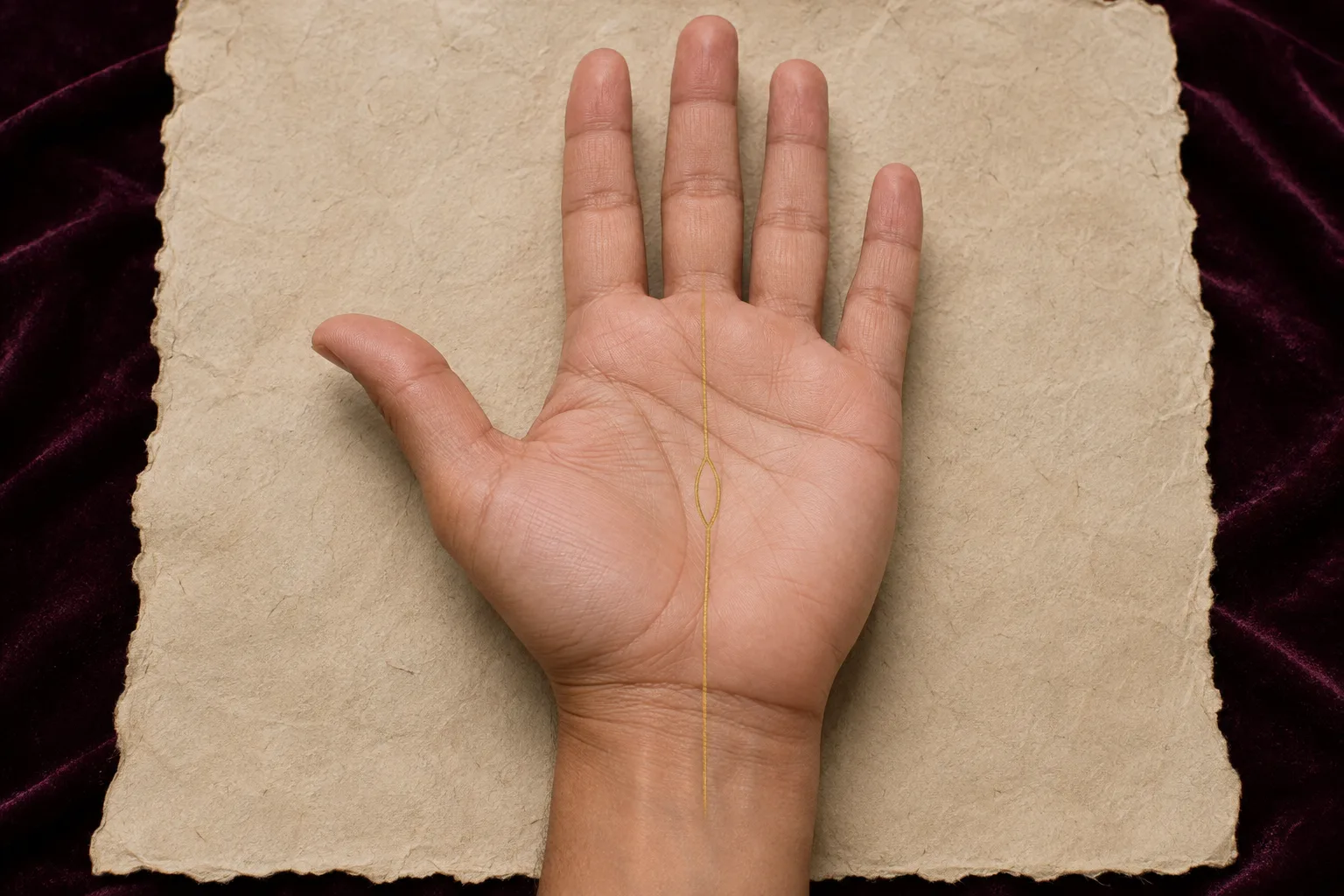
An island on the Fate line is one closed oval formed when a vertical Saturn-bound Fate line divides into two strands and reunites. Traditional palmistry reads it as a bounded period or subject of divided career direction, role conflict, delayed progress, uncertain identity, or competing responsibilities. It does not prove failure, unemployment, poverty, or permanent bad luck.
One Fate-line island becomes personal only after the true Saturn-bound parent, origin, single closed split-and-reunion geometry, position around Head and Heart landmarks, proportional size, depth, alignment, clarity before and after, double-route, break, overlap, fork, crossing, grille and Sun-line tests, Head, Heart, Sun, Jupiter, Saturn, Mercury, timing, real work, and both palms are compared. A whole-hand reading can show what divides direction and what becomes clearer afterward.
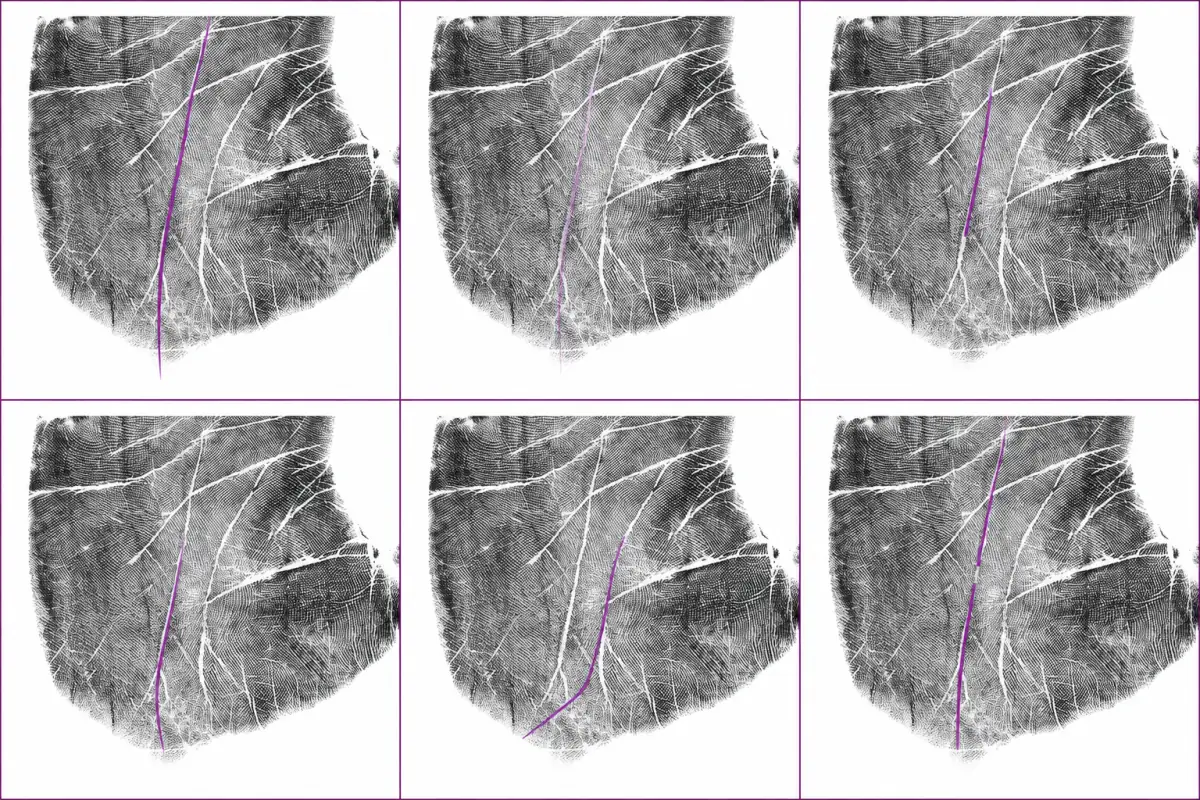
The complete route matters more than the oval alone. Verify where the Fate line begins, where it is going, where the island opens and closes, and whether the outgoing route becomes clearer, weaker, shifted, broken, forked, or redirected toward another mount. A clear continuation above one island tells a very different story from a line that stops inside it.
An island divides the route for a section; it does not end the route
The incoming Fate line shows the direction or responsibility entering the period. The two sides show competing pulls or a less unified path. The reunion shows what direction becomes available afterward. Read the island as a chapter within work and purpose, not a verdict on the complete career.
How to identify an island on the Fate line
The Fate line, also called the destiny or career line, is a vertical route that travels toward the Mount of Saturn below the middle finger. It may begin at the wrist, Moon, Life line, Venus, or the middle palm. Not every vertical crease is Fate. Trace the candidate upward to Saturn before naming its island.
Use this ten-part island-on-Fate-line method:
- Confirm one vertical parent genuinely travels toward Saturn.
- Trace its lower origin rather than assuming it starts at the wrist.
- Find where the parent visibly divides into two strands.
- Confirm the strands enclose one closed space.
- Find their reunion into one outgoing Fate route.
- Locate the island below Head, at Head, between Head and Heart, at Heart, or above Heart.
- Compare depth, alignment, and clarity before and after it.
- Separate crossings, overlap, break, fork, grille, Sun line, and double Fate routes.
- Add Head, Heart, Sun, Jupiter, Saturn, Mercury, and real work context.
- Compare the same route and timing landmarks on both palms.
The complete Fate line guide maps origins, destinations, depth, breaks, branches, and timing. This page owns one exact formation: a single closed island within a verified Saturn-bound parent.
Island versus double Fate line, break, overlap, fork, and crossing
Central palms contain many vertical and diagonal creases. Two nearby lines can appear to form an island even when they never share a parent. Use side light and trace each route from both directions.
| Formation | Geometry | Reading boundary |
|---|---|---|
| One Fate-line island | One parent splits, encloses one space, and reunites | Read one bounded divided section |
| Double Fate line | Two independent Saturn-bound routes remain separate | Compare two responsibilities or direction channels |
| Break | Empty skin separates related vertical segments | Read interruption and restart |
| Overlap | Old and new segments run beside each other briefly | Read a gradual handover |
| Fork | One parent divides into arms that do not rejoin | Read both destinations |
| Crossed-line eye | Independent strokes enclose space around an intact parent | Read the crossings separately |
| Grille | Several vertical and horizontal strokes form multiple cells | Read a broader mesh rather than one island |
Use the double Fate line guide when two routes have their own origins and never reunite. Use the broken Fate line guide when genuine empty skin separates aligned or shifted sections.
What a Fate-line island traditionally means for career
The Fate line is traditionally associated with work direction, responsibility, structure, identity, and the outside conditions shaping a path. Its temporary split can be explored as two roles competing for time, a career direction under review, work and family pulling against each other, delayed progress, uncertain authority, a business carrying conflicting demands, or a period when the old role no longer fits but the new one is not established.
The island cannot identify the event or outcome. The same shape can fit a student choosing a field, an employee balancing two teams, a founder managing cash and growth, a caregiver reducing work, a professional retraining, or someone deciding whether purpose matters more than security. Ask what the person is actually navigating.
Proportional size refines emphasis. A small narrow island suggests a concentrated issue. A long island broadens the divided interval. A wide island can show two clearly separated routes through the same stage. If one side is deeper, one role or direction may dominate. If both sides are faint, the path may feel less defined until the reunion.
Island below, at, or above the Head and Heart lines
The Head and Heart crossings are the most useful Fate-line landmarks. Confirm each crossing before applying a timing range; a line that merely ends near Head is not the same as one that passes through it.
| Island position | Traditional focus | What to compare |
|---|---|---|
| Lower palm below Head | Early structure, education, family conditions, first work direction, or starting responsibilities | Origin at wrist, Moon, Life, or Venus; Life-line support |
| At the Head-line crossing | A decision, training choice, plan, or judgment divides direction | Head-line depth, branches, restart, and real decisions |
| Between Head and Heart | Established work, identity, status, or responsibility under competing demands | Line strength, Sun support, Saturn, known career stage |
| At the Heart-line crossing | Values, relationships, family, or emotional priorities influence direction | Heart quality, Venus, relationship context, outgoing Fate route |
| Above Heart near Saturn | Later responsibility, vocation, legacy, or long-term role definition | Saturn mount, Jupiter and Sun branches, line endpoint |
An island touching Head does not automatically mean a bad decision. It shows that thought and direction share the same zone. An island touching Heart does not predict a relationship ending a career. It invites comparison between priorities, attachment, values, and responsibility.
Why the Fate line before and after the island matters
The route above the reunion often answers whether direction becomes clearer. A deeper outgoing line traditionally suggests renewed structure, commitment, or a more suitable role. A shifted continuation may show that the person resumes on different terms. A route that branches toward Jupiter, Apollo, or Mercury adds ambition, recognition, or communication, depending on its verified destination.
- Clear before, clear after: a bounded period of role conflict within an otherwise steady direction.
- Faint before, stronger after: purpose or responsibility becomes clearer after exploration.
- Strong before, faint after: the earlier structure gives way to a more open or tentative phase.
- Shifted continuation: direction resumes through a different role, environment, or identity.
- Island followed by a Sun branch: divided direction resolves before visibility or fulfillment gains emphasis.
- Island followed by a break: pressure and interruption are distinct stages.
- Island followed by a fork: one divided phase closes before two continuing destinations emerge.
What Head, Heart, Sun, Jupiter, and Saturn add
The Head line shows the person's decision style. A clear straight Head line can add practical planning; a Moonward line can add imagination and work with people, stories, design, or unfamiliar contexts. The Heart line shows values and emotional priorities. When either carries its own island or break near the Fate island, read two separate conditions before combining them.
The Sun line shows recognition, fulfillment, reputation, and creative visibility. A clear Sun route during a Fate island can mean that satisfaction or audience response remains available while formal direction is uncertain. Jupiter adds ambition and leadership; Saturn adds responsibility and endurance; Mercury adds communication, trade, analysis, or advisory work.
The origin matters too. A Moon-origin Fate line can connect the divided section with clients, public response, travel, or environment. A Life-origin route can connect it with self-development or family foundation. The career palm reading guide brings Fate, Sun, Head, Mercury, Jupiter, hand shape, and real skills together.
How to estimate timing on a Fate-line island
Fate-line timing is approximate. A common method treats the wrist end as earlier, the Head-line crossing as a broad mid-adult landmark, and the Heart-line crossing as a later landmark. Exact ages vary with hand proportions and the system used. Long islands need a range from opening to reunion.
- Mark where the island opens and where it closes.
- Locate both points relative to Head and Heart crossings.
- Check the complete Fate-line origin and destination.
- Compare nearby Head, Heart, Sun, Life, and travel-line changes.
- Calibrate with a known study, job, business, caregiving, or identity shift.
- Repeat on the other palm and report a broad range.
The palmistry timing guide explains proportional landmarks. The island cannot supply the exact date of a promotion, resignation, layoff, business result, or income change.
What a Fate-line island means in one hand or both
Compare both palms under matched light and state hand dominance. A common modern convention treats the less-active hand as background and the active hand as current development. Use that convention to frame change, then test it against the person's actual work and responsibilities.
| Two-hand pattern | Traditional comparison | Useful question |
|---|---|---|
| Similar island at a similar level in both | The divided direction repeats strongly | Which long-running role conflict fits the range? |
| Island only in the active hand | Present experience may have formed the pressure | What current work or duty divides direction? |
| Island only in the less-active hand | An underlying uncertainty may be handled more clearly now | What choice or skill strengthened the active route? |
| Shorter island in the active hand | The divided period may be more contained in current expression | What structure or boundary reduced it? |
| Clearer outgoing active Fate line | Direction or responsibility may be consolidating | Which role, commitment, or decision became clearer? |
Five worked examples
1. Central island with a stronger continuation
One island sits between Head and Heart, and the route above it is deeper. This can fit an established-career period of divided responsibility followed by clearer authority or commitment. Sun and Jupiter show whether visibility or leadership grows with it.
2. Island at the Head-line crossing
The Fate parent splits just before Head and reunites above it. A training choice, business decision, or change of plan may fit the traditional theme. The Head line and real decision history explain the issue; the palm cannot label the choice correct or wrong.
3. Island at Heart with a shifted restart
The route divides across the Heart crossing and resumes slightly toward Apollo. Values, relationships, or family priorities may influence direction, while the Apollo shift adds satisfaction or recognition. Trace the new route to confirm it remains Fate rather than becoming Sun.
4. Two Fate lines mistaken for one island
Two vertical routes run beside each other through the middle palm but have different origins and never join. This is a double Fate pattern, not an island. Compare both channels instead of inventing a reunion.
5. Crossing texture mistaken for an island
Fine diagonal lines form an eye around an intact Fate groove. Side light shows the central parent never splits. The vertical direction remains continuous, while the crossings may describe temporary demands around it.
Photo checklist for a Fate-line island
- Photograph both palms from fingertips through wrists.
- Keep the center, Head line, Heart line, and Saturn mount visible.
- Use bright indirect light plus one gentle side-lit close-up.
- Relax the palm without stretching the fingers backward.
- Trace the Fate line from its real origin to Saturn.
- Confirm one incoming route, two island sides, one reunion, and one outgoing route.
- Separate Sun, Mercury, influence, and crossing lines.
- Keep an unmarked original and annotate only a duplicate.
- State hand dominance and the career, purpose, role, or timing question.
Frequently asked questions
Does a Fate-line island mean career failure?
No. It traditionally marks divided direction, pressure, delay, or competing responsibility within a section. The outgoing line, support features, real choices, and both palms show what happens next.
Does it mean unemployment or poverty?
No. A palm line cannot predict employment status, income, debt, or poverty. The symbolic reading concerns structure and direction, not a guaranteed financial outcome.
What if the island is between the Head and Heart lines?
This central section is often read through established work, identity, status, and responsibility. Compare the line's depth, Sun support, known career stage, and the clarity after the island.
What if it touches the Head line?
Decision-making, study, planning, or judgment may be part of the divided direction. The Head line and actual decision explain the connection.
What if the Fate line gets stronger after the island?
A deeper continuation traditionally suggests renewed structure, responsibility, or clearer purpose after uncertainty. Its destination and supporting Sun, Jupiter, and Head features show how that clarity is expressed.
Can the island show an exact career-change age?
No. Use the opening and reunion, Head and Heart landmarks, calibration, and both hands for a broad range.
Can a Fate-line island change over time?
Fine crease visibility changes with lighting, skin condition, hand position, and image quality. Compare matched photographs before deciding that the formation has changed.
The complete answer
An island on the Fate line is one closed oval formed when a verified Saturn-bound vertical parent divides and reunites. Traditional palmistry associates it with a bounded period or theme of divided career direction, uncertain identity, delayed progress, role conflict, or competing responsibility, not permanent failure, unemployment, poverty, or bad luck. Verify the origin, Saturn destination, closed split-and-reunion geometry, and outgoing route against a double Fate line, break, overlap, fork, crossed-line eye, grille, Sun line, or random crease. Then add its location below Head, at Head, between Head and Heart, at Heart, or above Heart; proportional size; depth and clarity before and after; shifted continuation; Head; Heart; Sun; Jupiter; Saturn; Mercury; broad timing; real work; and both palms. A Full Palm Reading maps all the important features across both hands and combines them into a holistic reading focused on your questions about career, purpose, responsibility, recognition, decisions, timing, and the direction that becomes clearer after a divided phase.
A Full Palm Reading
Ask how your Fate-line island fits your complete career pattern
Your reading maps the true Saturn-bound Fate parent, origin, one closed split-and-reunion island, position around Head and Heart landmarks, proportional size, depth, alignment, clarity before and after, double-route, break, overlap, fork, crossing, grille and Sun-line tests, Head, Heart, Sun, Jupiter, Saturn, Mercury, timing, real work, and both palms, then adds every other important line, mount, finger, marking, shape, and texture into one holistic reading focused on your questions.
Your Full Palm Reading maps all the important features—hand shape, skin texture, thumb, fingers, mounts, major and minor lines, markings, and the differences between both palms—and brings them together in a holistic reading focused on your questions.