
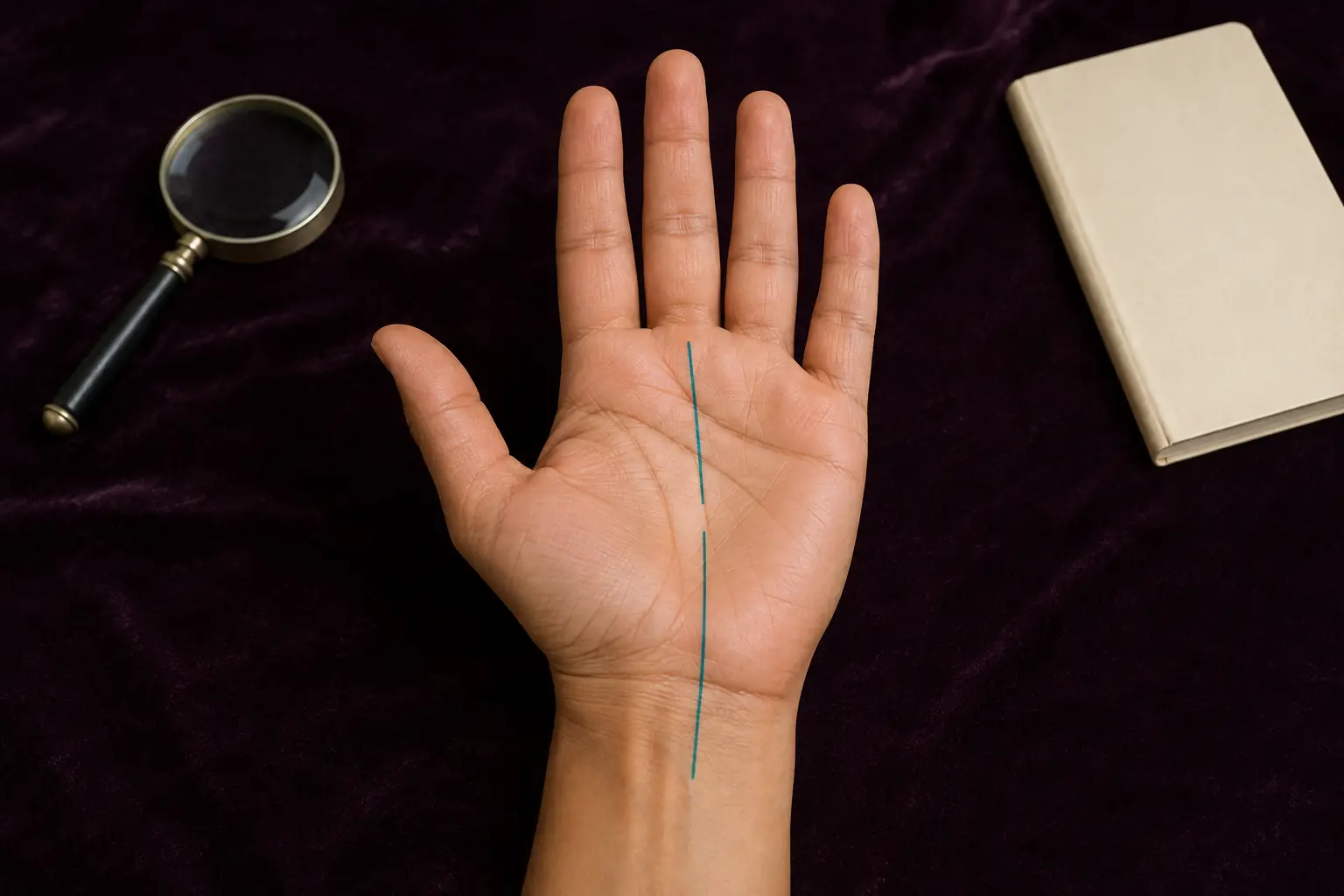
In traditional palmistry, a broken Fate line is an area of genuinely empty skin between two sections that belong to the same central route toward the Mount of Saturn below the middle finger. The gap is usually read as a change in work, responsibility, structure, purpose, location, or the direction through which a person organizes daily life. A visible upper continuation means the story resumes. Its strength, origin, and alignment show whether the later chapter returns to a familiar path, develops gradually, or starts from a different source.
A Fate-line break becomes meaningful only after the lower Saturn-bound parent, true empty gap, upper restart, alignment or displacement, strength before and after, overlap and faintness tests, endpoint and late-start tests, broad timing, Sun, Head, Heart, Mercury, Jupiter, support signs, and both palms are compared. A whole-hand reading can show how work, responsibility, structure, recognition, change, and direction work together.
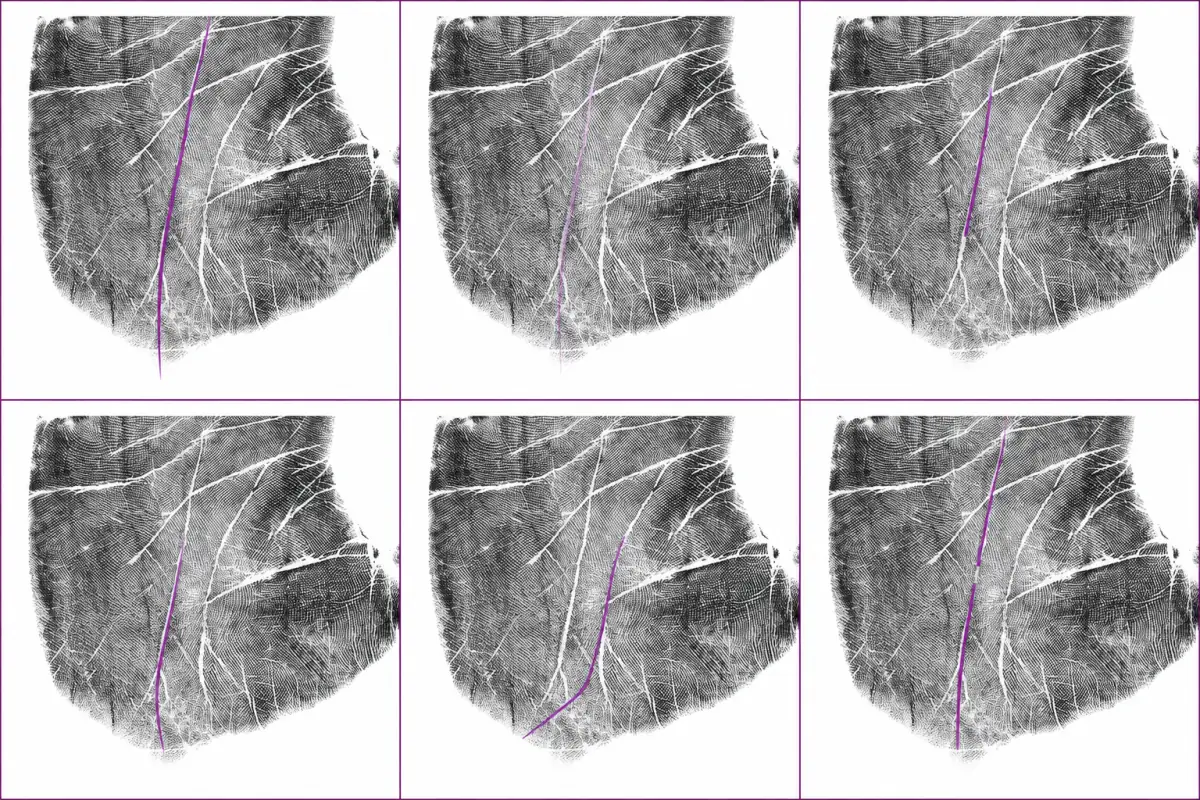
Use a ten-part broken-Fate-line method: locate Saturn, trace the lower parent upward, confirm empty skin, trace the upper continuation down, verify both sections are Saturn-bound, exclude faintness and a simple ending, test for overlap or two independent lines, compare strength and displacement after the gap, estimate a broad zone using Head and Heart crossings, then add the Sun line, career features, both palms, and real history. A gap does not automatically mean job loss, failure, poverty, or a directionless life.
The restart carries the practical answer
A Fate-line break shows discontinuity in the traditional map, but the upper segment describes what follows. A stronger restart, shifted route, overlap, supporting Sun line, or clearer active-hand pattern can turn the reading toward deliberate redirection, retraining, new responsibility, or a more suitable career structure.
Where the Fate line is and how a break looks
The Fate line is a vertical or rising line directed toward Saturn below the middle finger. It may start near the wrist, from the Mount of Moon on the outer lower palm, from the Life line, or in the middle of the hand. Some palms have a strong route, several partial routes, or no clear Fate line. Absence is normal and does not mean a person lacks purpose.
Begin at the lower candidate and trace upward without jumping across blank skin. At the suspected gap, record exactly where the groove ends. Then start below the middle finger and trace the upper candidate downward. For the pieces to form one broken Fate route, both should occupy a compatible central corridor and remain directed toward Saturn. A lower central line and an upper Apollo-bound Sun line can appear aligned in a cropped photograph, so destination is decisive.
| What you see | Decisive visual test | Best classification |
|---|---|---|
| Two Saturn-bound segments with empty skin between | No groove survives through the gap | Clean break and restart |
| Upper segment begins before the lower one ends | The routes overlap beside each other briefly | Overlapping transition |
| Shallow groove survives through the pale area | The parent remains traceable in side light | Faint or weakened Fate line |
| Lower route stops with no upper candidate | No later Saturn-bound continuation exists | Ending Fate line |
| Upper route starts with no related lower segment | No earlier parent points into the start | Late-starting Fate line |
| Two independent Saturn-bound routes remain separate | Each has its own origin and duration | Double Fate line |
| One route reaches Apollo below the ring finger | Destination is not Saturn | Sun line or Fate-to-Sun branch |
How to verify that the Fate-line gap is real
Use one full-palm photograph in bright indirect light and one with gentle side light. Keep the wrist, middle finger, Head line, and Heart line visible. A close crop can hide the destination and encourage the reader to join unrelated fragments. Flash glare can erase a fine connection, while strong shadows can create a false line.
- Locate Saturn directly below the middle finger.
- Trace the lower candidate from its origin toward the center.
- Mark the point where the groove visibly stops.
- Inspect the gap for a faint bridge, island edge, or crossing crease.
- Trace the upper candidate downward from Saturn.
- Confirm both segments occupy one plausible Fate-line corridor.
- Check whether they align, overlap, or restart to one side.
- Compare depth and clarity before and after the interruption.
- Record the gap relative to the Head and Heart lines.
- Repeat the same trace on the other palm.
The general broken-lines guide explains gaps, islands, overlaps, shifted continuations, squares, and support lines across any parent. This page owns the Fate-specific question: how direction, work structure, duty, and later responsibility change around an interrupted Saturn route.
What a broken Fate line traditionally means
Traditional palmists associate the Fate line with the structures that organize a person's path: work, vocation, responsibilities, long-term commitments, social role, and the effect of circumstances on direction. A break can correspond with leaving a job, changing fields, retraining, relocating for work, taking on care duties, losing or gaining independence, pausing a career, changing business models, or questioning an old definition of success.
The palm cannot select the event or decide whether it was voluntary. A clean gap may describe a decisive interruption, but the same geometry could fit redundancy, a chosen sabbatical, graduation, migration, parenthood, retirement from one field, or a move into self-employment. Real dates and context tell the reader which story is relevant.
| Break pattern | Balanced traditional direction | Useful question |
|---|---|---|
| Narrow aligned gap | A defined interruption followed by a familiar direction | What paused without changing the overall destination? |
| Wide gap | A longer or more substantial reorganization | What separated the earlier role from the later one? |
| Overlapping segments | A handover, parallel preparation, or transition with continuity | Did training or a second role begin before the first ended? |
| Restart shifted toward Jupiter | Leadership, advancement, autonomy, or authority may gain weight | Did the later path require greater initiative? |
| Restart shifted toward Apollo | Recognition, presentation, creative work, or public contribution may gain weight | Did visibility or satisfaction become more important? |
| Restart from Moon | Clients, audiences, travel, public contact, or outside influence may shape direction | Did the new chapter depend on people or places beyond the familiar circle? |
| Restart from the Life line | Personal effort, family foundations, or a self-built direction may become central | What responsibility or independent choice created the later route? |
Read the upper restart before judging the outcome
Compare the upper and lower segments under the same light. A deeper upper route is traditionally read as clearer direction, firmer responsibility, or stronger organization after the transition. An aligned restart of similar quality suggests return to a recognizable path. A fine or fragmented restart may show experimentation, several temporary roles, or direction that consolidates gradually.
Displacement matters only after destination is verified. A restart slightly to one side can represent a changed source of motivation, employer, field, or working structure. Follow the entire upper route: a line leaning to Jupiter, Apollo, or Mercury should be classified by where it actually ends. Do not call every shifted vertical a Fate continuation merely because it begins near the gap.
Sometimes the upper section begins at the Head line. That can connect the later path with a deliberate decision, training, planning, or changed belief. A route beginning at the Heart line may emphasize values, relationships, family, balance, or fulfillment in the later chapter. These are origins of a new route, and the Fate-line endpoint guide helps distinguish a true stop from a break with continuation.
What the Sun, Head, Heart, and supporting lines add
The Sun line shows whether recognition, expression, appreciation, or satisfaction continues while the Fate line changes. A steady Sun line beside a broken Fate line can mean a talent, audience, or source of fulfillment remains available even when work structure shifts. A Sun line that strengthens after the break may support growing visibility in the later route. It does not guarantee fame or income.
The Head line adds judgment, learning, strategy, and decision style. A Fate interruption around the Head-line level, followed by a strong upper restart, often invites questions about retraining, a major decision, or a new method of working. The Heart line adds values, relationships, and emotional priorities. If both Fate and Heart change at a similar level, personal commitments may be part of the redirection.
A close parallel sister line, an overlap, a bridge, or a square around the gap is traditionally read as support through change. Verify the shape rather than assuming a random crossing is protective. A second independent Saturn-bound route may be a double Fate line, suggesting two sustained responsibilities rather than one repaired gap.
For a career outcome, use the complete career palm-reading map. It combines Fate and Sun with Head, Mercury, Jupiter, Saturn, thumb, fingers, hand shape, timing, and both palms. This keeps one line from carrying the entire conclusion about work, business, promotion, or money.
How to estimate timing on a broken Fate line
The Fate line offers useful landmarks, but timing remains approximate. Traditional scales often treat the Head-line crossing as a broad adult midpoint and the Heart-line crossing as a later landmark. A gap below Head belongs to an earlier zone; one near Head sits around a decision-heavy middle zone; one between Head and Heart is later; and one near or above Heart is later still.
- Mark where the lower segment ends.
- Mark where the upper segment becomes independently clear.
- Record both points relative to the Head and Heart crossings.
- Use separate stop and restart ranges when the gap is wide.
- Compare nearby Sun, Head, Heart, travel, or influence changes.
- Calibrate against a known job, course, move, business, caregiving, or retirement event.
- Repeat the estimate on the other palm and keep the range broad.
The timing guide explains landmarks and proportional sections. A Fate-line break cannot reliably predict the exact date of job loss, promotion, career change, business success, or retirement.
What a broken Fate line means in both palms
Compare matching photographs of both hands and state hand dominance. A common modern method treats the less-active palm as a background pattern and the active palm as current development. This is a working convention rather than a fixed law or a gender rule.
| Two-hand pattern | Traditional comparison | Useful focus |
|---|---|---|
| Similar break at a similar level in both palms | The direction-change theme repeats strongly | Compare origins, restart quality, and known events |
| Break only in the dominant hand | Current choices or circumstances may have altered the path | Present work, duties, location, and decisions |
| Break only in the non-dominant hand | An underlying interruption may be organized more continuously now | Which choices or structures strengthened the active route? |
| Restart stronger in the dominant hand | Later direction may be consolidating through present effort | Training, responsibility, support, and follow-through |
| Restart shifts differently in each palm | Available tendencies and current path may emphasize different goals | Use destinations and lived priorities to resolve the contrast |
Differences between the palms can be more informative than the break alone. They show whether the visible path becomes clearer, weaker, more independent, or redirected in current life.
Five worked examples
1. Aligned restart above the Head line
The lower Fate route reaches the Head-line area, leaves a narrow empty gap, and resumes above with equal depth toward Saturn. The Sun line remains steady. This may describe a decision, course, or work pause followed by return to a familiar field, with recognition or satisfaction continuing through the transition.
2. Stronger restart shifted toward Jupiter
A central lower route ends below Head, while a deeper upper route begins slightly toward the index-finger side and still reaches Saturn. Jupiter is balanced and a branch rises from the Head line. The later chapter may emphasize leadership, autonomy, promotion, or responsibility developed through deliberate planning.
3. Overlap during a career handover
The old Fate segment continues faintly while a new parallel section begins beside it, and the two overlap before one becomes dominant. This supports gradual transition: training while employed, a side business becoming primary, or duties passing from one structure to another.
4. Faintness mistaken for a break
Overhead light makes the middle route disappear, but side light shows a shallow connection. The Fate line weakens and recovers instead of breaking. Read reduced emphasis, uncertainty, or a less structured period, then compare the active hand and actual work history.
5. Sun line mistaken for a Fate restart
A lower central Fate line ends near Head, while an upper vertical line appears to continue it but reaches Apollo below the ring finger. The upper route is a Sun line. The combination may link a change in formal direction with later expression or recognition, but it is not one broken Fate parent.
Photo checklist for a Fate-line break
- Photograph both palms from fingertips through wrists.
- Keep the middle-finger base and Saturn mount visible.
- Use bright indirect light without flash glare.
- Add a gentle side-lit image to reveal faint bridges and overlaps.
- Take a close-up centered on the gap, Head line, and Heart line.
- Trace the lower origin and upper destination before joining fragments.
- Check whether an upper line ends below Saturn, Apollo, Jupiter, or Mercury.
- Do not sharpen, smooth, trace, or raise contrast on the original.
- Keep one unmarked image and annotate only a duplicate.
- State hand dominance and the career, business, responsibility, or timing question.
Frequently asked questions
Does a broken Fate line mean job loss?
It can correspond with a change in work structure, but it does not predict job loss. A break may fit retraining, relocation, a chosen pause, caregiving, self-employment, retirement from one field, or a new role. The restart and real history decide the useful interpretation.
Is a broken Fate line bad?
No. It marks discontinuity in the traditional direction map. A strong restart, overlap, support line, clearer active hand, or supportive Sun and Head features can emphasize adaptation and a better-organized later path.
What if the line is stronger after the break?
A deeper upper continuation is traditionally read as clearer direction, greater responsibility, or a path that consolidates after change. Trace its origin and destination and compare what became more structured in real life.
What if the restart is shifted sideways?
Displacement can suggest a changed source, role, environment, or goal. Follow the route to its actual mount before interpreting it. A line reaching Apollo or Jupiter may belong to another system or add a distinct emphasis.
Is a gap at the Head line different?
A break around the Head-line level traditionally connects direction change with decisions, training, planning, or beliefs. First distinguish a stop at Head from a true gap with an upper Saturn-bound continuation.
Can a broken Fate line show exact career timing?
No. Head and Heart crossings provide broad landmarks. Use known events and both palms to calibrate a range rather than predicting an exact resignation, offer, promotion, or business launch date.
What if only one hand has the break?
Compare background pattern with current development. The active palm may show a change created through current circumstances, or it may show stronger continuity than the less-active hand. The difference belongs in the reading.
Can the Fate line change over time?
Fine crease visibility can vary with light, skin condition, hand position, and longer-term use. Keep matched photographs before deciding that a new gap or restart has appeared.
The complete answer
A broken Fate line is genuinely empty skin between two related Saturn-bound sections of the central vertical route. Traditional palmistry reads it as a transition in work, responsibility, structure, purpose, location, or personal direction. Verify the lower parent and upper continuation, distinguish the gap from faintness, an ending, late start, overlap, double Fate line, or Sun line, then compare the restart's strength, displacement, origin, and destination. Add the Head, Heart, Sun, Mercury and Jupiter features, support signs, broad timing, real history, and both palms. A Full Palm Reading maps all the important features across both hands and combines them into a holistic reading focused on your questions about career, business, responsibility, money, recognition, decisions, change, timing, and the direction that develops after the gap.
A Full Palm Reading
Ask what changes across your Fate-line gap
Your reading maps the lower Saturn-bound parent, true empty gap, upper restart, alignment or displacement, strength before and after, overlap and faintness tests, endpoint and late-start tests, broad timing, Sun, Head, Heart, Mercury, Jupiter, support signs, and both palms, then adds every other important line, mount, finger, marking, shape, and texture into one holistic reading focused on your questions.
Your Full Palm Reading maps all the important features—hand shape, skin texture, thumb, fingers, mounts, major and minor lines, markings, and the differences between both palms—and brings them together in a holistic reading focused on your questions.