
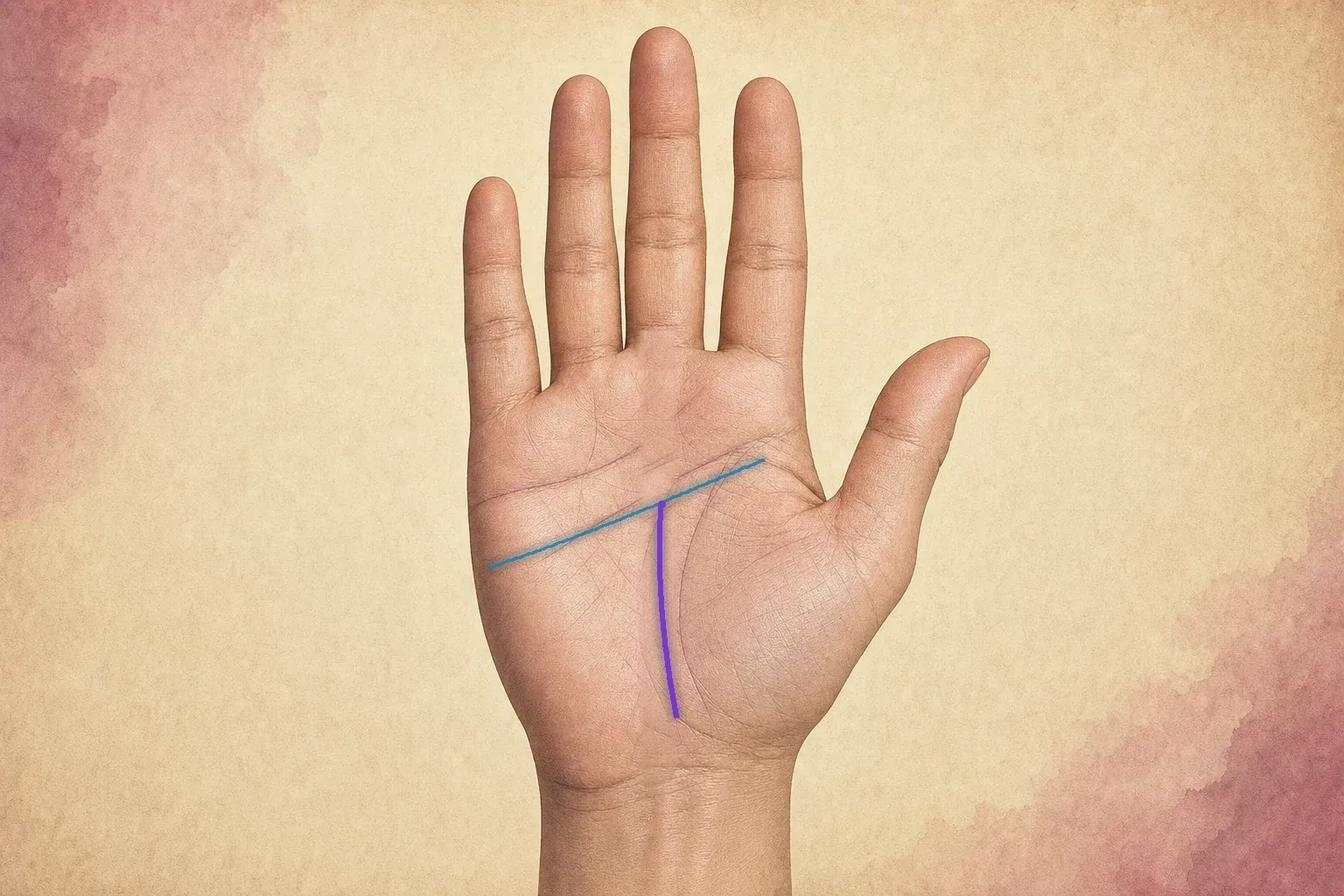
In traditional palmistry, a fate line that ends at the head line suggests an established direction reaches a decisive mental boundary. A choice, change of belief, education, strategy, or judgment may redirect the path around the broad head-line period. It does not mean work, income, purpose, or success must stop.
A fate-line stop at the head line becomes meaningful only after the parent route, exact junction, endpoint quality, faint continuation, gap, shifted restart, later destinations, supporting career features, timing, and both hands are compared. A whole-hand reading can show how decisions, training, strategy, relocation, recognition, and changing responsibilities reshape direction.
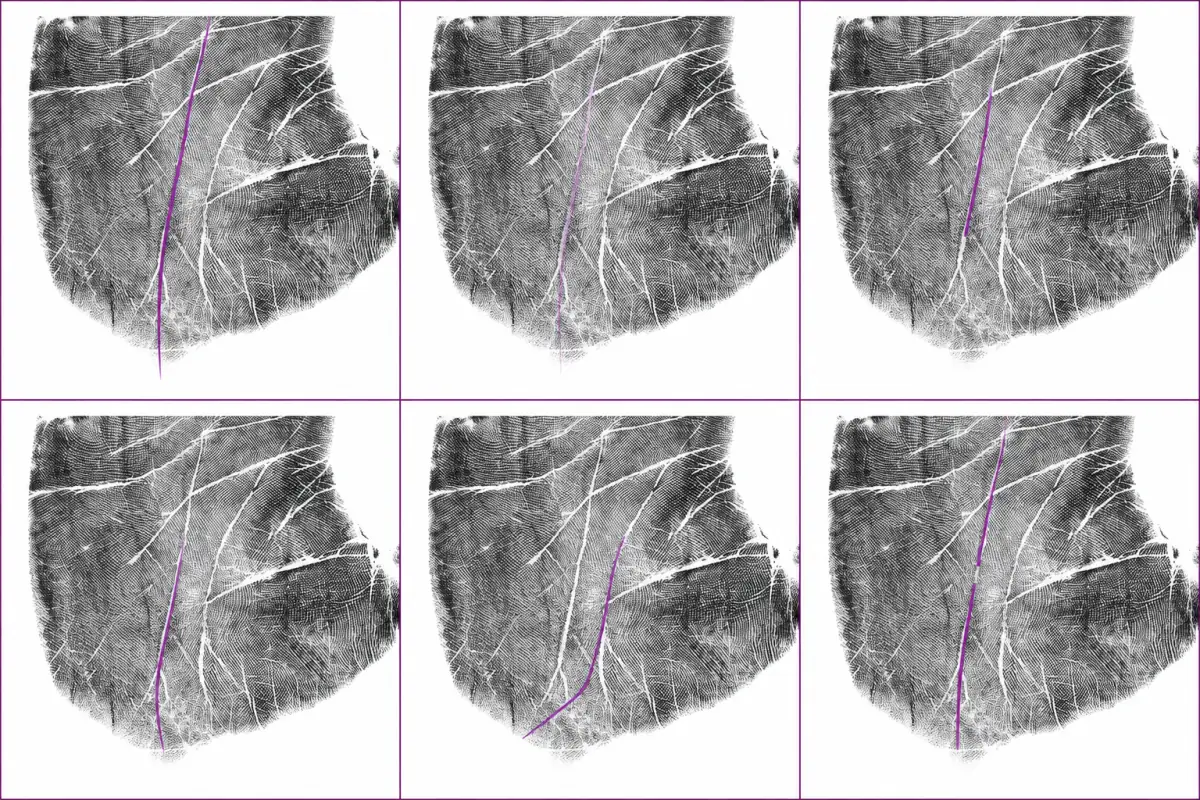
Use a seven-part fate-line endpoint method: identify the Saturn-bound parent, locate its meeting with the head line, confirm there is no continuation above the junction, inspect the way it ends, search for a shifted restart or new route, compare career-supporting features, and check both hands. The endpoint marks where one structure changes; the rest of the palm shows what replaces or reshapes it.
A meeting is not automatically an ending
A true ending stops at the head line and leaves clear skin above the junction. If the fate line crosses, fades and returns, shifts sideways, branches, or continues as a finer route, it has changed rather than ended. Follow every possible segment toward Saturn before interpreting the mark.
Locate the fate line and head line
The fate line rises vertically or diagonally through the center of the palm toward Saturn below the middle finger. The head line begins near the thumb-index side and travels across the middle palm. Their junction usually sits near the palm center. Use the complete fate-line guide to confirm the vertical parent and the head-line guide to trace the crossing crease.
| Feature | Route | Reading role |
|---|---|---|
| Fate line | Moves toward Saturn below the middle finger | Direction, work, responsibility, and structure |
| Head line | Crosses the central palm from the thumb-index side | Thinking, decisions, planning, and judgment |
| Junction | Vertical and horizontal routes meet | Decision stage affecting direction |
| Clear skin above | No Saturn-bound continuation | Supports a true endpoint |
| Upper restart | New line begins above or beside the junction | Shows a later structure or redirected path |
How to verify a fate line that truly ends at the head line
Trace the fate line upward from its origin rather than beginning at the middle of the palm. Confirm that it approaches Saturn and terminates exactly where it touches the head line. Then inspect the area above with the hand relaxed, soft side light, and a second viewing angle. Fine continuations often disappear under flat overhead light.
| Pattern at the head line | What you should see | Classification |
|---|---|---|
| True stop | Parent reaches head line; no route continues above | Fate line ends at head line |
| Clean crossing | Same route remains visible on both sides | Continuous fate line |
| Faint continuation | Thinner route keeps the same alignment | Weakened or changing direction |
| Gap and aligned restart | Open skin followed by an upper segment on the same axis | Break and continuation |
| Shifted restart | Upper route begins to one side | Redirection or changed structure |
| Branch at junction | Parent produces a side route while another segment continues | Branch, fork, or secondary direction |
| Short line starts at head line | No fate route exists below the junction | Late-starting fate line |
A crossing line, scar, dry skin fold, or photograph shadow can imitate a stop. The lower route must be a genuine fate line, and the apparent endpoint must coincide with the head line rather than a nearby minor crease. The broken-line guide explains how gaps, overlaps, and shifted restarts differ.
Traditional meaning: a decision redirects the established path
The head line symbolizes the way choices are formed and carried through. When a fate line ends there, traditional readers give decisions unusual weight in the career or responsibility story. The person may leave a fixed structure, change fields, return to study, reject an inherited plan, alter a business strategy, or reorganize work around a new understanding.
This mark is sometimes described too narrowly as a “career ending through a bad decision.” That wording ignores the rest of the hand and turns one endpoint into a verdict. A deliberate exit, profitable sale, planned career break, new qualification, caregiving chapter, move into flexible work, or change from one organizing role to another can all fit the broader symbol of mental redirection.
| Decision theme | Possible traditional expression | Check elsewhere |
|---|---|---|
| Education or retraining | Old route ends as a new skill becomes central | Head-line strength and Mercury |
| Career change | One structure is consciously replaced | Upper restart and destination |
| Independence | Person leaves a path chosen by others | Thumb, Jupiter, and separated origins |
| Strategy change | Same field continues through a different method | Branches or nearby parallel fate route |
| Competing priorities | Work no longer organizes the next chapter alone | Heart line, Venus, Moon, and life-line branches |
When is a fate line ending at the head line timed?
Many palmistry systems place the fate-line crossing with the head line around the mid-thirties, often near age 35. Treat that as a broad landmark rather than an exact birthday. Hand proportions, the angle of both lines, and the timing school used can move the estimate.
Calibrate the scale with a known earlier change on the same fate line. If a branch, break, or strengthening point corresponds with a dated education or work event, use the proportional distance between that point and the head-line junction. The palmistry timing guide explains this process. A reasonable reading gives a window and names what physically changes on the line; it does not promise a precise date.
What comes after the fate line stops?
The most important next step is to inspect the palm above the head line. An ending describes one route. It does not show the whole future unless every later indicator is absent, and even then palmistry cannot prove that a person will stop working or lose purpose.
| Later feature | Traditional synthesis | Question to ask |
|---|---|---|
| Shifted fate-line restart | A new structure follows the decision | Where does the new route originate and end? |
| Sun line strengthens | Recognition, craft, or fulfillment replaces fixed duty | Does it develop after the same level? |
| Mercury line develops | Communication, enterprise, or advisory work gains weight | Is it independent and Mercury-bound? |
| Branch reaches Jupiter | Leadership, teaching, or ambition redirects effort | Does the parent continue after the branch? |
| Life-line branch reaches Moon | Travel, relocation, or a wider environment changes the setting | Does the timing align with the fate endpoint? |
| No strong vertical line above | Direction may become flexible or self-defined | Which head, Sun, Mercury, or thumb features organize choices? |
For a work-focused synthesis, compare the endpoint with the career-line map. Fate describes sustained structure, while the Sun line adds fulfillment and recognition, Mercury adds communication and enterprise, Jupiter adds ambition, and the thumb adds will and practical execution.
How the endpoint and line quality change the reading
A deep fate line stopping cleanly at a strong head line gives the decision boundary more emphasis. A fate line that becomes weak before it reaches the junction suggests direction was already losing structure. A frayed or chained ending points to a period of repeated adjustment rather than one single choice. A square around the junction is traditionally read as containment or support, while an island before the stop adds a concentrated complication in that chapter.
| Endpoint quality | Traditional emphasis | Do not assume |
|---|---|---|
| Deep clean stop | Definite decision or boundary | That the decision is negative |
| Gradual fade | Responsibility loses force over time | One sudden event |
| Chained approach | Several adjustments precede redirection | One exact turning date |
| Island before stop | A contained difficulty complicates the transition | What caused it without other evidence |
| Square at junction | Support or containment surrounds the change | Guaranteed protection |
| Strong head line after contact | Planning remains active after the old structure ends | That career capacity ended |
Fate line ending at the head line on one hand or both
If the same stop appears on both hands, the decision-led redirection carries more weight in the traditional pattern. If it appears only on the active hand, present choices may have changed how the original direction is expressed. If the less-active hand stops but the active hand crosses or restarts, later effort may have developed continuity beyond the background pattern.
Compare the fate-line origin, depth, junction, upper continuation, and destination in each palm. The which-hand guide explains the active and less-active comparison. Differences are useful only when both hands were photographed in the same light and position.
Fate-line endpoint combinations
| Combination | Traditional synthesis | Read with |
|---|---|---|
| Stop + strong straight head line | Practical judgment deliberately resets the structure | Thumb and Mercury |
| Stop + sloping head line | Imagination, meaning, or a less conventional plan redirects work | Moon and Apollo |
| Stop + upper Saturn restart | A new organized path follows the decision | Restart origin and quality |
| Stop + Sun line after junction | Fulfillment or visibility becomes more important than duty | Apollo mount and timing |
| Stop + firm flexible thumb | Decision combines persistence with adaptation | Both thumb phalanges |
| Stop + Moon life-line branch | A move or wider environment accompanies the redirection | Branch timing and destination |
Worked examples
A deep wrist-origin fate line stops cleanly at the head line
An established structure reaches a firm decision boundary. If a clear Sun line begins above the same level, the later chapter may emphasize creative fulfillment or recognition rather than one fixed duty.
The fate line fades before the head line and a shifted route starts above it
Direction weakens before the decision stage and reforms differently afterward. Trace the new origin and destination before calling it a complete stop.
The less-active fate line stops, but the active line crosses the head line
The background pattern suggests a boundary, while present development shows continuity beyond it. Compare line strength and later branches to see how the route was extended or reorganized.
Photo checklist for a head-line fate endpoint
- Photograph both full palms from wrist to fingertips.
- Keep the central palm and middle-finger base sharply focused.
- Use soft side light to reveal fine upper continuations.
- Trace the fate line upward from its origin.
- Take a second angle with the hand relaxed.
- Check for a gap, fade, shifted restart, branch, or crossing.
- Record changes in depth before and after the junction.
- State hand dominance and the career or direction question you want explored.
Read the endpoint inside your complete direction pattern
A Full Palm Reading maps the fate-line origin, complete route, head-line junction, endpoint quality, timing, possible restart, branches, destinations, supporting career features, and both palms. It then adds the head and heart lines, Sun and Mercury lines, mounts, thumb, fingers, shape, and texture into one holistic reading focused on your questions.
The complete answer
A fate line ending at the head line traditionally marks an established direction reaching a decision, belief, training, or strategy boundary around the broad head-line period. It does not mean career or purpose ends. Verify a true stop, inspect the line quality, search above the junction for a continuation or replacement route, compare career features and timing, and read both hands. A Full Palm Reading maps this endpoint and all important features across both palms and combines them into a holistic reading focused on your questions about career change, study, business decisions, responsibility, recognition, timing, purpose, and direction.
A Full Palm Reading
Ask what follows your fate-line decision point
Your reading maps the fate-line origin, full route, head-line junction, endpoint quality, timing, possible restart, later destinations, supporting career features, and both palms, then adds the Sun and Mercury lines, mounts, thumb, fingers, shape, and texture into one holistic reading focused on your questions.
Your Full Palm Reading maps all the important features—hand shape, skin texture, thumb, fingers, mounts, major and minor lines, markings, and the differences between both palms—and brings them together in a holistic reading focused on your questions.