
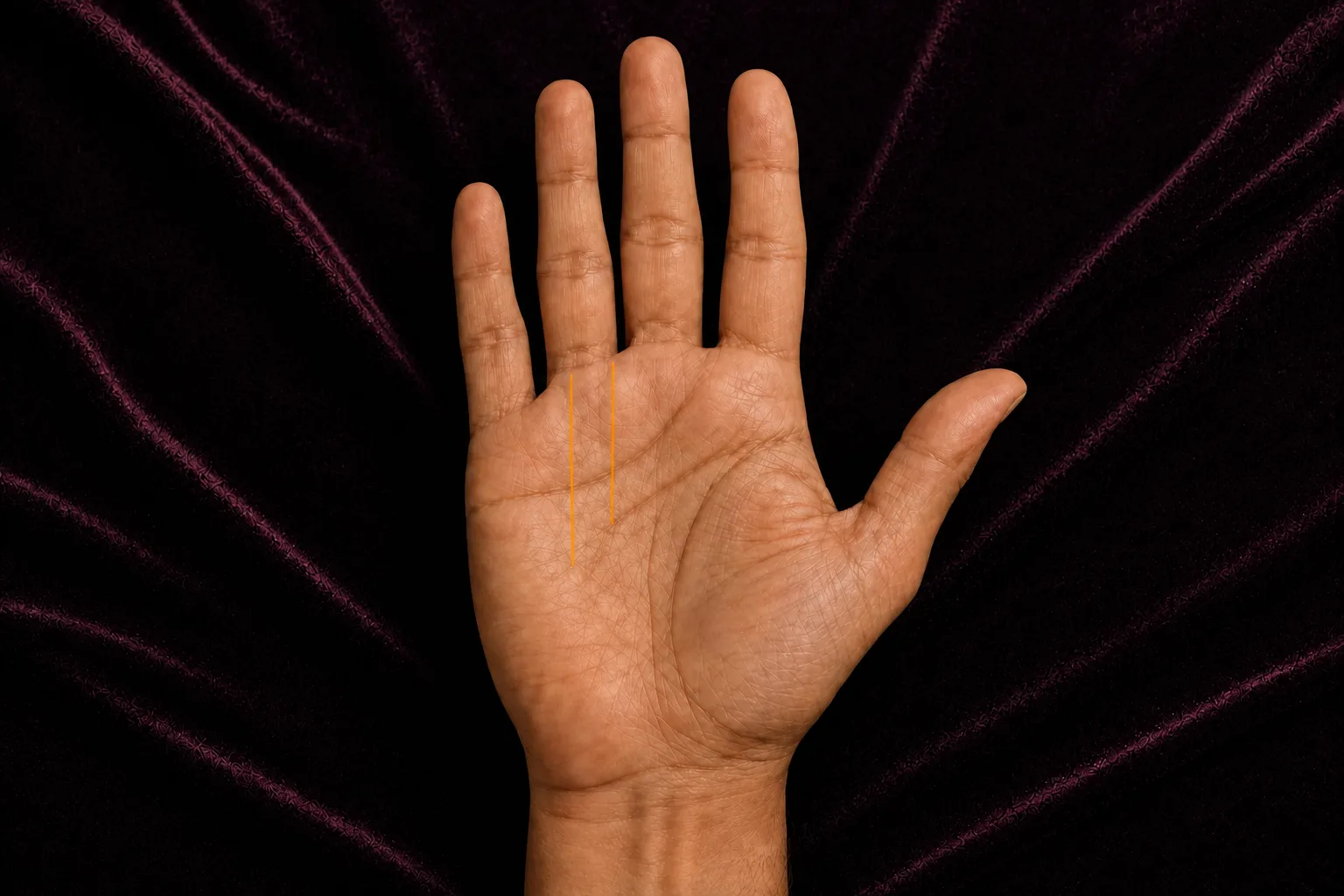
In traditional palmistry, a double Sun line means two distinct vertical routes rise independently toward the Mount of Apollo below the ring finger. The pair is commonly associated with two channels of expression, appreciation, visibility, reputation, or personal fulfillment. One line may describe a primary path and the other a supporting outlet, or the two may become important in different life phases. The sign does not automatically mean double wealth, two careers, celebrity, or twice the success.
Two Apollo routes become meaningful only after both independent origins, complete destinations, spacing, relative depth, duration, overlap, breaks, crossbars, fork and sister-line tests, Fate and Mercury separation, Apollo condition, Head, Jupiter, thumb, hand shape, and both palms are compared. A whole-hand reading can show how talents, outlets, audiences, reputation, focus, recognition, fulfillment, and direction work together.
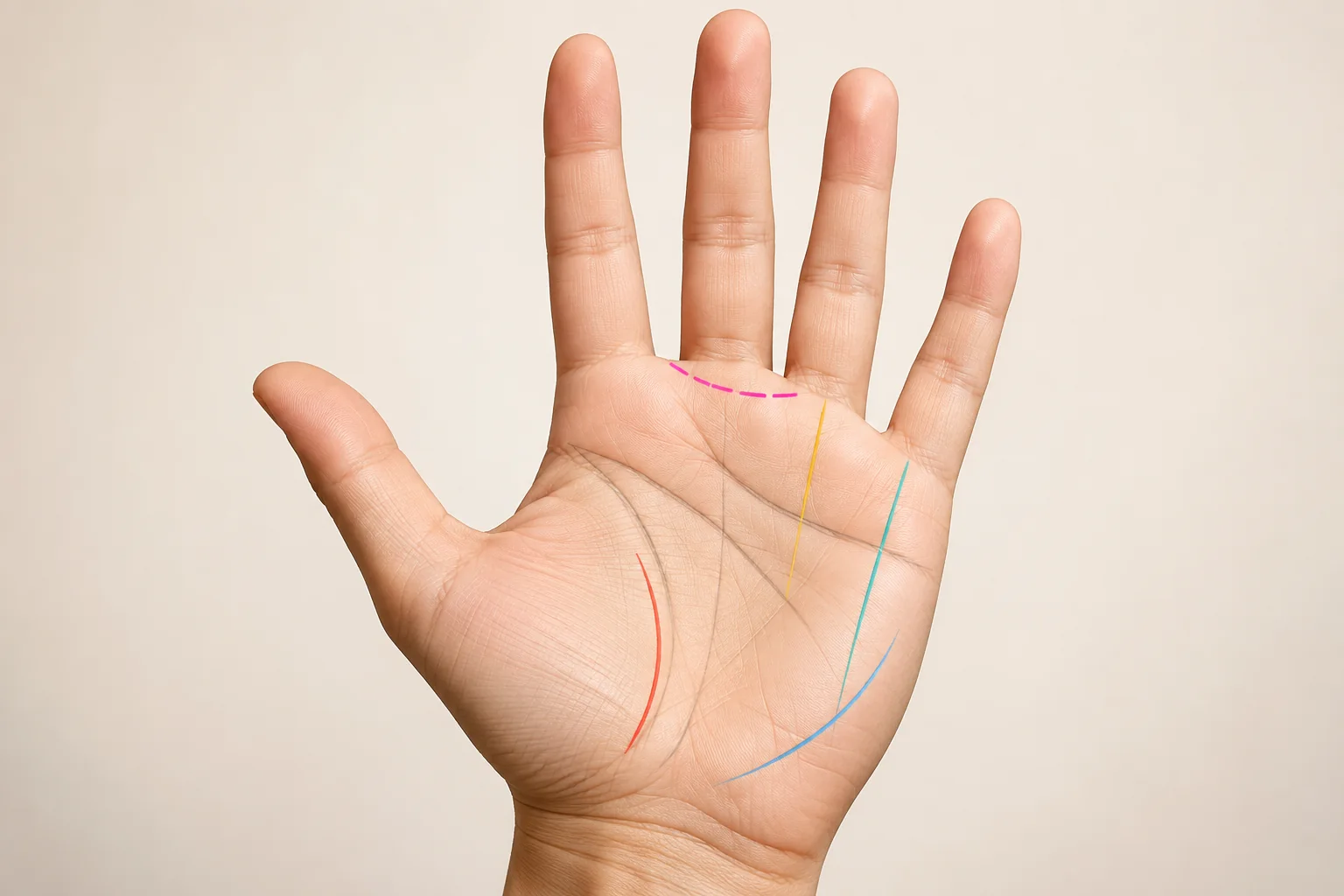
Use a ten-part two-Apollo-line method: locate the ring-finger mount, trace each line down from its own Apollo endpoint, confirm a visible gap between the routes, identify two independent origins, exclude one parent splitting into a fork, exclude a central Fate line and a Mercury line, compare length and depth, map breaks and crossbars separately, estimate the duration and overlap of each route, then add Apollo, Head, Fate, Mercury, Jupiter, thumb, hand shape, and both palms. A real double is established by two complete traces, not by counting every vertical crease beneath the ring finger.
Two lines must remain two lines
If the routes share one lower parent and divide, the formation is a fork. If one line ends below the middle finger, it is likely a Fate line. If several hair-fine strokes appear only under certain light, they may be surface texture or a scattered Apollo zone. A double Sun line needs two separately traceable Apollo-bound parents.
Where to look for two Sun lines
Find the ring finger and the padded area directly beneath it: the Mount of Apollo. A Sun or Apollo line rises toward this zone from somewhere lower in the hand. It may begin near the wrist, from Moon on the outer palm, beside or from the Fate line, at the Head line, near the Heart line, or in the upper palm.
For a double formation, find two vertical grooves in or approaching the Apollo zone. Trace each from its upper endpoint downward. The lines may be roughly parallel, start at different heights, or angle toward the same mount from different origins. They do not need identical length, but both should be more coherent than the surrounding fine creases.
Next, establish the boundaries of Apollo. On a right palm facing you, the ring finger is the second upright finger from the outer, little-finger side. Saturn lies under the middle finger, and Mercury lies under the little finger. A line reaching Saturn is read as a Fate route; one slanting to Mercury belongs to a different system. Destination comes before meaning.
| What you see | Decisive visual test | Best classification |
|---|---|---|
| Two independent Apollo routes | Separate origins and a visible gap remain throughout | Double Sun line |
| One parent divides near the top | Both arms can be traced back to one shared trunk | Forked Sun line |
| One deep line plus a close short companion | Second route is clearly subordinate and hugs the main line | Sister or support line |
| One line reaches Saturn | Upper destination is below the middle finger | Fate line beside a Sun line |
| Three or more weak scratchy strokes | No two lines remain coherent through the zone | Scattered Apollo markings or surface texture |
How to verify a true double Sun line
Use bright, indirect light and relax the hand. Direct flash can erase shallow grooves, while side shadow can turn skin ridges into dramatic lines. Keep one straight full-palm photograph for destinations and one close-up for depth and separation.
Begin at the lower end of the first candidate and trace it to Apollo without jumping a gap. Repeat for the second. Then inspect the space between them. A fork eventually joins into one parent. A sister line may remain separate, but it is normally shorter, finer, and close enough to look like reinforcement rather than a second full route. Two independent lines retain their own origins, courses, and durations.
Turn the test around and trace from Apollo downward. This catches a common misidentification: a central Saturn-bound Fate line may run parallel to an Apollo line for much of the palm. The pair becomes a Sun-plus-Fate combination, not a double Sun line. The same reverse trace separates a Mercury line that angles toward the little finger.
| Verification question | If yes | If no |
|---|---|---|
| Do both routes end in the Apollo zone? | Continue the double-line test | Classify each line by its actual destination |
| Can each line be traced to its own origin? | Independent routes are possible | Look for a fork, break, or aligned fragments |
| Does skin remain visible between them throughout? | The lines stay separate | A junction or shared parent changes the formation |
| Are both clearer than nearby texture? | The pair has reading weight | Recheck in neutral light |
| Do the lines exist in several photos? | The formation is repeatable | Shadow, pressure, or camera processing may be responsible |
Three useful double-line patterns
Two comparable independent lines
When both lines are clear, similarly deep, and visibly separate, traditional palmistry reads two substantial channels of Apollo expression. The person may receive appreciation for different skills, hold a professional identity alongside a creative or public role, or experience two distinct forms of satisfaction. The rest of the hand shows whether the channels cooperate or compete for time and attention.
One main line with a shorter supporting line
A finer companion can be read as reinforcement, especially if it runs beside a damaged section of the main line or becomes clear while the parent weakens. This is often called a sister line. It may represent a secondary ability, supportive audience, parallel outlet, or additional source of confidence. Its effect is specific to the portion it accompanies; a short upper companion should not be stretched into a lifelong second route.
Several fine Apollo lines
More lines do not always mean more success. A cluster of weak, wavy, or broken verticals can describe many interests, changing outlets, sensitivity to response, or energy spread across too many directions. A clear Head line, firm thumb, and one strengthening route can show focus emerging from versatility. Count coherent lines rather than scratches.
| Double-line balance | Traditional emphasis | Question to ask |
|---|---|---|
| Both lines equally strong | Two important recognition or fulfillment channels | Where do both receive sustained effort? |
| One deep, one faint | Primary path plus emerging or occasional outlet | Does the faint route strengthen higher up? |
| One long, one short | Different duration or a later supporting phase | Where does each line begin and end? |
| Lines converge without touching | Separate routes becoming more closely related | Is a skin gap still visible at the closest point? |
| Lines cross or tangle | Competing roles, interruptions, or misidentification | Can either parent still be traced continuously? |
Trace the origin of each Apollo line
Do not assign the same meaning to both lines merely because they end together. Their origins describe different foundations. Read each route separately before combining them.
- From the life line: expression or recognition linked with personal effort, roots, lived experience, and sometimes family context. See the life-to-Apollo guide.
- From the Fate line: appreciation developing from vocation, responsibility, or an established direction. Use the Fate-to-Sun guide when a true junction exists.
- From the Mount of Moon: response through audiences, clients, imagination, travel, communication, or the wider public. The Moon-origin Sun guide owns that route.
- From the Head line: a later route associated with learned skill, judgment, planning, or mental application.
- From the Heart line or upper palm: later expression shaped by values, relationships, beauty, or meaningful enjoyment.
Two different origins can produce a more specific synthesis. A Fate-origin line beside a Moon-origin line may connect professional work with audience response. A life-origin line beside a Head-origin line may connect rooted ability with developed skill. Two upper-palm lines may represent later outlets rather than two lifelong careers.
Read quality, breaks, branches, and crossbars separately
Give each line its own record: origin, endpoint, depth, width, color, continuity, branches, bars, islands, and changes in strength. A defect on one route does not automatically damage the other. Likewise, a stronger companion does not erase every interruption; it shows another channel remains available in the same zone.
A clean, continuous pair suggests more organized expression than two chained or wavering lines. A line that strengthens upward can represent an outlet gaining clarity. A line fading before Apollo may show an interest or recognition phase that does not continue. Horizontal bars are traditionally linked with interruption, criticism, or competing demands; the recovery above a bar matters more than the bar by itself.
If one route contains an empty gap with a separate upper continuation, analyze that line through the focused broken-Sun geometry instead of silently joining the pieces. If one parent splits into two arms, use the forked-lines guide. Classification protects the reading from turning every complicated Apollo zone into “double success.”
Timing two lines and their overlap
Each Sun line has its own beginning, duration, and endpoint. Compare their heights relative to the Head and Heart lines. A route visible below the Head line begins earlier in the palm's sequence than one that first appears between Head and Heart. A line starting above the Heart line belongs to a later zone. These are broad relative stages, not exact calendar dates.
The overlap between the two routes can be more useful than either starting point alone. If a long line is already active when a second appears, the later route may add another outlet or source of appreciation. If one fades as the other begins, the pair may represent a handover between roles. If both begin and end at similar levels, they may operate side by side during the same phase.
| Timing pattern | Possible traditional reading | Check before concluding |
|---|---|---|
| Both begin at similar height | Two channels develop in one broad phase | Independent origins and equal continuity |
| Second begins while first continues | An additional outlet or reputation develops | Real history and strength after the start |
| First fades as second appears | A shift in expression or audience | Any overlap, bridge, or empty gap |
| One exists only above Heart | A later supporting or fulfillment route | Upper-palm clarity and Apollo condition |
| Different pattern in other hand | Timing or emphasis may have changed | Use the same landmarks on both palms |
Use the palmistry timing guide to calibrate proportional zones against known events. A range is more credible than an exact age, and a line cannot promise the date of a promotion, award, launch, or financial result.
Compare double Sun lines in both palms
State which hand you use most, then photograph both palms under matching light. Traditional schools differ about active and passive labels, so begin with what is observable.
- Double lines clearer in the dominant hand: multiple outlets or recognition channels may be more developed through present choices and practice.
- Double lines clearer in the non-dominant hand: versatility or more than one available channel may feel less fully expressed.
- Two lines in both hands: the pattern may be stable, but origins, strength, and timing can still differ.
- Two lines becoming one: focus may have consolidated, or one route may now carry more weight.
- One line becoming two: an additional outlet may have developed; confirm it is independent rather than a recent surface crease.
The broader hand matters. Apollo shows the style of expression; the Head line shows how abilities are organized; the Fate line shows direction and responsibility; Mercury adds communication or commerce; Jupiter adds aspiration and leadership; and the thumb shows how intention is applied. A Full Palm Reading can map these together instead of equating a line count with an outcome.
Four worked examples
1. Two clear lines from different origins
One Apollo line branches from the Fate line while another rises independently from Moon. Both are deep and continue under the ring finger. Traditionally, the first links recognition with work direction; the second adds audience, client, imaginative, or public response. The pair may support a profession whose work and reception reinforce each other.
2. Main route with a short upper companion
A long Sun line reaches Apollo, and a finer line runs beside it only above the Heart line. Read the long route first. The short companion may add later support, a secondary outlet, or renewed appreciation. Its upper-only duration does not justify claiming two lifelong careers.
3. Two weak lines inside a cluster
Several faint verticals appear beneath the ring finger, but only two persist in side lighting. Both are wavy and the Head line is fragmented. The balanced reading emphasizes multiple interests and uncertain focus rather than guaranteed versatility. Check whether one route strengthens in the other hand.
4. Fate line mistaken for the second Sun line
Two strong vertical lines cross the central palm. The outer line reaches Apollo, but the inner line ends under the middle finger. This is one Sun line beside one Fate line. It can still combine direction with appreciation, but it is not a double Apollo route. Compare it with the double Fate-line test when another Saturn-bound line is present.
Photo checklist for two Apollo lines
- Photograph the full palm from wrist to fingertips.
- Keep the camera directly above the relaxed hand.
- Use bright indirect light and avoid flash glare.
- Take a second photo with gentle side light.
- Include a close-up from the Head line to the ring-finger base.
- Trace each candidate from its own lower origin.
- Confirm that both terminate in the Apollo zone.
- Confirm visible skin separates them throughout.
- Check for one shared parent that would make a fork.
- Exclude a Saturn-bound Fate line and Mercury-bound line.
- Record depth, length, gaps, bars, and strengthening for each route.
- Repeat the same images for the other palm.
Frequently asked questions
Are two Sun lines rare?
Two clear, independent Apollo routes are less common than one short or faint Sun line. Fine vertical texture is common, so verify continuity and destination before deciding the hand has a true double.
Does a double Sun line mean two careers?
It can be read as two expression or recognition channels, but those may exist within one career, across a career and a side practice, or in different life phases. The Fate line, origins, timing, and real history clarify the structure.
Does it mean double money or fame?
No. Apollo concerns appreciation, expression, visibility, and fulfillment. Income and scale need separate evidence. A respected specialist, local creator, teacher, or private craftsperson can carry a strong Apollo pattern without celebrity.
Is a sister line the same as a double Sun line?
A sister line is a shorter or finer companion that closely supports a main route. It can be included in the broader “two Sun lines” discussion, but two comparable independent routes carry a stronger dual-channel reading.
What if the two lines join at the top?
If they remain separate until they meet near Apollo, record a convergence and inspect the exact junction. If they arise from one lower parent and split upward, it is a fork. Origins and direction determine the name.
What if one line is broken?
Read that route's gap, continuation, overlap, and strength separately. The other line may provide a continuing channel, but it does not erase the interruption. A true empty gap needs a broken-line analysis.
Can two faint lines still count?
They can if both remain continuous and Apollo-bound in neutral light, but faintness reduces emphasis. If they vanish with a change of angle or merge into a larger cluster, classify them cautiously.
Which hand matters more?
Compare both. Note hand use, then inspect the same origins, destinations, strength, and timing zones. Differences can show how the pattern's expression has developed rather than canceling one hand.
The complete answer
A double Sun line traditionally describes two separately traceable routes to Apollo and can symbolize more than one channel of expression, appreciation, visibility, reputation, or inner fulfillment. Confirm independent origins, a visible gap, and two ring-finger destinations so a fork, sister line, Fate line, Mercury line, line shadow, or weak cluster is not misread. Then compare each route's origin, quality, duration, overlap, breaks, crossbars, Apollo condition, Head, Fate, Mercury, Jupiter, thumb, hand shape, real history, and both palms. A Full Palm Reading maps all important features across both hands and combines them into a holistic reading focused on your questions about talents, work, creativity, audiences, reputation, focus, money, recognition, satisfaction, purpose, timing, and direction.
A Full Palm Reading
Ask how your two Apollo routes work together
Your reading maps both independent origins, complete Apollo destinations, spacing, relative depth, duration, overlap, breaks, crossbars, fork and sister-line tests, Fate and Mercury separation, Apollo condition, Head, Jupiter, thumb, hand shape, and both palms, then adds every other important line, mount, finger, marking, shape, and texture into one holistic reading focused on your questions.
Your Full Palm Reading maps all the important features—hand shape, skin texture, thumb, fingers, mounts, major and minor lines, markings, and the differences between both palms—and brings them together in a holistic reading focused on your questions.