
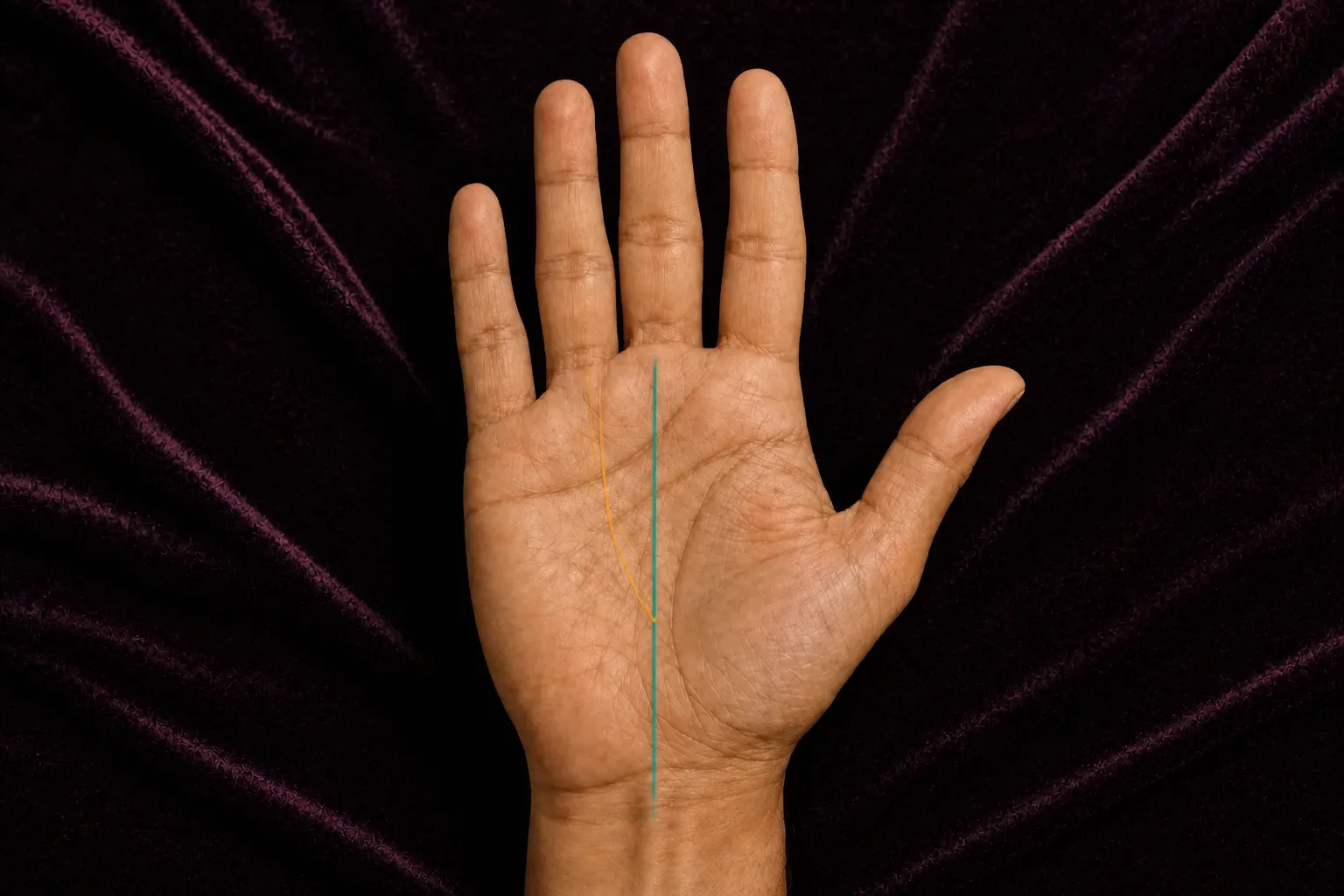
In traditional palmistry, a Sun or Apollo line that branches from the Fate line and reaches the mount below the ring finger is associated with recognition, appreciation, creative expression, or personal fulfillment growing out of an established direction, vocation, responsibility, or long-built body of work. The Fate line should continue toward Saturn below the middle finger while a separate route leaves the same junction for Apollo. This formation can connect purposeful effort with visibility, but it does not guarantee fame, wealth, promotion, or a specific career result.
A Fate-to-Sun branch becomes meaningful only after the complete Fate parent, Saturn continuation, exact junction, independent-line test, full Apollo branch, depth before and after the split, crossings, breaks, broad junction timing, Head and Heart support, Mercury, Jupiter, Apollo, Saturn, thumb, and both hands are compared. A whole-hand reading can show how work, responsibility, skill, reputation, recognition, satisfaction, and direction work together.
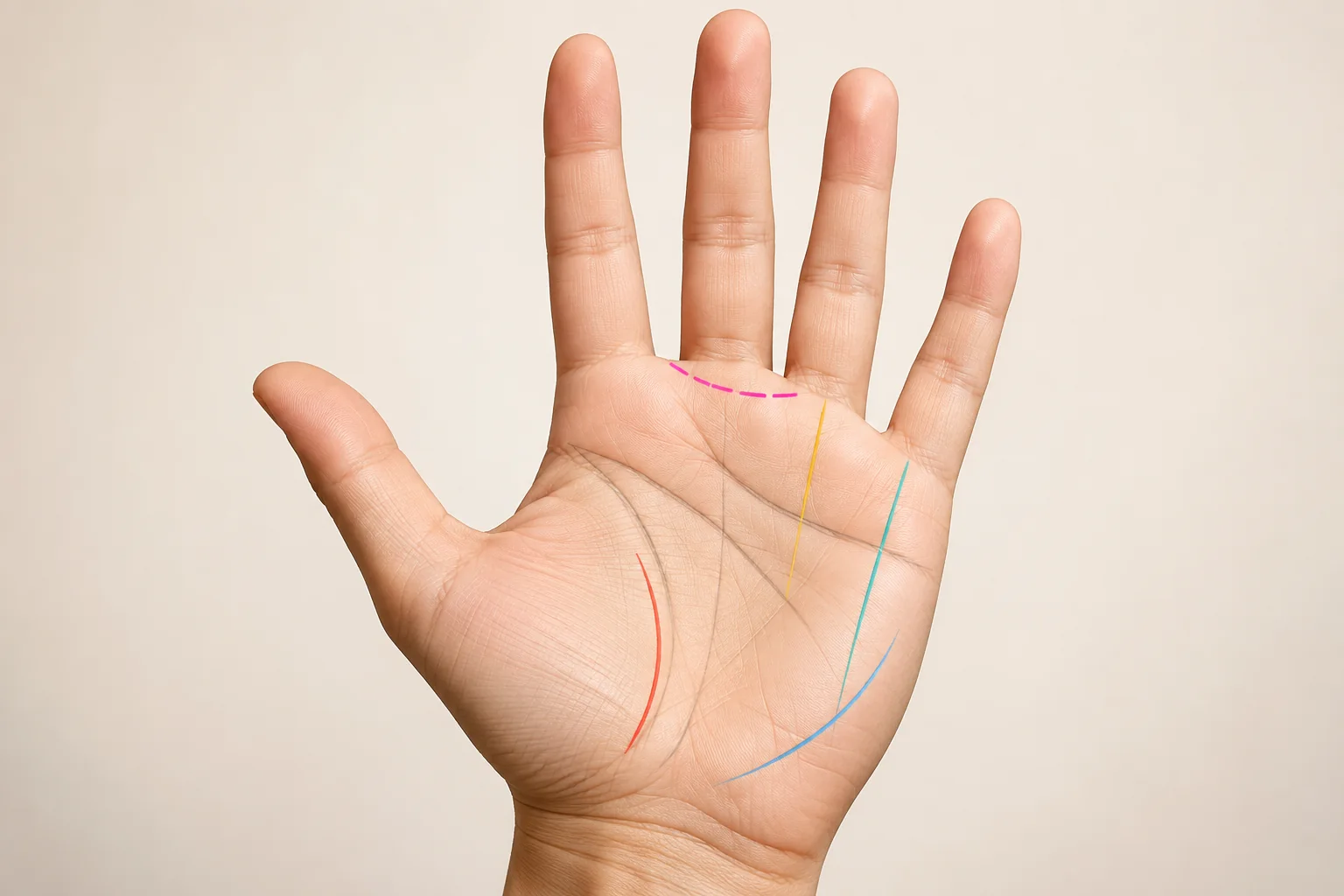
Use a ten-part Fate-to-Apollo method: trace the Fate line from its lowest visible origin, confirm its Saturn destination, find the exact shared junction, follow the parent above that point, trace the new branch separately to Apollo, distinguish a fork from two independent lines or a crossing stroke, compare depth before and after the split, locate Head- and Heart-line crossings, estimate only a broad junction window, and then add Apollo, Saturn, Head, Mercury, Jupiter, thumb, and both palms. The two destinations are the decisive visual test.
Read the parent and branch as two subjects
The Fate line traditionally describes direction, structure, responsibility, and the way work or circumstances organize a life. The Sun line describes expression, appreciation, recognition, and the satisfaction taken from what develops. Their junction links those subjects; it does not turn every job change into fame or every Apollo branch into money.
First locate the Fate line and Apollo route
The Fate line normally rises through the central palm toward the Mount of Saturn beneath the middle finger. It may begin at the wrist, the life line, the Mount of Moon, or higher in the palm. Its origin can change the story of direction, but its upper destination identifies the route.
A Sun line rises toward the Mount of Apollo beneath the ring finger. On a right palm facing you, Apollo sits one finger to the outer side of Saturn. A Fate-to-Sun formation therefore looks like one central parent that reaches a junction and then sends a clear branch diagonally or vertically toward the ring-finger axis.
Start at the lower end of the central line and trace upward with your eyes. At the suspected junction, pause. Follow one route to Saturn and the other to Apollo. If both destinations can be reached without jumping across an empty gap or borrowing a nearby crease, you have the basic geometry.
| Visible formation | How to recognize it | What to read |
|---|---|---|
| Sun branch from Fate line | One shared junction; parent continues to Saturn and branch reaches Apollo | Direction plus recognition or fulfillment |
| Forked Fate line | One parent divides, but neither arm clearly reaches Apollo | Two directions or responsibilities; identify both endpoints |
| Two independent lines | Fate and Sun routes run separately without a shared junction | Compare direction and recognition as parallel subjects |
| Crossing stroke | A short bar touches or cuts the Fate line and continues across it | Interruption or influence; do not rename it as a Sun line |
| Fate line bends to Apollo | The original route leaves Saturn and turns wholly toward the ring finger | A changed destination rather than a continuing parent plus branch |
How to verify a true shared junction
A crowded central palm can make separate grooves look joined. Use bright indirect light, take one straight photograph, and inspect the natural crease rather than a traced mark. A true branch shares a small section or a definite point with the parent. A crossing line approaches from one side, passes through, and keeps going with no Apollo destination.
Next test continuity. The parent Fate line must remain visible above the junction and continue toward Saturn. The branch must move away and enter the Apollo zone. If the gold-looking route is actually the parent changing course while no line continues to Saturn, describe what is visible as a Fate line redirecting toward Apollo. If the Apollo route begins slightly beside the Fate line, it is an independent Sun line even when the gap is tiny.
Check the endpoint from the finger downward. Find the ring finger, place your attention on the pad beneath it, and trace any vertical groove down to the junction. This reverse trace prevents a common mistake: following a central Fate line upward and assuming its nearest fork must be Apollo-bound.
| Verification question | Yes suggests | No suggests |
|---|---|---|
| Does the parent continue to Saturn? | A continuing Fate line | A bend, stop, break, or changed destination |
| Does the branch end below the ring finger? | An Apollo-bound Sun route | A Jupiter, Saturn, Mercury, or unnamed branch |
| Is there one exact shared junction? | A branch from the Fate line | Two independent lines or an apparent overlap |
| Does the stroke pass straight through the parent? | A crossing or influence line | A branch may be present if it begins there and rises |
| Can both routes be traced without borrowing faint fragments? | A coherent formation | Aligned fragments or surface texture |
Traditional meaning: direction becomes visible or satisfying
The central idea is development. The Fate line supplies an existing current: a profession, responsibility, enterprise, discipline, public role, or stable direction. The Apollo branch suggests that something growing from this current becomes more expressive, appreciated, visible, or personally satisfying. Recognition may come from the work itself, from a skill developed through it, or from an outlet that becomes possible because the underlying structure is already in place.
Recognition has scale. It can mean a respected reputation among clients, appreciation inside a team, an audience for a craft, greater confidence in showing work, or the private contentment of doing an activity well. The Mount of Apollo, ring finger, hand shape, and the line's strength help describe whether expression is public, aesthetic, practical, entrepreneurial, or quietly personal.
This junction is often described as work leading to success. A more useful reading asks what kind of work the Fate line represents, what kind of recognition the Apollo route can carry, and whether the rest of the hand supports the bridge between them. A clear Head line can add planning and developed skill. Mercury may add communication or commercial application. Jupiter may add ambition and leadership. A firm but flexible thumb can support sustained choice and follow-through.
Compare the parent, junction, and branch quality
Depth shows emphasis; continuity shows how steadily the theme is carried. Compare the lines under the same lighting and against nearby creases. A branch does not need to be as deep as a major line to matter, but it should be clearer and more organized than random skin texture.
| Line pattern | Traditional reading | What changes the interpretation |
|---|---|---|
| Both parent and branch deep and clear | Direction and recognition reinforce each other | Destinations, crossings, Apollo and Saturn development |
| Strong Fate line, faint Apollo branch | Stable work with emerging or secondary visibility | Whether the branch strengthens higher in the palm |
| Faint Fate line, stronger Apollo branch | Expression or appreciation may become more central than the old structure | Later Fate continuation and real-life change |
| Branch strengthens after Head line | Developed judgment, learning, or chosen skill supports recognition | Head-line quality and branch continuity |
| Branch crossed by bars | Criticism, interruptions, competing demands, or delayed visibility | Number of bars and recovery above them |
| Branch breaks before Apollo | A stop, change of outlet, or incomplete recognition route | Separate restart, overlap, and strength after the gap |
Inspect the junction itself. A clean Y suggests one coherent split. Chaining, an island, or several fine bars around the meeting point can show a more complicated transition. If the Fate line weakens exactly as the Sun branch strengthens, the emphasis may shift from obligation or fixed structure toward expression and appreciation. If the parent remains equally strong, the person may carry both responsibility and visibility together.
Do not merge a broken Sun route into this page's formation. A true empty interruption and separate continuation belongs to the focused broken Sun-line reading. Likewise, two complete Apollo-bound routes belong to a double Sun-line comparison rather than one Fate parent with one branch.
Work, creative outlets, reputation, and money
This sign is most useful when the question concerns how work becomes known. In a structured career, it may describe expertise that begins receiving notice. In business, it can show a product, voice, or client reputation growing from the enterprise. In a creative life, it can connect routine practice and professional discipline with an audience. In a private life, it may mark a satisfying craft or role that develops alongside ordinary responsibilities.
The branch does not specify an occupation. Use the complete career palm-reading framework: compare the Head line for work style, Mercury for communication and commerce, Jupiter for leadership, Saturn for responsibility, Apollo for expression, and the thumb for how intention becomes action. A branch alone cannot choose between promotion, self-employment, a public project, a portfolio career, or a valued hobby.
Nor is it automatically a wealth line. Recognition can support income, but money needs its own evidence: a coherent Fate route, practical Head line, Mercury features, clear triangles where relevant, and the person's actual financial situation. If your main question is earnings or security, use the money and wealth lines guide rather than treating Apollo as a guaranteed payout.
Ask what becomes appreciated
The strongest interpretation names the bridge: a work skill becomes visible, a responsibility produces authority, a service earns trust, a practice finds an audience, or a long-built role brings satisfaction. The route's destination says more than labels such as “lucky” or “famous.”
How to time the Fate-to-Sun junction
The junction marks where the two themes meet, but palm timing is approximate. First decide which line provides the timing scale. Because the branch begins on the Fate line, use Fate-line landmarks: the lower palm for earlier development, the Head-line crossing for a broad adult midpoint, the space between Head and Heart for a later phase, and the Heart-line crossing or upper palm for later development.
Then read the entire sequence. Note the Fate line's condition below the junction, the exact point of departure, the Apollo branch's strength above it, and whether either route crosses the Head or Heart line. A junction below the Head line can suggest that the work-to-recognition theme begins relatively earlier. One between Head and Heart points to a middle phase. One above Heart indicates later emergence. These are broad relative zones rather than calendar promises.
Calibrate the scale against a known change in the same hand before assigning a window. The palmistry age-calculation guide explains landmark crossings, proportional sections, and why a range is more credible than a single age. A visible branch describes development; it cannot prove that a promotion, award, sale, or public breakthrough will happen on a set date.
Compare the branch in both hands
Photograph both palms in matching light and angle. Traditional systems differ on how they label active and passive hands, so state which hand you use most and compare observable features first.
| Two-hand pattern | Balanced interpretation | Useful follow-up |
|---|---|---|
| Clearer in the dominant hand | The work-to-recognition route may be more developed in current choices | Identify the skill or outlet strengthened through practice |
| Clearer in the non-dominant hand | The pattern may feel available, inherited, or less fully expressed | Compare current role, confidence, and opportunity |
| Clear in both hands | Direction and appreciation may be a stable repeated theme | Compare timing and relative strength rather than seeking a yes/no |
| Different junction levels | The theme may have changed in timing, emphasis, or expression | Use known events to calibrate each palm |
| Present in only one hand | One palm emphasizes the route while the other organizes success differently | Read Fate, Head, Mercury, Jupiter, and Apollo in both |
A missing branch in one hand does not cancel the other. Look for an independent Sun line, stronger Apollo mount, Fate-line strengthening, or supporting Head and Mercury features. The which-hand guide gives a repeatable comparison order.
Four worked examples
1. A clear branch after the Head-line crossing
A central Fate line crosses the Head line, continues firmly to Saturn, and sends a clean branch to Apollo just above the crossing. The Head line is straight and clear, Mercury is balanced, and Apollo is moderately developed. Traditionally, this supports recognition growing from learned judgment, practical expertise, or work refined over time. The branch adds visibility; it does not name the job or promise a title.
2. A faint branch that strengthens near Apollo
The Fate line is strong, while the branch begins lightly and becomes clearer only in the upper palm. This can describe a secondary outlet or reputation that develops gradually from stable work. Check whether the person recently began publishing, teaching, presenting, designing, advising, or sharing a skill. The strengthening is more informative than the faint start alone.
3. Two separate vertical lines mistaken for a branch
A Fate line reaches Saturn and a separate Sun line reaches Apollo, but a small gap remains between them. Read these as parallel routes. Direction and recognition may support each other, yet the photograph does not show recognition literally branching from the Fate line. This distinction also prevents confusing a nearby second Fate line with Apollo.
4. A parent weakens while the Apollo route becomes dominant
The Fate line is clear below the junction, faint above it, and the Apollo branch is deeper toward the ring finger. Traditionally, emphasis may shift from an earlier structure toward expression, reputation, or satisfaction. A real reading would compare the timing zone, Head and Heart crossings, job history, other responsibilities, and both palms before describing the shift.
Photo checklist for a Fate-to-Sun branch
- Photograph the full palm from wrist to fingertips.
- Keep the camera directly above the hand.
- Use bright indirect light without deep central shadows.
- Include a close-up of the suspected junction.
- Mark which hand is dominant.
- Trace the central parent down to its lowest visible origin.
- Confirm that the parent continues toward Saturn.
- Trace the branch to Apollo below the ring finger.
- Check for a gap that would make the lines independent.
- Check whether a short stroke crosses instead of branches.
- Record depth, breaks, bars, forks, and strengthening above the junction.
- Take the same photographs of the other palm.
Do not draw over the only photograph. Keep one unmarked image for texture and continuity, then use a duplicate to trace the possible routes. A full-hand view establishes destinations; a close-up verifies the junction.
Frequently asked questions
Is a Sun line from the Fate line lucky?
Traditional palmistry generally treats a clear Apollo-bound branch favorably because it connects direction with appreciation or fulfillment. “Lucky” is too broad by itself. Quality, destination, supporting features, timing, and real effort determine how the pattern is read.
Does it guarantee career success or fame?
No. It can symbolize work becoming more visible or satisfying, but it cannot guarantee a promotion, celebrity, income, or outcome. Recognition may be local, professional, creative, or private.
What if the Fate line stops at the junction?
If no parent continues to Saturn, the formation may be a redirected Fate line, an ending with a new Apollo route, or aligned fragments. Trace every route independently and compare the upper palm before calling it a branch.
What if the branch goes toward Jupiter?
A route toward the index-finger mount is traditionally read through Jupiter themes such as ambition, authority, advancement, and leadership. Apollo requires a ring-finger destination.
Can a faint branch still count?
Yes, if it has a real shared junction and continuous Apollo destination. Its faintness makes the theme lighter, emerging, intermittent, or less established than a deep branch. Dry-skin texture and lighting artifacts should be excluded first.
Is a parallel Sun line the same sign?
No. A parallel Sun line can still combine meaningfully with the Fate line, but without a shared junction it is an independent route. This page is specifically about recognition arising from the Fate-line current.
Can the junction give an exact age?
It provides an approximate zone on a Fate-line scale. Use Head- and Heart-line landmarks, proportional sections, both palms, and known life events to estimate a range. Do not claim an exact date from one point.
Should the branch be read alone?
No. Read the complete Fate and Sun routes, then add line quality, Head, Heart, Mercury, Jupiter, Apollo, Saturn, thumb, hand shape, texture, both palms, and the person's actual question.
The complete answer
A Sun line branching from the Fate line traditionally connects established direction, vocation, responsibility, or sustained work with recognition, expression, appreciation, and inner fulfillment. Confirm one exact shared junction, a Fate parent continuing to Saturn, and a separate branch reaching Apollo so the formation is not confused with a fork, crossing, bend, or two independent lines. Then compare quality before and after the split, timing zone, Head and Heart crossings, Apollo, Saturn, Mercury, Jupiter, thumb, work history, and both hands. A Full Palm Reading maps all important features across both palms and combines them into a holistic reading focused on your questions about work, skill, reputation, creativity, visibility, money, satisfaction, purpose, timing, and direction.
A Full Palm Reading
Ask how your work-to-recognition route develops
Your reading maps the complete Fate parent, Saturn continuation, exact Sun-line junction, independent-line test, full Apollo branch, depth before and after the split, crossings, breaks, broad timing, Head and Heart support, Mercury, Jupiter, Apollo, Saturn, thumb, and both palms, then adds every other important line, mount, finger, marking, shape, and texture into one holistic reading focused on your questions.
Your Full Palm Reading maps all the important features—hand shape, skin texture, thumb, fingers, mounts, major and minor lines, markings, and the differences between both palms—and brings them together in a holistic reading focused on your questions.