
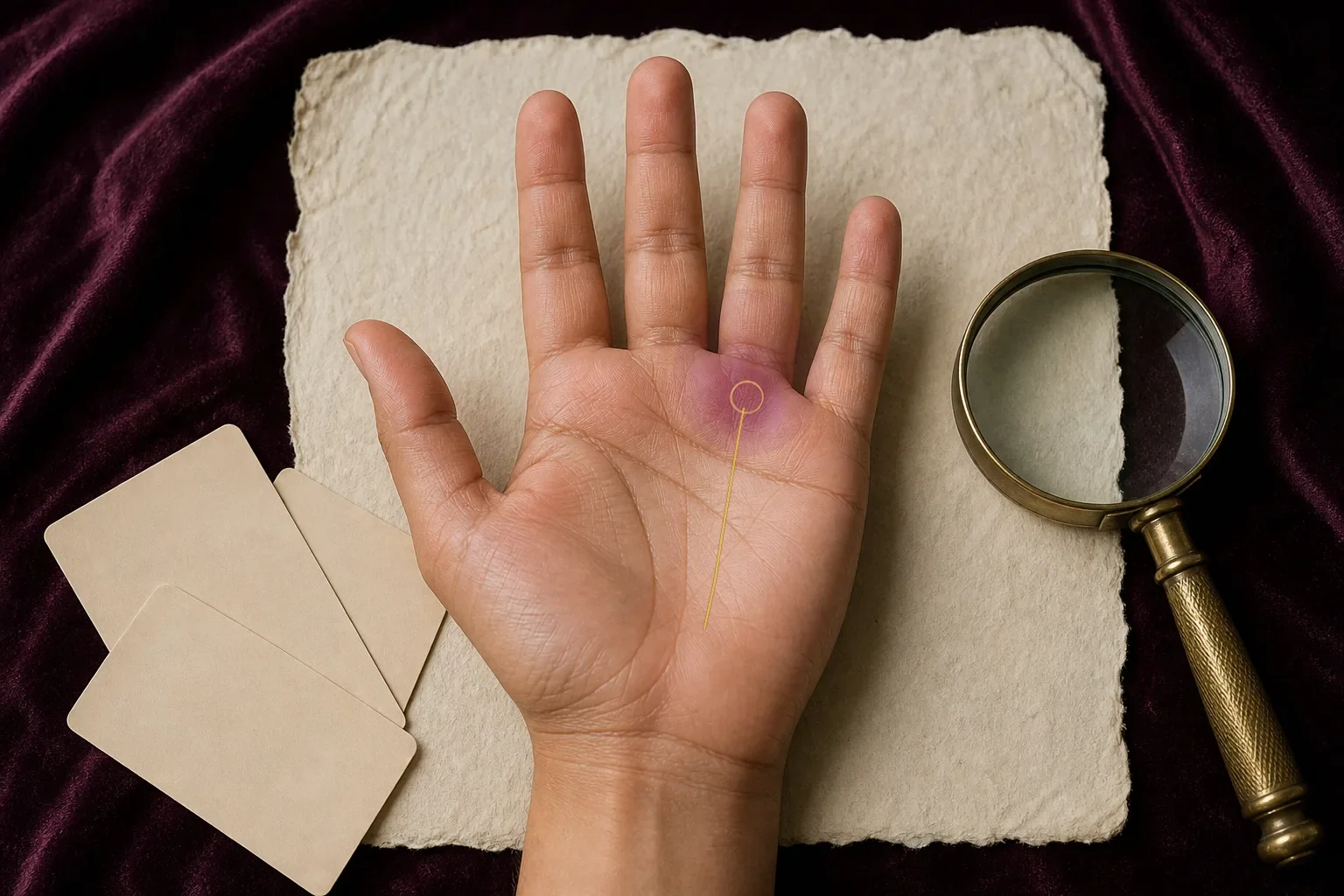
The Mount of Apollo, also called the Mount of Sun, is the compact padded area directly below the ring finger, above the heart line, between the Saturn and Mercury mounts. Traditional palmistry connects it with creative expression, aesthetic sense, enjoyment, confidence in showing one's work, reputation, appreciation, recognition, and the wish to make a visible contribution. A balanced resilient Apollo mount suggests expression with proportion. Its fuller meaning comes from firmness, apex, texture, ring finger, Sun line, markings, and both hands.
An Apollo-mount reading becomes useful only after its boundaries, height, firmness, apex, texture, Sun line, markings, ring finger, fate line, and the other hand are compared. A whole-hand reading can show how creativity, visibility, reputation, satisfaction, discipline, and communication connect with work, purpose, success, or direction.
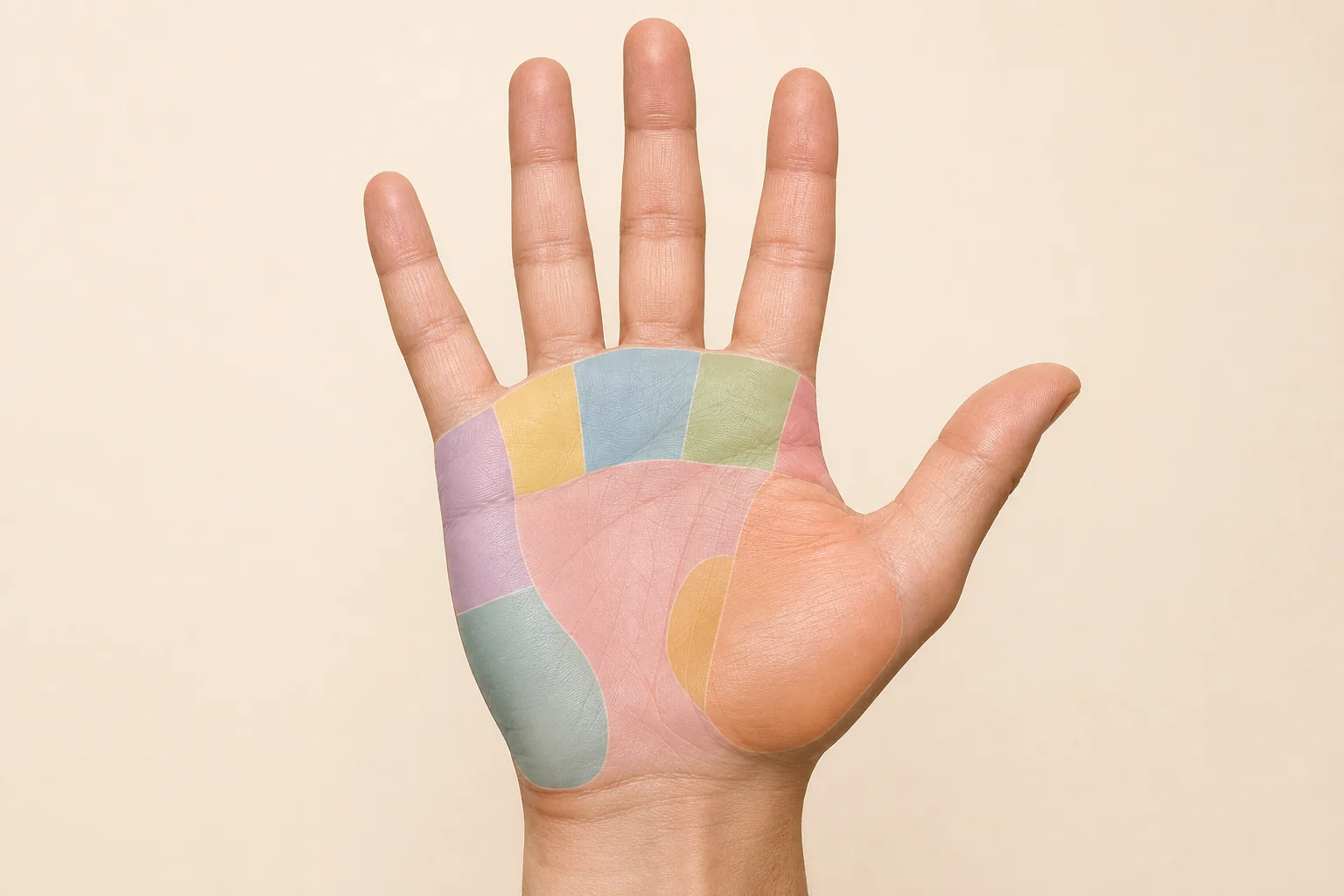
Use an eight-part Apollo mount reading sequence: confirm the boundaries, compare height, test firmness, locate the apex, inspect texture, study the ring finger, trace the Sun line, and compare both hands. This avoids a common error: treating any fullness under the ring finger as a promise of fame. Apollo describes how expression, fulfillment, and visibility are handled; it does not guarantee celebrity.
Apollo shows how expression becomes visible
The mount shows the appetite for beauty, creativity, enjoyment, and appreciation. The ring finger shows the style and confidence of expression. The Sun line shows how consistently work or identity develops toward recognition. The fate line adds vocation, Mercury adds communication and practical skill, Saturn adds discipline, and Jupiter adds ambition.
Where is the Mount of Apollo or Sun?
Hold the palm open without stretching the fingers. Find the ring finger, between the middle and little fingers, then move directly down to the cushion between its base crease and the heart line. That upper-palm zone is Apollo. Palmists use Mount of Apollo and Mount of Sun for the same area.
| Boundary | How to locate it | What lies beyond it |
|---|---|---|
| Upper | Base crease of the ring finger | Ring finger and lower phalanx |
| Thumb side | Valley between middle and ring fingers | Saturn mount |
| Little-finger side | Valley between ring and little fingers | Mercury mount |
| Lower | Heart-line zone beneath the ring finger | Quadrangle and central palm |
| Apex | Highest point under gentle side light | Its position shows a Saturn or Mercury lean |
Use the complete palm-mount map when the cushions blend. Apollo lies below the ring finger; Saturn lies below the middle finger and relates to duty, depth, and patience; Mercury lies below the little finger and relates to communication, exchange, and applied skill. Fullness between two mounts blends their themes, so find the apex before naming the dominant area.
Flat, balanced, prominent and overdeveloped Apollo mounts
Compare Apollo with the other finger mounts and the same area on the other palm. Finger spread, camera angle, pressure, dominant-hand use, age, and natural hand structure change the visible cushion. Judge the stable relative pattern after controlling those effects.
| Apollo form | Visual and touch cues | Traditional emphasis | Next check |
|---|---|---|---|
| Flat or low | Little rise below the ring finger | Private taste, selective expression, or fulfillment away from attention | Ring finger, Sun line, head line |
| Balanced | Proportionate cushion with resilient feel | Expression, enjoyment, and recognition held in proportion | Sun line and fate line |
| Prominent and firm | Clear local rise that springs back | Creative confidence, presentation, optimism, visible contribution | Jupiter and Saturn |
| Prominent and soft | Full cushion with yielding feel | Strong response to beauty, pleasure, appreciation, or feedback | Texture, thumb, head line |
| Hard or dominant | Tight high pad that overwhelms nearby mounts | Expression may become performative, status-conscious, or inflexible | Grille, thumb, Saturn |
| Displaced apex | Peak sits nearer Saturn or Mercury | Apollo is channeled through discipline or communication | Read the destination mount |
What does a flat Mount of Apollo mean?
A flat mount does not mean a lack of creativity. Traditional palmistry reads it as less need for display, applause, ornament, or visible distinction. Creative work may stay private, practical, collaborative, or tied to another mount. A clear Sun line, long ring finger, imaginative head line, or strong Mercury can still provide a strong expressive outlet.
What does a prominent Mount of Apollo mean?
A prominent firm mount strengthens interest in creative work, presentation, beauty, enjoyment, reputation, and response from an audience. The rest of the hand shows whether this becomes craft, performance, design, leadership, teaching, entrepreneurship, or a vivid personal style.
Does a strong Apollo mount mean fame?
No single mount promises fame. Apollo can support visibility and appreciation, but sustained recognition needs a coherent Sun line, a suitable fate pattern, communication or craft, discipline, opportunity, and continuation over time. Read recognition on a scale: private satisfaction, appreciation by a small group, professional reputation, wider visibility, or public prominence.
Firmness, texture and the Apollo apex
Height shows how much territory the mount occupies. Firmness shows whether its qualities are directed or diffuse. Texture shows how simply or complexly they operate. The apex shows where their emphasis moves.
| Cue | Traditional reading | Cross-check |
|---|---|---|
| Firm and resilient | Expression supported by focus and follow-through | Thumb, head line, fate line |
| Soft and yielding | Sensitivity to beauty, enjoyment, atmosphere, and feedback | Skin texture, Moon, Venus |
| Fine clear texture | Selective, refined, or concentrated expression | Finger tips and head line |
| Dense crossed texture | Attention divided among competing responses or goals | Verify a true grille |
| Apex centered | Apollo qualities operate directly | Ring finger and Sun line |
| Apex toward Saturn | Expression blends with patience, structure, depth, or serious work | Middle finger and fate line |
| Apex toward Mercury | Expression blends with language, teaching, media, trade, or applied skill | Little finger and Mercury line |
Firmness cannot be judged from a photograph. Support the relaxed hand and press the same central point with the same light pressure on both palms. Side light shows contour; touch shows resistance.
How the ring finger changes the Apollo reading
The ring finger is Apollo's paired finger. Read its relative length, setting, lean, tip, and spacing. A longer ring finger traditionally increases appetite for expression, experience, display, or calculated risk; a straighter, well-set finger gives a more direct outlet; a lean toward Saturn adds seriousness; and a lean toward Mercury adds communication or business.
| Ring-finger feature | Traditional contribution | Combined reading |
|---|---|---|
| Long relative to index | Expressive courage, experience, display, calculated risk | Saturn and thumb show control |
| Short relative to index | Expression contained by purpose, standards, or leadership needs | A Sun line may still show recognition |
| Leans toward Saturn | Expression seeks structure, mastery, or lasting value | Useful for disciplined craft |
| Leans toward Mercury | Expression seeks audience contact, teaching, trade, or media | Mercury shows delivery |
| Rounded or conic tip | Responsive, intuitive, aesthetic approach | Fine texture adds refinement |
| Square tip | Method, order, and practical presentation | Saturn supports production |
A long ring finger on a low mount can show expressive courage without much concern for recognition. A full mount under a shorter ring finger can show taste and enjoyment expressed more cautiously. The thumb still matters because imagination and presentation require judgment and follow-through.
Sun line and the Mount of Apollo
The Sun line, also called the Apollo line, is a vertical route that ends on the Apollo mount. It may begin near the wrist, life line, fate line, head line, heart line, or Mount of Moon. Its source gives context; its destination makes it a Sun line.
| Sun-line form | Traditional emphasis | Question to ask |
|---|---|---|
| Clear single line | Consistent outlet for work, expression, satisfaction, or reputation | Where does it begin? |
| From fate line | Recognition develops through vocation or a defined role | Does fate continue clearly? |
| From life line | Expression grows through personal effort or identity | Is the source clean? |
| From Moon | Audience, clients, imagination, travel, or public response contributes | Does the route stay coherent? |
| From head line | Skill develops after learning or a mental decision | What happens at the junction? |
| From heart line | Later fulfillment linked with values or mature preference | Does it rise clearly above? |
| Broken but overlapping | Change of outlet, audience, medium, or identity with continuity | Where does the new segment begin? |
| Several fine parallels | Multiple interests or channels of appreciation | Is one route dominant? |
A balanced mount with no visible Sun line can still show taste, creative interest, and enjoyment; it simply lacks one sustained route to recognition. A clear Sun line on a flatter mount can show work or reputation built through consistency rather than a strong appetite for display. The fate line describes sustained direction, while the Sun line describes satisfaction, visibility, craft, or appreciation.
Stars, triangles, squares and other marks on Apollo
Verify the geometry before adding a mount meaning. Natural skin contains crossings, ridge patterns, scars, folds, and partial shapes. A valid mark needs clear independent boundaries and a center fully or mainly inside Apollo.
| Mark | Shape test | Traditional reading | Cross-check |
|---|---|---|---|
| Star | Three or more strokes share one center | Concentrated visibility, opportunity, or attention | Star verification |
| Triangle | Three closed sides | Strategy or specialized skill applied to expression | Identify every parent line |
| Square | Four closed sides | Containment, organization, or protection | See what it encloses |
| Trident | One stem divides into three prongs | Expression spreads through several useful outlets | Trident verification |
| Cross | Two independent lines create four arms | Interruption, conflict, or a decisive intersection | Trace both lines |
| Circle | Closed rounded crease with empty center | Concentrated attention; traditionally unusual | Exclude an island or ridge loop |
| Grille | Repeated cells from vertical and horizontal lines | Expression scattered by competing impressions or aims | Two crossings are not a grille |
| Island on Sun line | Line splits and rejoins around a narrow space | A period of uncertainty, diffusion, or reputational complexity | Trace before and after |
The mount supplies the subject; the parent line supplies the process. A star at the end of a clear Sun line differs from a star formed by random surface lines. A square around a break modifies the break. Three separate rising lines are not one trident unless they share one stem and junction.
Creativity, recognition, reputation and fulfillment
Translate broad words such as “success” or “fame” into the form of visibility the person actually seeks.
| Question | Start with Apollo | Add these features |
|---|---|---|
| How do I express creativity? | Firmness, texture, ring finger, vertical lines | Head line, Moon, Mercury |
| Will my work be recognized? | Sun-line source, clarity, ending, marks | Fate line, Jupiter, timing |
| What public role suits me? | Apex direction and ring-finger style | Jupiter, Saturn, Mercury, thumb |
| Why does creativity feel blocked? | Hardness, softness, grille, cross, broken line | Head line, thumb, Saturn, both hands |
| Can a side project grow? | New Sun segment or branch to Apollo | Fate branches, Mercury, life line |
| Is this fame or fulfillment? | Scale and consistency of Apollo evidence | Public contact, vocation, ambition, context |
| How does reputation affect money? | Sun line and mount quality | Mercury, fate, Jupiter, business pattern |
For work questions, combine Apollo with the fate-line career guide. For broader achievement, use the future-success map. Apollo shows how work may become appreciated, but it cannot by itself specify an occupation, audience, income, or exact date.
Compare Apollo on both hands
Read the same boundaries under the same lighting and pressure. Traditional readers often use the less-active hand for the underlying pattern and the active hand for qualities expressed or developed through use. Handedness is context, not a shortcut.
| Two-hand pattern | Traditional interpretation | Verify first |
|---|---|---|
| Similar on both | Stable, consistently expressed Apollo pattern | Equal angle, light, spread, pressure |
| Firmer on active hand | Expression or confidence developed through use | Callus and muscle use |
| Clearer active Sun line | A more focused route for work or recognition | Source and continuation |
| Stronger on less-active hand | Underlying ability expressed privately or selectively | Current choices and opportunity |
| Apex shifts toward Mercury | Expression increasingly uses communication or applied skill | Little finger and career context |
| New crossed texture | Attention may be divided or under pressure | Dryness, cuts, image quality |
Worked Mount of Apollo combinations
1. Balanced firm Apollo with one clear Sun line
The mount gives proportionate interest in expression and appreciation; the line supplies a sustained outlet. A straight ring finger and supportive fate line favor consistent craft and growing recognition more than sudden fame.
2. Prominent soft Apollo with many fine lines
Fullness increases responsiveness to beauty and attention, while softness and multiple lines diffuse focus. A firm Saturn mount can supply discipline. The practical question is which outlet deserves sustained effort.
3. Flat Apollo with a line from the fate line
The mount suggests little need for display, yet the line connects appreciation with vocation. This can describe recognition earned through useful work rather than a desire for the spotlight.
4. Apollo apex leaning toward Saturn
Expression blends with seriousness, patience, research, or mastery. A square ring-finger tip and steady fate line strengthen methodical craft; a hard mount and rigid thumb can make it overly controlled.
5. Apollo apex leaning toward Mercury
Creative qualities move toward language, teaching, media, trade, or practical application. A clear little finger and strong head line support delivery.
6. Verified trident ending a clear Sun line
First confirm one stem and three shared-junction prongs. The line provides a coherent route and the trident suggests several useful expressions or forms of appreciation. Read each prong's direction.
7. Apollo grows firmer on the active hand
Similar height but greater resilience and a clearer Sun line traditionally suggest developed expressive confidence or a more consistent public outlet. Matched images and equal pressure must confirm the difference.
Photo and touch checklist for the Mount of Apollo
- Photograph both palms from fingertips through wrists in neutral light.
- Keep the middle, ring, and little fingers relaxed with equal spacing.
- Add gentle side light to reveal contour and the apex below the ring finger.
- Take a close-up containing all three adjacent finger bases and the heart line.
- Keep images in color without filters, smoothing, sharpening, or drawn overlays.
- Press the same central point lightly on each Apollo mount to compare firmness.
- Trace any vertical route downward to its source before naming it a Sun line.
- State hand dominance and the creativity, recognition, work, reputation, or fulfillment question you want explored.
Read Apollo inside the complete hand
Map the boundaries, height, firmness, apex, texture, Sun line, and markings, then add the ring finger, Saturn, Mercury, Jupiter, head line, fate line, thumb, hand shape, timing, and both palms. This shows how expression, satisfaction, recognition, discipline, communication, and ambition connect with the question you are asking.
The complete answer
The Mount of Apollo or Sun is the upper-palm cushion directly below the ring finger, above the heart line, between Saturn and Mercury. Traditional palmistry associates it with creative expression, beauty, enjoyment, confidence in showing one's work, reputation, appreciation, and recognition. A balanced resilient mount suggests expression with proportion; a flat mount suggests private, selective, or practical expression; a prominent firm mount strengthens presentation and visible contribution; and a very soft, hard, or grilled mount changes how focused and adaptable those qualities are. The apex shows whether Apollo blends with Saturn or Mercury, the ring finger shows expressive style, and the Sun line shows a route through which work or identity may develop toward satisfaction and recognition. Verified markings modify the pattern rather than replacing it. A Full Palm Reading maps Apollo and all other important features across both hands and combines them into a holistic reading focused on your questions about creativity, visibility, work, reputation, fulfillment, success, purpose, and direction.
A Full Palm Reading
Ask what your Mount of Apollo means across the complete hand
Your reading maps the mount's boundaries, height, firmness, apex, texture, Sun line, and markings, then adds the ring finger, Saturn, Mercury, Jupiter, head line, fate line, thumb, hand shape, timing, and both palms into one holistic reading focused on your questions about creativity, visibility, work, reputation, fulfillment, success, purpose, and direction.
Your Full Palm Reading maps all the important features—hand shape, skin texture, thumb, fingers, mounts, major and minor lines, markings, and the differences between both palms—and brings them together in a holistic reading focused on your questions.