
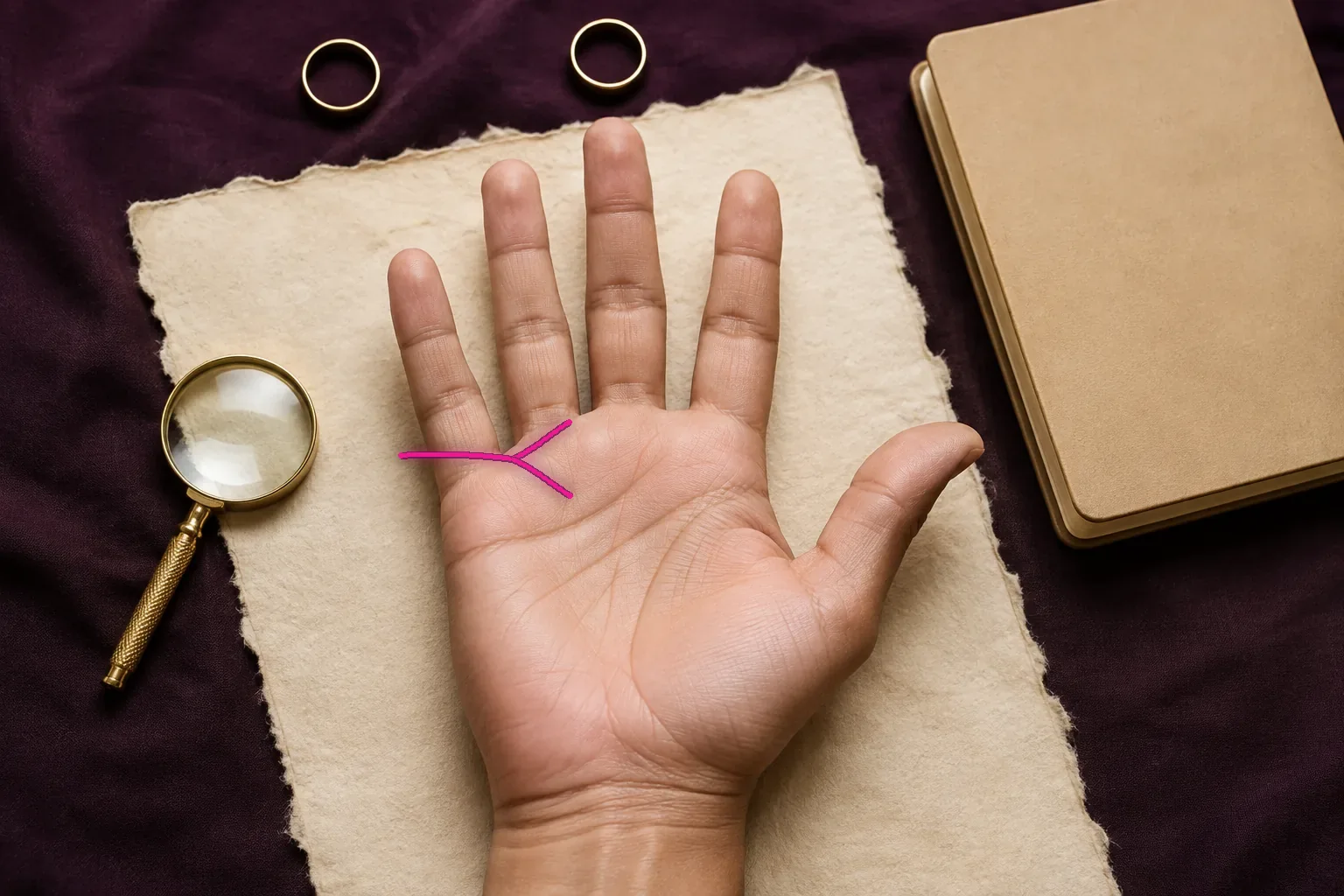
A forked marriage line is traditionally read as two relationship directions developing from one shared bond. A fork at the inner end can suggest priorities, circumstances, or paths diverging after the relationship has developed. A fork at the outer start can suggest separate beginnings, distance, or two conditions that later come together. Neither pattern proves separation, divorce, infidelity, or the number of marriages.
A forked relationship line becomes meaningful only after its edge position, parent route, shared junction, start or end location, prong width, direction, relative strength, continuation, timing, supporting features, and both hands are compared. A whole-hand reading can show how commitment, distance, priorities, strain, repair, and relationship direction fit together.
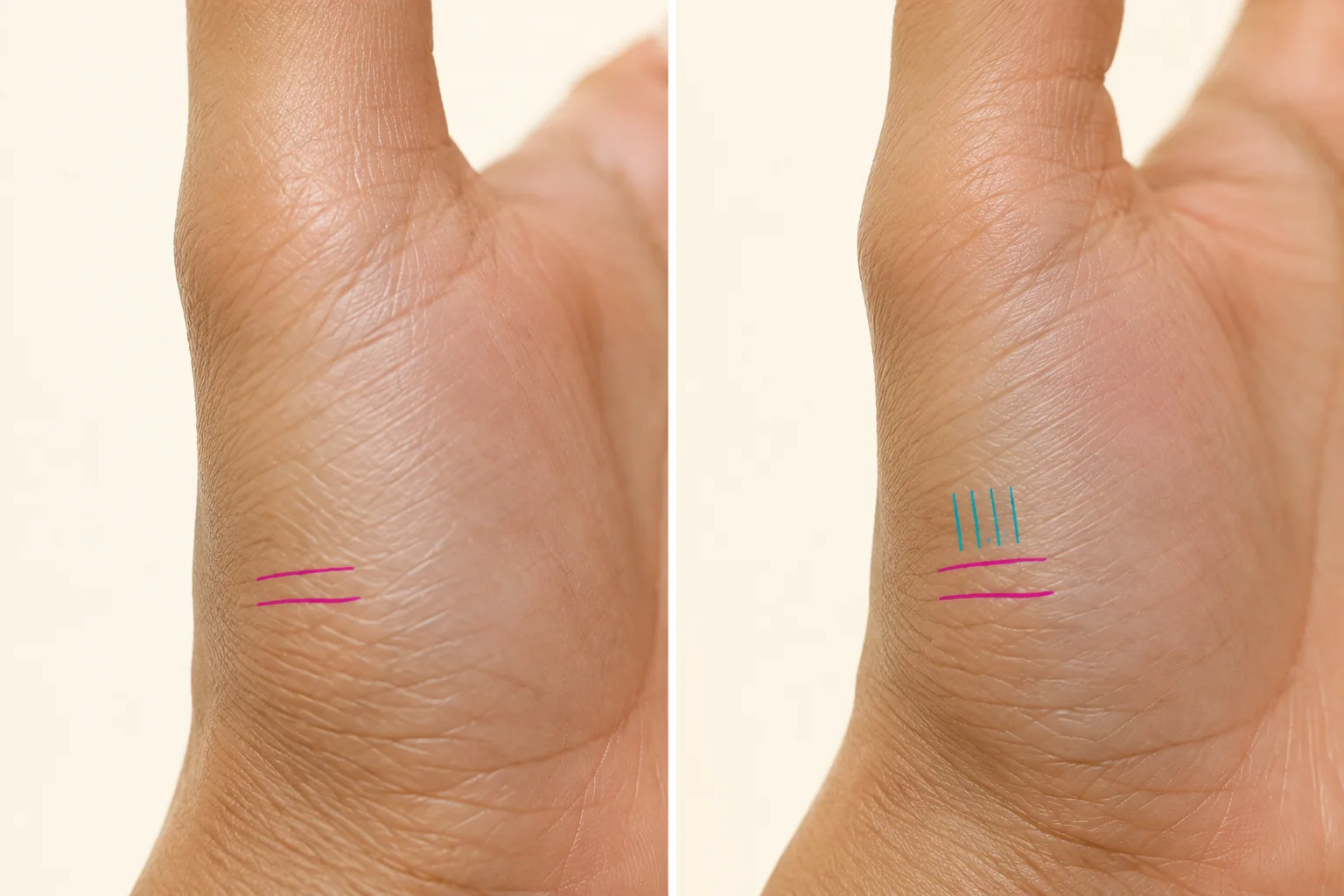
Use a seven-part forked-marriage-line method: verify the relationship-line zone, identify one parent line, locate the shared junction, decide whether the fork is at the outer start or inner end, compare prong width and direction, trace what happens afterward, and compare the heart line and both hands. The complete pattern matters more than the word “fork.”
A fork describes direction, not a guaranteed outcome
One small split cannot tell you whether a relationship ends. A narrow fork that rejoins, a wide sustained divergence, a branch, and two overlapping lines are different formations. Read the geometry first, then test whether other relationship features repeat the same theme.
Where the marriage line is located
The lines commonly called marriage lines sit on the outer edge of the palm below the little finger and above the heart line. “Relationship line” is the more accurate label because the crease does not certify a legal marriage. The complete relationship-line guide explains the zone, line ranking, depth, length, slope, and common variations.
Photograph the edge as well as the open palm. The line begins at the outer edge and travels inward. This orientation is essential: a split nearest the edge is a start fork, while a split at the palmward end is an end fork. A straight-on palm photo can hide the edge and reverse that interpretation.
| Landmark | What it establishes | Common error |
|---|---|---|
| Outer hand edge | Relationship-line beginning | Calling the palmward end the start |
| Heart line below | Lower boundary of the zone | Reading a heart-line branch as marriage line |
| Little-finger base above | Upper boundary of the zone | Counting finger-joint creases |
| Deepest independent horizontal line | Principal relationship line | Giving every fine crease equal weight |
| Shared junction | True location of the fork | Joining two unrelated lines visually |
How to verify a true fork
A true fork has one parent relationship line and exactly two prongs sharing one junction. At an end fork, the parent stops at the junction and both prongs continue. If the parent continues straight beyond a side stroke, the smaller route is a branch. The general fork guide explains this parent-continuation test.
| Pattern | Identification | Read as |
|---|---|---|
| One line becomes two endpoints | One junction; parent stops | True end fork |
| Two edge routes join into one | Two beginnings; one continuation | True start fork |
| Parent continues past an offshoot | Main route remains visible | Branch |
| Two lines overlap without joining | No shared junction | Overlapping relationship lines |
| Line stops and restarts | Open skin separates sections | Break or shifted continuation |
| Split rejoins | Enclosed space appears | Island |
Retake the edge with soft side light. Skin folds, glare, compression from a bent little finger, or ink drawn over the line can create a false junction. The prongs should remain visible with the hand relaxed and under a second angle.
What a forked marriage line does not tell you
A fork does not identify a partner, prove that two people are involved, or determine who leaves. It cannot distinguish legal marriage from a meaningful unmarried partnership, and it cannot replace what the people involved communicate and do. Palmistry uses the formation as a symbolic clue about direction within a relationship pattern. The most useful question is therefore not “Does this guarantee divorce?” but “What kind of divergence appears, how strong is it, and do the rest of the hand and the lived situation support the same theme?”
Keep the name of the feature separate from the strength of the evidence. A tiny shallow split visible only under hard flash carries less weight than two clear sustained prongs repeated on both hands. Likewise, a dramatic-looking fork followed by a reunion has a different sequence from a modest split with no continuation. Classification comes first; the parent line, the route after the junction, and repeated supporting signs decide the interpretation.
Fork at the start versus fork at the end
An outer-start fork begins as two edge routes that converge into one relationship line. Traditional readers may explore separate circumstances, distance, hesitation, or different starting positions that become more unified. An inner-end fork begins as one line and separates into two palmward routes, traditionally emphasizing later divergence in priorities, location, emotional direction, or shared plans.
| Fork location | Traditional theme | What changes the reading |
|---|---|---|
| Narrow start fork that joins cleanly | Different beginnings become coordinated | Strength after the join |
| Wide start fork | Distance or distinct conditions shape the opening | Length before convergence |
| Narrow end fork | Two priorities emerge but remain close | Prong clarity and later marks |
| Wide end fork | More sustained divergence in direction | Whether either route reconnects |
| End fork with one faint prong | One main path with a secondary possibility | Which prong is continuous |
| Fork that rejoins | A period of divided direction followed by repair | Line quality after reunion |
Even a wide end fork is not a standalone divorce sign. The separation guide requires a sequence: sustained divergence, breaks or repeated cuts, weakening, lack of continuation, and agreement from the heart line, fate changes, influence lines, and both hands.
Fork width, prong strength, and direction
Measure width relative to the relationship line and hand, not with a universal millimeter rule. A narrow opening keeps the two directions closely related. A wide opening gives their difference more weight. Equal prongs suggest two comparably strong aims; one deep and one fine prong makes the deeper route primary.
| Feature | Traditional emphasis | Check next |
|---|---|---|
| Equal clear prongs | Two directions carry similar weight | Endpoints and both hands |
| One stronger prong | One direction dominates | Whether the fine route persists |
| Upper prong rises | Aspirations, standards, or greater commitment shape one path | Jupiter and heart-line ending |
| Lower prong descends toward heart line | Emotional pressure or disconnection affects one path | Actual contact with heart line |
| Prongs stay level | Difference concerns parallel practical directions | Width and continuation |
| One prong curves back | Reconsideration or attempted reunion | Whether it reconnects |
Can a forked marriage line predict when separation happens?
No exact date comes from fork width or length. The vertical position of the entire relationship line within the edge zone is used only for a broad relationship chapter. Along the line, the outer beginning is earlier and the inner end later within that bond. The timing guide explains why this produces a sequence rather than a calendar promise.
| Timing observation | Reasonable use | Avoid |
|---|---|---|
| Fork at outer start | Opening phase has divided conditions | Assigning a wedding age |
| Fork near inner end | Divergence appears after development | Assigning a divorce year |
| Fork followed by reunion | Separation-and-repair sequence | Promising reconciliation |
| Later independent line | Another relationship chapter may become prominent | Counting legal marriages |
| Matching fate or life-line change | Use the overlap as a broad calibration | Forcing unrelated scales to one date |
Forked relationship line on one hand or both
Compare both palms using the active hand for present expression and the less-active hand for underlying capacity. A matching wide end fork on both hands gives divergence more structural weight. A fork only on the active hand may show a current change in priorities. A fork only on the less-active hand can show an underlying possibility expressed through a simpler present route.
Differences between hands describe development, not contradiction. The which-hand guide explains this comparison without gender rules. Use matched edge photos because different finger tension can make one hand look more forked.
Combinations that refine a forked marriage line
| Combination | Traditional synthesis | Read with |
|---|---|---|
| Narrow end fork + clear heart line | Different priorities remain inside emotional continuity | Heart ending and Venus |
| Wide end fork + relationship-line break | Divergence gains weight as a changed chapter | Continuation after the break |
| Start fork + Moon influence | Distance, relocation, or outside environment shapes the beginning | Fate-line contact |
| End fork + upward Jupiter prong | Commitment standards or personal growth alter one direction | Jupiter mount and index finger |
| Fork rejoins + clear fate line | Repair occurs while shared structure remains | Line after reunion |
| Fork + repeated crossing bars | Outside pressures complicate divided priorities | Sources of the bars |
The whole-hand love guide combines the relationship line with the heart line, Venus, Moon, Jupiter, Mercury, thumb, fate influences, and both hands.
Worked forked marriage-line examples
Narrow inner-end fork with two equal prongs
Two priorities emerge after one shared route, but their closeness and equal strength suggest coordination remains possible. A clear heart line and a later reunion would strengthen continuity.
Wide end fork with one fading lower prong
The relationship develops divergent directions, though the clearer prong becomes the main continuation. Check whether a break, later line, fate shift, or repeated bars confirm a changed chapter.
Wide start fork that joins into one deep line
Separate circumstances, distance, or hesitation shape the opening, followed by a more unified relationship route. Moon and fate contacts can clarify whether environment or relocation belongs to the story.
Apparent fork that is actually a branch
The parent relationship line continues straight and one fine stroke rises from it. Read an added aspiration or influence instead of treating the formation as two equal directions.
Photo checklist for a forked relationship line
- Take one full-palm photo of each hand.
- Add a sharp edge-on close-up below each little finger.
- Keep the little finger relaxed and naturally extended.
- Include the heart line as the lower boundary.
- Show where the parent line begins, joins, or splits.
- Retake under soft side light to verify fine prongs.
- Do not press, stretch, or draw over the crease.
- State hand dominance and the relationship question you want explored.
Read the fork inside the complete relationship pattern
A Full Palm Reading maps the relationship-line edge, parent route, junction, fork location, both prongs, width, direction, strength, timing, crossings, continuation, and both hands. It then adds the heart line, Venus, Moon, Jupiter, Mercury, thumb, fate influences, hand shape, and texture into one holistic reading focused on your questions.
The complete answer
A forked marriage line is one relationship route with two shared directions. A start fork concerns conditions that begin separately and may converge; an end fork concerns priorities or paths that diverge after the bond has developed. Width, prong strength, upward or downward direction, reunion, breaks, crossings, later lines, timing sequence, and both hands decide how much weight it carries. It cannot prove divorce, separation, infidelity, or a marriage count. A Full Palm Reading maps the fork and all important features across both hands and combines them into a holistic reading focused on your questions about commitment, distance, strain, repair, separation, timing, and the relationship path ahead.
A Full Palm Reading
Ask what your relationship-line fork means across both hands
Your reading maps the relationship-line edge, parent route, shared junction, start or end fork, both prongs, width, direction, strength, timing, crossings, continuation, and both palms, then adds the heart line, Venus, Moon, Jupiter, Mercury, thumb, fate influences, shape, and texture into one holistic reading focused on your questions.
Your Full Palm Reading maps all the important features—hand shape, skin texture, thumb, fingers, mounts, major and minor lines, markings, and the differences between both palms—and brings them together in a holistic reading focused on your questions.