
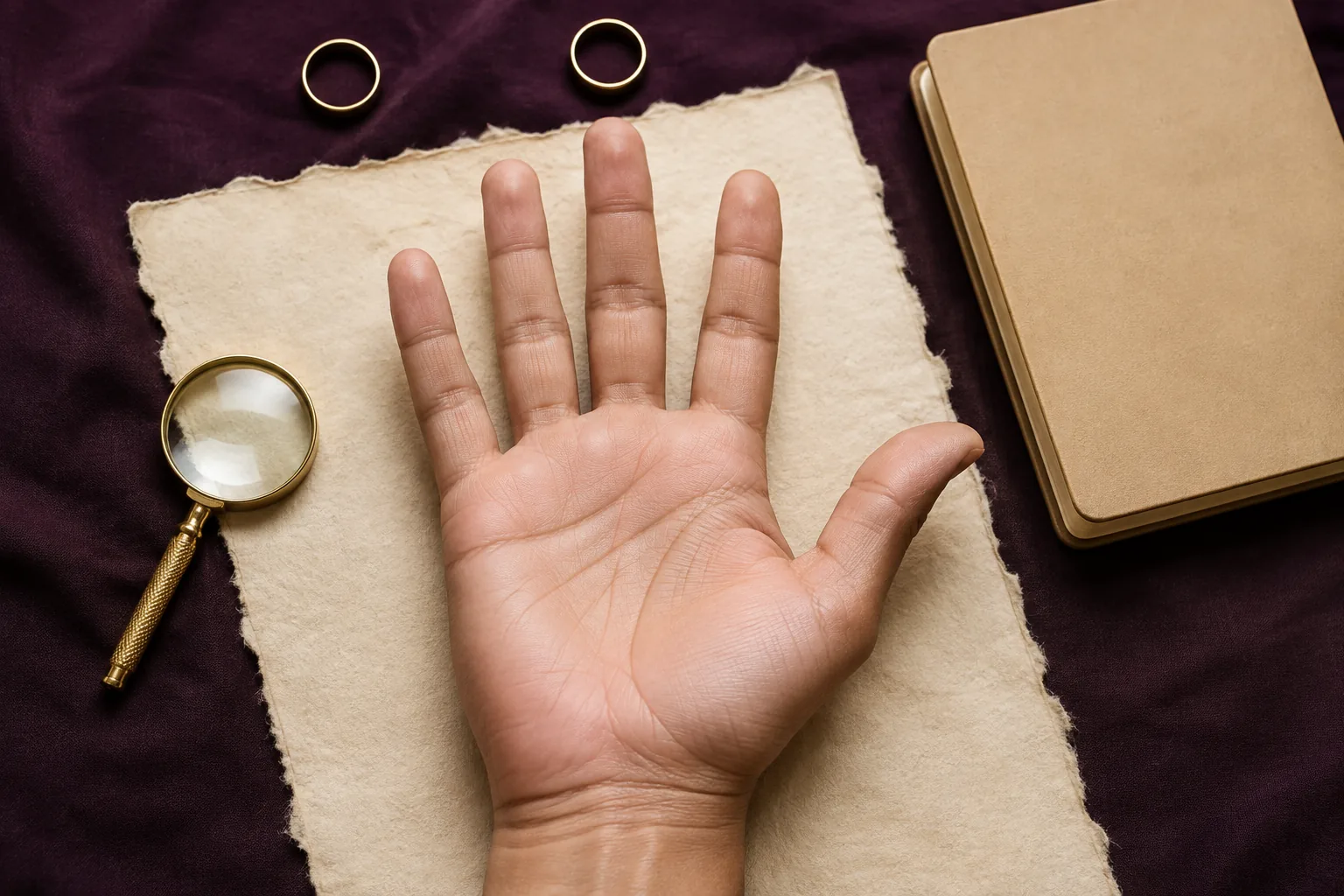
In palmistry, the traditional signs most often associated with separation are a wide fork at the inner end of a clear relationship line, a clean break or gap, a deep bar cutting the line, a downward curve toward the heart line, or an island followed by weakening. None works alone as a divorce verdict. The strongest separation pattern repeats across the relationship line, heart line, fate line, influence lines, and both hands. What the line does after the mark—rejoin, overlap, strengthen, change course, or disappear—shows whether the chapter leans toward repair, prolonged distance, or a different path.
A fork, break, bar, or island becomes useful only when its direction, continuation, timing, and supporting lines are clear. A whole-hand reading can distinguish strain from sustained divergence and show whether repair, distance, closure, or a later chapter repeats across both palms.
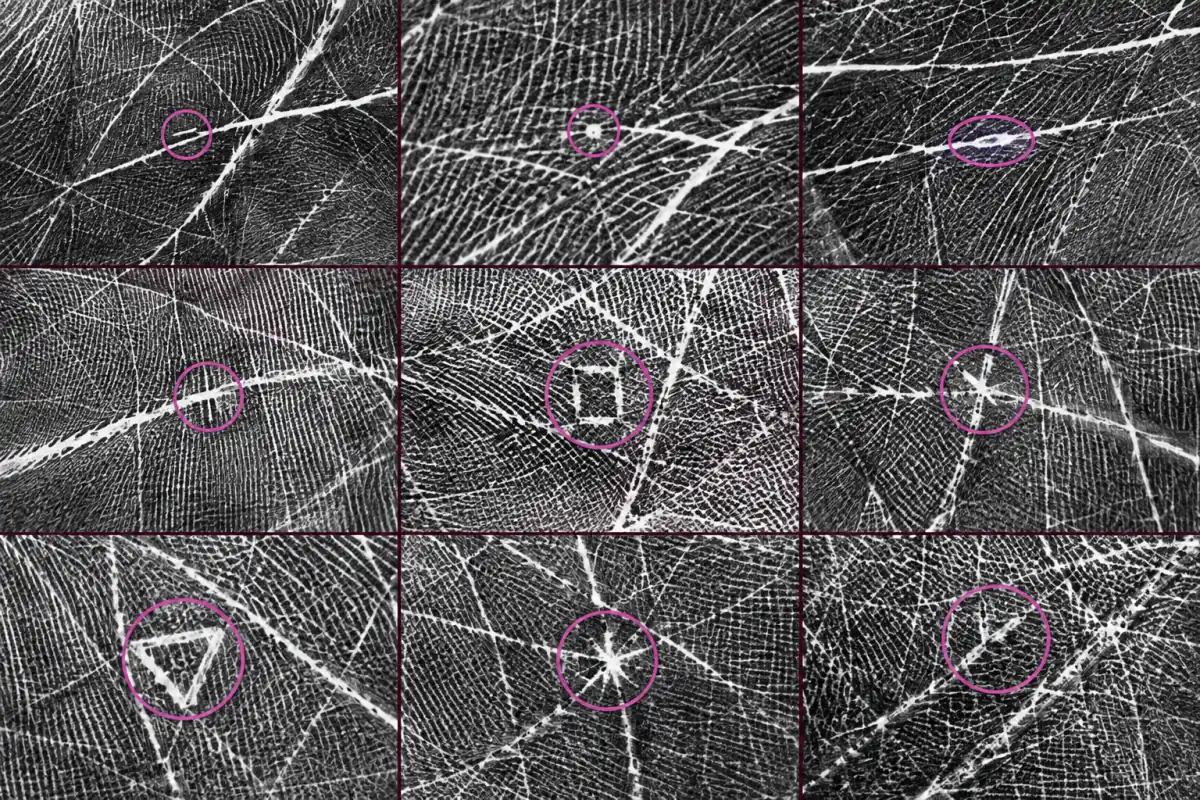
Begin with one correctly identified relationship line. It enters from the outer edge below the little finger and above the heart line. Follow it from the edge inward. The outer end shows how the bond begins; the inner end shows how its direction develops. This reading order is essential because a starting fork and an ending fork tell different stories.
Divorce and separation signs at a glance
| Observed feature | Traditional relationship meaning | What changes the reading |
|---|---|---|
| Wide fork at the inner end | Two directions, priorities, or lives diverge after the bond forms | Fork width, branch direction, and supporting heart or fate changes |
| Gap in a clear relationship line | Interruption, separation, or a major change in the agreement | Whether the continuation aligns, overlaps, strengthens, or shifts |
| Deep bar crossing the line | A defined outside obstacle affects the relationship | Source of the bar and line condition after the crossing |
| Island within the line | An extended complicated, uncertain, or entangled period | Island length and whether the line clears afterward |
| Line bends down toward the heart line | Emotional burden, disappointment, distance, or loss of shared direction | How close it comes to the heart line and the heart line's own condition |
| Many fine cuts or chaining | Repeated tension, interference, or stop-start progress | Whether one deep line remains intact beneath the fine marks |
| Separate later relationship line | A new significant bond may follow the first chapter | It must begin independently and carry real depth and length |
Verify the line zone with the relationship-line guide. A finger-base crease, a vertical children line, or a shadow in a front-facing photograph should not be relabelled as a divorce sign.
Forked marriage line: the direction changes the meaning
A true fork belongs to one line: a single stem divides into two visible branches. Trace from the outer edge to locate the split. A fork at the beginning can describe a difficult start that later unites; a fork at the inner end can describe divergence after the relationship develops.
| Fork pattern | How it looks | Traditional reading |
|---|---|---|
| Small fork at the outer beginning | Two fine edge branches soon merge into one line | Hesitation, distance, or different starting conditions that later align |
| Wide fork at the outer beginning | Branches begin far apart before meeting | A longer or more complicated route into commitment |
| Small inner-end fork | The established line divides slightly near its endpoint | Different priorities or a period of divided direction |
| Wide inner-end fork | Two strong branches move apart and do not reunite | Stronger traditional separation or estrangement theme |
| Upper branch rises | One branch moves toward the little-finger base | Independence, ambition, or a change that raises personal direction |
| Lower branch falls | One branch moves toward the heart line | Emotional strain, disappointment, or unequal adjustment |
| Branches reunite | A divided section becomes one clear line again | Temporary separation, renegotiation, or repair |
Does a forked marriage line mean divorce?
The strongest traditional association applies to a wide fork at the inner end whose branches keep separating, especially when the heart line and fate line change in the same broad chapter. A tiny fork, a starting fork that joins, or a branch created by crossing skin creases does not carry the same weight. Measure the structure before interpreting the word.
Broken marriage line: gap, overlap, or shifted continuation?
A break interrupts an otherwise identifiable relationship line. The continuation determines the sequence. A clean continuation can show a bond resuming; an overlapping continuation can show separation and reconnection; a shifted line can show the relationship returning under different terms or a later distinct bond.
| Break pattern | Visual cue | Traditional sequence |
|---|---|---|
| Narrow gap, same route | Two ends align across a small empty space | A contained interruption with potential continuity |
| Overlapping fragments | The second segment begins before the first fully ends and runs beside it | Separation followed by reconnection or repair |
| Continuation above the gap | The new segment resumes on a slightly higher course | Relationship continues with more independence, aspiration, or changed terms |
| Continuation below the gap | The new segment resumes nearer the heart line | Emotional weight or reduced ease after the disruption |
| Wide gap with no continuation | The first line stops and the area remains clear | A stronger ending theme within this one-line method |
| New independent line at another level | A separate line begins again at the outer edge | A later relationship chapter rather than a continuation |
The distinction between an offset continuation and a genuinely new line is central. A continuation belongs to the earlier route; a second relationship line has its own outer-edge start. The second-marriage guide provides a full independence test.
What if the break is covered by a fine line?
A fine line bridging the gap changes the reading from a clean ending to a link that persists through the interruption. An overlap, connecting branch, or square-like enclosure can be read as continuity, protection, or a route to repair. Check that the bridge is a real crease and not the edge of an island.
Bars, crosses, islands, and downward curves
These marks describe how strain enters the relationship. Their source, depth, and aftermath matter. One deep crossing line carries more weight than a mesh of superficial skin texture.
| Mark | What to verify | Question it raises |
|---|---|---|
| Bar | A separate line cuts fully across the relationship line | What outside condition interrupts the bond, and does the line recover? |
| Cross | Two short lines form a complete X on or beside the line | Is this a single defining conflict or two unrelated creases? |
| Island | The line divides around a closed oval and reunites | How long does the uncertain or entangled section last? |
| Chain | Several small linked islands replace a clean segment | Is tension repeated, or is the photograph exaggerating fine texture? |
| Downward curve | The main line itself bends toward the heart line | Does emotional burden dominate the later part of the relationship? |
| Downward branch | One branch falls while the main line continues | Is there strain within the bond without complete loss of continuity? |
| Upward branch after a mark | A branch rises from a continuing line | Does growth, independence, or resolution follow the difficult stage? |
Can family or distance appear as the obstacle?
A line approaching from Venus can add family, home, attachment, or close-network influence. A line approaching from Moon can add distance, relocation, public life, travel, or a different social environment. Neither source proves who caused a separation. It identifies the field where pressure or change may be experienced.
What does the heart line add?
The heart line shows whether the emotional pattern repeats the relationship-line change. A break with an overlapping continuation can support disruption followed by recovery. A downward branch at a similar stage can add disappointment or emotional load. A line that remains deep and even while the relationship line forks can suggest the feelings stay strong even when practical paths divide. Use the heart-line guide to locate these variations.
Which palmistry signs suggest separation and reunion?
Repair signs show continuity after disruption. Palmists look for a joined fork, overlapping fragments, a bridging line, a clean continuation after an island, a relationship line that deepens again, or a clearer active-hand pattern. Fate and heart lines that continue strongly through the same chapter add support.
| After the difficult mark | Traditional direction | Interpretive emphasis |
|---|---|---|
| Fork branches reunite | Two directions become one again | Temporary distance or renegotiation |
| Broken fragments overlap | Continuity survives the gap | Separation followed by reconnection |
| Fine bridge crosses the gap | A link remains during interruption | Communication, responsibility, or attachment holds |
| Line clears after an island | Uncertainty resolves into a steadier path | Recovery after a complicated period |
| Line becomes deeper after a bar | The bond regains force after an obstacle | Adaptation and renewed commitment |
| Active hand is clearer than less-active hand | Current choices show more integration | The lived pattern may be improving |
| No continuation and later independent line | The first route ends and another begins | Closure followed by a different relationship chapter |
A repaired line does not erase the difficult chapter; it changes the ending of the sequence. Ask how the continuation looks, not only whether a break exists.
How fate-line changes support a relationship reading
The fate line describes direction and structure. If it breaks, shifts, or weakens at a stage that matches the relationship-line disruption, partnership may coincide with changes in work, home, responsibility, or identity. If fate strengthens after the junction, the relationship change may lead into a clearer direction. If it remains unaffected, the separation theme may be more emotional than structural.
Influence lines joining fate can also show another person becoming important. If a later independent influence joins after the first relationship line ends, compare it with any later relationship line. This may support a new chapter, but it cannot identify the person or guarantee remarriage.
Temporary separation versus a lasting split
Temporary separation patterns retain visible continuity; lasting-split patterns show sustained divergence or no return to the original route. The comparison is about line structure rather than legal status.
- Temporary or repair emphasis: small fork that rejoins, narrow aligned gap, overlapping continuation, bridge line, cleaner line afterward, or stronger active-hand version.
- Prolonged distance emphasis: wide fork with branches continuing separately, long island, repeated bars, or a weak continuation that never regains depth.
- Changed path emphasis: first line ends and a separate significant line begins at another level, supported by a new fate-line influence.
- Contradictory pattern: difficult relationship line with a steady heart and fate pattern, or a clear relationship line with disrupted major lines. Keep the conclusion conditional and identify the contradiction.
Which hand shows divorce or separation?
Compare both. Under the active-hand convention, the less-active palm shows the underlying relationship pattern and the active palm shows how choices and circumstances have developed it. The active hand carries more weight for the current path, while the other supplies context.
- Same wide ending fork on both hands: the divergence theme repeats strongly.
- Fork on the less-active hand, joined line on the active hand: lived choices may be resolving an underlying division.
- Clear line on the less-active hand, break on the active hand: current experience shows a disruption that was not as strong in the background pattern.
- Break on one hand, overlap on the other: interruption with some route to reconnection fits better than a clean ending.
- Different marks and different timing zones: they may describe separate relationship chapters; do not force them into one event.
Follow the two-hand comparison method rather than assigning divorce to one fixed hand or using a gender rule.
How is separation timing estimated?
Place the mark along the relationship line from outer beginning to inner development, then place the entire line in the lower, middle, or upper part of the relationship zone. Compare that broad stage with a matching fate-line or heart-line change. Use known relationship events to calibrate the scale.
- Confirm the relationship line and its outer-edge start.
- Identify the exact mark: fork, gap, overlap, bar, island, or curve.
- Record where it occurs along the line and within the edge zone.
- Describe the continuation after the mark.
- Find any heart-line or fate-line change at a comparable broad stage.
- Repeat the sequence on the other palm.
- Calibrate using a known relationship, move, work change, or family event.
This produces a broad relationship chapter, not a reliable date for separation or legal divorce.
Six worked examples
Example 1: difficult beginning that settles
The relationship line begins with a small fork at the outer edge, then becomes deep and even. The heart line remains clear and fate strengthens later. This fits differing starting conditions that resolve into one stable direction.
Example 2: temporary separation and reunion
A narrow gap divides the relationship line, but the fragments overlap and the later section grows stronger. The heart line also has a fine overlapping continuation. The repeated sequence supports disruption followed by reconnection.
Example 3: sustained divergence
A deep line ends in a wide inner fork whose branches continue apart. One branch falls toward the heart line, and fate shifts at a similar stage on both palms. Traditional palmistry gives this a stronger separation reading than a tiny isolated fork.
Example 4: outside obstacle without a split
One deep bar cuts the relationship line, but the line continues straight and clear afterward. A Moon influence reaches fate near the same chapter. The pattern can describe distance or relocation testing the bond without removing continuity.
Example 5: a complicated period that clears
The main line contains one modest island and returns to a deep even route. The active hand shows a smaller island than the less-active hand, and the heart line remains strong. This leans toward an entangled or uncertain period that becomes more settled.
Example 6: first chapter ends, later relationship begins
The lower line stops after a downward branch. Clear space separates it from a later independent upper line that begins at the outer edge and stays even. A new influence joins fate in the later zone. This supports a changed relationship path and should be compared with the later-partnership framework.
Photo checklist for separation markings
- Photograph both full palms from fingertips through wrists.
- Add a sharp 45-degree view below each little finger.
- Keep the hand relaxed and capture both sides at the same angle.
- Use bright indirect light plus one gentle side-lit image.
- Include the heart-line endpoint and little-finger base in the edge frame.
- Do not draw over, smooth, sharpen, or increase contrast around the mark.
- Capture the full fate line if timing or life-direction change matters.
- State hand dominance and whether the question concerns strain, distance, repair, separation, or a new relationship.
Questions that make this reading useful
- Is the mark a true inner-end fork, a starting fork, or crossing creases?
- Do the broken fragments align, overlap, shift, or stop completely?
- What happens to the relationship line after the difficult mark?
- Does the heart line repeat emotional disruption or show continuity?
- Does the fate line connect the relationship chapter with work, home, or changed direction?
- Do Moon or Venus influences suggest distance, relocation, family, or close-network pressure?
- Does the active hand look more divided or more integrated?
- Is there a later independent relationship line after the first route ends?
- What needs clarity now: repair, reconnection, boundaries, timing, separation, closure, or a new chapter?
Read the relationship change as one complete pattern
Verify the relationship line, compare forks, islands, and crosses with the markings guide, add emotional continuity through the heart line, and use the whole-hand love map before deciding what the change means.
The complete answer
Divorce and separation lines in palmistry are read as a sequence: identify the principal relationship line, locate a genuine inner-end fork, break, crossing bar, island, downward curve, or repeated cuts, then follow what the line does afterward. Rejoining branches and overlapping continuations support repair; sustained divergence or no continuation gives separation more weight; a later independent line can describe another relationship chapter. The heart and fate lines, Moon and Venus influences, Jupiter, the thumb, timing zones, and both palms show whether the wider pattern agrees. A Full Palm Reading maps all these important features across both hands and combines them into a holistic reading focused on the person's questions about strain, repair, separation, closure, timing, or the relationship path ahead.
A Full Palm Reading
Ask what happens after the difficult mark in your relationship pattern
Your reading verifies the fork, break, bar, island, or curve, follows the relationship line before and after it, then adds the heart and fate lines, Moon, Venus, Jupiter, thumb, timing zones, and both palms to explore strain, repair, separation, closure, or a new chapter.
Your Full Palm Reading maps all the important features—hand shape, skin texture, thumb, fingers, mounts, major and minor lines, markings, and the differences between both palms—and brings them together in a holistic reading focused on your questions.