
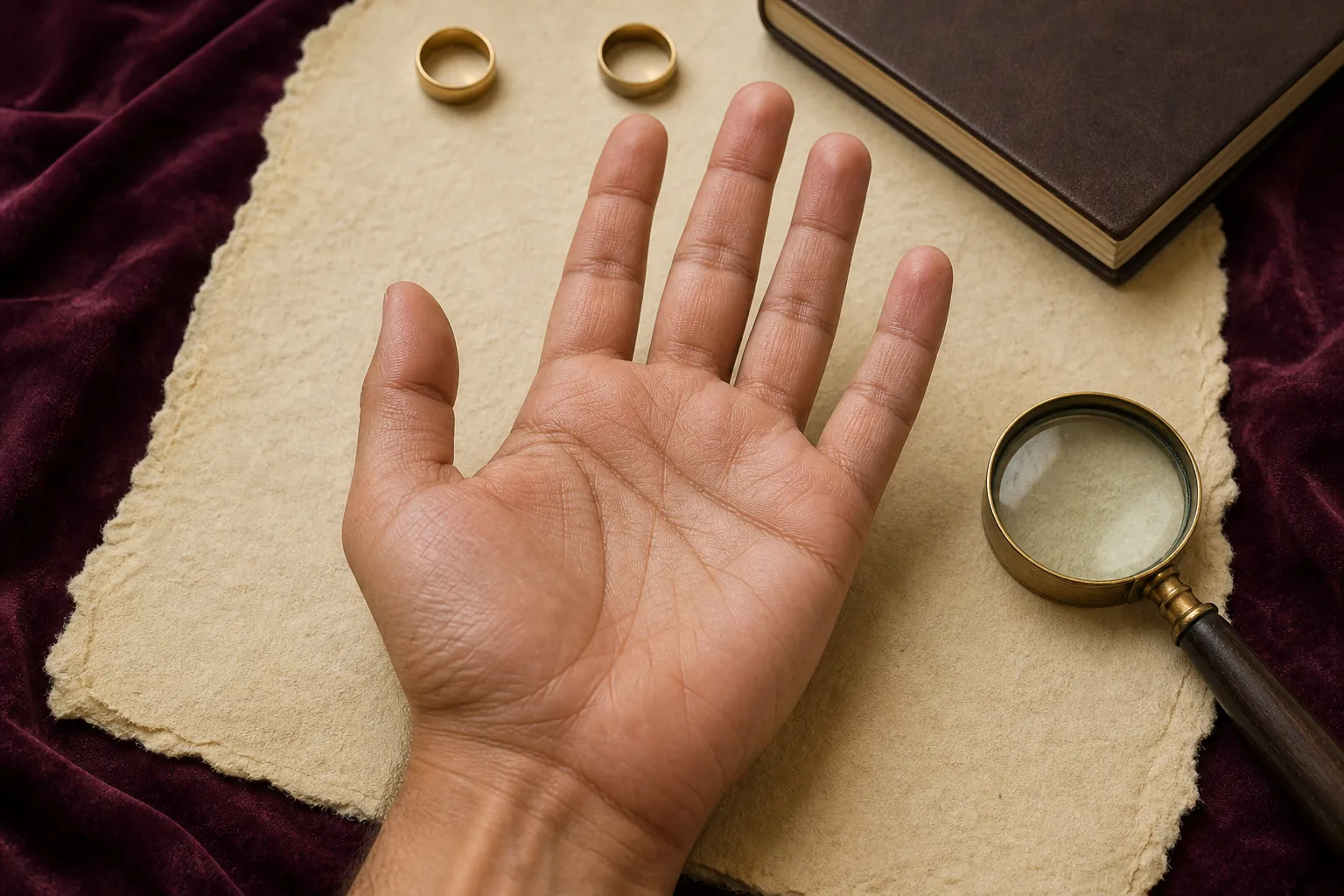
In palmistry, two relationship lines do not automatically mean two marriages. A possible second-marriage or later-partnership pattern needs two separate, clear lines of real strength, with the later line positioned above the earlier one in the traditional timing zone. The first line should show its own completed, weakened, forked, or interrupted chapter, while the second begins independently and develops on a distinct course. Heart-line changes, fate-line influences, and repetition across both hands can strengthen that reading.
Two lines can describe separate relationships, an earlier attachment and later marriage, overlapping chapters, or one bond that changes form. A whole-hand reading can trace each line, compare both palms, and show which relationship sequence the supporting features repeat.
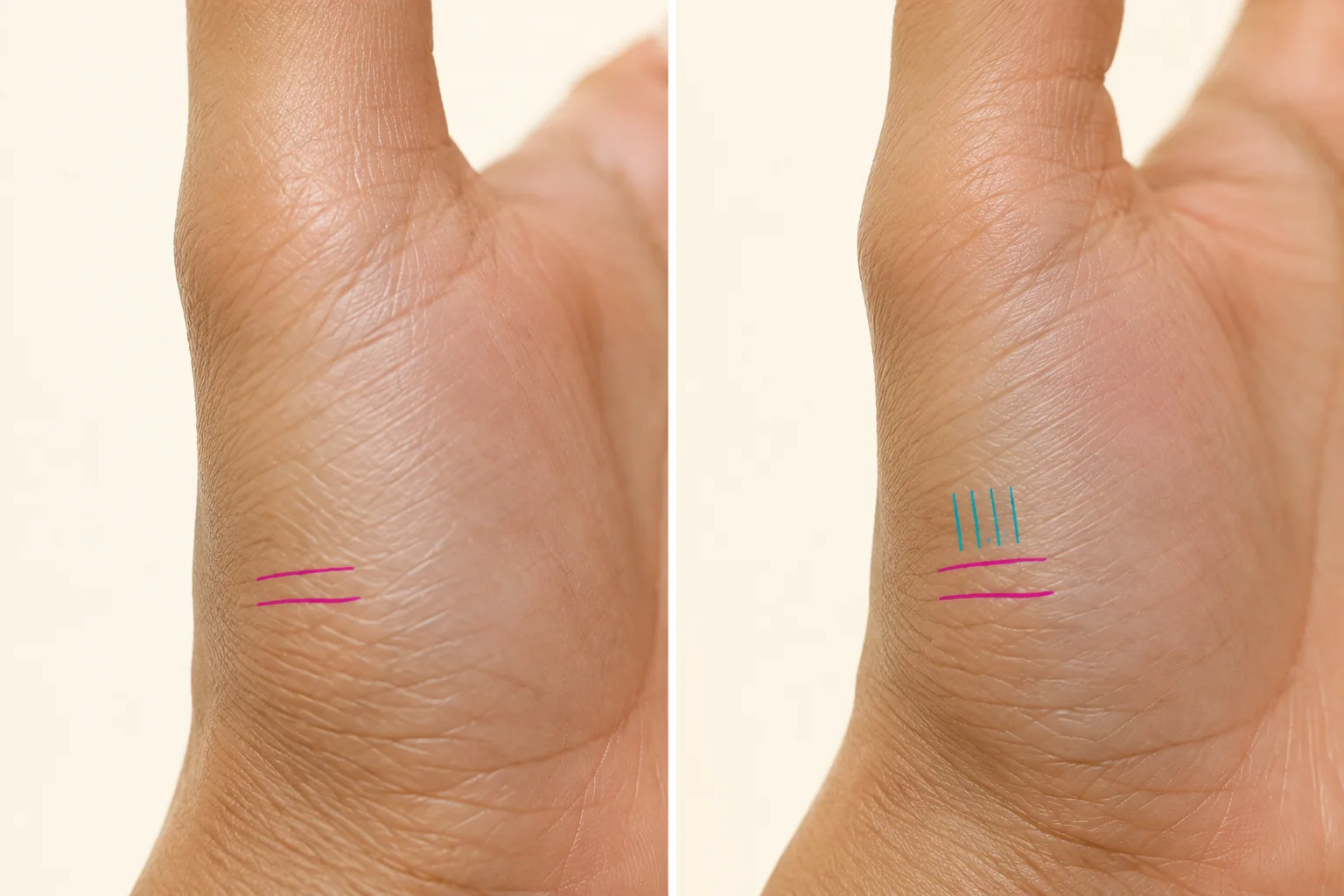
Many palms carry several fine horizontal creases below the little finger. Palmists treat them as relationship or affection lines because they can represent attachments, not marriage certificates. One may reflect a formative love, engagement, long partnership, remarriage, reconciliation, or an emotional ideal. Count visual significance before counting lines.
First verify that there are two relationship lines
Relationship lines enter from the outer, little-finger edge above the heart line and below the crease at the base of the little finger. View the area at a gentle angle with the hand relaxed. The clearest line is usually the main relationship indicator; tiny surface creases receive less weight.
| Visible mark | Does it count as a separate relationship line? | How to verify |
|---|---|---|
| Two horizontal lines that each begin at the outer edge | Possibly | Both should have independent starts, visible length, and meaningful depth |
| One line splitting into two branches | No | Trace backward; both branches share one parent line |
| Two segments separated by a small gap on the same level | Usually no | They may form one broken or interrupted line |
| A fine line running closely beside a deeper line | Not necessarily | It can be a parallel support line or second thread within one bond |
| Vertical marks above a relationship line | No | These belong to the traditional children-line zone |
| A crease visible only when the hand is clenched | No reliable weight | Repeat the photograph with the palm relaxed |
The relationship-line guide maps the correct zone and basic line forms. A side photograph matters because a front-facing palm can hide the actual starting point and make one fork look like two independent lines.
What do two marriage lines mean in palmistry?
After confirming two genuine lines, compare their depth, length, spacing, vertical order, and direction. The stronger line shows the bond that carries greater weight in the hand; it is not always the lower or earlier one.
| Two-line pattern | Traditional interpretation | What prevents a quick conclusion |
|---|---|---|
| One deep line and one faint line | One defining bond and one less developed attachment or possibility | The faint line may never represent a lived partnership |
| Two clear lines widely separated | Two distinct relationship chapters at different broad stages | Distinct bonds do not necessarily equal two legal marriages |
| Two clear lines close and parallel | Two emotional threads, overlapping bonds, or one partnership with dual roles | Close parallel lines can belong to the same life chapter |
| Lower line weakens; upper line is deep and even | An earlier bond loses force before a later relationship becomes central | Check that the upper line starts independently |
| Lower line breaks; upper line begins elsewhere | A first chapter changes or ends, followed by a separate later bond | A shifted continuation can imitate a second line |
| Two equal lines joined by fine branches | Strong overlap, transition, or two connected relationship stories | The bridge can suggest one evolving situation rather than clean separation |
| Three or more fine lines | Several attachments, attractions, or emotional impressions | Rank clarity instead of counting every crease |
Which line is the second marriage line?
Using the common edge-zone timing convention, read upward from the heart line toward the little-finger base. A lower significant line belongs to an earlier broad chapter; a higher independent line belongs later. The upper line is therefore the possible second relationship line only after both lines pass the significance test.
Do not label the upper line as remarriage when it is merely a short branch of the lower line, a parallel sister line, or a skin fold at the finger base. Do not label the lower line as a first marriage when it is faint, short, and contradicted by the rest of the hand.
The complete second-bond sequence
A stronger second-marriage interpretation is a sequence, not a single mark: a first significant line establishes an earlier bond, that line changes or loses force, and a later independent line establishes a new relationship chapter.
| Step | What to observe | Question it answers |
|---|---|---|
| 1. First line | A clear lower relationship line with meaningful length | Was there an earlier defining bond? |
| 2. Transition | Fading, ending, break, fork, downward branch, or changed heart pattern | Does the first chapter lose continuity or change direction? |
| 3. Separation | Visible space between the first line and the later line | Are these genuinely distinct routes? |
| 4. Later line | An independent upper line that begins at the outer edge | Does a new bond form at a later broad stage? |
| 5. Later quality | Depth, length, continuity, upward or downward movement | How stable or complicated is the later chapter? |
| 6. Wider hand | Heart line, fate changes, influence lines, Jupiter, Venus, and both palms | Does the rest of the hand repeat relationship renewal? |
What strengthens a later partnership?
- The upper relationship line is deeper, longer, and cleaner than the lower one.
- The later line rises slightly or gains a fine upward branch.
- The heart line becomes clearer after an earlier interruption or downward branch.
- A new influence from Moon or Venus reaches the fate line at a compatible broad stage.
- The fate line strengthens, shifts into a clearer route, or gains supportive branches after that junction.
- Jupiter carries balanced development or an upward support line associated with commitment and shared growth.
- The active hand shows a more settled later line than the less-active hand.
These signs describe the quality of a later relationship chapter. They cannot identify a specific person, prove that the first marriage ends, or guarantee that a later bond becomes legal marriage.
Could two lines describe one marriage with two chapters?
Yes. One long partnership can contain separation and reunion, renewed vows, a major relocation, recovery after conflict, a change in how the couple lives together, or a second phase with different priorities. Palmists look for continuity between the lines before declaring separate partners.
| Visual relationship | One-bond explanation | Separate-bond explanation |
|---|---|---|
| Two lines very close and parallel | One relationship carries two strong roles or phases | Two bonds overlap or occur close together |
| Lower line breaks and upper segment overlaps the gap | Separation followed by repair or reunion | A later bond begins before the earlier chapter is fully resolved |
| Fine branches connect the two | One partnership changes form while retaining continuity | The emotional transition between two relationships remains connected |
| Lower line fades as upper line strengthens | The same bond renews around new terms | An earlier attachment recedes while another becomes central |
| Lines are clearly separated with independent starts | Less support for a single continuous story | Stronger support for two distinct relationship chapters |
Break and continuation versus a second line
A broken relationship line stays on roughly the same route: one segment stops, a gap appears, and another segment continues inward. When the fragments overlap slightly, palmists often read interruption followed by reconnection. A separate second line begins at the outer edge on another level and establishes its own path. Trace from the edge before deciding which structure you have.
Fork versus two lines
A fork has one stem and two branches. If it opens at the outer edge and joins inward, it describes a divided or hesitant beginning that later becomes one path. If it opens at the inner end, it describes divergence after the bond has developed. Neither formation supplies two independent relationship lines.
How line quality changes the second-marriage reading
| Later line quality | Traditional emphasis | Useful follow-up |
|---|---|---|
| Deep, even, and unbroken | The later bond becomes defining and steady | Check whether the heart and fate lines also stabilize |
| Longer than the earlier line | The later partnership carries greater emotional or practical weight | Compare its direction and ending |
| Faint at the edge, clearer inward | The relationship or readiness develops gradually | What helps it become more definite? |
| Rising slightly | Growth, aspiration, independence, or improving circumstances | Does fate or Jupiter repeat that growth? |
| Cut by bars | Outside conditions complicate progress | What happens to the line after each crossing? |
| Contains an island | A period of uncertainty or entanglement occurs within the bond | Does the line clear after the island? |
| Ends in a wide fork | Plans or directions diverge later in the chapter | Keep this distinct from how the bond began |
How heart, fate, Moon, and Venus support the sequence
The heart line shows the emotional pattern carried through both chapters. A break with an overlapping continuation can fit emotional disruption and recovery; upward branches can show renewed openness or hope. Read the full structure with the heart-line guide rather than treating one cross or fork as a verdict.
A new influence line joining fate can connect partnership with a change of direction. Moon-side influence may emphasize a connection through distance, relocation, public life, work, travel, or wider social circles. Venus-side influence may emphasize family, familiar networks, home, or close support. What fate does after the joining point—strengthening, shifting, continuing, or weakening—matters more than the source alone.
Jupiter adds ideals, respect, formal commitment, and shared growth. Venus adds affection, attachment, and home life. The thumb adds how firmly the person chooses and how readily they adapt. Together these features distinguish a later clear partnership from a second faint possibility.
How is second-marriage timing compared?
First place the two lines in vertical order within the edge zone. Then compare the later line with a fate-line junction or change. Below the head line belongs to an earlier life-direction chapter, between head and heart to a middle chapter, and above the heart line to a later one. Use this only as a broad comparison.
- Confirm both lines begin independently at the outer edge.
- Mark the lower line as earlier and the upper line as later.
- Record the end or change in the earlier line.
- Assess the strength and direction of the later line.
- Find any separate influence joining fate and place it relative to head and heart.
- Compare the same sequence on the other palm.
- Calibrate with a known relationship, move, work change, or family event.
The marriage-timing method explains the zone in more detail. Do not convert the spacing between two lines into exact years without calibration.
Which hand shows a second marriage?
Compare both hands. Under the active-hand convention, the less-active palm supplies the underlying relationship pattern and the active palm shows how lived choices and circumstances have developed it. The active hand receives more weight for the current path, but repeated structure across both hands creates the strongest pattern.
- Two separate clear lines on both hands: two defining relationship chapters repeat strongly.
- Two lines on the less-active hand, one dominant line on the active hand: one lived bond may have become central while another remained potential or background.
- One line on the less-active hand, two on the active hand: lived experience has developed a second significant relationship chapter.
- Broken lower line on one hand, overlapping continuation on the other: interruption and renewal may fit better than two separate bonds.
- Later line clearer on the active hand: the newer chapter may be becoming more settled through current choices.
Use the both-hand comparison guide rather than assigning a fixed hand by gender.
Five worked examples
Example 1: two important relationships, only one marriage
A clear lower line is moderately long but fades. A higher line is deeper, longer, and even. The lower line can describe a formative bond or engagement; the upper line can carry the eventual marriage. Two significant lines do not require remarriage.
Example 2: later partnership after an earlier marriage
The lower line is deep and ends with a clear downward branch. Visible space separates it from a higher independent line that begins at the outer edge and remains clean. A new influence also joins fate near the later stage. This is a stronger traditional second-partnership sequence.
Example 3: separation and reunion within one bond
What appears to be two lines is one broken route with overlapping fragments on the same level. Fine branches connect the sections, and the heart line shows an interrupted but clear continuation. One relationship with a pause and renewal fits better than an automatic second marriage.
Example 4: overlapping relationship chapters
Two strong parallel lines run close together and are linked by fine branches. The timing zones nearly coincide. Palmists may explore emotional overlap, a transition, or two important roles within one partnership; the lines do not establish what happened without context.
Example 5: surface creases mistaken for multiple marriages
Four shallow marks appear only when the little finger is bent, and none continues far from the edge. The heart and fate patterns offer no matching sequence. There is no basis for counting four relationships or marriages; repeat the photograph with the hand relaxed.
Photo checklist for second-marriage lines
- Photograph both full palms from fingertips through wrists.
- Add a sharp 45-degree view below each little finger.
- Keep the hands relaxed and photograph both at the same angle.
- Use bright indirect light, then add one gentle side-lit image.
- Include the heart-line endpoint and little-finger base as boundaries.
- Do not draw, smooth, sharpen, or increase contrast around the lines.
- State hand dominance and whether the question concerns remarriage, reunion, or a later partnership.
- Include the full fate line if timing or life-direction change matters.
Questions that make a second-marriage reading useful
- Do I have two independent relationship lines or one forked or broken line?
- Which line is deeper, longer, and more continuous?
- Does the earlier line fade, end, fork, or continue beneath the later one?
- Does the upper line describe a later partner, reunion, or renewed phase?
- Do heart-line changes repeat disruption followed by recovery?
- Does a Moon or Venus influence join fate in the same broad chapter?
- Do both hands show two distinct bonds?
- What matters most now: closure, reconnection, a new partner, timing, or stability?
Read the full relationship sequence
Start with the relationship-line map, place the lines with the broad timing method, compare delay patterns through the marriage-delay guide, and add the whole-hand love pattern.
The complete answer
Second marriage lines in palmistry are two separate, significant relationship lines with independent starts and distinct timing positions—not a fork, break, parallel support line, or group of surface creases. The first line must show its own chapter, while the upper later line establishes another bond and its quality. Heart-line development, fate-line changes, Moon or Venus influences, Jupiter, the thumb, and comparison across both palms help distinguish a new partnership from reconciliation or a second phase within one marriage. A Full Palm Reading maps all these important features across both hands and combines them into a holistic reading focused on the person's questions about earlier bonds, closure, reunion, remarriage, timing, and later relationship stability.
A Full Palm Reading
Ask whether your lines show separate bonds or one relationship in two chapters
Your reading compares the depth, length, spacing, direction, and timing of each relationship line, then adds the heart and fate lines, Moon, Venus, Jupiter, thumb, and both palms to explore closure, reunion, remarriage, and the quality of a later partnership.
Your Full Palm Reading maps all the important features—hand shape, skin texture, thumb, fingers, mounts, major and minor lines, markings, and the differences between both palms—and brings them together in a holistic reading focused on your questions.