
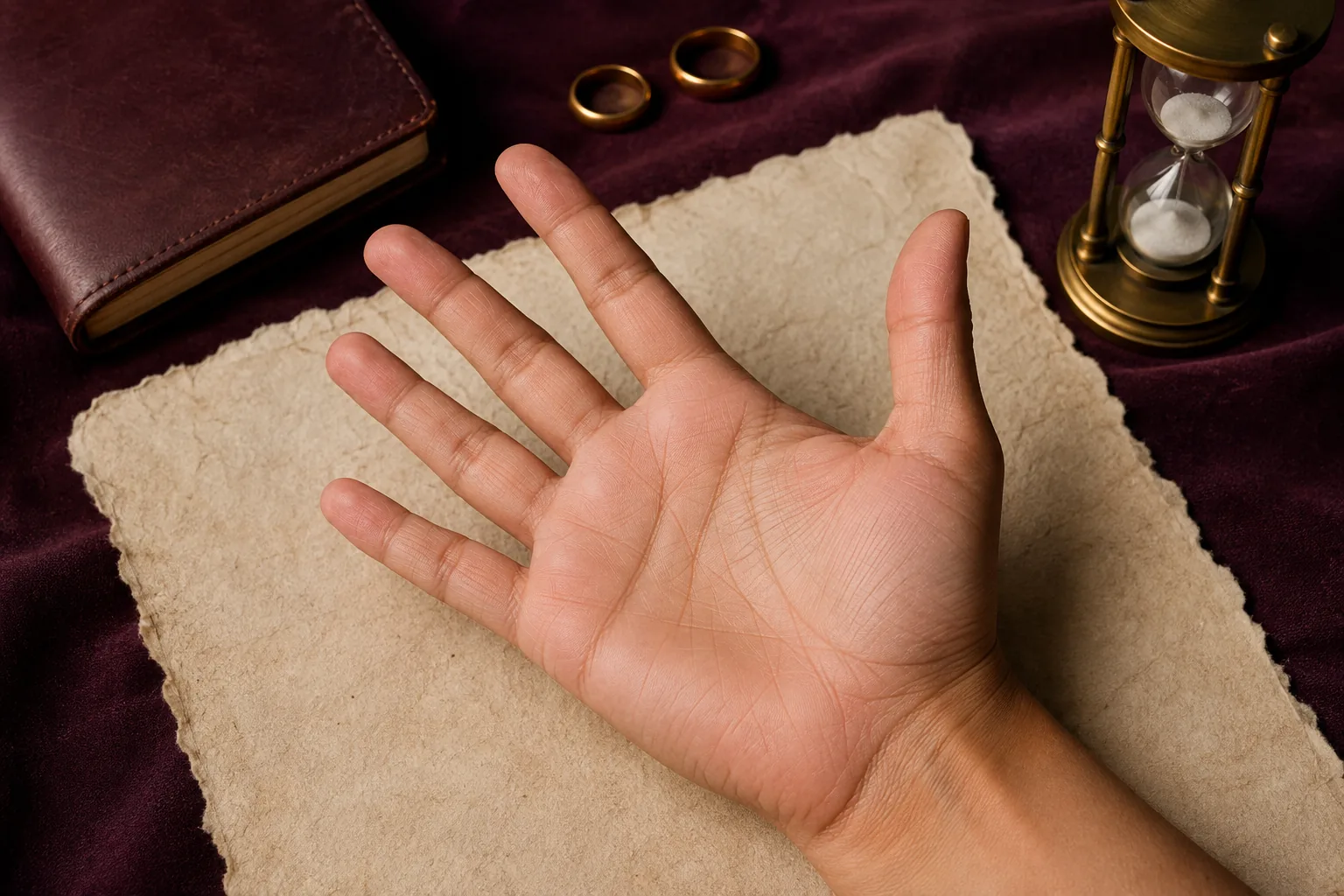
In palmistry, the clearest traditional sign of later marriage or commitment is one strong relationship line placed high in the narrow zone below the little finger, closer to the finger base than to the heart line. The reading becomes a delay pattern when that high position is repeated by a faint or slowly strengthening line, a fork at the beginning, one or more bars, an island, a late-stabilizing fate line, or signs of family, distance, career, or personal-readiness obstacles. Delay does not mean denial: a high line that becomes clear and even can describe a later but stable partnership.
A high relationship line may show a later chapter, while forks, bars, faintness, work, distance, family influence, or emotional readiness can describe why the path takes time. A whole-hand reading can distinguish later timing from a temporary obstacle and show what develops after it.
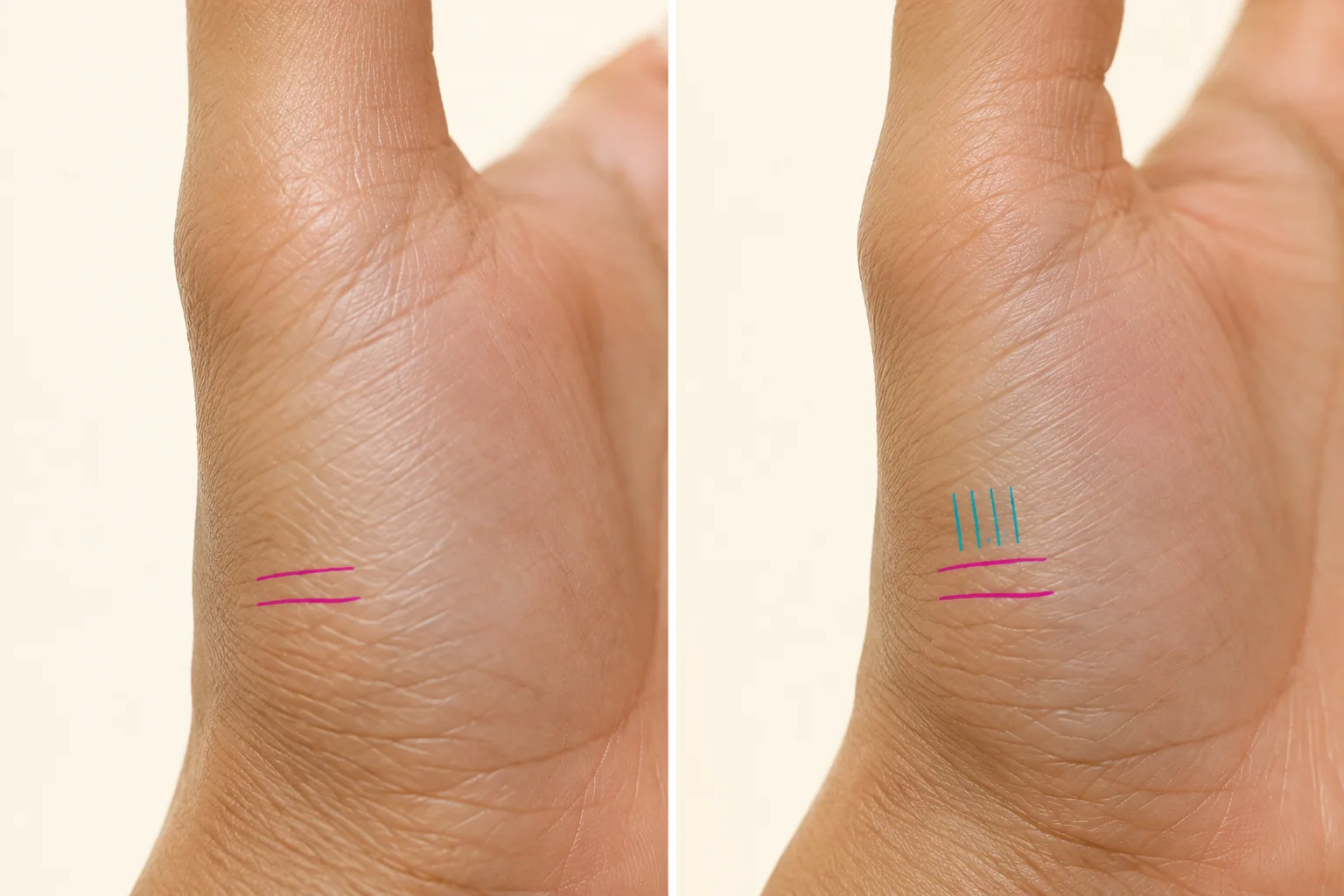
Start by finding the correct line. Relationship lines are short horizontal creases entering from the outer, little-finger edge of the palm above the heart line. Select the longest and clearest line in that area. Do not count every fine skin crease, the crease at the base of the little finger, or a line seen only when the hand is tightly bent.
Marriage-delay signs at a glance
| Observed feature | Traditional delay meaning | What must be checked next |
|---|---|---|
| Clear relationship line high in the zone | Commitment becomes central in a later life chapter | Line quality, both hands, and a second timing method |
| Main line faint near its beginning, clearer inward | A bond or readiness develops gradually | Whether the line truly starts at the edge and strengthens |
| Fork at the outer beginning | Hesitation, distance, differing plans, or a delayed start | Whether the branches reunite into one clear line |
| Fine bar crosses the line | A specific obstacle or interruption affects progress | Location of the bar and condition after it |
| Island on the early or middle section | An extended period of uncertainty or entanglement | Whether the line clears after the island |
| Several weak relationship lines, one later strong line | Early connections remain less defining than a later bond | Do not count the fine lines as marriages |
| Fate line settles or strengthens later | Work, direction, or independence stabilizes before commitment | Compare its timing with the relationship zone |
A mark matters only when it belongs to a clear relationship line and repeats a wider story. A high, clean line and a high, heavily obstructed line may both point later, but they do not describe the same path. Use the relationship-line guide to verify the location and basic variations first.
Does a high marriage line mean late marriage?
Traditionally, yes: a principal relationship line nearer the little-finger base is read later than one nearer the heart line. It is a relative scale, not a dependable calendar. Hand proportions, the width of the zone, the angle of the photograph, and the reader's chosen timing system all change the estimate.
| Position of the clearest line | Traditional timing emphasis | Best wording |
|---|---|---|
| Lower zone, nearer the heart line | Earlier adult relationship chapter | Earlier relative to the other available markings |
| Middle of the zone | Middle relationship chapter | A broad middle period, refined with other lines |
| Upper zone, nearer the little-finger base | Later relationship chapter | Later commitment, not a fixed age |
| No clearly dominant line | The edge scale cannot carry timing | Use other features and avoid inventing a date |
How to place the line correctly
- Relax the hand; do not clench it to manufacture edge creases.
- Find the heart line where it reaches the little-finger side.
- Find the skin crease at the base of the little finger.
- Treat the space between those two boundaries as one zone.
- Choose the clearest horizontal line entering from the outer edge.
- Record whether it lies in the lower, middle, or upper third.
- Repeat the observation on the other hand before interpreting it.
The separate marriage-timing guide explains how palmists compare this relative position with a fate-line junction. For delay intent, the more useful question is whether the line develops cleanly or encounters obstacles before it becomes established.
Forks, bars, islands, and faint lines
Markings describe the route into commitment more precisely than the line's height alone. Always follow the relationship line from the outer edge inward and note whether the difficulty appears at the beginning, middle, or end.
| Line form | How it looks | Traditional reading for delay |
|---|---|---|
| Starting fork | Two fine branches enter from the edge and join | Different starting conditions take time to resolve before one path forms |
| Middle fork that rejoins | The line divides briefly, then becomes one again | A temporary split in plans, location, or readiness |
| Crossing bar | A separate short line cuts across the relationship line | An outside condition interrupts progress at that stage |
| Island | The line divides around an enclosed oval and reunites | A sustained uncertain or complicated period |
| Faint beginning | The line is barely visible at the edge but gains depth inward | A connection or willingness to commit takes time to become definite |
| Break with offset continuation | One section stops and another starts on a shifted course | A pause, changed agreement, or restart; not automatically the same as delay |
| Downward branch | A branch leaves the line toward the heart line | Emotional strain can complicate progress; read the heart line before concluding |
A starting fork is different from an ending fork
A fork at the outer edge belongs to the opening of the relationship story. It can fit a long courtship, distance, hesitation, different family expectations, or two possible routes that later become one. A fork at the inner end belongs later in the line's development and more often describes divergence after the bond has formed. Direction matters; calling every fork a marriage delay loses the sequence.
What does a line crossing the marriage line mean?
A fine bar is traditionally read as an obstacle, but it cannot name the obstacle. Compare its source and the wider hand. Lines arriving from Venus may add family duties or familiar-circle influence. Moon-side and travel features may add distance, relocation, or an outside environment. A changing fate line may add work or financial direction. A stressed heart line may add emotional uncertainty or repair work.
Delay, difficulty, and denial are not the same pattern
| Pattern | What the lines show | Interpretive focus |
|---|---|---|
| Later timing | A high, clear, largely even principal relationship line | A later chapter that can still be stable |
| Delayed start | A starting fork, faint beginning, or early bar that clears | What must align before commitment becomes definite |
| Difficult chapter | Island, repeated bars, weakening, or an interrupted heart pattern at the same stage | Complexity, pressure, or repair rather than calendar timing alone |
| Changed relationship path | A break with a shifted continuation or strong divergence | Pause, renegotiation, restart, or a different bond |
| No usable indication | Only fine surface creases or no dominant relationship line | Do not turn absence into a prediction that marriage cannot happen |
An absent or very faint relationship line is not proof of no marriage. The edge of the palm carries many shallow folds, and the visibility of those folds changes with pressure, dryness, lighting, and camera angle. Palmists give more weight to what is clear and repeated than to what they expected to find but could not.
Supporting combinations that explain a delay
A complete reading asks what is developing around the relationship line. The same high line can sit inside a career-first, distance, family, emotional-readiness, or selective-partner pattern.
| Combination | Possible palmistry story | What strengthens the later outcome |
|---|---|---|
| High relationship line + fate line stabilizes later | Work, direction, or financial independence settles before commitment | Fate becomes clearer and continuous after the change |
| Starting fork + Moon travel features | Distance, relocation, study, work abroad, or different home bases slow the start | The fork rejoins and fate remains clear |
| Crossing Venus lines + balanced Jupiter | Family duties or approval shape the pace of formal commitment | A clean principal line and supportive Jupiter pattern |
| High line + heart line ending toward Jupiter | Strong standards or selectivity make the person wait for alignment | Clear heart line rather than heavy chaining or breaks |
| Faint line becomes deep + stronger active-hand pattern | Readiness or one relationship becomes more definite over time | The later section stays even and uncut |
| Island followed by a clean continuation | A complicated period resolves before steadier partnership | The line regains depth and supporting signs repeat stability |
Career and marriage delay
If the fate line begins weakly, changes course, or becomes strong only above the head line, palmists may read a life direction that takes longer to settle. When the relationship line is also high or initially faint, the combined story can place commitment after work, study, business, or independence becomes clearer. Read the fate-line route with the career-change and timing guide.
Family influence and approval
Several clear lines crossing from Venus toward the life or fate line can add family involvement, responsibility, or pressure. They do not automatically show opposition. A fine supportive Venus influence that joins a steady fate line may instead describe help, introduction, or approval. The love-versus-arranged marriage guide shows how Venus and Moon influences are distinguished.
High standards and emotional readiness
A heart line ending strongly toward Jupiter is traditionally linked with clear ideals and selectivity. A straight or guarded heart line with a firm thumb may prefer certainty before commitment. A chained or interrupted heart line can add an unsettled emotional chapter, but it should not be used to label someone incapable of love. Compare the pattern with the heart-line guide.
Which hand shows marriage delay?
Compare both hands. In the active-hand method, the less-active hand shows the underlying relationship pattern and the active hand shows how choices and circumstances have developed it. The active hand carries more weight for the path currently being built, but the reading is strongest when the same theme repeats.
- High clear line on both hands: the later-timing theme is repeated.
- Faint line on the less-active hand, clearer line on the active hand: commitment or relationship direction has become more defined.
- Fork on the less-active hand, joined line on the active hand: an underlying hesitation or divided start may be resolving.
- Clean line on the less-active hand, bars on the active hand: current conditions may complicate an otherwise steady background pattern.
- Different vertical positions: do not average them into an exact age; compare the events and calibrate the scale.
Use the two-hand comparison method rather than assigning one hand to women and the other to men.
How palmists estimate whether the delay resolves
- Choose the clearest relationship line and place it in the lower, middle, or upper zone.
- Follow the line inward and record exactly where it forks, weakens, crosses, or clears.
- Check whether the line after the obstacle becomes deeper, straighter, and more continuous.
- Compare the heart line for emotional stability and Jupiter for standards and formal commitment.
- Trace the fate line for a matching stage of work, relocation, independence, or family influence.
- Repeat the same sequence on the other hand.
- Calibrate the broad zones against a known relationship or life turning point.
Resolution is traditionally stronger when a starting fork joins, an island closes into a clean continuation, an early bar is followed by an even line, or the fate line strengthens in the same broad chapter. The method can describe sequence and relative timing; it cannot produce a reliable wedding date.
Five worked examples
Example 1: later but steady commitment
One deep relationship line sits in the upper third, stays even, and has no bars or islands. The heart line is clear, Jupiter is balanced, and fate is stable. The strongest reading is later timing with steady commitment, not a blocked marriage.
Example 2: a delayed start caused by distance
The main line begins with a small fork that reunites. Travel lines appear on Moon, and a Moon influence joins fate near the same broad stage. This combination can describe distance, relocation, or different home bases that must align before the relationship settles.
Example 3: career stability before commitment
The relationship line is high and initially faint, while fate is broken early but becomes strong above the head line. The active hand shows a clearer continuation than the less-active hand. Palmists may read work or independence becoming definite before partnership does.
Example 4: family pressure that later clears
A Venus-side line crosses the beginning of the relationship line, but the principal line becomes deep and even afterward. Jupiter has an upward support line and fate remains steady. The story is family involvement or approval slowing the opening stage, followed by a more settled path.
Example 5: insufficient evidence
The edge shows several shallow creases only when the hand is tightly bent, with no dominant line on either hand. There is no sound basis for declaring delay. The next step is a relaxed side-view photograph and a whole-hand reading, not choosing the highest crease and assigning it an age.
Photo checklist for marriage-delay signs
- Photograph both palms from fingertips through wrists.
- Add a sharp 45-degree view of the edge below each little finger.
- Keep the hand relaxed rather than clenched or stretched.
- Use bright indirect light plus one side-lit image for fine lines.
- Keep the heart-line endpoint and little-finger base in the same frame.
- Do not draw over, sharpen, smooth, or filter the creases.
- State hand dominance and the relationship or commitment question.
- Include a known timing event if you want the broad scale calibrated.
Questions that make a marriage-delay reading useful
- Is my clearest relationship line actually high, or am I counting a finger-base crease?
- Does the line show later timing, an obstacle, or both?
- Does a starting fork reunite into one steady direction?
- What changes after the bar, island, faint section, or break?
- Do work, distance, family involvement, or personal standards repeat elsewhere?
- Do both hands show the same sequence?
- Which broad life chapter does the relationship line share with the fate line?
- What present question needs the most clarity: meeting, readiness, approval, distance, commitment, or timing?
Build the complete marriage-timing picture
Verify the relationship line, compare its broad stage with the marriage-timing method, add relationship style through the love-reading map, and compare both palms before deciding what the delay pattern means.
The complete answer
Marriage delay signs in palmistry begin with a clear relationship line placed high below the little finger, then add its starting condition, forks, bars, islands, depth, and continuation. Fate-line changes can connect the delay with career or independence; Moon features with distance or relocation; Venus influences with family involvement; and the heart line, Jupiter, and thumb with readiness, standards, and commitment. A clear line after the obstacle is more supportive than an obstructed line that keeps weakening. A Full Palm Reading maps all these important features across both hands and combines them into a holistic reading focused on the person's questions about timing, obstacles, approval, readiness, and the relationship path ahead.
A Full Palm Reading
Ask what is shaping the timing of commitment in your complete hand
Your reading verifies the relationship line and its markings, then adds the heart and fate lines, Moon, Venus, Jupiter, thumb, broad timing zones, and both palms to explore whether the pattern reflects a later chapter, a temporary obstacle, or readiness that is still developing.
Your Full Palm Reading maps all the important features—hand shape, skin texture, thumb, fingers, mounts, major and minor lines, markings, and the differences between both palms—and brings them together in a holistic reading focused on your questions.