
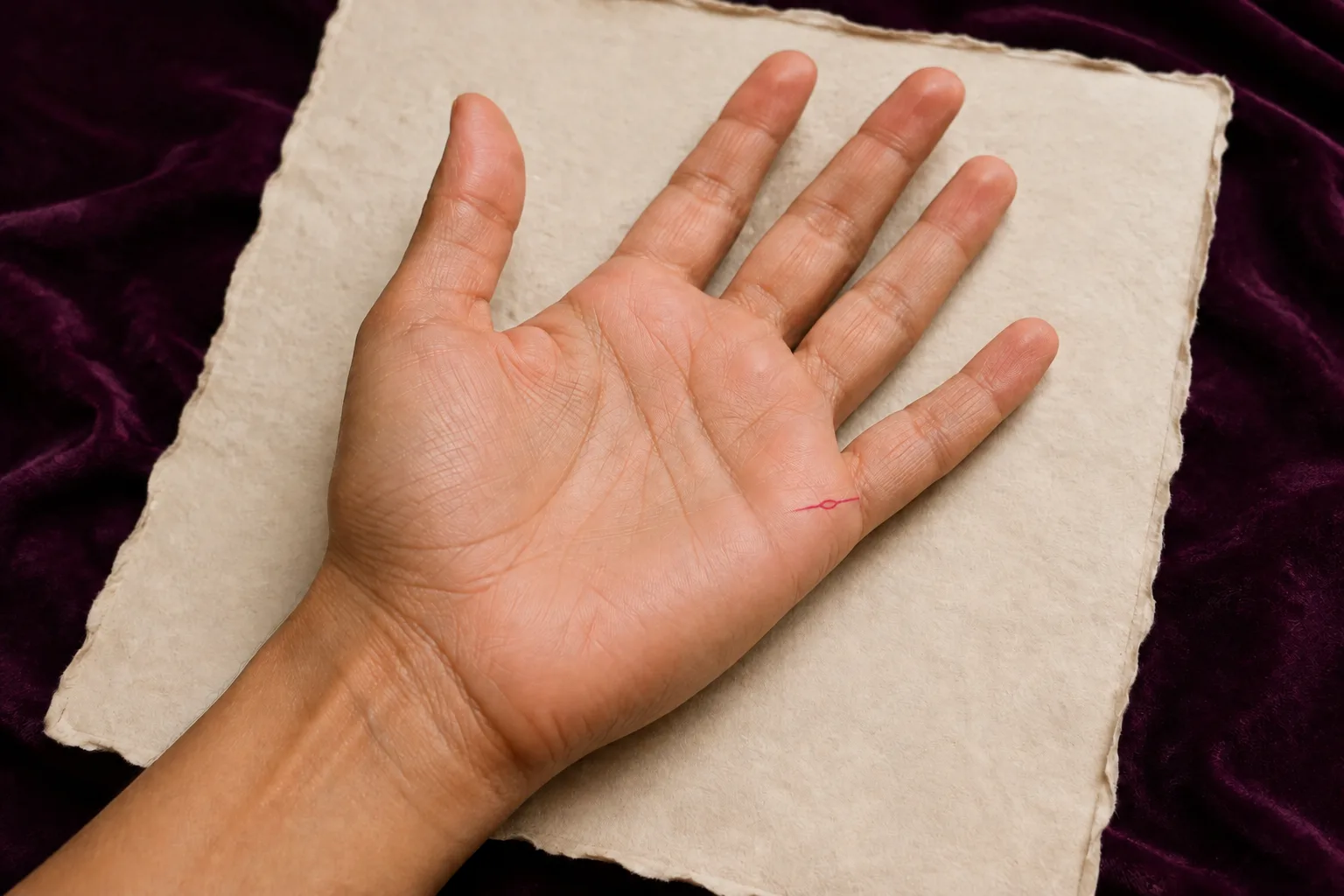
An island on the marriage line is one closed oval formed when a verified relationship-line parent divides into two short strands and then reunites. Traditional palmistry reads the enclosed section as a bounded phase of divided relationship attention, uncertainty, distance, or competing pressure. It does not prove divorce, infidelity, separation, or an unhappy marriage. The line's height, the island's position along it, the clarity of the continuation, the Heart line, other relationship lines, real behavior, and both palms are needed before interpretation.
One relationship-line island becomes personal only after the correct Mercury-edge zone, true horizontal parent, single closed split-and-reunion geometry, start, middle or end position, line height, proportional size, depth, clarity before and after, multiple-line, fork, overlap, break, chain, crossing, child-line and skin-fold tests, Heart, Venus, Head, Fate, Mercury, timing, actual behavior, and both palms are compared. A whole-hand reading can show what divided connection and what becomes clearer afterward.
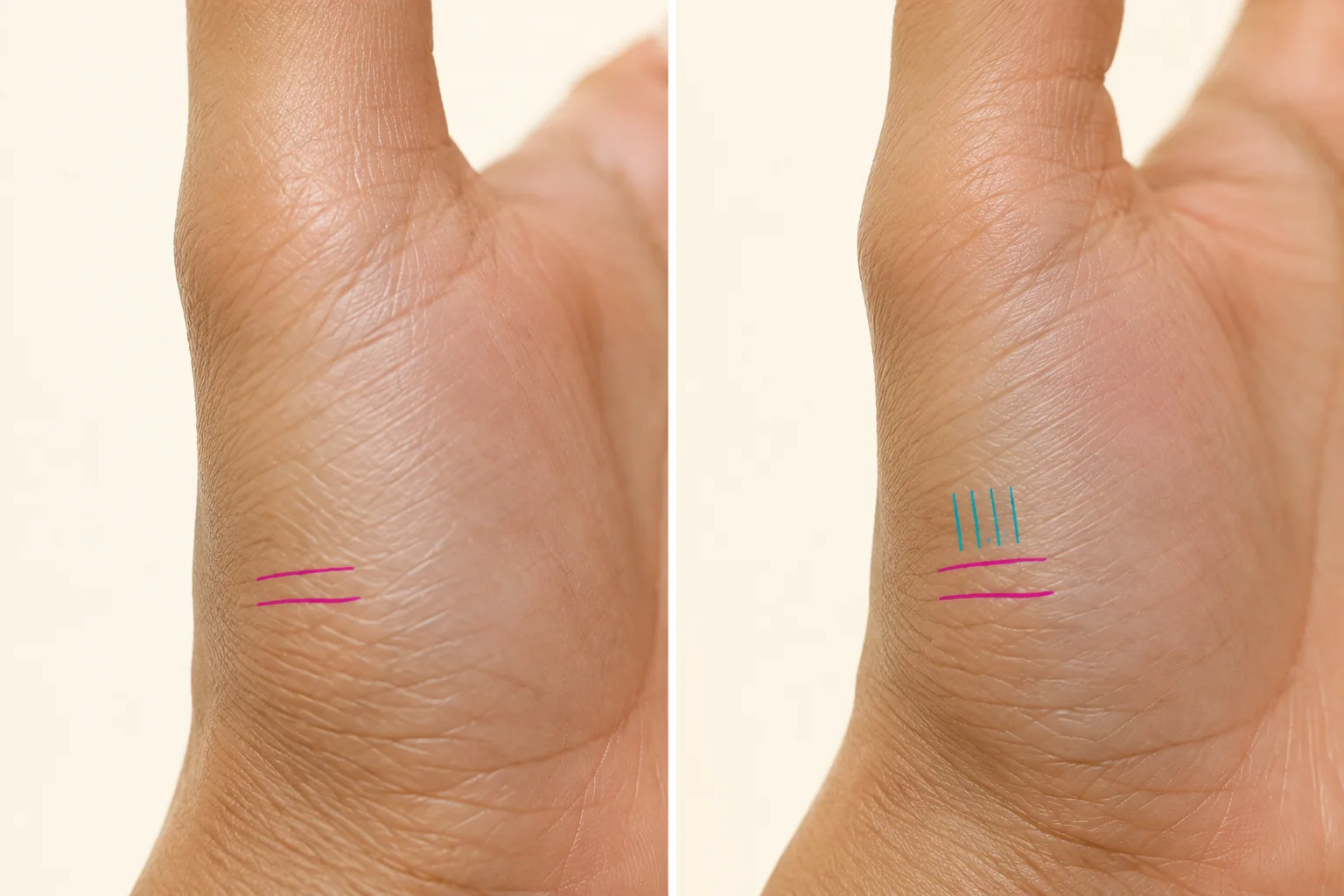
The older name “marriage line” is widely searched, but these short horizontal creases are also called relationship, union, affection, or attachment lines. They sit on the outer edge below the little finger and above the Heart line. They are traditionally explored through significant attachment patterns rather than counted as legal marriages. An island describes texture within one line; it does not identify a partner, name an event, or settle the future of a relationship.
Read the visual sequence before the symbolism. One line enters from the outer edge, divides around a closed space, reunites, and continues. The opening can mark where a complicated phase begins within the line's symbolic story, while the reunion and outgoing route show what happens afterward. A clear continuation changes the answer materially.
How to identify a true relationship-line island
Begin with a full-palm photograph, then add an edge close-up. A crop of the Mercury edge alone can make ordinary skin folds look like independent relationship lines. The complete marriage-line guide shows the correct zone and explains how to select the strongest line before reading a variation.
- Locate the zone. Find the outer edge below the little finger and above the Heart line.
- Select one parent. Trace a genuine horizontal edge-origin line rather than the longest mark in a crop.
- Find the opening. The single parent must divide into two connected sides.
- Confirm a closed space. Both sides should enclose one visible oval or almond shape.
- Find the reunion. The two sides must reconnect.
- Trace the continuation. Check whether one route continues inward after the reunion.
- Relax the hand. Edge folds change when the fingers are stretched or clenched.
- Use side light. A second angle separates real grooves from shadows and dry texture.
- Compare nearby lines. Separate the island from another relationship line and vertical child-line creases.
- Repeat on the other palm. Similar or cleaner geometry can show how the pattern differs.
This is the ten-part island-on-marriage-line method: zone, parent, opening, closed space, reunion, continuation, relaxed hand, side light, nearby-line comparison, and both palms. If the two sides never join at both ends, record the actual formation instead of forcing an island label.
Island, fork, two lines, overlap, break, chain, or fold?
The relationship-line edge carries many fine creases. Most dramatic readings begin with a geometry error. A true island belongs to the same parent before and after the oval. Use the general island test when the formation is unclear.
| Formation | What to trace | Why it differs |
|---|---|---|
| One relationship-line island | One parent splits, encloses one space, reunites, and continues | A bounded divided section within one line |
| End fork | One parent divides into prongs that remain separate | No reunion after the split |
| Two relationship lines | Two independent routes begin at the outer edge | No shared opening and reunion |
| Overlap | One line fades while another begins beside or across it | Routes may cross without enclosing a joined oval |
| Break | The parent stops, leaves a true empty gap, and may restart | No two connected sides around a space |
| Chain | Several linked loops repeat along the line | An extended texture rather than one island |
| Crossing or child line | A vertical crease crosses or rises from the zone | It does not form both sides of the parent |
| Edge fold | The mark changes or disappears when the hand relaxes | Ordinary skin movement, not stable island geometry |
The forked marriage-line guide owns a split that stays open, while the multiple-line guide owns two or more independent edge-origin routes. Those patterns should not inherit an island meaning.
What the island traditionally means for relationships
Traditional readers associate one island with a limited span of divided attachment, uncertainty, emotional distance, mixed priorities, family pressure, logistical strain, or difficulty communicating clearly. The mark can be used to ask what pulled the relationship in two directions and what helped the two sides come back together.
The palm cannot identify the cause. An island does not prove cheating, a third party, incompatibility, infertility, abuse, or divorce. Similar visible geometry could be explored through work demands, living apart, caregiving, money pressure, a private relationship, differing expectations, or one person's uncertainty. Actual communication and behavior decide which context is relevant.
The reunion matters. Unlike a break or an unresolved fork, the island closes. If the line continues deeply after it, the traditional story emphasizes renewed clarity or consolidation. If it becomes faint, drops, breaks, or branches, read that next formation on its own before combining the sequence.
Island at the start, middle, or end of the line
Position along the parent line is traditionally read as sequence within the attachment. The outer edge is the beginning of that line's story; the inward end represents its later development. This does not create calendar dates or prove the length of a relationship.
| Island position | Traditional focus | Question to ask |
|---|---|---|
| At the outer start | Uncertainty, distance, timing, or outside pressure as the bond forms | What made the beginning difficult to define? |
| In the first third | Early adjustment, trust building, family response, or practical compatibility | Which expectation needed negotiation? |
| Near the middle | A significant established-phase conflict, transition, or divided priority | What pulled attention in two directions? |
| In the final third | Later re-evaluation, distance, changing roles, or renewed boundaries | What changed after the relationship was established? |
| At the inner end | Unresolved ambiguity if no line continues, or a late difficult phase if it does | Does the route truly rejoin and continue? |
An island at the line's inner end needs the strictest verification. If the sides do not visibly rejoin, it may be a fork, two fading lines, a tassel, or overlapping crease. Do not call an open shape an island merely because it looks eye-shaped in one photograph.
What the line after the island changes
The outgoing section often answers the searcher's real question more directly than the island. Trace its depth, direction, length, and markings. A clear line continuing inward supports a different reading from a line that fades immediately after the reunion.
- Clear before and after: a bounded complication inside a more stable relationship pattern.
- Faint before, deeper after: commitment or clarity may strengthen after an uncertain start.
- Deep before, faint after: attention or definition may need more deliberate support later.
- Upward branch after: aspiration, shared plans, or constructive expression may gain emphasis.
- Downward branch after: emotional weight or disappointment may need comparison with the Heart line and behavior.
- Break after: the island and later interruption are separate stages.
- Fork after: one difficult phase closes before two unresolved directions appear.
Line quality is comparative. A relationship line that looks faint beside the major creases may still be the clearest line in its tiny edge zone. Compare like with like and use the same lighting on both hands.
What the Heart line, Venus, Head, Fate, and other relationship lines add
The Heart line shows emotional expression, trust, ideals, and boundaries. A deep, well-directed Heart line can add stable emotional capacity even when a relationship line carries a local island. A break, chain, or island on the Heart line is a separate formation; compare its location and continuation instead of treating the two marks as automatic confirmation.
Venus adds attachment, warmth, intimacy, family ties, and social energy. The Head line adds communication and decision style. Fate can connect a similar broad period with work, duty, or responsibility. Mercury and the little finger add exchange, candor, negotiation, and practical communication. Other relationship lines show more than one meaningful attachment or pattern, not a count of marriages.
The love and relationship palm-reading guide combines the Heart line, Venus, thumb, Head line, relationship lines, hand shape, and actual behavior. Repetition across independent features is more useful than one small oval.
How relationship-line island timing works
Relationship-line timing uses two different proportions. Height between the Heart line and little-finger base is traditionally used for the broad life period in which a significant attachment becomes central. Position along the selected relationship line is used for sequence within that attachment. Mixing those two scales creates false precision.
- Identify the strongest independent relationship line.
- Place its height proportionally between the Heart line and little-finger base.
- Mark where the island opens and closes along that line.
- Treat the outer edge as earlier within the attachment and the inward direction as later.
- Compare Heart, Fate, Venus influence, and major-line changes in a similar broad range.
- Calibrate with a known relationship milestone or pressure period.
- Repeat on the other palm and report a broad phase.
The palmistry timing guide explains proportional calibration. The island cannot give an exact wedding, separation, reconciliation, or divorce date.
What the island means in one hand or both
Compare matched edge photographs of both palms and state hand dominance. A common modern convention treats the less-active hand as background and the active hand as current development. Use that framework to explore change, then compare it with the relationship's actual history.
| Two-hand pattern | Traditional comparison | Useful question |
|---|---|---|
| Similar island on comparable lines in both | The divided relationship theme repeats strongly | Which sustained pattern fits both the background and current expression? |
| Island only in the active hand | Current experience may have shaped the uncertainty | What present pressure divides attention? |
| Island only in the less-active hand | An underlying pattern may be handled differently now | What behavior or boundary changed? |
| Smaller island in the active hand | The difficult phase may be more contained now | What repair, support, or communication helped? |
| Clearer outgoing active line | Definition or trust may be consolidating | Which consistent action created clarity? |
Five worked examples
1. Early island with a deeper continuation
One small oval appears just inside the outer edge, and the relationship line becomes deeper after it. This can fit uncertainty while the bond forms followed by clearer definition. The Heart line and actual conversation show whether trust, distance, family, or timing was the central issue.
2. Middle island with a Fate-line change
The island sits around the center of one strong relationship line while the Fate line changes direction in a similar broad period. Traditional reading may connect relationship strain with work, duty, relocation, or responsibility. It does not prove the career change caused the relationship issue.
3. Island followed by an upward branch
The oval closes, the parent continues, and one fine branch rises. This can describe a difficult phase followed by renewed shared purpose or constructive plans. Verify that the branch is connected and not a separate vertical child-line crease.
4. Two independent lines mistaken for an island
Two short routes start at the edge and converge inward without sharing an opening. This is not an island because one parent never divides and reunites. Compare the independent lines and avoid inventing a period of strain.
5. End fork mistaken for a closing island
The relationship line divides near its inner end, but the two prongs remain separate. The open split is a fork. Read its direction and strength through the fork guide rather than applying the bounded island meaning.
Photo checklist for a relationship-line island
- Photograph both full palms from fingertips through wrists.
- Add both outer-edge views below the little fingers.
- Keep the Heart line and little-finger base visible for location.
- Use bright indirect light plus one gentle side-lit view.
- Relax the fingers and avoid pulling the little finger backward.
- Trace one edge-origin parent, two island sides, the reunion, and the continuation.
- Separate multiple lines, forks, overlaps, breaks, crossings, child lines, and skin folds.
- Keep one unmarked original and annotate only a duplicate.
- State hand dominance and the relationship question you want explored.
Frequently asked questions
Does an island on the marriage line mean divorce?
No. It traditionally describes a complicated or divided section within one attachment pattern. Divorce is a legal and personal outcome that a small crease cannot determine.
Does it mean my partner will cheat?
No. The island does not identify infidelity or a third party. Examine actual honesty, agreements, communication, and behavior rather than using the palm as evidence about another person.
Does an island mean separation?
It can be explored symbolically through distance or divided attention, but it does not guarantee physical separation or the end of the bond. The reunion and outgoing line are essential parts of the formation.
What does an island at the beginning mean?
Traditional readers consider early uncertainty, difficulty defining the relationship, distance, family response, or timing pressure. A stronger line after it can show the bond becoming clearer.
What does an island at the end mean?
First confirm the two sides rejoin. A closed island near the inner end can describe later ambiguity or strain; an open shape is more likely a fork or fading overlap.
What if the line is clearer after the island?
A deeper continuation traditionally suggests renewed definition, trust, or shared direction after the divided phase. Ask which behavior, decision, boundary, or practical support fits the improvement.
Can it show an exact relationship age?
No. Use the line's height for a broad life period and the island's position for sequence within the attachment, then calibrate with known milestones and both palms.
Can the island change?
Fine edge creases can look different with light, skin condition, finger position, and image quality. Compare matched photographs before deciding that the shape has opened, closed, or deepened.
The complete answer
An island on the marriage or relationship line is one closed oval formed when a verified horizontal edge-origin parent divides and reunites below the little finger. Traditional palmistry associates it with a bounded period or theme of divided relationship attention, uncertainty, distance, competing priorities, or communication pressure, not guaranteed divorce, infidelity, or separation. Verify the correct zone, one parent, opening, two connected sides, closed space, reunion, and continuation against multiple lines, a fork, overlap, break, chain, crossing crease, child line, and ordinary skin fold. Then add the island's start, middle, or end position; line height; proportional size; depth before and after; upward or downward branches; Heart; Venus; Head; Fate; Mercury; other relationship lines; broad timing; actual behavior; and both palms. A Full Palm Reading maps all the important features across both hands and combines them into a holistic reading focused on your questions about love, trust, communication, commitment, timing, relationship pressure, and what becomes clearer after a divided phase.
A Full Palm Reading
Ask how your relationship-line island fits your complete love pattern
Your reading maps the correct Mercury-edge zone, true horizontal relationship-line parent, one closed split-and-reunion island, start, middle or end position, line height, proportional size, depth, clarity before and after, multiple-line, fork, overlap, break, chain, crossing, child-line and skin-fold tests, Heart, Venus, Head, Fate, Mercury, timing, actual behavior, and both palms, then adds every other important line, mount, finger, marking, shape, and texture into one holistic reading focused on your questions.
Your Full Palm Reading maps all the important features—hand shape, skin texture, thumb, fingers, mounts, major and minor lines, markings, and the differences between both palms—and brings them together in a holistic reading focused on your questions.