
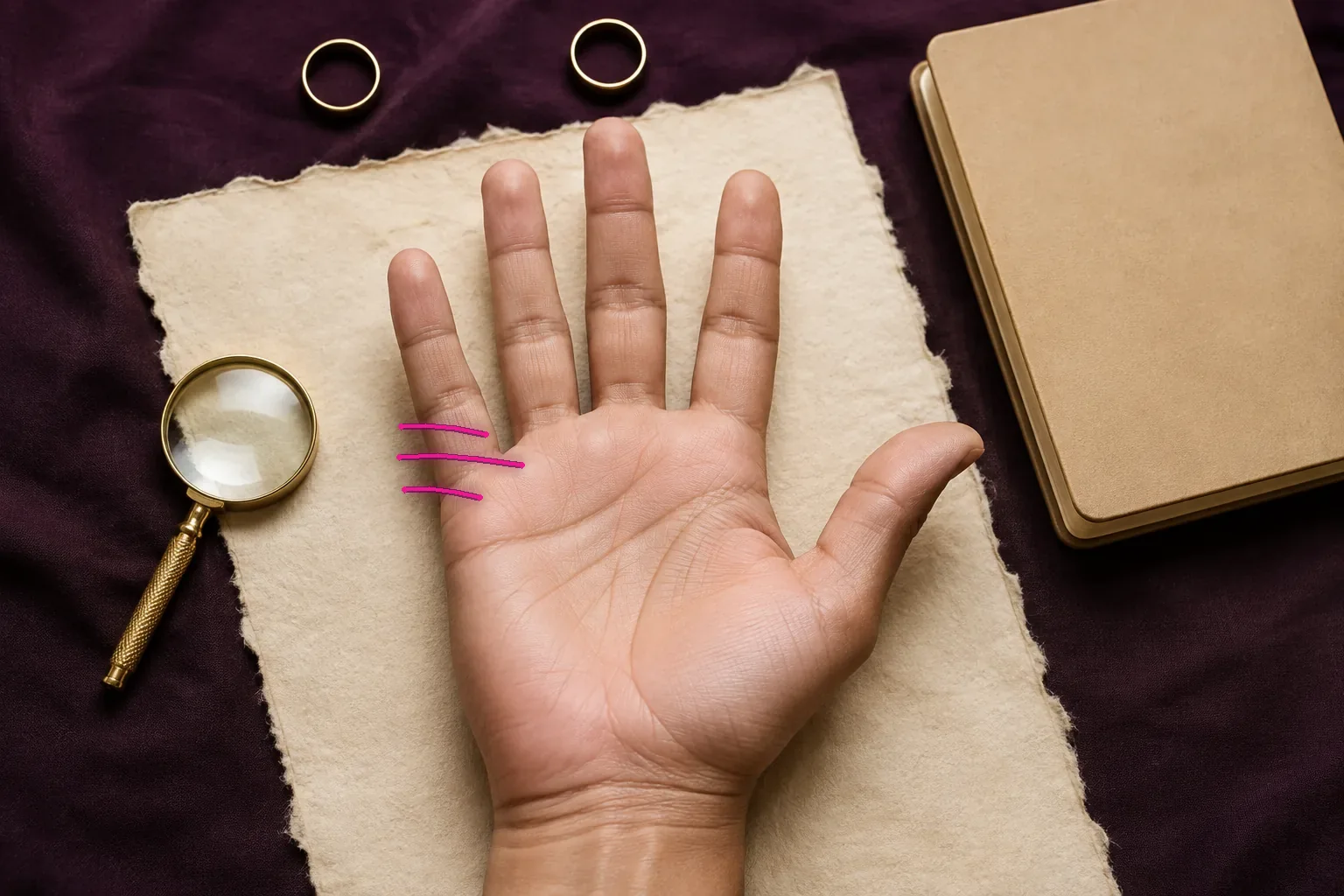
Two, three, or many marriage lines do not predict the same number of legal marriages. In traditional palmistry, several independent lines on the outer edge below the little finger can represent distinct significant bonds, different relationship chapters, strong attachments, or repeated partnership themes. The deepest and longest line usually carries the greatest weight; short faint creases are secondary and may not describe a defining relationship at all.
Multiple relationship lines become meaningful only after every independent edge origin, depth, length, clarity, condition, height, spacing, fork, break, continuation, timing, supporting feature, and both hands are compared. A whole-hand reading can show which bonds or chapters carry the greatest weight and how they connect with commitment, family, change, and relationship direction.
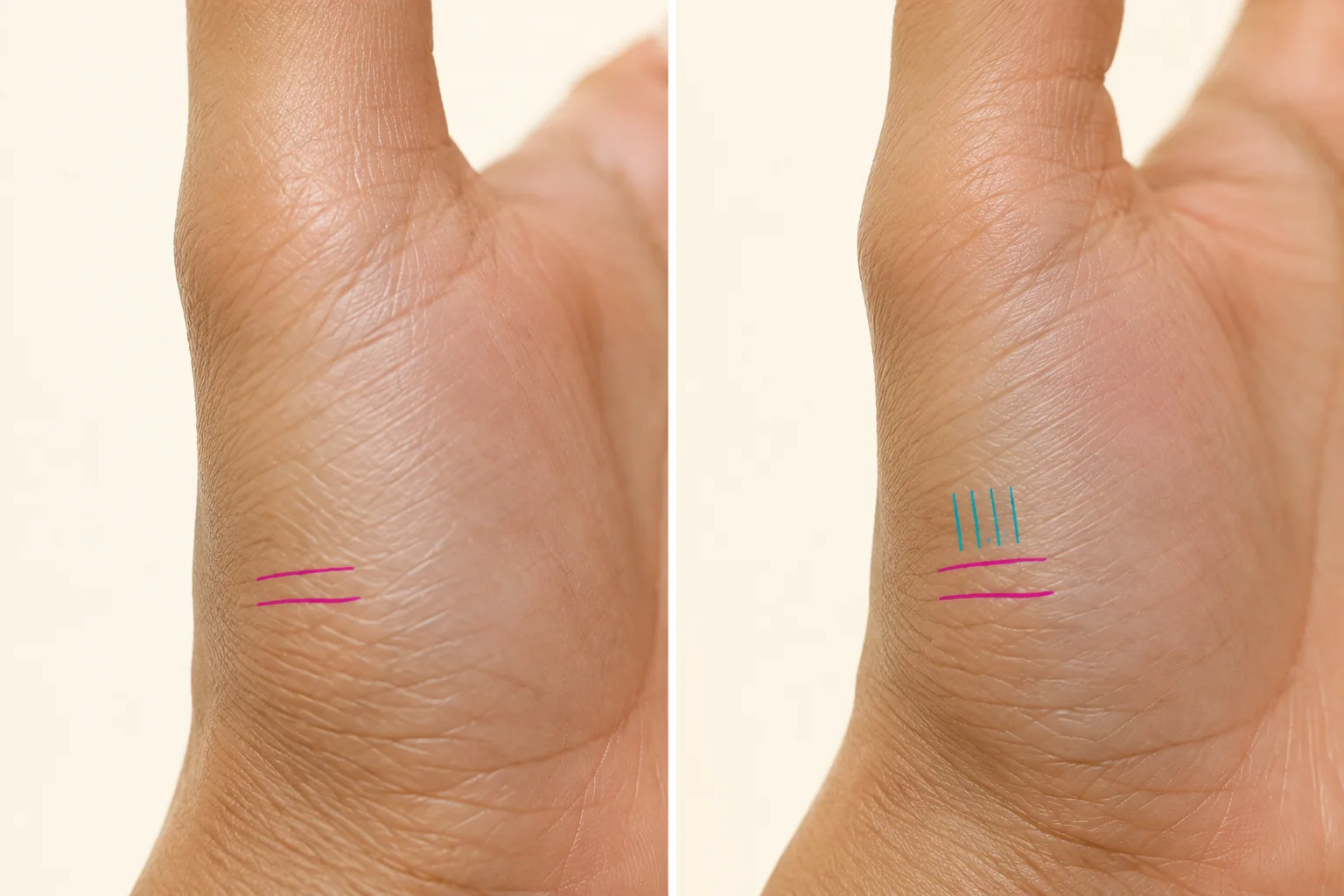
Use a seven-part multiple-relationship-line method: locate the correct edge zone, count only lines that begin independently at the edge, exclude forks and branches, rank depth and length, compare height and spacing, inspect the heart line and supporting features, and compare both hands. The number is only the beginning of the reading.
Do not turn every edge crease into a marriage
The side of the hand naturally contains fine skin folds. A line earns more interpretive weight when it begins clearly at the edge, remains visible with the little finger relaxed, travels a meaningful distance, and can be traced separately from neighboring lines. Rank the evidence before assigning a relationship chapter.
Where multiple marriage lines appear
The lines commonly called marriage lines sit on the percussion edge beneath the little finger and above the heart line. “Relationship lines” is more precise because they can refer to significant bonds without certifying marriage. The complete marriage-line guide maps the zone, direction, depth, slope, and major variations.
| Boundary or feature | How to identify it | Why it matters |
|---|---|---|
| Little-finger base | Upper border above the line zone | Excludes finger-joint folds |
| Heart line | Deep major crease below the zone | Excludes heart-line branches |
| Outer edge | Side where each relationship line begins | Establishes independent origins |
| Palmward endpoint | Where a line ends inside the palm | Shows length, slope, forks, or breaks |
| Relaxed skin | Lines stay visible without bending the finger | Reduces false counts |
How to count marriage lines correctly
Count a line when it has its own origin at the outer edge and travels inward as a separate route. Do not count the two prongs of one fork as two relationship lines. Do not count a small branch leaving a parent line, a broken segment that continues the same route, or an overlap that replaces one line after a shift.
| What you see | Count | Reason |
|---|---|---|
| Two separate edge origins | Two independent lines | Each begins on its own |
| One line splits into two prongs | One forked line | Both routes share one parent |
| One parent with an upward branch | One line plus branch | Parent continues beyond junction |
| Two segments aligned across a gap | One broken route | Segments form a continuation |
| Parallel fragments that overlap | Usually one shifted route | One replaces the other |
| Short folds visible only when bent | Do not count | Likely surface texture |
The forked marriage-line guide shows the shared-parent test. For a later line to support a distinct second relationship chapter, it should begin independently rather than emerge from the first line.
What two, three, or many relationship lines mean
Two clear independent lines traditionally support two relationship chapters or two bonds carrying substantial emotional weight. Three clear lines broaden that pattern to three chapters, but they still do not specify legal status, sequence of marriage, or partner identity. When many fine lines fill the zone, the reading shifts from literal counting toward emotional responsiveness, multiple attachments, social involvement, or a highly lined Mercury area.
| Visible pattern | Traditional emphasis | Reading limit |
|---|---|---|
| One dominant line | One defining relationship pattern | Does not guarantee one marriage |
| Two equal clear lines | Two significant bonds or chapters | Does not prove remarriage |
| One deep plus one fine line | One central bond and one secondary attachment | Fine line may not be partnership |
| Three independent clear lines | Three notable relationship chapters | Legal status remains unknown |
| Many fine parallel lines | Emotional or social sensitivity around attachment | Do not count each as a spouse |
| Different counts on each hand | Capacity and present expression differ | Confirm matched photos |
The second-marriage guide focuses on whether a later independent line, together with changed heart and fate patterns, supports another major partnership chapter. This page owns the broader two, three, or many-line count.
What the number of lines cannot tell you
The count cannot tell whether a bond becomes legal marriage, how long it lasts, whether the people live together, who the partner is, or whether two lines refer to relationships that overlap. It also cannot label one line a “true love” and another a failure. Palmistry gives more weight to the way each route develops: whether it stays clear, changes direction, forks, weakens, recovers, or connects with other life patterns. A useful reading therefore asks which chapter is most established and what qualities repeat, rather than treating the edge like a spouse counter.
Rank depth, length, clarity, and condition
Lines are not equal merely because they occupy the same zone. Rank them first by stable visibility, then by depth, length, clarity, and continuity relative to each other. A deep long line traditionally carries a stronger or more defining bond. A short fine line can describe affection, an important possibility, or a bond that does not organize the wider life pattern.
| Line quality | Traditional weight | What to inspect |
|---|---|---|
| Deep, long, clear | Major defining relationship chapter | Ending and both hands |
| Fine but continuous | Subtle yet persistent attachment | Visibility under changed light |
| Short and shallow | Secondary bond or possibility | Whether it begins independently |
| Chained or islanded | Complexity within that route | Where it clears |
| Broken with continuation | Interruption or changed form | Restart alignment |
| Forked at inner end | Divergent priorities within one route | Fork width and reunion |
Compare each line with the rest of the same hand through the deep-versus-faint line guide. A crease that looks deep only because of side lighting should not outrank a stable line visible from several angles.
Height, spacing, and timing
Traditional timing reads lower relationship lines, nearer the heart line, as earlier chapters and higher lines, nearer the little-finger base, as later chapters. This is a broad order rather than an exact age scale. Closely spaced lines can describe chapters that overlap or arise near each other; widely separated lines suggest more separation between phases.
| Position pattern | Traditional sequence | Limit |
|---|---|---|
| Lower independent line | Earlier relationship chapter | No exact age by height alone |
| Higher independent line | Later relationship chapter | Does not guarantee later marriage |
| Two closely spaced lines | Nearby or overlapping emotional periods | May be overlap, not two routes |
| Wide vertical spacing | More separation between chapters | Scale varies by hand |
| Later line deepens inward | Bond gains importance as it develops | Verify direction from edge |
The palmistry timing guide explains why relationship-line zones provide approximate sequence and windows, not dependable wedding dates.
Multiple marriage lines on one hand or both
Use the active hand for present expression and the less-active hand for underlying capacity. Matching dominant lines on both palms carry more structural weight. A new clear line on the active hand can show a relationship theme becoming more important through current experience. Extra faint lines on only one hand may be secondary possibilities or photo differences.
Do not average the counts. Match lines by relative height, depth, route, and condition. The which-hand guide explains comparison without gender rules.
What if a relationship line appears or disappears?
Fine edge creases can look different as lighting, skin hydration, camera angle, and little-finger tension change. Use dated photographs made in the same position before calling a line new or gone. If a stable line becomes clearer on the active hand while the heart line, fate line, or Venus influences also strengthen, traditional readers give the developing relationship theme more weight. If a line vanishes only in one photo but returns under side light, treat that as image uncertainty. A true structural comparison needs the same edge zone, scale, focus, and relaxed posture on both dates.
Combinations that refine multiple relationship lines
| Combination | Traditional synthesis | Read with |
|---|---|---|
| Two clear lines + changing heart ending | Relationship chapter and emotional standards both shift | Heart-line timing and Venus |
| Higher line + fate-line influence | Later partnership intersects life direction | Origin and outcome of fate contact |
| Many fine lines + lined Venus | Attachment and family sensitivity repeat | Thumb boundaries and heart clarity |
| One dominant line + clear Jupiter branch | One central bond aligns with commitment ideals | Jupiter mount and index finger |
| Lower faded line + higher deep line | Later chapter carries greater present weight | Active hand and fate changes |
| Independent lines + repeated crossing bars | Outside pressures affect more than one chapter | Bar origins and recovery |
The whole-hand love guide combines relationship lines with the heart line, Venus, Moon, Jupiter, Mercury, thumb, fate influences, and both palms.
Worked multiple-line examples
Two equal deep independent lines
Two defining relationship chapters receive similar weight. Their relative height supplies sequence; the heart and fate lines show whether wider emotional or life-direction changes support two distinct periods.
One deep line with three fine lines
The deep route is central. The fine creases may represent secondary attachments, possibilities, or a sensitive relationship zone rather than three additional marriages.
Lower line fades while a higher line is clear
An earlier chapter loses emphasis and a later relationship pattern becomes more established. Compare the active hand, heart-line changes, and a later fate influence.
Two lines that share one edge origin
This is a start fork, not two independent lines. Read separate opening conditions that converge rather than counting two relationships.
Photo checklist for multiple marriage lines
- Photograph both full palms under the same light.
- Add an edge-on close-up below each little finger.
- Keep the little finger relaxed and naturally extended.
- Include the complete space down to the heart line.
- Trace each candidate line back to its own edge origin.
- Retake at a second angle to remove glare.
- Record which line is deepest, longest, and clearest.
- State hand dominance and the relationship question you want explored.
Read every relationship line inside the complete hand
A Full Palm Reading maps the relationship-line zone, every independent origin, depth, length, height, spacing, slope, fork, break, crossing, continuation, timing, and both palms. It then adds the heart line, Venus, Moon, Jupiter, Mercury, thumb, fate influences, hand shape, and texture into one holistic reading focused on your questions.
The complete answer
Multiple marriage lines traditionally show several significant relationship themes or chapters, not a guaranteed count of legal marriages. Count only independent edge-origin lines, exclude forks, branches, overlaps, broken continuations, and temporary skin folds, then rank each line by depth, length, clarity, condition, height, spacing, and repetition across both hands. A Full Palm Reading maps every relationship line and all important features across both palms and combines them into a holistic reading focused on your questions about commitment, past and future chapters, timing, family, repair, compatibility, and relationship direction.
A Full Palm Reading
Ask how all your relationship lines fit together
Your reading maps the full relationship-line zone, every independent edge origin, depth, length, height, spacing, slope, fork, break, crossing, continuation, timing, and both palms, then adds the heart line, Venus, Moon, Jupiter, Mercury, thumb, fate influences, shape, and texture into one holistic reading focused on your questions.
Your Full Palm Reading maps all the important features—hand shape, skin texture, thumb, fingers, mounts, major and minor lines, markings, and the differences between both palms—and brings them together in a holistic reading focused on your questions.