
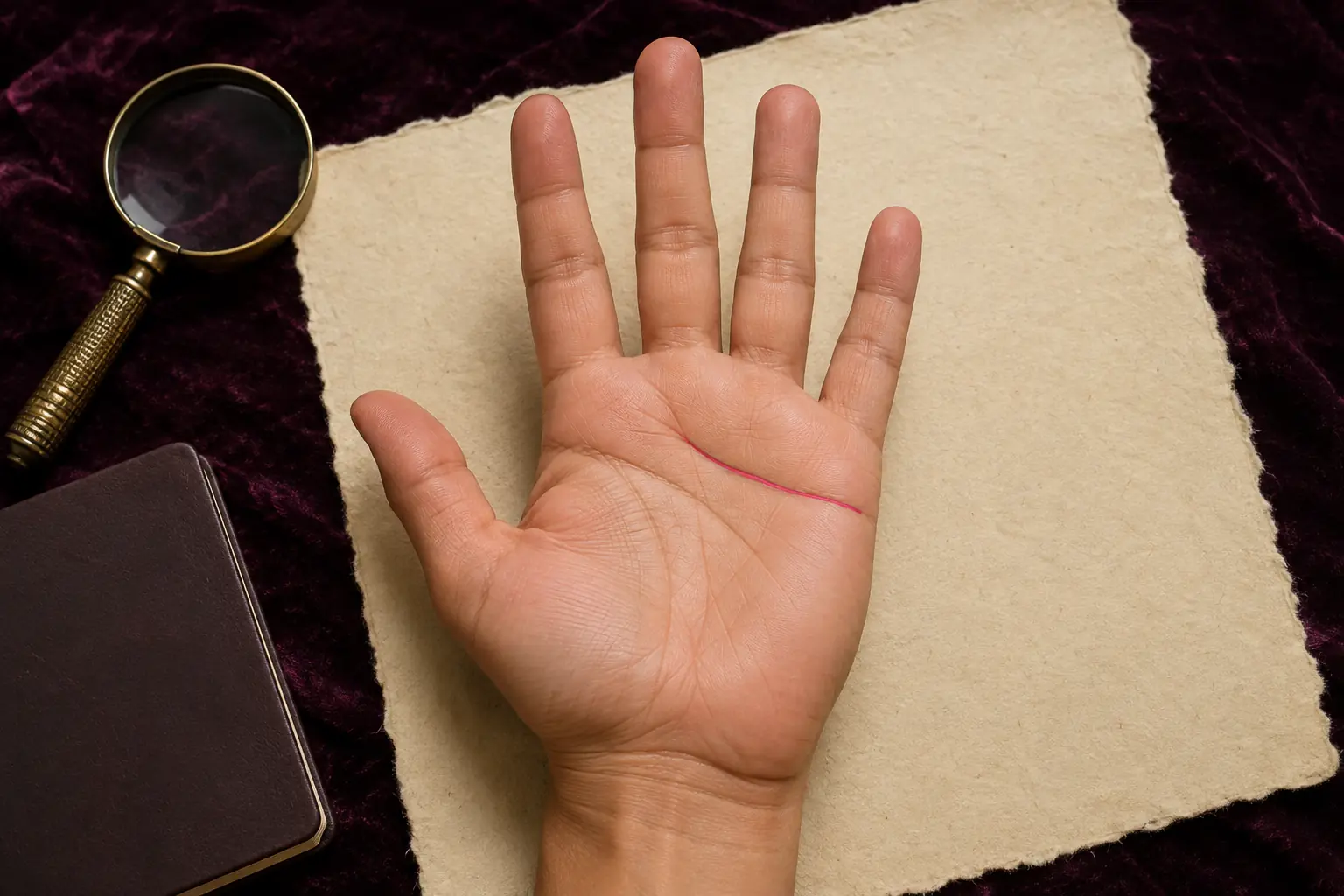
In traditional palmistry, a short Heart line is one coherent upper-palm parent that begins at the little-finger edge and reaches a genuine endpoint noticeably before the index side of the palm. It is commonly associated with focused, self-contained, or selectively expressed emotional investment. It does not mean that someone is cold, selfish, disloyal, unable to love, or destined to have a short relationship.
A short Heart line becomes personal only after the outer-edge parent, genuine early endpoint, proportional span, faint-continuation and restart tests, straight or curved path, depth, clarity, fork, Girdle and simian-line checks, Head, Venus, Jupiter, thumb, relationship lines, hand shape, real behavior, and both palms are compared. A whole-hand reading can show how focused investment, trust, expression, communication, and boundaries work together.
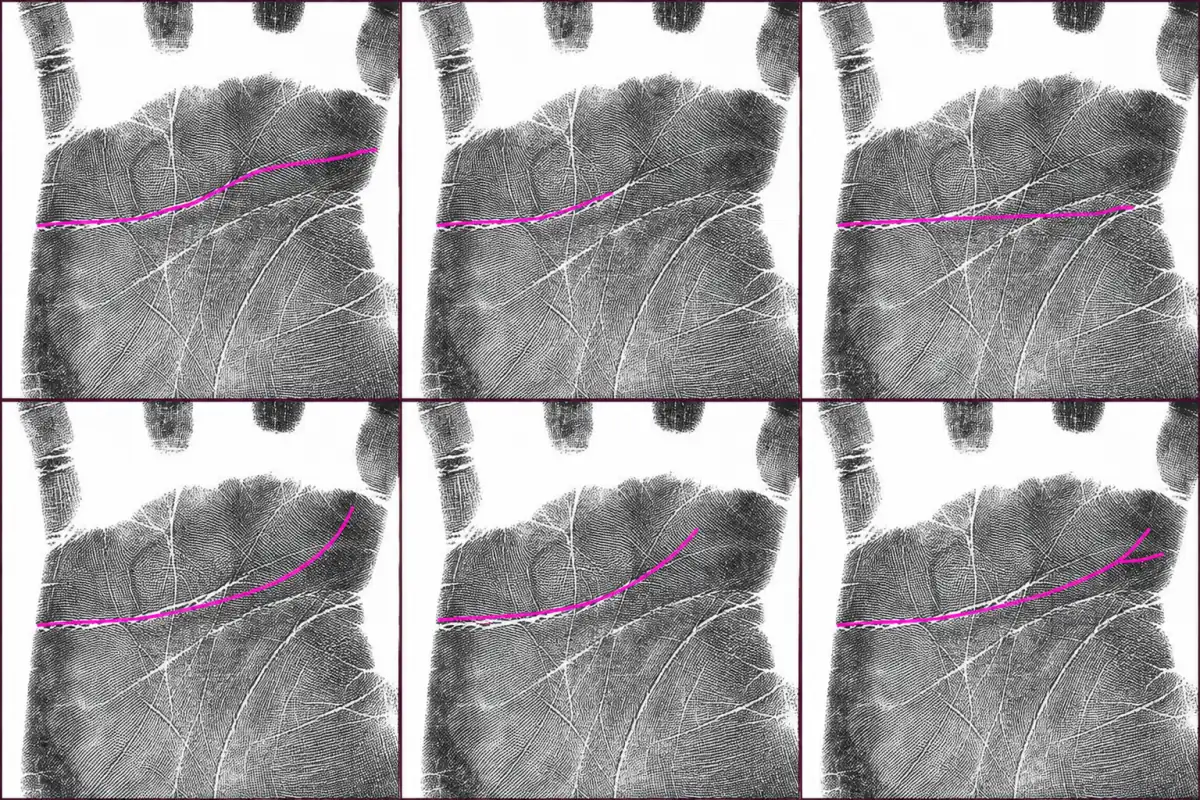
Confirm the outer origin and true endpoint before interpreting length. A shallow continuation, empty gap with a restart, terminal fork, crossing line, hidden percussion edge, or merged Head-and-Heart crease can change the classification. Then add path, depth, clarity, endpoint zone, Venus, Head, thumb, relationship lines, hand shape, real behavior, and both palms.
Locate the Heart-line parent
The Heart line is usually the highest major transverse crease. It enters from the outer edge beneath the little finger and moves inward across the upper palm. A full-palm photo proves the route; a second angled photo proves that it actually reaches the outer edge.
Trace from the little-finger side inward. The main groove should keep a coherent direction and texture until it stops. Judge the span relative to the width of that same palm. A parent ending around the central upper palm or below Saturn is shorter than one that reaches the Jupiter side, but mount location and length remain separate observations.
Short does not mean less love
Line length is traditionally used to discuss the breadth or concentration of emotional attention. It does not measure empathy, moral character, loyalty, or the capacity for connection. Real communication and behavior carry more weight than a crease label.
Use a ten-part short-Heart-line method
- Relax the hand. Keep the palm open without pulling the fingers backward.
- Photograph the outer edge. Prove where the parent enters beneath the little finger.
- Trace one parent. Follow the strongest coherent upper-palm groove.
- Find the stopping point. Look for a rounded, tapered, or clean natural endpoint.
- Search with side light. Check whether the groove continues faintly.
- Test for a gap. Look beyond the endpoint for an aligned restart.
- Exclude foreign creases. Do not count forks, branches, crossings, or the Girdle of Venus.
- Separate length from endpoint. Record Saturn, central, or other destination independently.
- Add supporting features. Compare path, quality, Head, Venus, thumb, and relationship lines.
- Compare both palms. Use matched images and test the reading against lived patterns.
Short Heart line or a lookalike?
| What you see | Decisive test | Best classification |
|---|---|---|
| One parent stops early with no aligned continuation | The endpoint remains final under side light | Short Heart line |
| The groove becomes very fine but continues | One aligned texture survives beyond the apparent stop | Faint continuation, not a short endpoint |
| Open skin is followed by an upper aligned segment | A separate restart exists beyond the gap | Broken Heart line |
| Two arms leave one shared endpoint junction | The parent divides rather than ends once | Forked Heart line |
| One transverse crease replaces both Heart and Head | No separate major Head line crosses below | Possible simian line |
| The visible line seems to start inside the palm | The outer edge is absent from the photo | Insufficient image, not confirmed shortness |
A break requires empty skin and a separate continuation; the broken Heart-line guide explains restarts and overlap. A single crease replacing the Head and Heart routes needs the anatomical checks in the simian-line guide.
What a short Heart line traditionally means
Traditional palmistry associates a short route with emotional attention concentrated on fewer people, priorities, or values. Feelings may be held privately until trust is established, shown through action instead of display, or protected by a clear boundary between inner experience and public expression.
Concentration can support loyalty and consistency when the rest of the hand agrees. It can also feel difficult to read when words, gesture, or reassurance are sparse. A useful interpretation asks how care becomes visible and whether close people understand that language. It does not assume that reserve equals absence.
Compare the long Heart-line guide for the opposite measurement task. Long and short describe range, not good and bad. A short, clear route may express steadier feeling than a long, faint, heavily chained line.
Path, endpoint, and quality change the reading
A straight short line reinforces measured or action-based expression. A curved short line can combine concentrated investment with visible warmth. Use the straight-versus-curved guide to keep path separate from length.
| Short-line feature | Traditional modifier | Useful question |
|---|---|---|
| Clear and deep | A concentrated pattern expressed consistently | Which relationships receive your strongest commitment? |
| Fine but continuous | Subtle or less visible emotional signals | How can others recognize your care? |
| Straight path | Feeling processed privately or through practical action | Do you rely on deeds when words would help? |
| Curved path | Focused investment with more open demonstration | Where are you expressive, and where selective? |
| Ending below Saturn | Reserve, realism, or self-protection may be emphasized | Which boundaries support connection? |
| Chained section | Fluctuation or sensitivity within the concentrated field | What steadies your emotional signals? |
Supporting features that prevent a one-line verdict
The Mount of Venus adds warmth, attachment, sociability, and available energy. A full, resilient Venus area can make a short Heart line warmer in practice than the word “short” suggests. A flatter Venus area may reinforce selectivity or lower outward demand, but the combination still does not prove indifference.
The Head line shows how feeling is processed. A clear straight Head route can reinforce deliberation; a line sloping toward Moon adds imagination and association. The thumb adds will, flexibility, and boundaries. Jupiter adds standards. Relationship lines describe significant-bond formations at the hand edge but do not count partners or marriages.
Hand texture matters. Fine skin may register subtle emotional detail even when the Heart line is brief. Firmer or coarser texture may express care more directly through action. The complete Heart-line guide places length among all the variables.
Translate the sign into a relationship question
Ask: “Who receives my emotional energy?”, “How do I signal care?”, “What helps me trust?”, and “Do my boundaries create clarity or distance?” These questions preserve the value of the symbolism without forcing a negative label.
Does a short Heart line mean a short relationship?
No. Crease length does not predict relationship duration, marriage length, separation, or the number of partners. The love and relationship guide combines emotional style, Venus, relationship lines, Head, thumb, and both palms while keeping outcomes open.
Does it mean someone is emotionally unavailable?
No. Emotional availability is shown through communication, responsiveness, consent, reliability, and behavior. A short line may prompt questions about selectivity or private expression in a traditional reading, but it cannot diagnose another person's intentions or readiness.
What if only one palm has a short Heart line?
Verify both outer edges and use the same lighting. Many palmists read the less-used hand as background disposition and the active hand as current development. Treat that as a reading convention rather than a fixed anatomical rule.
A shorter active-hand parent can suggest more focused emotional priorities or more guarded expression developing through experience. A longer active-hand parent may suggest widening investment. Faintness, pose, and an unseen restart can create a false difference, so confirm geometry before meaning.
Worked examples
Example 1: short, deep, straight route with full Venus
The line is concentrated and measured, while Venus adds warmth and attachment. The synthesis is selective affection expressed through consistency and practical support, not coldness.
Example 2: short, curved route with a clear Head line
The short span suggests focused investment, the curve adds visible expression, and Head adds reflection. This person may be openly warm with a small trusted circle.
Example 3: apparent stop followed by a faint aligned groove
Side light reveals that the same parent continues. Classify the route by its full reach and record the faint upper section as quality. Do not publish a short-line conclusion from the first photo.
Example 4: early stop with a separate aligned restart
Open skin and a distinct second segment make this a broken Heart line. Read the interruption, restart position, and strength before judging total span.
Example 5: short active-hand route and longer less-used route
After matched photos confirm the endpoints, a reader may explore whether emotional investment has become more selective. Real relationship history shows whether the theme fits.
Photo checklist for a short Heart line
- Capture both full palms and both little-finger edges.
- Use bright indirect light plus one gentle side-light image.
- Keep the camera parallel and at the same height for both hands.
- Relax the fingers rather than stretching the creases flat.
- Include every finger base, the thumb mound, and the wrist.
- Look beyond the apparent endpoint for a faint or restarted segment.
- Keep forks, crossings, and the Girdle separate from the parent.
- Avoid filters, smoothing, glare, and annotations on the source image.
Frequently asked questions
What counts as a short Heart line?
The parent enters from the little-finger edge and ends noticeably before the index side, often around the central upper palm or Saturn area, with no faint aligned continuation or restart.
Is a short Heart line bad?
No. It traditionally suggests concentrated or private emotional investment. Quality, path, Venus, Head, thumb, behavior, and both palms decide how that style appears.
Does it mean I cannot love deeply?
No. A palm crease cannot measure the capacity to love. Depth of connection appears through lived choices and behavior.
Could the line simply be faint?
Yes. Use side light and trace the same alignment past the apparent endpoint. A coherent faint groove changes the measured length.
Can a broken line look short?
Yes. Search beyond the endpoint for a separate aligned restart. Open skin between the pieces indicates a break rather than one final stop.
Which hand should I read?
Read both. Compare the same parent, endpoint, and supporting features, then use handedness and real history as context.
The complete answer
A short Heart line is one coherent parent entering from the little-finger edge and ending early in the upper palm without a faint continuation or separate restart. Traditional palmistry connects it with concentrated, selective, or privately expressed emotional investment. It does not mean coldness, inability to love, or a short relationship. Verify the endpoint against faintness, a break, fork, crossing, hidden edge, Girdle of Venus, and simian crease, then add path, depth, clarity, Venus, Head, thumb, Jupiter, relationship lines, hand shape, real behavior, and both palms. A Full Palm Reading maps all the important features across both hands and combines them into a holistic reading focused on your questions about love style, trust, emotional availability, communication, boundaries, compatibility, and relationship patterns.
A Full Palm Reading
Ask how your short Heart line fits your complete relationship pattern
Your reading maps the outer-edge Heart-line parent, genuine early endpoint, proportional span, faint-continuation and restart tests, straight or curved path, depth, clarity, fork, Girdle and simian-line checks, Head, Venus, Jupiter, thumb, relationship lines, hand shape, real behavior, and both palms, then adds every other important line, mount, finger, marking, shape, and texture into one holistic reading focused on your questions.
Your Full Palm Reading maps all the important features—hand shape, skin texture, thumb, fingers, mounts, major and minor lines, markings, and the differences between both palms—and brings them together in a holistic reading focused on your questions.