
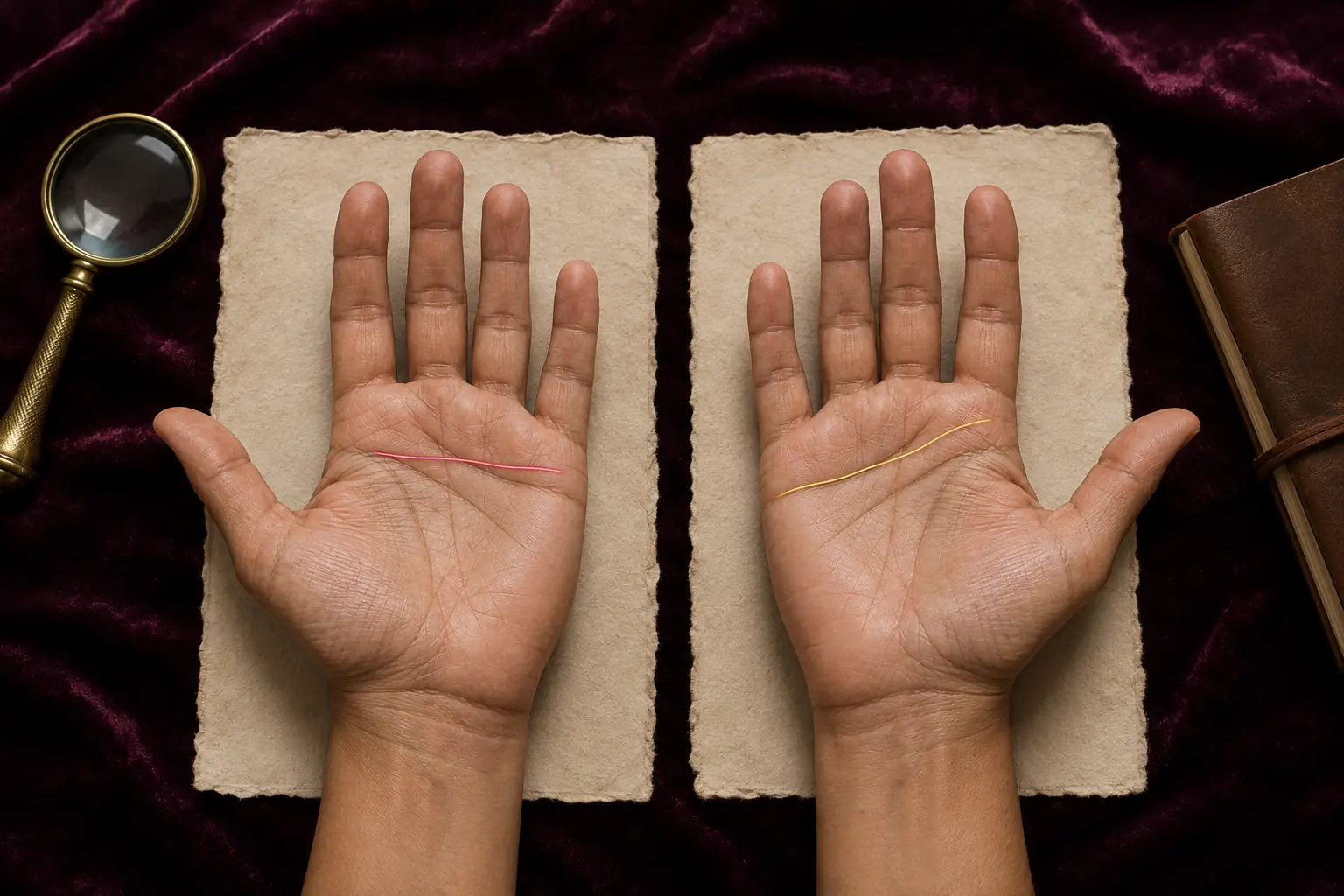
In traditional palmistry, a relatively straight Heart line suggests that emotion is contained, processed privately, or expressed through consistency and practical care. A clearly curved Heart line suggests that warmth, affection, and emotional response are demonstrated more openly. The path describes style of expression. It does not measure the capacity to love, predict whether a relationship succeeds, or reveal a partner's private intentions.
Heart-line path becomes personal only after the true outer-edge parent, sustained level or rising course, endpoint, length, depth, clarity, forks, breaks, Girdle and simian-line tests, Head, Venus, Jupiter, thumb, relationship lines, hand shape, real behavior, and both palms are compared. A whole-hand reading can show how feeling, expression, communication, ideals, boundaries, and relationship patterns work together.
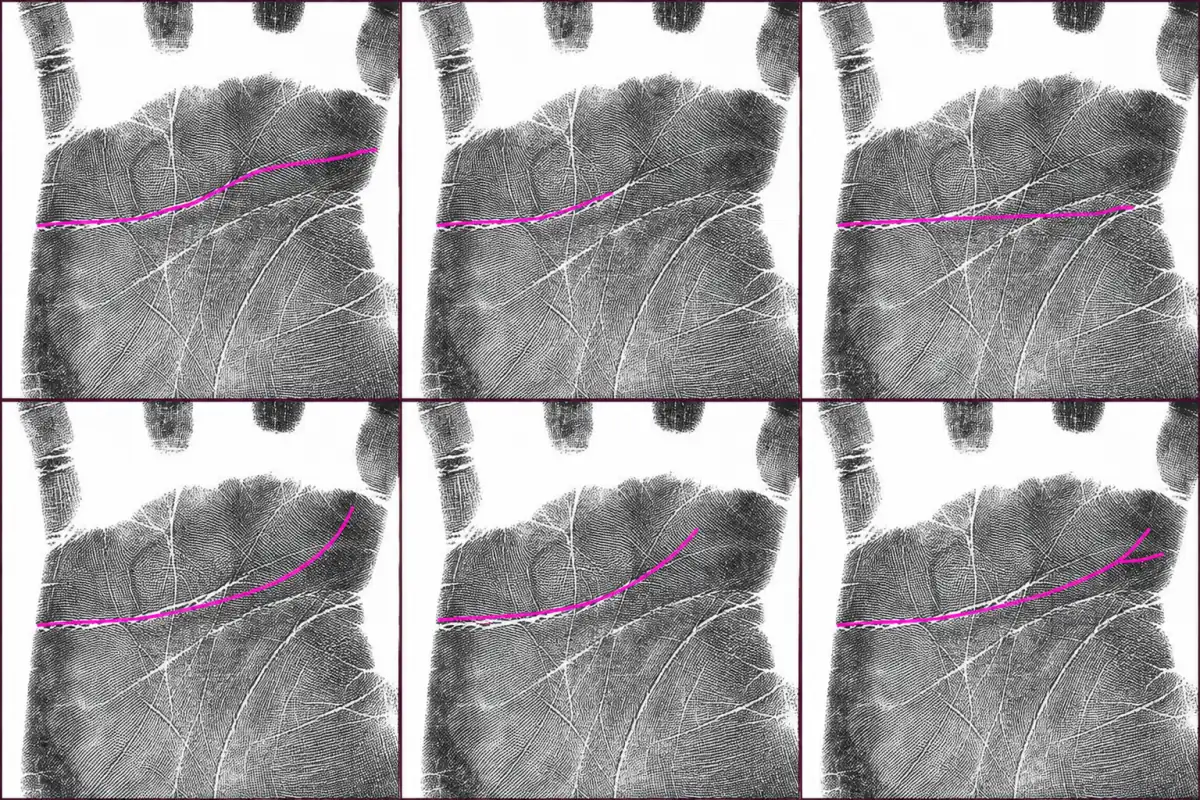
First verify that you are following the upper major crease from the little-finger edge. Then judge how much the whole route rises toward the finger bases. Keep path separate from its ending point, length, depth, forks, breaks, and nearby Girdle of Venus. Compare the Head line, Venus and Jupiter mounts, thumb, relationship lines, hand shape, and both palms before drawing a personal conclusion.
Find the Heart line before judging its curve
The Heart line is usually the highest major transverse crease. It enters from the outer edge below the little finger and travels across the upper palm toward the index- and middle-finger side. Read from the outer edge inward so a nearby branch, Girdle of Venus fragment, or crossing line does not become the false parent.
Use relaxed hands under broad, even light. A cupped palm can make the line look more curved because the skin folds toward the fingers. A hand stretched flat can pull a gentle arc into a straighter appearance. Photograph both palms from the same height with the camera square to the skin, then trace the same parent crease on each image.
The geometry comes before the meaning
A Heart line can be long and straight, short and curved, deep and gently arched, or faint and almost level. “Straight” and “curved” describe the path only. Do not silently replace path with length, endpoint, depth, or quality.
Use a ten-part straight-versus-curved-Heart-line method
- Relax the hand. Keep the palm open without forcing the fingers backward.
- Find the outer origin. Locate the main crease entering below the little finger.
- Trace one parent. Follow the most coherent upper-palm route toward the index side.
- Imagine a level guide. Compare the line with the row of finger bases and the width of the palm.
- Judge the whole path. Look for a sustained rise, not one local bump near the ending.
- Separate the endpoint. Record whether it finishes below Saturn, between Saturn and Jupiter, or toward Jupiter.
- Record length and quality. Note reach, depth, clarity, chains, islands, gaps, forks, and crossbars separately.
- Exclude lookalikes. Check the Girdle of Venus, a simian crease, upper branches, and camera distortion.
- Add supporting features. Compare Head, Venus, Jupiter, thumb, relationship lines, and hand shape.
- Compare both palms and real behavior. Use the feature as a prompt for reflection, then test it against lived patterns.
| What you see | Classification | Do not confuse it with |
|---|---|---|
| The parent stays broadly level across most of the upper palm | Relatively straight Heart line | A temporarily flattened line on a stretched hand |
| The parent rises in a sustained arc toward the finger bases | Curved Heart line | One upward terminal branch on an otherwise level parent |
| A second broken arc sits above the Heart line | Possible Girdle of Venus | The true Heart-line parent |
| Head and Heart occupy one complete transverse crease | Possible simian line | An unusually straight Heart line |
| Two terminal arms leave one junction | Forked ending | The curve of the parent route |
What a straight Heart line means
A straight Heart line is relative rather than ruler-flat. Its parent route crosses the upper palm with little sustained rise toward the fingers. Traditional readers associate that level course with emotional self-command, private processing, selectivity, and care shown through dependability, problem-solving, or practical action.
This does not mean coldness. Someone can feel strongly while revealing those feelings slowly, preferring useful support to dramatic display. The practical question is how care becomes visible: keeping promises, making time, solving a problem, maintaining stability, or speaking only after reflection.
Strength changes the reading. A clear, even straight line can emphasize consistency and defined boundaries. A faint route may make emotional expression less settled or less easy to read. Chaining adds sensitivity or fluctuation; a gap adds a transition; a fork adds two modes or ideals at the ending. These modifiers do not turn straightness into a verdict.
Straight Heart line combinations
| Combination | Traditional synthesis | Useful question |
|---|---|---|
| Straight Heart + clear Head line | Feeling may be organized through reflection and direct reasoning | Do you explain care more easily than you display it? |
| Straight Heart + full Venus | Private expression may coexist with strong warmth and attachment | Which actions make affection obvious to people close to you? |
| Straight Heart + firm thumb | Commitment and boundaries may be expressed consistently | When does steadiness become rigidity? |
| Straight Heart + fine skin | Reserved display can coexist with subtle sensitivity | Do others miss signals that feel clear to you? |
What a curved Heart line means
A curved Heart line rises noticeably as it travels inward, creating a sustained arc toward the finger bases. Traditional palmistry associates that rising route with demonstrative warmth, spontaneous emotional response, affectionate gesture, and a greater tendency to make feeling visible.
Curved does not mean emotionally wiser, more loyal, or more intense. It describes outward expression. A person may speak affection readily, seek responsive connection, or communicate through touch and gesture, yet the line alone cannot show how well they listen, manage conflict, or choose partners.
Degree matters. A gentle curve may suggest expression balanced with reflection. A steep rise brings the ending close to a finger mount, so endpoint meaning becomes especially important. If the line approaches Jupiter, ideals and standards enter the traditional reading; if it finishes nearer Saturn, self-protection or practical expectation may alter the tone. Record the arc and destination separately before combining them.
Curved Heart line combinations
| Combination | Traditional synthesis | Useful question |
|---|---|---|
| Curved Heart + balanced Venus | Warmth may be expressed naturally without dominating the hand | How do you show affection while respecting space? |
| Curved Heart + strong Jupiter | Open feeling may be shaped by ideals, standards, or devotion | Are your expectations stated clearly? |
| Curved Heart + sloping Head | Feeling and imagination may reinforce vivid empathy or romantic response | What helps separate intuition from assumption? |
| Curved Heart + many fine cross-lines | Open expression may meet many competing sensitivities | Which emotional signals deserve attention? |
Path and endpoint answer different questions
Path asks whether the Heart line stays level or rises. Endpoint asks where it finishes. A straight line may still reach toward Jupiter because it travels far across the palm. A curved line may finish between Jupiter and Saturn after a shorter, steeper rise. Treating every Jupiter ending as “curved” erases useful detail.
The dedicated Heart-line endpoint guide compares the mount zones. Use it after recording the path. Then add length: a longer parent spans more of the palm, while a shorter parent stops earlier. A fork is a separate terminal division, and a break requires a true empty gap. The complete Heart-line guide shows how all of these variables fit together.
| Variable | Question it answers | Example observation |
|---|---|---|
| Path | How does the route travel? | Mostly level or visibly rising |
| Endpoint | Where does the parent finish? | Saturn, between Saturn and Jupiter, or Jupiter |
| Length | How far does it travel? | Short, medium, or long relative to this palm |
| Quality | How coherent is the route? | Deep, fine, chained, broken, crossed, or islanded |
| Branches | What secondary routes leave it? | Upward, downward, forked, or absent |
Add the features that can confirm or change the reading
The Mount of Venus adds warmth, attachment, sociability, and available energy to the traditional reading. A full, resilient Venus area can make a straight Heart line much warmer in practice than a one-line label suggests. A balanced Venus area can give a strongly curved route steadier boundaries.
The Head line shows how emotion is processed and communicated. A straight Head line can reinforce analysis and sequence; a line sloping toward Moon adds imagination and association. Jupiter adds ideals and standards. The thumb adds will, flexibility, and boundaries. Relationship lines add the way a significant bond is marked at the hand edge, but they do not count partners or prove future events.
Look for repetition rather than collecting isolated signs. If Heart path, Head direction, Venus, thumb, and actual behavior all point toward measured expression, the theme has support. If they conflict, keep both sides: someone may feel openly but decide cautiously, or appear contained while investing deeply through action.
Use the line to improve communication
A useful reading turns the symbolic distinction into a concrete conversation: “How do I show care?”, “What signals do I expect from a partner?”, and “When do I need words, action, touch, or space?” Those answers matter more than attaching a fixed personality label.
Does a straight or curved Heart line predict relationship success?
No. Neither route guarantees loyalty, compatibility, marriage, or separation. Palmistry treats the Heart line as a symbolic pattern of emotional style. Relationship outcomes depend on communication, choices, circumstances, boundaries, and the people involved. The love and relationship palm-reading guide maps the wider combination without reducing a relationship to one crease.
Can the curve show timing?
The overall curve is not a clock. Some readers divide the Heart line into broad zones, but the scale varies with the route and cannot support an exact age. A local fork, break, island, or crossing may be placed approximately only after the full parent is traced and calibrated against known history. Do not convert a straight or curved path into a date.
What if one palm is straight and the other is curved?
Compare the same feature under matched conditions. Many readers treat the less-used hand as background disposition and the active hand as qualities developed through experience and repeated choice. Use handedness as context, not a rigid universal law.
A straighter route in the active hand may suggest more measured expression, stronger boundaries, or a practical communication style developing over time. A more curved active-hand route may suggest greater willingness to demonstrate feeling. Confirm that the difference is sustained across the parent and not caused by pose, visibility, or a terminal branch.
Worked examples
Example 1: straight, clear Heart line with full Venus
The route stays level and even, while the thumb mound is full and resilient. The synthesis is not “cold.” It suggests affection expressed through loyalty, presence, shared activity, and practical care, with feelings revealed selectively.
Example 2: curved line toward Jupiter with a balanced Head line
The Heart line rises gently toward the index-finger zone, and the Head line remains clear without excessive slope. A reader might describe open warmth shaped by relationship ideals, with enough mental structure to discuss expectations rather than only feel them.
Example 3: straight parent with one upward ending branch
Most of the parent remains level, then one small branch rises. Classify the parent as straight and the branch separately. The combination may suggest a contained baseline with an additional idealistic or demonstrative outlet rather than a fully curved Heart line.
Example 4: curved but faint line with many fine crossings
The arc suggests visible emotional response, while faintness and crossings reduce consistency. A balanced reading explores sensitivity, changing signals, and the need for clear boundaries instead of assuming that curve alone means effortless connection.
Example 5: different paths across both hands
The less-used palm is gently curved and the active palm is straighter. After matched photographs confirm the difference, the reading can explore whether open feeling has become more deliberate in expression. Real relationship history decides whether that interpretation fits.
Photo checklist for comparing the path
- Photograph both full palms and the outer little-finger edges.
- Use diffuse daylight or bright indirect light without glare.
- Keep wrists, fingertips, and thumb mounds inside the frame.
- Relax the fingers; do not stretch the palm until the creases flatten.
- Hold the camera parallel to the palm rather than at an angle.
- Take one closer upper-palm image for the parent route and endpoint.
- Avoid filters, beauty smoothing, harsh sharpening, and drawn overlays on the source photograph.
- Label active and less-used hands before comparing them.
Frequently asked questions
Is a straight Heart line bad?
No. Traditional palmistry associates it with contained or practical emotional expression. Depth, clarity, Venus, Head, thumb, behavior, and both palms determine whether that reserve feels steady, selective, or difficult to communicate.
Does a curved Heart line mean a romantic person?
It can support a reading of demonstrative warmth or visible emotional response. Endpoint, Venus, Jupiter, Head, and real behavior show whether that appears as romance, affection, empathy, idealism, or another form of expression.
How curved must a Heart line be?
Look for a sustained rise across the parent route compared with the palm width and finger bases. One final upward branch does not make the whole line curved.
Can a straight line still end under Jupiter?
Yes. Path and endpoint are separate. A long, broadly level route may reach Jupiter, while a shorter curved route may rise steeply toward a different zone.
Is the upper curved line always the Heart line?
No. A broken arc above the Heart line may be the Girdle of Venus. Trace the true parent from the outer edge below the little finger before classifying it.
What if my Heart line looks different in photographs?
Match lighting, camera angle, distance, and hand relaxation. Compare several images before deciding that the path or quality changed.
Which hand should I use?
Use both. Compare the underlying pattern and current expression, with the active hand identified by actual use rather than gender.
The complete answer
A straight Heart line travels across the upper palm with little sustained rise and is traditionally associated with private, measured, or action-based emotional expression. A curved Heart line rises toward the fingers and is associated with more visible warmth and demonstration. Locate the parent from the little-finger edge, relax the hand, judge the full route, then record endpoint, length, depth, clarity, forks, breaks, branches, Head, Venus, Jupiter, thumb, relationship lines, hand shape, real behavior, and both palms. Neither path ranks emotional capacity or predicts relationship success. A Full Palm Reading maps all the important features across both hands and combines them into a holistic reading focused on your questions about love style, communication, boundaries, compatibility, relationship patterns, and how your emotional expression is developing.
A Full Palm Reading
Ask how your Heart-line path fits your complete relationship pattern
Your reading maps the true Heart-line parent, sustained straight or curved path, endpoint, length, depth, clarity, forks, breaks, Girdle and simian-line tests, Head, Venus, Jupiter, thumb, relationship lines, hand shape, real behavior, and both palms, then adds every other important line, mount, finger, marking, shape, and texture into one holistic reading focused on your questions.
Your Full Palm Reading maps all the important features—hand shape, skin texture, thumb, fingers, mounts, major and minor lines, markings, and the differences between both palms—and brings them together in a holistic reading focused on your questions.