
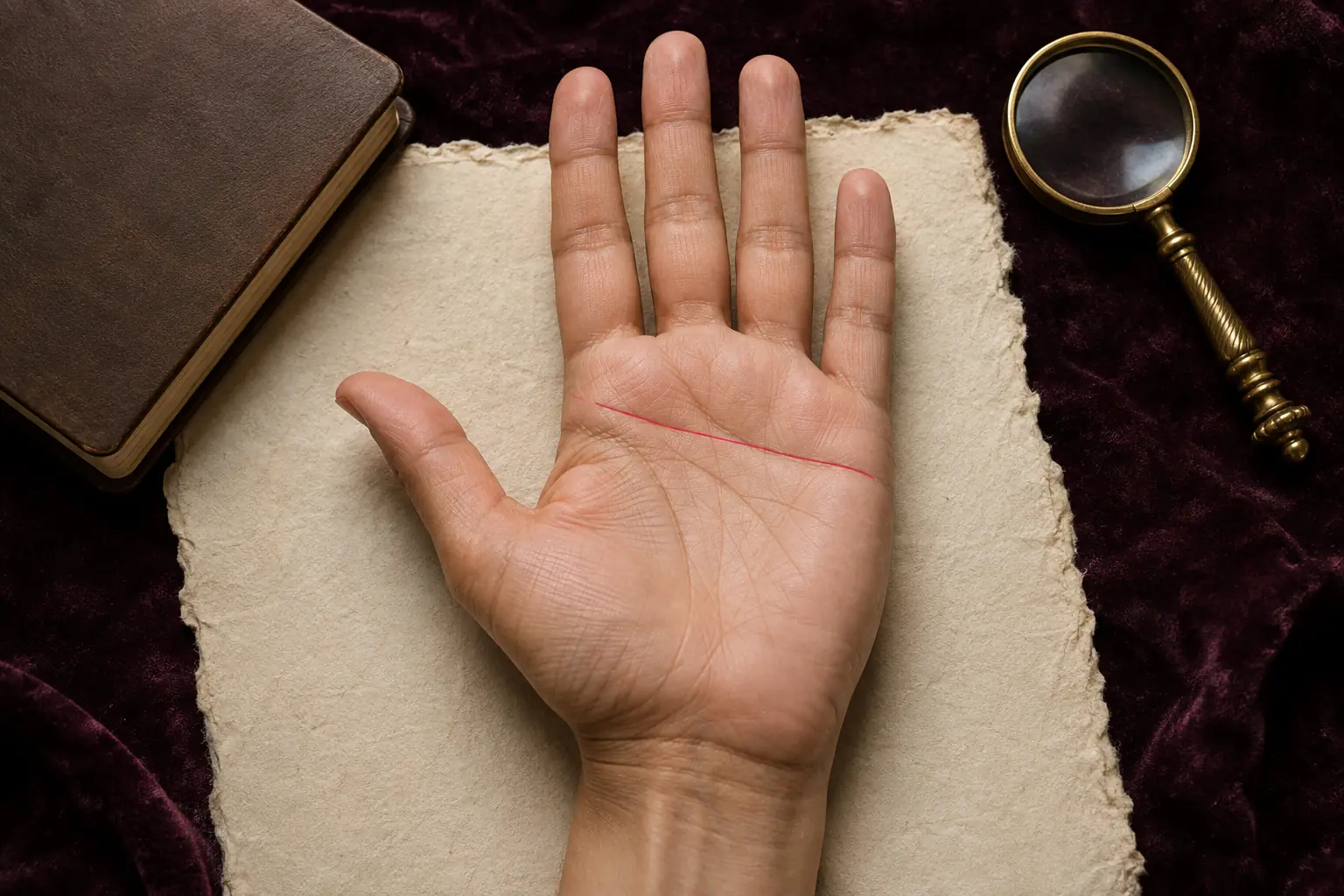
In traditional palmistry, a long Heart line is one coherent upper-palm crease that begins at the little-finger edge and travels across most of the palm toward the index-finger side. Its reach is associated with broad emotional investment, sustained attachment, and a tendency to give relationships or personal values considerable importance. Length does not prove deeper love, loyalty, a long relationship, or a certain number of partners.
Heart-line length becomes personal only after one true outer-edge parent, its endpoint, proportional span, straight or curved path, depth, clarity, forks, branches, crossings, breaks, Girdle test, Head, Venus, Jupiter, thumb, relationship lines, hand shape, real behavior, and both palms are compared. A whole-hand reading can show how emotional investment, love style, expectations, communication, boundaries, and relationship patterns work together.
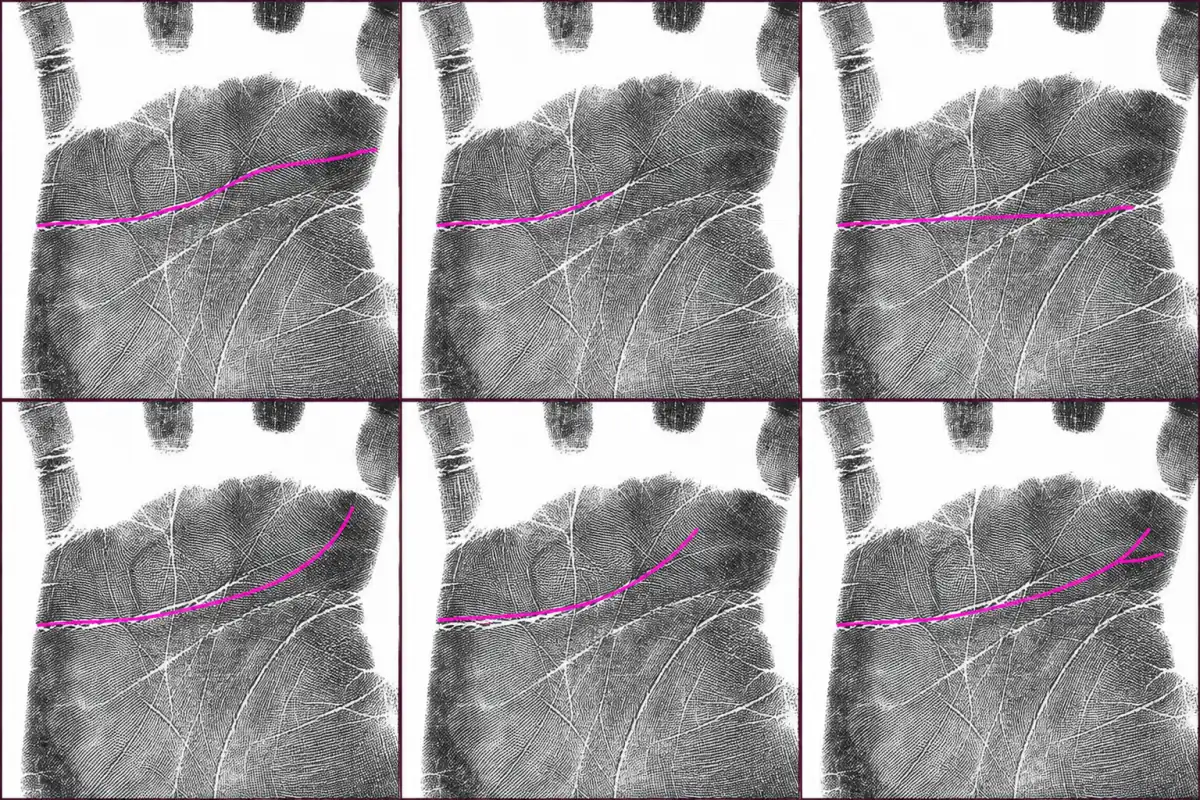
Measure only the parent route. Do not add the length of a fork, branch, crossing line, Girdle of Venus, or a faint crease that merely touches it. Then combine true length with the endpoint below Saturn, between Saturn and Jupiter, or toward Jupiter; the straight or curved path; depth and clarity; Venus and Jupiter; Head line; thumb; relationship lines; and both palms.
Where a long Heart line begins and ends
The Heart line is normally the highest major transverse crease. It enters from the percussion edge below the little finger and runs inward across the upper palm. For length, the starting evidence is the outer edge. A top-down photo may hide the first few millimetres, so include an angled edge photograph before deciding that the line starts late.
A genuinely long parent reaches well into the index side of the palm, commonly toward the space between the index and middle fingers or below the index finger. Compare its span with the width of that same palm. Finger length, palm width, camera distance, and the line's curve make comparisons between different people unreliable.
Length is reach, not relationship duration
“Long Heart line” describes how far the crease travels. It does not mean one romance lasts longer, that a person has more partners, or that marriage is guaranteed. Relationship timing belongs to a separate approximate method and still cannot establish a fixed outcome.
Use a ten-part long-Heart-line method
- Relax the palm. Avoid stretching the fingers backward or cupping the hand.
- Find the little-finger edge. Confirm the parent enters the upper palm from the correct outer zone.
- Trace one continuous route. Follow the dominant groove across the upper palm.
- Locate the true endpoint. Stop where the parent ends, even if a fine crossing continues.
- Compare with palm width. Judge how much of this hand the route spans.
- Exclude additions. Remove forks, side branches, crossbars, and nearby creases from the measurement.
- Record endpoint separately. Note Saturn, the Jupiter–Saturn space, or Jupiter.
- Record path and quality. Add straightness, curve, depth, clarity, chains, islands, or gaps.
- Add supporting features. Compare Head, Venus, Jupiter, thumb, relationship lines, and hand shape.
- Repeat on the other palm. Use matched photographs and connect observations with real behavior.
| What you see | Does it count as length? | Best classification |
|---|---|---|
| One parent spans most of the upper palm | Yes | Long Heart line |
| A short parent sends one thin branch toward Jupiter | No; stop at the parent endpoint | Shorter Heart line with an upward branch |
| Two terminal arms share one junction | Measure the parent before the split | Forked Heart line |
| Open skin separates two aligned pieces | No continuous full span | Broken Heart line with a restart |
| A broken arc lies above the Heart line | No | Possible Girdle of Venus |
| A separate crease crosses and continues | No | Crossing line or crossbar |
How to decide whether your Heart line is long
Begin with proportion rather than a universal measurement. A line that travels from the little-finger edge into the index-side third of the upper palm is long relative to most visible routes. A line ending nearer the middle of the palm is shorter even if a branch or crossing makes the area look busy.
Trace with your eyes or a removable annotation on a duplicate photo, never by drawing on the skin. Use gentle side light to reveal shallow sections. If the groove fades, change the light angle. A faint continuation counts only when it follows the same alignment and texture without an empty gap or foreign crossing.
The complete Heart-line guide provides the full variation map. This page answers the narrower task: determining genuine length and understanding what that one variable contributes.
What a long Heart line traditionally means
Traditional palmistry connects a long Heart line with emotional breadth: relationships, principles, people, or causes can occupy a large part of the person's inner life. The person may invest across a wide emotional field, remember relational details, or place sustained importance on affection, belonging, and values.
That breadth can look very different in practice. With a straight path, investment may be expressed through loyalty, planning, protection, and dependable action. With a curved path, it may appear through warmth, gesture, verbal affection, or visible response. The straight-versus-curved Heart-line guide owns that expression question.
Length is not a score for emotional maturity. A long line can be deep or faint, clear or chained, flexible or rigid in its wider context. It does not show whether someone's investment is reciprocated, whether their judgment is sound, or whether a current partner shares the same priorities.
Add the endpoint without confusing it with length
A long parent often reaches the Jupiter side, but “long” and “ending under Jupiter” are not synonyms. Endpoint identifies the terminal mount zone. Length measures the span from the outer origin. A deeply curved route can reach a high endpoint with less horizontal distance, while a straighter route may travel farther across the palm before ending.
| Long line ending | Traditional modifier | Question to test in life |
|---|---|---|
| Below Saturn | Broad investment filtered through realism, reserve, or self-protection | How do you balance closeness with practical limits? |
| Between Saturn and Jupiter | Breadth combined with a negotiation between ideals and practical needs | Which expectations can bend and which cannot? |
| Toward Jupiter | Broad investment shaped by standards, devotion, respect, or an ideal of partnership | Are your ideals stated and mutually understood? |
| Forking between zones | One broad emotional current with two terminal perspectives | How do ideal and practical needs work together? |
Use the Heart-line endpoint guide for the detailed mount comparison. A forked ending also needs the one-parent, shared-junction, two-arm test explained in the forked Heart-line guide.
Path, depth, and markings change the expression
A clear, even long line gives the emotional theme continuity. A deep route may make the theme more consistent or strongly expressed. A fine but coherent route can suggest subtle expression. Chaining adds repeated small fluctuations; an island encloses one local section; a break introduces a true interruption and restart.
Read every modifier independently before combining it. A long line with one island is still long. A long line with a terminal fork is still long up to the junction. A line does not become “longer” because upward branches reach farther toward the fingers.
| Quality | What it adds to a long route | What to verify |
|---|---|---|
| Clear and even | Consistent emotional priorities or expression | The groove remains coherent under different light |
| Deep | A strongly established pattern | Depth rather than a dark shadow or stain |
| Fine or faint | Subtlety, variability, or less visible expression | A real continuous groove survives side light |
| Chained | Many small changes within a broad emotional field | Linked loops rather than crossing surface creases |
| Broken | A transition within the route | Open skin between the parent and restart |
Supporting features for a useful reading
The Mount of Venus adds warmth, attachment, sociability, and available energy. A balanced Venus area can support sustained connection; an unusually full or flat area changes how a broad Heart-line theme is expressed. Jupiter adds standards and ideals, especially when the line ends there.
The Head line shows how feelings are processed. A clear Head line may help broad emotional investment become articulate and considered. A sloping Head line adds imagination and association. The thumb adds will, boundaries, flexibility, and follow-through. Relationship lines can add the shape of significant-bond questions but do not count legal marriages.
Hand shape and texture alter the tone. A fine-textured hand may register and communicate small emotional shifts. A firmer, coarser hand may express the same investment through direct action. Seek repeated evidence across features rather than using one long crease as a personality verdict.
A better question than “Does this mean I love more?”
Ask where your emotional attention goes, how you show investment, which expectations guide it, and what boundaries keep it sustainable. These questions turn a symbolic observation into useful self-reflection.
Does a long Heart line mean a long marriage?
No. Heart-line length and relationship duration are different ideas. The line cannot establish when you marry, how many relationships you have, whether someone stays, or whether a partnership succeeds. The love and relationship guide combines emotional style with Venus, relationship lines, Head, thumb, and both palms without turning one sign into certainty.
Can a long Heart line show jealousy or possessiveness?
Length alone shows breadth of emotional investment in traditional reading. It does not prove jealousy, control, or any harmful behavior. If a reader explores intensity, they should compare depth, rigidity, Venus, thumb, Head, markings, and real patterns of trust and boundaries rather than applying a loaded label from one line.
What if only one hand has a long Heart line?
First confirm the difference with matched photographs. Many palmists treat the less-used hand as background disposition and the active hand as the way qualities have developed through experience. This is a reading convention, not an anatomical rule.
A longer, clearer active-hand route may suggest emotional priorities or relationship awareness becoming more developed. A shorter active-hand route does not mean affection has diminished; it may reflect more focused investment, different expression, or simple variation in crease visibility. Compare endpoints, path, depth, supporting features, and real history.
Worked examples
Example 1: long, straight, clear route toward Jupiter
The line spans most of the palm, stays relatively level, and finishes toward Jupiter. The synthesis combines broad emotional investment with measured expression and strong ideals. Care may appear through sustained commitment and practical support rather than display.
Example 2: long, gently curved line ending between Jupiter and Saturn
The long span supports emotional breadth, the curve adds visible warmth, and the balanced endpoint brings ideal and practical expectations together. The next question is whether Head, Venus, and thumb support clear boundaries.
Example 3: medium parent with a long upward branch
The parent stops near the central upper palm and one thin branch reaches Jupiter. Do not call the parent long. Read medium length first, then treat the branch as a secondary route toward aspiration or expression.
Example 4: long parent with a terminal fork
Measure the single parent from the little-finger edge to the shared junction. Record long length, then compare the two arms and their destinations separately. The fork does not add both arm lengths to the measurement.
Example 5: long but faint line on the active hand
The route covers most of the palm but is fine. Traditional synthesis may describe broad emotional attention expressed subtly or inconsistently. Side-light photographs, the other palm, Venus, Head, and lived behavior decide whether that interpretation fits.
Photo checklist for measuring Heart-line length
- Take one full-palm image and one outer-edge image for each hand.
- Use bright indirect light, then add one gentle side-light photograph.
- Keep the camera parallel to the palm at the same height for both hands.
- Include the wrist, all fingertips, finger bases, and full thumb mound.
- Relax the hand instead of flattening the skin under tension.
- Trace the parent from the little-finger edge to its own endpoint.
- Do not count forks, branches, crossings, or a Girdle of Venus.
- Avoid filters, smoothing, harsh contrast, and annotations on the source photo.
Frequently asked questions
What counts as a long Heart line?
One coherent parent should travel from the little-finger edge across most of the upper palm toward the index side. Judge the span relative to that palm rather than using a fixed centimetre measurement.
Does a long Heart line mean deep love?
Traditional palmistry associates length with breadth of emotional investment, not superior depth or capacity. Depth, clarity, path, endpoint, Venus, Head, thumb, and behavior add the rest.
Can a branch make the Heart line long?
No. Measure the parent to its own endpoint or shared fork junction. Record an upward or downward branch separately.
Is a long Heart line lucky?
Length is neither lucky nor unlucky. It describes one part of emotional style and needs supporting context.
Does it predict many relationships?
No. Heart-line length does not count partners, relationships, or marriages.
What if the line reaches the index finger?
Record both a long span and a Jupiter-zone endpoint. Traditional readers add ideals, standards, devotion, or respect to the emotional-breadth theme, then compare Jupiter and the rest of the hand.
Can Heart-line length change?
Visibility can change with light, dryness, pose, and longer-term crease development. Keep matched dated photographs before deciding that the endpoint has extended or faded.
The complete answer
A long Heart line is one continuous parent that begins at the little-finger edge and spans most of the upper palm toward the index side. Traditional palmistry associates that reach with broad emotional investment and sustained importance placed on relationships, people, values, or causes. Measure the parent only; exclude forks, branches, crossings, gaps, and the Girdle of Venus. Then add endpoint, straight or curved path, depth, clarity, markings, Venus, Jupiter, Head, thumb, relationship lines, hand shape, real behavior, and both palms. Length does not measure the capacity to love or predict relationship duration. A Full Palm Reading maps all the important features across both hands and combines them into a holistic reading focused on your questions about emotional investment, love style, expectations, communication, boundaries, compatibility, and relationship patterns.
A Full Palm Reading
Ask how your long Heart line fits your complete relationship pattern
Your reading maps one true Heart-line parent, its endpoint, proportional span, straight or curved path, depth, clarity, forks, branches, crossings, breaks, Girdle test, Head, Venus, Jupiter, thumb, relationship lines, hand shape, real behavior, and both palms, then adds every other important line, mount, finger, marking, shape, and texture into one holistic reading focused on your questions.
Your Full Palm Reading maps all the important features—hand shape, skin texture, thumb, fingers, mounts, major and minor lines, markings, and the differences between both palms—and brings them together in a holistic reading focused on your questions.