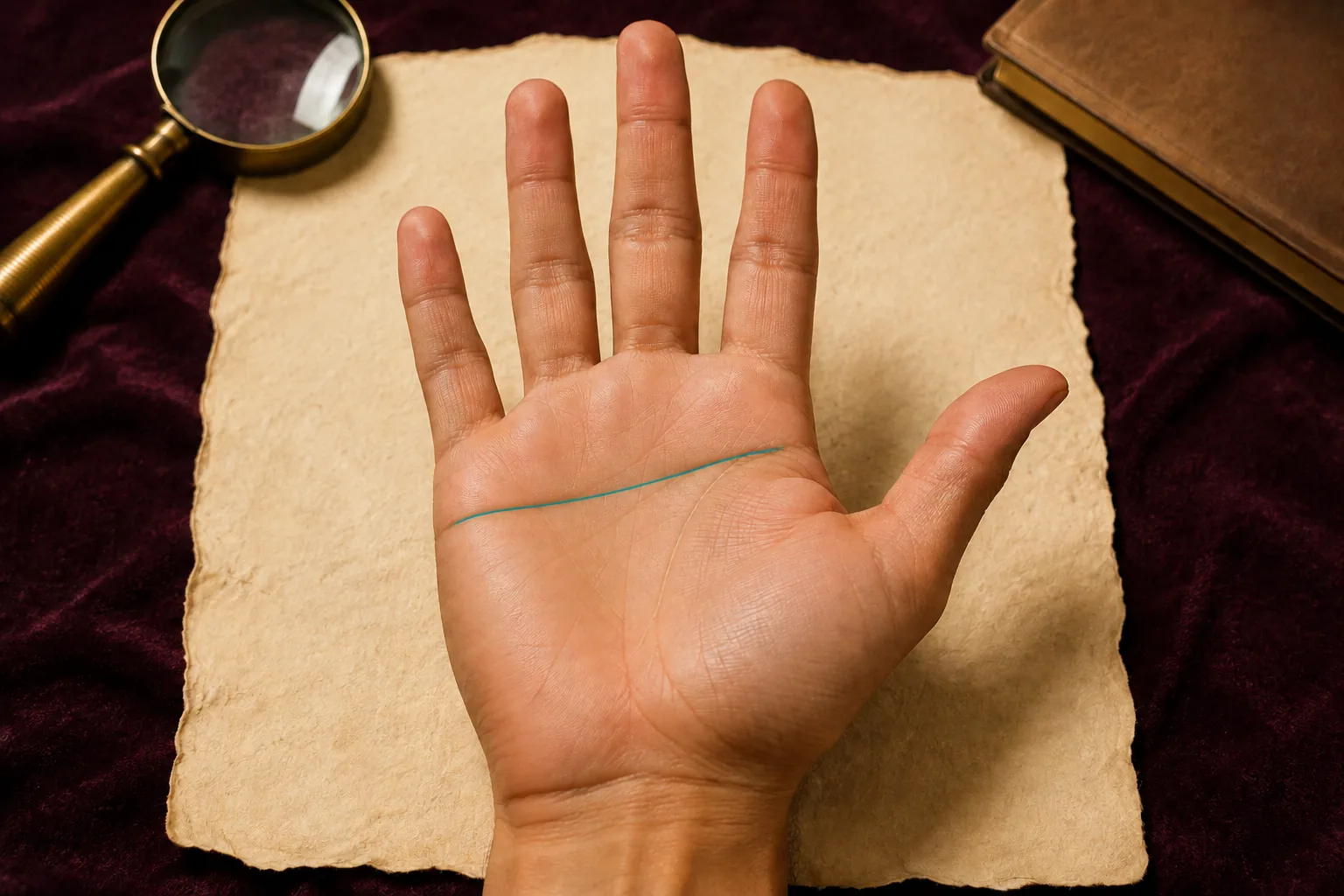
A simian line is one strong transverse crease across the palm where the head line and heart line would normally appear as two separate lines. In palmistry, this joining is traditionally read as thought and feeling operating through one concentrated channel. It can indicate intensity, commitment, focus, and directness, while the line's position, depth, branches, interruptions, supporting features, and appearance on the other hand decide how that intensity is expressed.
One transverse crease can look simple while its position, branches, crossings, supporting lines, and opposite-hand pattern tell a much richer story. A whole-hand reading can verify the formation and show how its concentrated thinking-feeling pattern is directed in your life.
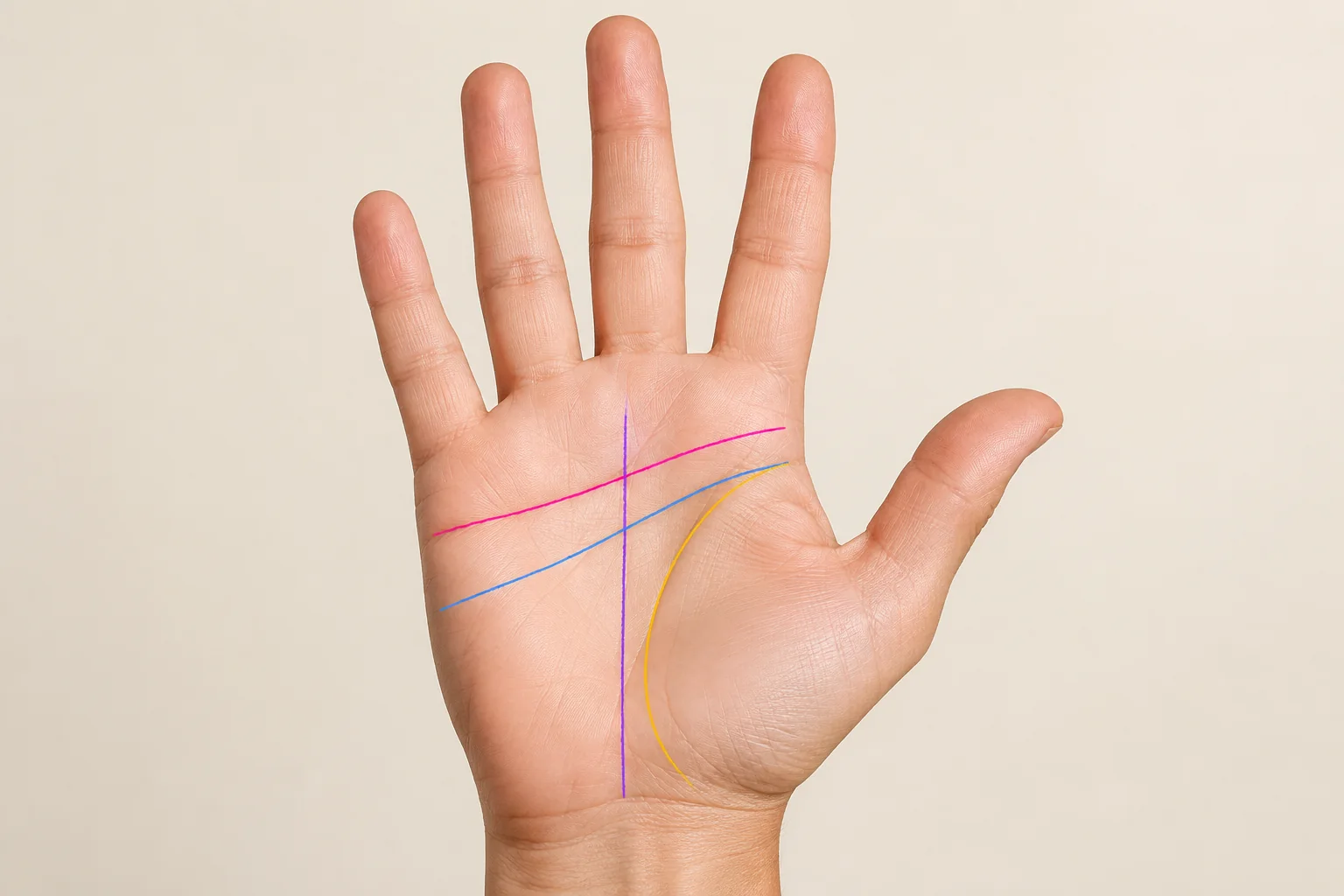
The anatomical name is a single transverse palmar crease. It can be a normal hand variation and the crease by itself does not diagnose a medical, developmental, personality, or intellectual condition. For a palm reading, stay with observable structure: verify that there is one main transverse crease, then read the complete hand around it.
How to identify a true simian line
First find the two lines most palms show below the fingers. The heart line normally occupies the upper palm, while the head line crosses the middle. A complete simian formation replaces that two-line arrangement with one dominant crease extending from the little-finger side across the palm toward the thumb and index area.
Five-step identification test
- Relax the hand and look in bright, indirect light.
- Find the little-finger edge and trace the strongest transverse crease inward.
- Check whether the same crease continues across most or all of the palm.
- Look above and below it for a separate, independent head or heart line.
- Repeat the check on the other hand and note hand dominance.
| What you see | Likely classification | What to read next |
|---|---|---|
| One continuous, dominant crease across the palm with no second full transverse line | Complete simian line | Position, depth, endpoint, branches, markings, and both hands |
| Head and heart lines join for part of their route, then separate | Partial or transitional simian formation | Where the joining begins and where the two functions separate again |
| Two full lines touch through a short branch | Connected head and heart lines | The connecting branch rather than a complete simian line |
| One strong line plus a shorter independent fragment above or below | Simian line with a secondary head or heart branch | Which function the secondary line restores or releases |
| Several fine creases seem to bridge two main lines only in a photo | Chance crossing or image artifact | Retake the image without filters and trace the parent lines |
A bent palm can make ordinary creases meet. Confirm the structure with the fingers naturally extended and compare it with the beginner palm-reading sequence before naming the formation.
What does a simian line mean in palmistry?
The traditional interpretation begins with fusion. The head line represents reasoning, attention, decisions, and mental style; the heart line represents emotional expression, attachment, values, and relationship expectations. When both share one crease, palmists read a person who may engage with ideas, work, people, and convictions with unusual concentration. Feeling can drive thought, thought can organize feeling, and a subject may hold the person's full attention rather than only part of it.
This does not create one fixed personality. Intensity can become disciplined persistence, creative immersion, firm loyalty, blunt conviction, or difficulty stepping back, depending on the rest of the hand. A flexible thumb, balanced fingers, clear fate line, developed mounts, and fine release branches can give the joined line several ways to express itself.
The six-feature simian-line reading map
| Feature | What to observe | Traditional reading question |
|---|---|---|
| Route | High, central, low, straight, or curved | Does emotional or analytical emphasis lead the combined channel? |
| Quality | Deep, fine, broad, chained, clear, or uneven | Is the intensity steady, sensitive, forceful, or changeable? |
| Length and endpoints | Where the line begins and ends | How widely does the focus reach, and toward which mounts? |
| Branches | Upward, downward, forked, or secondary fragments | Where do ambition, affection, imagination, or alternative thinking find an outlet? |
| Interruptions | Breaks, islands, bars, crosses, or shifted continuation | Where does the combined pattern meet strain, redirection, or divided attention? |
| Whole hand | Thumb, mounts, fate and Sun lines, hand shape, and opposite palm | What directs and balances the person's concentrated energy? |
Strengths traditionally linked with the line
- Deep concentration when a goal carries personal meaning.
- Persistence after a clear decision has been made.
- Direct emotional and intellectual commitment.
- The ability to immerse fully in work, craft, study, or a relationship.
- Strong internal consistency when values and plans agree.
Challenges traditionally linked with the line
- Difficulty disengaging from a thought, emotion, goal, or conflict.
- All-or-nothing decisions when flexibility would help.
- Taking disagreement personally when beliefs and feelings are tightly joined.
- Periods of indecision when the mind and heart do not reach one shared answer.
- Concentrating so strongly on one area that other priorities receive less attention.
These are paired possibilities, not automatic outcomes. The same concentrated pattern can look constructive in a flexible, well-balanced hand and more rigid when the thumb, fingers, mounts, and supporting lines repeat inflexibility.
High, central, low, straight, or curved simian line
The crease's position changes which half of the joined meaning appears more prominent. Compare it with the normal territories of the heart and head lines rather than judging height from the wrist alone.
| Line position or route | Visual cue | Traditional emphasis |
|---|---|---|
| High across the palm | Runs closer to the finger bases and heart-line territory | Values, emotional conviction, attachment, and personal meaning strongly guide decisions |
| Central | Occupies the space between the usual heart and head routes | Thought and feeling have relatively equal weight |
| Low across the palm | Runs closer to the usual head-line territory | Planning, practicality, and mental control organize emotional expression |
| Very straight | Crosses with little rise or fall | Direct focus, firm standards, and preference for clear conclusions |
| Rising toward Jupiter | Turns upward beneath the index finger | Purpose, ideals, ambition, leadership, or high relationship standards |
| Sloping toward Moon | Drops toward the lower outer palm | Imagination, intuition, empathy, imagery, and subjective understanding |
Use the palm-mount map to name the endpoint accurately. A high line should not automatically be called emotional, nor a low line analytical, unless its quality, branches, thumb, and broader hand repeat that emphasis.
How depth, branches, breaks, and markings change the reading
| Variation | How it looks | Traditional interpretation |
|---|---|---|
| Deep and clear | Strong, even channel with little disturbance | Sustained focus and forceful commitment; check flexibility elsewhere |
| Fine but clear | Narrow crease that remains continuous | Sensitivity and concentration expressed with less outward force |
| Broad or diffuse | Wide, shallow channel | Strong involvement that may spread across several concerns |
| Chained section | Small linked islands along part of the route | A phase of complication, repeated processing, or divided focus in that zone |
| True break with overlap | Gap followed by a shifted continuation | Redirection rather than a simple ending; follow the new route |
| Upward branch | Branch rises toward a finger mount | Ambition, ideals, communication, or recognition gains a separate outlet |
| Downward branch | Branch descends toward the central or outer lower palm | Practical concern, memory, imagination, or emotional weight draws energy downward |
| Forked end | Line divides into two clear endpoints | Greater ability to hold two perspectives or direct intensity into two areas |
Confirm islands, crosses, bars, and forks through the marks-and-symbols verification method. A mark matters through its parent line and location. One fine crossing crease should not outweigh the full transverse pattern.
What does a fate line crossing the simian line mean?
A vertical fate line crossing the simian line connects direction and responsibility with the joined thought-feeling channel. A clean crossing traditionally suggests work or purpose can organize intensity. A stop, island, break, or branch at the meeting calls for closer attention to the continuation: does fate strengthen above it, shift course, or disappear?
What does a Sun line above the simian line mean?
A clear Sun line above the crease can give concentrated effort a path toward craft, satisfaction, or recognition. It does not promise fame. Its origin, clarity, and continuation show whether visibility develops from the central line, the fate line, Moon, or another influence.
Simian line on the right hand, left hand, or both palms
Read active and less-active hands, not one hand for women and another for men. The two-hand comparison uses the dominant hand for the pattern expressed and developed through current choices, while the less-active hand supplies an underlying or earlier pattern.
| Where it appears | Traditional comparison | Question to explore |
|---|---|---|
| Active hand only | Concentrated thinking-feeling has become more visible in present behaviour | What experience, role, relationship, or goal now demands complete engagement? |
| Less-active hand only | Intensity belongs to the underlying pattern but is expressed through more separate channels now | Where has the person learned flexibility or differentiation? |
| Both hands | The joined style is deeply rooted and consistently expressed | Which features provide release, perspective, and direction? |
| Complete on one, partial on the other | The central pattern remains but its expression is changing | Where do the lines separate, and which function gains an independent route? |
| Different heights on each hand | The balance between emotional and analytical emphasis has shifted | Which palm places the crease nearer heart or head territory? |
Does the meaning change for women and men?
The line's structure does not change with gender. Compare dominance, line quality, position, branches, mounts, thumb, supporting lines, and both palms. Assigning fixed hands by gender hides the most useful evidence: how the same feature changes between the two hands.
What can the simian line mean for love and relationships?
In relationship questions, the joined line can describe wholehearted attachment, high personal stakes, direct loyalty, or difficulty separating what happened from how it felt. A high line, upward branches, developed Venus, and a flexible thumb may express warmth and devotion. A very straight deep line with a firm thumb may express consistency and strong boundaries, but also resistance once a conclusion has formed.
Do not infer relationship outcomes from the simian line alone. Add relationship lines, Venus, the thumb, little finger, fate influences, and the other palm through the complete love-reading map.
What can the simian line mean for work and purpose?
At work, concentration can become specialization, sustained problem-solving, craft mastery, mission-driven effort, or deep ownership. The direction of that focus comes from the fate line, Jupiter, Saturn, Sun, Mercury, thumb, fingers, and hand shape. A simian line does not identify a profession or promise success by itself.
Compare it with the career-line framework. A strong fate line may organize intensity around responsibility; Sun support can direct it toward visible craft; Mercury features may channel it through communication, analysis, trade, or technical skill.
Six worked examples
Example 1: deep central line with flexible thumb
One clear transverse crease crosses the centre of the active palm. The thumb opens widely and bends moderately, while fate continues cleanly above the crossing. The combined reading emphasizes deep commitment with enough adaptability to reconsider methods while preserving the goal.
Example 2: high simian line with Jupiter branch
The line runs high and sends a branch toward the index-finger mount. Venus is firm and the index finger is strong. Values, relationships, ideals, and ambition may become closely linked; the person may commit most fully when a goal feels personally meaningful.
Example 3: low straight line with strong fate
The crease crosses closer to head-line territory, stays straight, and meets a deep fate line. The thumb is firm and the hand is relatively square. Planning and responsibility organize the concentrated pattern, favoring sustained practical work over frequent shifts.
Example 4: partial simian with a rising heart branch
The lines share one channel through the centre, then a distinct branch rises toward the heart-line zone. The person may approach important matters with joined thought and feeling but still develop a separate way to express affection, values, or relationship needs.
Example 5: complete line on the less-active hand only
The less-active palm has one joined crease, while the active palm shows separate head and heart lines. The underlying style is intense and unified, but present expression may have learned to separate analysis from emotional response when useful.
Example 6: crease with an island and clean continuation
A small island interrupts the central section, but the line becomes clear again and a Sun line strengthens above it. Palmists would examine a period of divided attention or emotional-mental complication, then give equal weight to the recovery and renewed creative direction.
Photo checklist for a simian-line reading
- Photograph both full palms from fingertips through wrists.
- Keep the fingers naturally extended and the palm relaxed.
- Use bright indirect light, then add one gentle side-lit image.
- Use the same camera distance and angle for both hands.
- Capture the little-finger edge and the thumb-index side where the crease begins and ends.
- Include close-ups only after taking both complete palms.
- Do not draw over, smooth, sharpen, or increase contrast around the line.
- State which hand is dominant and what question you want the reading to explore.
Questions that make a simian-line reading useful
- Is there truly one transverse crease, or do two full lines touch through a branch?
- Is the formation complete, partial, or accompanied by a secondary head or heart fragment?
- Does it run high, central, low, straight, rising, or sloping?
- Where do its branches point, and which mounts receive them?
- Does a fate or Sun line meet, cross, stop, or strengthen at the crease?
- Are any apparent islands, breaks, bars, or forks complete and visible in natural light?
- Does the thumb add flexibility, restraint, firmness, or independence?
- Is the line present on the active hand, less-active hand, or both?
- What matters most now: focus, emotional intensity, relationships, decisions, work, creativity, or direction?
Read the single crease inside the whole hand
Compare the usual head-line and heart-line territories, trace fate through the direction guide, then add mounts, thumb, branches, markings, and the opposite palm.
The complete answer
A simian line is one main transverse crease occupying the territory normally shared by separate head and heart lines. Palmists traditionally read it as concentrated thought and feeling, but its useful meaning comes from the line's height, route, depth, branches, interruptions, endpoints, supporting fate and Sun lines, thumb, mounts, hand shape, and the differences between both palms. A Full Palm Reading maps all these important features across both hands and combines them into a holistic reading focused on the person's questions about focus, emotions, relationships, decisions, work, creativity, and direction.
A Full Palm Reading
Ask what your simian line means inside the complete hand
Your reading verifies the single transverse crease, then adds its height, depth, branches, markings, fate and Sun crossings, thumb, mounts, hand shape, and both palms to explore focus, emotions, relationships, decisions, work, creativity, and direction.
Your Full Palm Reading maps all the important features—hand shape, skin texture, thumb, fingers, mounts, major and minor lines, markings, and the differences between both palms—and brings them together in a holistic reading focused on your questions.