
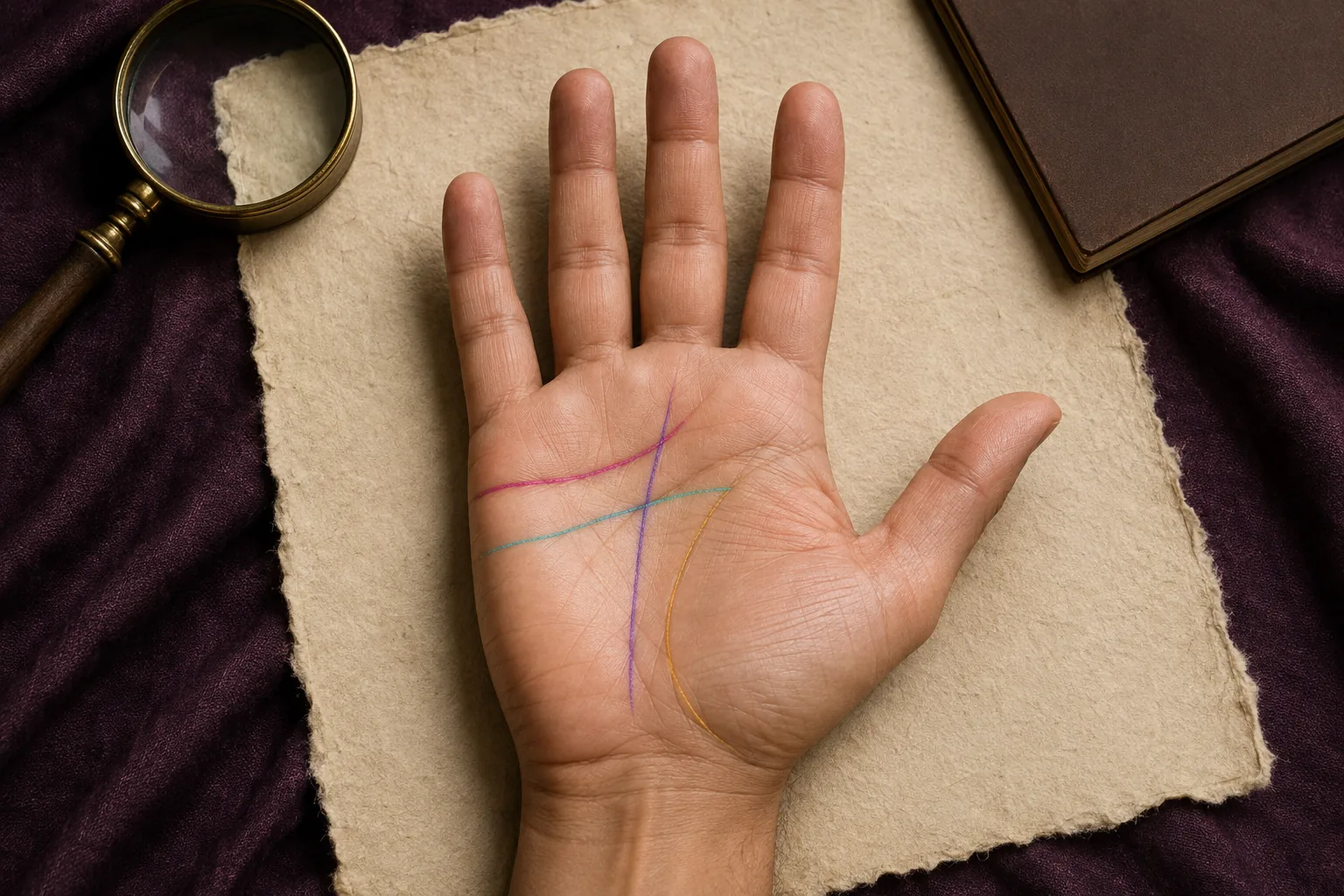
The M sign on a palm is an approximate capital-M-shaped formation created when the life, head, heart, and fate lines connect or align clearly across the hand. It is not a fifth line and should not be traced through gaps or unrelated skin creases. In palmistry, a clean M is traditionally associated with judgment, intuition, self-direction, responsibility, and the ability to connect thought with feeling. Its actual reading comes from the four component lines, not from the letter shape alone.
An M shape becomes meaningful only after each stroke is traced to a real life, head, heart, or fate line. A whole-hand reading can show which component dominates, where the lines change, and whether the formation becomes clearer or less complete across both palms.
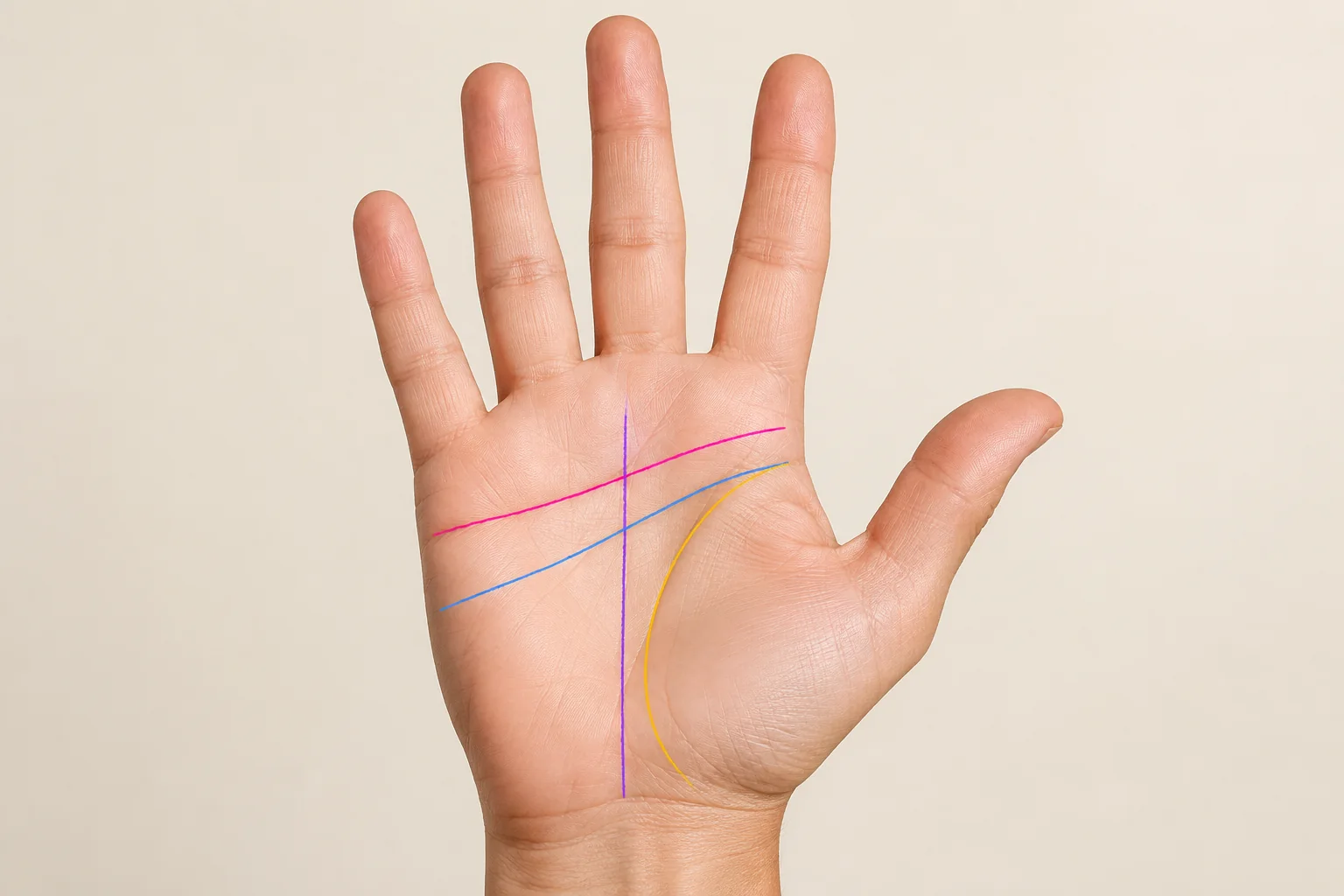
A clear fate line is usually the decisive stroke. Most hands already have life, head, and heart lines, so an M-like outline can appear whenever a central vertical line connects them. This makes the formation visually striking but not automatically rare, lucky, wealthy, or more important than the complete hand.
Which lines form the M sign?
| Component | Where to find it | Traditional contribution to the M |
|---|---|---|
| Life line | Curves from between the thumb and index finger around the thumb mound | Energy, grounding, physical engagement, and major life changes |
| Head line | Runs across the middle of the palm | Thinking style, judgment, focus, planning, and imagination |
| Heart line | Runs across the upper palm below the fingers | Emotional expression, values, attachment, and relationship expectations |
| Fate line | Rises vertically through the central palm toward the middle finger | Direction, responsibility, vocation, and the influence of circumstances |
The M is therefore a summary shape. Its four strokes may be uneven, curved, or slightly disconnected because real palm lines are not typography. A strong formation lets you trace the relevant sections without guessing where the line should go.
How to trace the M step by step
- Find the life line around the thumb mound and follow it to its starting point.
- Find the head line leaving or beginning near that same area and crossing the middle palm.
- Locate the fate line rising through the centre and check whether it clearly meets or crosses the head line.
- Continue the fate line upward and see whether it reaches or clearly aligns with the heart line.
- Follow the heart line across the upper palm to complete the visible zigzag.
- Repeat the sequence on the other hand before interpreting it.
Use the life-line guide, head-line guide, heart-line guide, and fate-line guide if any stroke is unclear.
How do you know if the M sign is real?
A useful M formation is built from identifiable major lines. The test is continuity and parentage: every visible stroke must belong to the life, head, heart, or fate line. Random crossing creases can imitate a letter in a high-contrast photograph.
| Formation | What you can trace | How to classify it |
|---|---|---|
| Clear complete M | All four parent lines are identifiable and the fate line links the central structure | Give the composite pattern full interpretive weight |
| Soft or approximate M | All four lines are present, but one junction is curved, light, or slightly open | Read the component lines; keep the letter secondary |
| Incomplete M | Life, head, and heart are clear but the fate line stops early or begins late | Read the missing or changing fate stroke as part of the meaning |
| Broken M | One parent line has a true gap or shifted continuation | Interpret the break within that line before the overall shape |
| False M from minor creases | Fine crossing lines fill gaps between unrelated sections | Do not promote the accidental outline to a major sign |
| Drawn or filter-enhanced M | The supposed strokes disappear in natural light or on the original photograph | Repeat the observation without editing |
Three quick verification checks
- Parent-line check: can each stroke be named as life, head, heart, or fate?
- Continuity check: can you trace the formation without jumping across blank skin?
- light check: does the same structure remain visible in flat and gentle side light?
The detailed marks-and-symbols guide explains how to separate complete formations from chance intersections.
What does the M sign mean in palmistry?
The traditional meaning comes from integration. The life line contributes energy and grounded action, the head line judgment, the heart line values and feeling, and the fate line direction. When all four are clear enough to form one coherent M, palmists often read a person whose decisions, emotions, effort, and purpose can reinforce one another.
| Traditional M-sign theme | Which lines support it | What changes the interpretation |
|---|---|---|
| Judgment | Clear head line meeting a steady fate line | Head-line length, slope, forks, and islands |
| Intuition | Head line slopes toward Moon while fate remains coherent | Moon development, fingerprints, and sensitivity elsewhere |
| Leadership | Strong fate line with Jupiter support and a balanced thumb | Whether direction serves responsibility or control |
| Integrity or consistency | Heart and head lines remain clear while fate connects them | Contradictions, breaks, and differences between hands |
| Self-direction | Fate line is independent and strengthens through the central palm | Its origin, branches, interruptions, and endpoint |
| Financial or career ability | Clear fate plus practical head line, thumb, Sun, or Mercury support | The M alone does not promise wealth or professional success |
Does the M sign mean money or wealth?
The popular wealth meaning comes mainly from combining a clear fate line with judgment and follow-through. A practical head line can add planning; a strong thumb can add decision and discipline; Sun and Mercury lines can add recognition or commercial skill. Without those supporting features, the M remains a line arrangement rather than a money promise.
For financial questions, compare the formation with the money and wealth line map and the money-triangle verification guide. The M and a money triangle are different structures: the M uses major-line segments, while the triangle needs three enclosed sides.
Does the M sign show intuition?
Intuition receives more weight when the head line slopes clearly toward the Moon mount, the Moon area is developed, and the hand shows supporting sensitivity or pattern-recognition features. A straight practical head line inside an M creates a more analytical reading. The same letter outline can therefore describe different decision styles.
How M sign variations change the reading
| M variation | Visible structure | Traditional emphasis |
|---|---|---|
| Deep, balanced M | Four clear lines of comparable quality | Thought, feeling, energy, and direction work with relative consistency |
| Strong fate stroke | Central vertical line dominates the other components | Duty, career, direction, or circumstance organizes the pattern |
| Strong heart stroke | Heart line is deeper than head or fate | Values and relationships strongly influence decisions and direction |
| Strong head stroke | Head line is long and dominant | Analysis, planning, or imagination shapes the path |
| Faint life stroke | Life-line segment is light while the other lines remain clear | Energy, grounding, or lifestyle conditions need more context |
| Fate line stops at head | The central stroke ends at the middle transverse line | A major decision, education, or thinking pattern redirects purpose |
| Fate line stops at heart | The central stroke reaches the upper transverse line but not beyond | Relationships or values reshape the later direction |
| Uneven or open M | One junction remains separated or one side is much lighter | The component lines disagree or one theme is still developing |
Large M versus small M
A larger-looking M usually comes from widely spaced head and heart lines, a broad palm, or a fate line running through much of the centre. A smaller M can come from closer transverse lines or a shorter visible fate segment. Size describes geometry; clarity and the quality of each parent line carry more interpretive weight.
Deep M versus faint M
A deep M means the component lines themselves are easy to see. Palmists may read the combined themes as more strongly expressed. A faint M asks you to rank the lines individually. If the fate line is the only faint stroke, direction may be flexible or developing even when thought, feeling, and energy are clearly marked.
M sign on the right hand, left hand, or both palms
Use hand dominance. In the common active-hand method, the less-active palm shows the background pattern and the active palm shows how it has developed through choices and experience. Right and left therefore do not carry fixed meanings for every person.
| Where the M appears | Traditional comparison | What to inspect |
|---|---|---|
| Clear on the active hand only | Integration, direction, or judgment has become more developed | Which component strengthened compared with the other palm? |
| Clear on the less-active hand only | The underlying potential is stronger than the currently expressed structure | Which active-hand line became faint, interrupted, or redirected? |
| Clear on both hands | The combined pattern repeats strongly in background and lived expression | Compare depth, size, line endings, and branches rather than stopping at presence |
| Complete on one, incomplete on the other | One area of life has changed the balance among thought, feeling, energy, and direction | Identify the missing or changed parent line |
| No clear M on either hand | No composite-letter emphasis | Read the four major lines normally; absence is not a negative sign |
Follow the two-hand comparison method and state whether the person is right- or left-handed before assigning the active palm.
Does the M sign mean the same for women and men?
Yes. The formation is read from the same life, head, heart, and fate lines regardless of gender. Older rules that assign a particular hand to women or men are less useful than comparing the hand used for writing and skilled action with the other palm.
Is the M sign rare?
A perfectly letter-like, equally deep M is less common than a loose M-shaped impression. An approximate M is not surprising because most people have the three principal lines, and many have at least part of a fate line. Treat clarity as a spectrum rather than declaring every M rare or dismissing every imperfect one.
Six worked M-sign examples
Example 1: balanced complete M
The life, head, heart, and fate lines are all clear and continuous. The head line is practical with a slight downward branch, the heart line is balanced, and fate continues beyond both crossings. The traditional reading emphasizes coordinated judgment, values, adaptability, and sustained direction.
Example 2: M dominated by a straight head line
The M is visible, but the head line is much deeper and straighter than the heart line. The thumb is firm and balanced. This combination leans toward analysis, planning, and practical decision-making more than intuitive or emotionally led judgment.
Example 3: intuitive M
The head line slopes toward Moon, the fate line stays clear, and the heart line curves upward. The M combines imagination and pattern recognition with enough direction to apply them. Check whether the person uses this in creative, advisory, research, or people-focused work.
Example 4: incomplete M because fate begins late
Life, head, and heart are clear, but fate begins only above the head line. The reading emphasizes established thought and emotional patterns while career or purpose becomes definite later. The missing lower stroke is more informative than forcing a complete letter.
Example 5: fate stops at the heart line
The central stroke crosses the head line and ends at the heart line. The M looks complete below, while direction changes at the emotional crossing. Palmists may explore whether relationships, family, or personal values reshape the later path.
Example 6: accidental M from fine crossing lines
A photo filter makes several shallow creases look connected, but the fate line cannot be traced and the outline disappears in natural light. There is no strong composite sign. Read the visible major lines separately instead.
Photo checklist for the M sign
- Photograph both palms from fingertips through wrists.
- Keep the hands relaxed, flat, and at the same angle.
- Use bright indirect light and add one gentle side-lit image.
- Capture the life, head, heart, and full fate-line route in one frame.
- Keep the image in colour so scars and shadows remain distinguishable.
- Turn off beauty filters, smoothing, artificial sharpening, and high-contrast effects.
- Do not draw an M over the photo before the lines have been identified.
- State hand dominance and the question you want the formation to inform.
Questions that make an M-sign reading useful
- Can every stroke be traced to the life, head, heart, or fate line?
- Which of the four component lines is strongest or weakest?
- Does the fate line begin at the wrist, Moon, life line, or mid-palm?
- What happens where fate crosses the head and heart lines?
- Does the head line make the pattern analytical, imaginative, or mixed?
- Does the heart line add strong ideals, balance, reserve, or emotional change?
- Is the M clearer on the active hand, less-active hand, or both?
- Do the thumb, Jupiter, Sun, or Mercury features support leadership, recognition, or commercial skill?
- Which real question matters most: career direction, judgment, intuition, relationships, money, or personal development?
Read the M as four connected lines
Verify the life line, compare the head line and heart line, then trace the fate line before interpreting the composite shape.
The complete answer
The M sign on a palm is a composite formed by identifiable sections of the life, head, heart, and fate lines. A clear M traditionally links energy, judgment, values, and direction; an incomplete or uneven M shows which one of those themes is lighter, interrupted, or developing. Its meaning changes with the origin and strength of fate, the shape of the head and heart lines, the thumb, mounts, supporting lines, and the differences between both palms. A Full Palm Reading maps all these important features across both hands and combines them into a holistic reading focused on the person's questions about intuition, decisions, career, relationships, money, and direction.
A Full Palm Reading
Ask what your complete M formation means inside the whole hand
Your reading traces the life, head, heart, and fate lines that create the M, then adds their origins, branches, breaks, mounts, thumb, Sun and Mercury support, and both palms to explore judgment, intuition, leadership, relationships, money, and direction.
Your Full Palm Reading maps all the important features—hand shape, skin texture, thumb, fingers, mounts, major and minor lines, markings, and the differences between both palms—and brings them together in a holistic reading focused on your questions.