
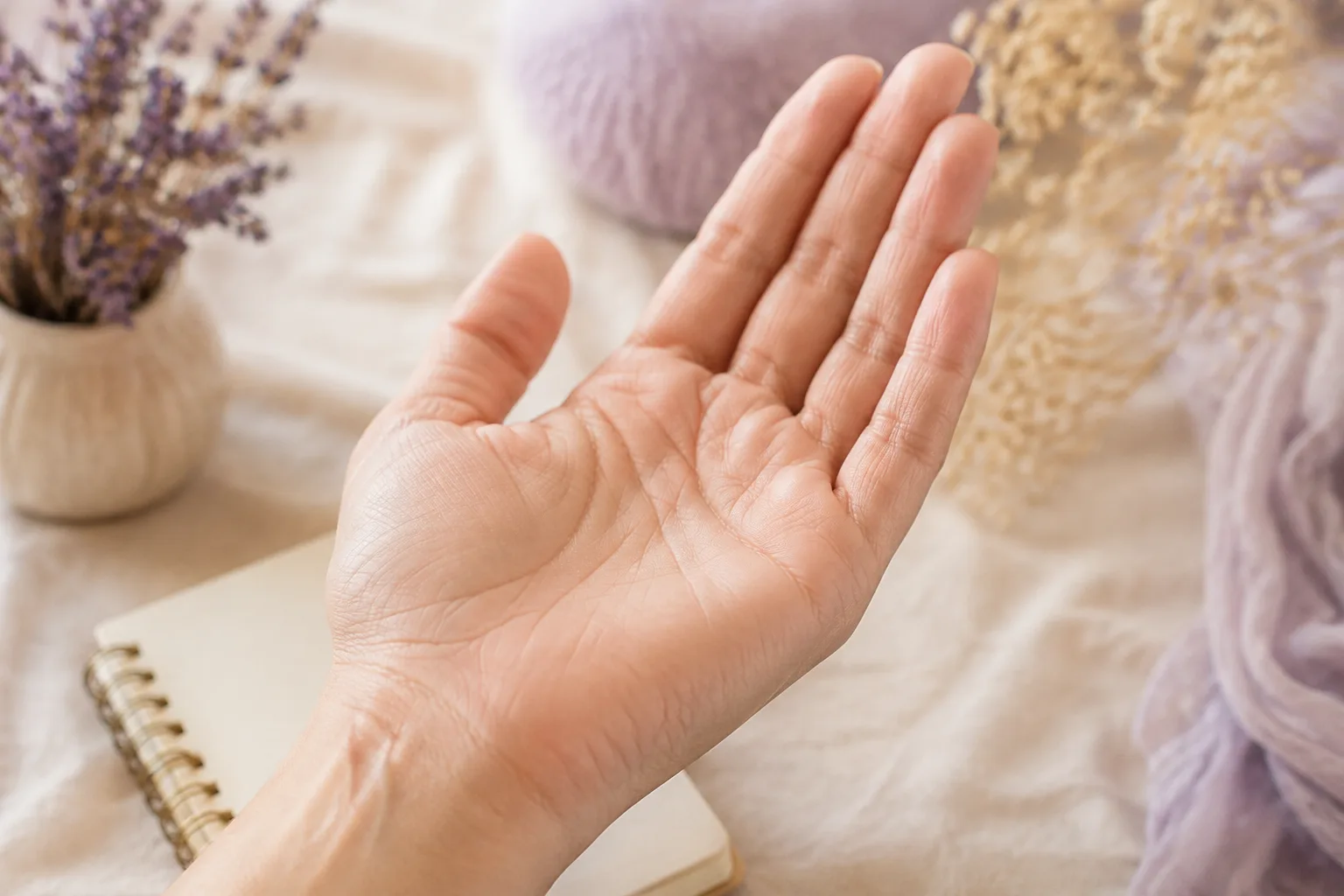
Children lines in palmistry are the very fine vertical marks traditionally read above or crossing the relationship lines on the outer edge of the palm beneath the little finger. A clear line is given more weight than a shallow skin fold. These lines are used symbolically for a person’s relationship with children, mentoring, or caregiving; counting them does not reliably reveal the number of children or predict pregnancy.
Tiny lines at the edge of the hand are easy to misidentify. A focused reading can compare the close-up with both full palms and place family, caregiving, and relationship themes in context.
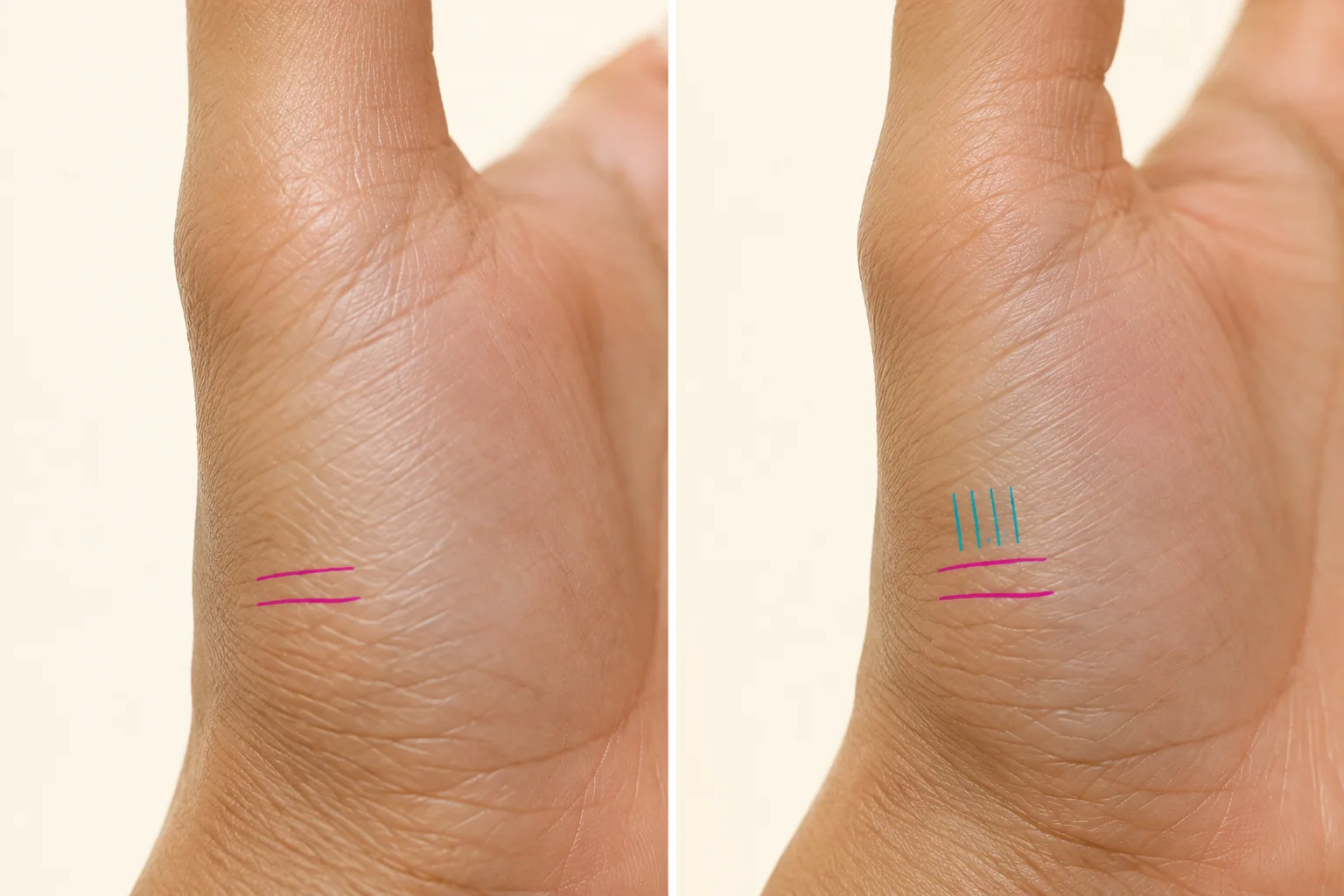
Where are children lines on the palm?
The area is small and easy to misread. Use this order:
- Turn the hand sideways so the little-finger edge faces you.
- Find the heart line entering the palm from below.
- Find the short horizontal relationship lines above it.
- Look for fine vertical strokes rising from or immediately above a clear relationship line.
- Check the same area on the other palm.
Children lines are usually much finer than the heart line and shorter than the relationship line. If a vertical crease continues far into the palm or across the little-finger mount, it may belong to another minor-line pattern.
Traditional meanings of common forms
| Observed form | Traditional reading | Useful interpretation |
|---|---|---|
| Clear vertical line | A strongly marked child or caregiving bond | Children, mentoring, or guiding others may carry personal importance |
| Fine or faint line | A subtler family influence | Give it less weight than the heart and relationship lines |
| Several fine lines | Several young people or caregiving roles | Do not turn the count into a fertility prediction |
| Fork at the top | A bond expressed in two directions | Distance, changing roles, or divided responsibilities may be the reflection theme |
| Line touching a relationship line | Family and partnership themes are linked | Discuss how caregiving affects the relationship |
| No visible lines | No emphasized minor mark | It says nothing certain about children, fertility, or family life |
Do deep lines mean sons and fine lines mean daughters?
Some older systems divide children lines by depth or width and assign a sex to each. The same visual difference can come from pressure, skin texture, lighting, or crease depth, so that distinction is not dependable. A more useful reading asks how strongly the family or mentoring theme appears, without assigning sex.
Lines commonly confused with children lines
- Relationship lines: these run horizontally from the hand’s edge; children lines are described as vertical.
- Mercury-mount striations: numerous fine vertical lines directly below the little finger may be read as communication, service, or Samaritan lines depending on their location.
- Skin folds: shallow lines that appear only when the little finger bends are positional folds.
- Scars: a scar has different texture or colour and may cut across the normal ridge flow.
- Branches from the heart line: these begin lower and connect visibly to the major crease.
The main test is continuity. Trace the mark from start to finish with the hand relaxed. If you cannot distinguish it twice under consistent light, leave it unclassified.
Which hand shows children lines?
Use both. In a common active/passive method, the non-dominant hand represents background expectations and the dominant hand represents the pattern being lived or developed. A clear line on only one hand can be read as a difference between private expectation and present experience. It should not be framed as an event that must happen.
How to photograph the children-line area
- Clean the camera lens and use the rear camera if possible.
- Relax the hand instead of pulling the little finger back.
- Photograph the palm straight on first.
- Take a second close-up with the outer edge turned about 45 degrees toward the camera.
- Use bright indirect daylight from the side.
- Tap the edge below the little finger to focus; avoid beauty filters and sharpening.
The full-palm image gives context; the angled close-up captures the tiny edge marks. Keep both because a close crop alone can make an ordinary fold look unusually important.
How children lines fit into a family reading
Begin with the Venus mount for warmth and family attachment, then read the heart line for emotional expression and the little finger for communication. Add children lines only when they are clear. This turns the question from “How many children will I have?” into a more detailed picture of family closeness, caregiving, teaching, and how those roles interact with partnership.
Children-line FAQ
Can palmistry predict pregnancy?
No. Palm creases cannot confirm pregnancy, fertility, miscarriage, or a future birth. Those questions require appropriate medical testing and care.
Do lines show biological children only?
Traditional interpretations vary. Many modern readers include stepchildren, younger relatives, students, mentees, and other strong caregiving relationships.
Why do my lines appear only when I bend my hand?
They are likely movement folds. Read the area with a relaxed hand and compare photographs taken in the same position.
Map the outer edge correctly
First locate the relationship lines, then compare the minor-line map and the guide to forks and branches.
The direct answer
Children lines are fine vertical marks in the relationship-line area under the little finger. Read clarity, direction, and connection to nearby lines, then combine them with the Venus mount, heart line, and little finger. Their strongest use is exploring caregiving and family themes, not predicting a number or medical outcome.
A Full Palm Reading
Place the fine edge lines inside your family and relationship pattern
Your reading uses both full palms and angled edge views to distinguish the traditional children-line area from relationship lines, skin folds, and nearby marks before exploring your question.
Your Full Palm Reading maps all the important features—hand shape, skin texture, thumb, fingers, mounts, major and minor lines, markings, and the differences between both palms—and brings them together in a holistic reading focused on your questions.