
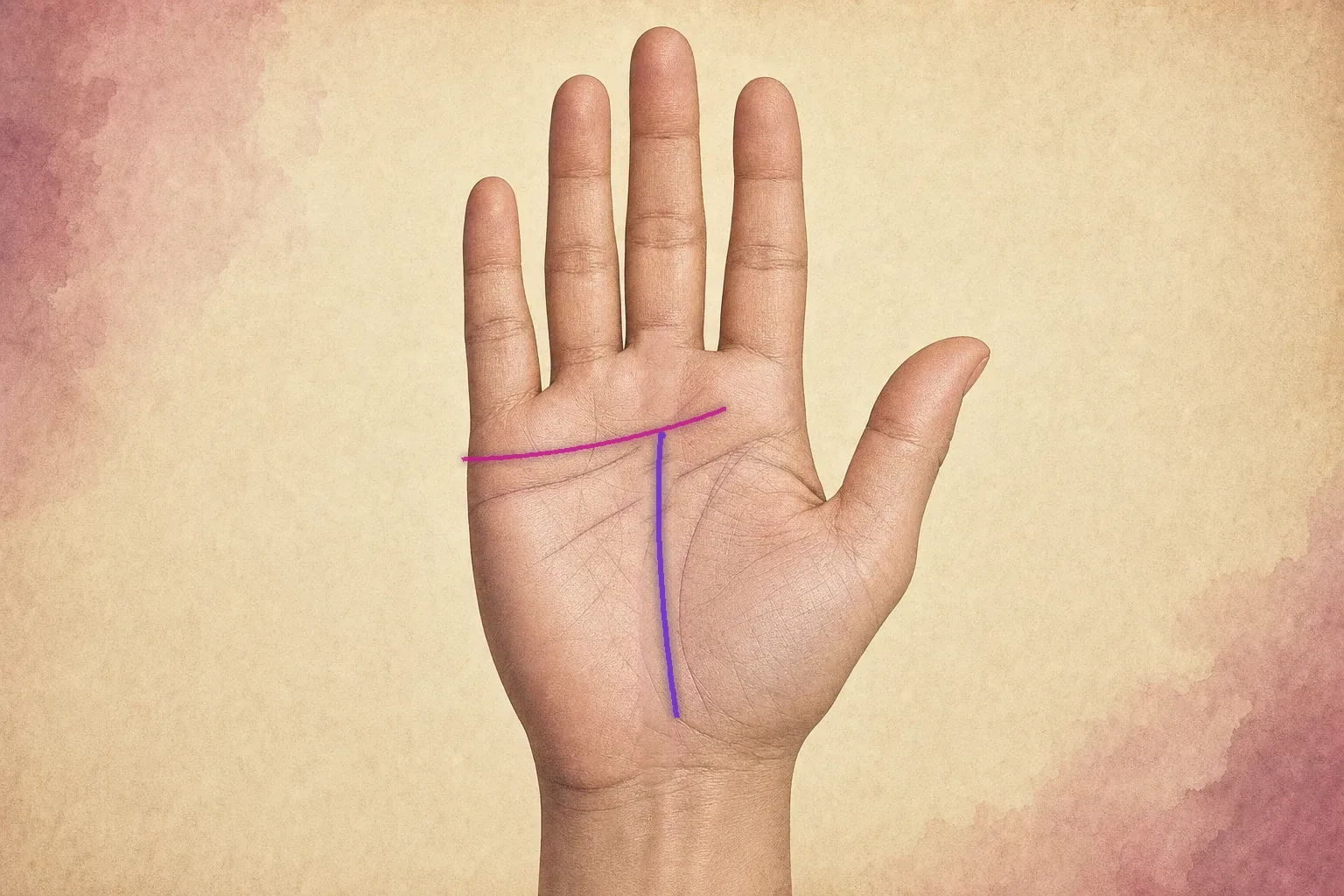
In traditional palmistry, a fate line that ends at the heart line suggests an established path reaches a boundary shaped by feelings, relationships, personal values, or emotional priorities. The person may reorganize work around what matters more deeply, change responsibilities because of a close bond, or leave a structure that no longer feels meaningful. The sign does not automatically mean career failure, retirement, divorce, or sacrifice for another person.
A fate-line stop at the heart line becomes meaningful only after the parent route, exact junction, endpoint quality, crossing test, faint continuation, shifted restart, nearby Sun line, influences, timing, and both hands are compared. A whole-hand reading can show how values, relationships, family, balance, fulfillment, and later responsibilities reshape direction.
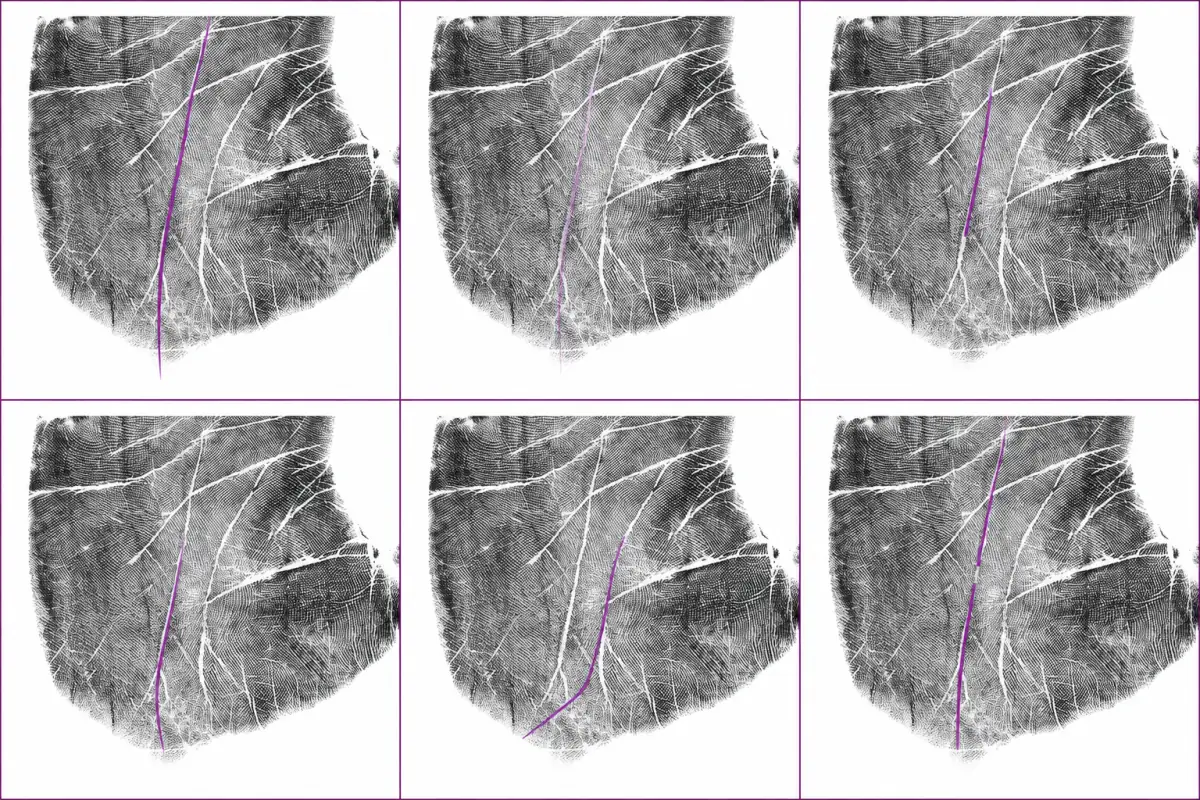
Use a seven-part heart-line fate-endpoint method: trace the Saturn-bound parent from below, locate its meeting with the heart line, confirm there is no continuation above the junction, inspect how the line finishes, search for a restart or replacement route, compare relationship and career features, and read both hands. One endpoint describes where a particular structure changes; it cannot explain the entire later life by itself.
First decide whether the fate line ends or begins here
A true ending has a visible fate route below the heart line and no continuation above it. A fate line that begins at the heart line has no Saturn-bound route below the junction and develops upward from it. A line crossing the heart line remains visible on both sides. Trace downward and upward before assigning meaning.
Locate the fate line and heart line
The fate line rises through the center of the palm toward Saturn below the middle finger. The heart line begins at the outer edge below the little finger and travels across the upper palm toward Jupiter or Saturn. Their meeting lies above the head line, usually beneath the middle-finger region. The complete fate-line guide maps origins and destinations, while the heart-line guide explains the upper transverse parent.
| Feature | Route | Reading role |
|---|---|---|
| Fate line | Develops toward Saturn | Work, responsibility, direction, and structure |
| Heart line | Crosses the upper palm from the outer edge | Values, attachment, emotional expression, and relationship style |
| Junction | Vertical route meets upper transverse line | Values or relationships affect established direction |
| Clear skin above | No fate continuation toward Saturn | Supports a true ending |
| Upper restart | New route develops above or beside the meeting | Shows a later structure or redirected purpose |
How to verify a true stop at the heart line
Begin at the fate-line origin and trace the same crease upward through the head-line level. It should continue to the heart line and stop at the point of contact. Inspect the Saturn area above it under soft side light. A thin upper segment, nearby Sun line, fingerprint ridge, or shadow can be mistaken for either a continuation or an ending.
| Pattern at the heart line | What you should see | Classification |
|---|---|---|
| True stop | Established fate route reaches heart line; no route continues above | Fate line ends at heart line |
| Clean crossing | Same route remains visible below and above | Continuous fate line |
| Faint upper section | Route keeps its alignment but becomes finer | Changing or reduced structure |
| Gap and restart | Open skin separates lower and upper segments | Break with later continuation |
| Shifted continuation | Upper route begins on a different axis | Redirection after the junction |
| Route begins at heart line | No fate line exists below the contact | Heart-line-origin or late-starting fate line |
| Sun line near junction | Upper route aims below the ring finger | Apollo line, not fate continuation |
The destination test matters. A line above the heart line that reaches the ring finger belongs to the Sun or Apollo system, while fate aims toward the middle finger. Follow the complete route rather than extending it mentally. Photograph the full palm so the finger destination remains visible.
Traditional meaning: values reshape the established path
The heart line represents more than romance. Traditional readers connect it with what a person values, how affection is expressed, and which emotional priorities carry lasting weight. When the fate line ends there, work or responsibility may stop being the central organizing structure in its previous form.
A relationship can be part of the story, but it is only one possibility. The mark can also fit a decision to care for family, choose meaningful work over status, protect personal time, retire from one role into another, build a partnership, sell a business, reduce pressure, or pursue creative fulfillment. The heart line explains the kind of boundary; the rest of the palm shows how it is expressed.
| Priority theme | Possible traditional expression | Confirm with |
|---|---|---|
| Relationship | A close bond changes location, workload, or responsibility | Relationship lines, Venus, and influence lines |
| Family | Care, home, or shared duty reorganizes the path | Venus and life-line branches |
| Meaning | A role without emotional value is released | Sun line and heart-line quality |
| Balance | Personal time gains priority over one fixed structure | Thumb flexibility and later routes |
| Partnership | Independent work becomes shared or collaborative | Influence joining fate before the endpoint |
| Completion | One long duty reaches its natural limit | Clean endpoint and strong supporting lines |
When is a fate line ending at the heart line timed?
Many palmistry systems place the fate-line crossing with the heart line in the mid-to-late fifties, often near age 55. Use this as a broad chapter marker. The angle of the heart line, the length of the palm, and the reader’s timing system can shift the estimate, so the crease cannot supply an exact birthday or retirement date.
Calibrate the fate line with known earlier events. If the head-line crossing aligns with a remembered career decision, compare the proportional distance from that landmark to the heart-line endpoint. Changes in depth, branches, joins, or breaks along the route can provide additional reference points. The timing guide explains how to build a window without inventing precision.
What happens after the fate line ends?
The palm above and beside the junction matters more than the stop alone. A person can remain active without one strong Saturn-bound line. Sun, Mercury, Jupiter, Moon, the thumb, and the head line may show how direction continues through fulfillment, communication, leadership, travel, adaptability, or self-defined work.
| Later feature | Traditional synthesis | What to verify |
|---|---|---|
| Shifted fate restart | A new responsibility structure follows the value change | New origin and Saturn destination |
| Sun line continues strongly | Recognition, craft, or fulfillment carries the later chapter | Apollo destination and timing |
| Mercury line strengthens | Communication, enterprise, or guidance becomes more central | Independent route to Mercury |
| Branch reaches Jupiter | Teaching, leadership, or aspiration redirects effort | Whether the parent ends or continues |
| Moon route joins before endpoint | Clients, travel, or a wider environment influences the transition | Exact join and Moon origin |
| No later vertical route | Direction may become flexible, relational, or project based | Head line, thumb, mounts, and real priorities |
The career-lines guide combines the fate line with the Sun line, Mercury line, head line, thumb, fingers, and mounts. This prevents one traditional endpoint from being treated as a complete career forecast.
How line quality changes the reading
A deep fate line stopping cleanly at a clear heart line gives the values boundary more emphasis. A gradual fade before contact suggests the old structure has already been losing force. A frayed or chained approach points to repeated adjustments. If an influence line joins fate shortly before the endpoint, a person or close obligation may have a stronger role in the transition.
| Endpoint quality | Traditional emphasis | Reading limit |
|---|---|---|
| Deep clean stop | Definite completion or priority boundary | Does not prove loss or failure |
| Gradual fade | Responsibility reduces over a period | Do not assign one event |
| Chained approach | Several negotiations or adjustments precede change | Timing should remain broad |
| Influence joins before stop | A close person or obligation affects direction | Trace the influence origin |
| Square around junction | Containment or support surrounds the transition | Not guaranteed protection |
| Heart line remains clear | Values stay coherent after the old route ends | Career ability has not ended |
Fate line ending at the heart line on one hand or both
A matching stop on both palms gives the values-led transition more structural weight. If only the active hand stops, present choices or relationships may have reorganized how direction is expressed. If the less-active hand stops while the active fate line crosses or restarts, later development may have built continuity beyond the underlying pattern.
Compare the origin, depth, heart-line junction, upper route, and supporting features on both palms. The which-hand guide explains active and less-active comparison. Use photographs taken at the same distance, angle, and light so a shallow continuation is not lost on one side.
Fate-line and heart-line combinations
| Combination | Traditional synthesis | Read with |
|---|---|---|
| Stop + clear curved heart line | Warmth or close bonds guide the transition | Venus and relationship zone |
| Stop + straight heart line | Values are applied through measured practical choices | Head line and thumb |
| Stop + strong Sun line | Fulfillment or recognition remains active after fixed duty changes | Apollo timing |
| Stop + upper fate restart | A new structured role follows changed priorities | Restart origin and strength |
| Stop + Venus influence joining fate | A close relationship or family duty affects the path | Source and timing of the joining line |
| Stop + flexible firm thumb | Adaptation and will help reshape responsibility | Thumb opening and phalanges |
Worked examples
A deep fate line stops cleanly at a strong heart line
One sustained structure reaches a clear values boundary. If the Sun line continues above the same level, recognition or personally meaningful work may remain strong without the former Saturn pattern.
A Venus influence joins fate shortly before the heart line
A partner, family member, home obligation, or close bond may contribute to the change. Confirm the influence line’s origin and avoid assuming one specific relationship outcome.
The less-active fate line stops, but the active line crosses the heart line
The underlying pattern suggests a boundary, while current development shows continued structure. Compare later line quality and destinations to see how priorities were integrated rather than treated as a stop.
Photo checklist for a heart-line fate endpoint
- Photograph both full palms from wrist to fingertips.
- Keep the heart line and Saturn area sharply focused.
- Use soft side light to reveal an upper continuation.
- Trace the fate line upward from its origin.
- Check whether the route crosses, fades, stops, or restarts.
- Confirm any upper line reaches Saturn rather than Apollo.
- Record changes in depth before the junction.
- State hand dominance and the work, relationship, or values question you want explored.
Read the endpoint inside your complete direction pattern
A Full Palm Reading maps the fate-line origin, route, heart-line junction, endpoint quality, timing, possible restart, influences, later destinations, supporting career and relationship features, and both palms. It then adds the head and heart lines, Sun and Mercury lines, Venus, Moon, Jupiter, thumb, fingers, shape, and texture into one holistic reading focused on your questions.
The complete answer
A fate line ending at the heart line traditionally shows an established path reaching a boundary shaped by values, relationships, attachment, family, or emotional priorities around the broad heart-line period. It does not guarantee career failure, retirement, or sacrifice. Verify a true ending rather than a crossing or heart-line start, inspect the line quality, search for later routes, compare career and relationship combinations, and read both hands. A Full Palm Reading maps this endpoint and all important features across both palms and combines them into a holistic reading focused on your questions about work, relationships, family, balance, fulfillment, timing, purpose, and later direction.
A Full Palm Reading
Ask how values and relationships reshape your direction
Your reading maps the fate-line origin, route, heart-line junction, endpoint quality, timing, possible restart, influences, later destinations, career and relationship features, and both palms, then adds the Sun and Mercury lines, mounts, thumb, fingers, shape, and texture into one holistic reading focused on your questions.
Your Full Palm Reading maps all the important features—hand shape, skin texture, thumb, fingers, mounts, major and minor lines, markings, and the differences between both palms—and brings them together in a holistic reading focused on your questions.