
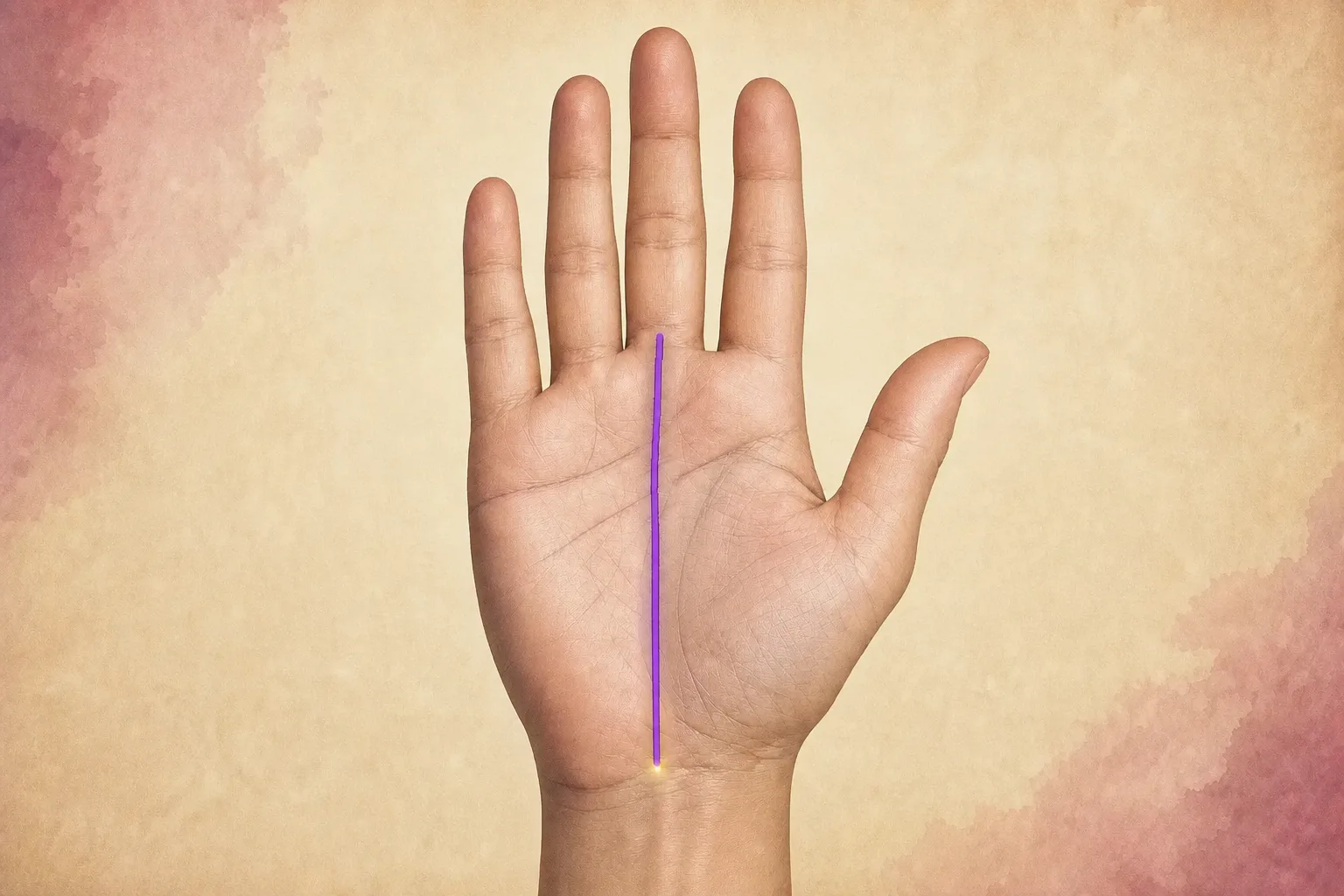
In traditional palmistry, a fate line that begins independently at or just above the wrist and rises toward Saturn is associated with direction, structure, duty, or responsibility taking shape early in life. A clear continuous route suggests that this organizing thread remains relatively steady. A faint, broken, shifted, or branching route shows that the way responsibility is expressed can change. The origin does not guarantee one lifelong career, wealth, fame, or a fixed destiny.
A wrist-origin fate line becomes meaningful only after the bracelet boundary, independent starting point, complete Saturn-bound route, depth, continuity, head- and heart-line crossings, changes, branches, destination, timing, and both hands are compared. A whole-hand reading can show how early structure, responsibility, work, decisions, values, recognition, communication, and direction develop together.
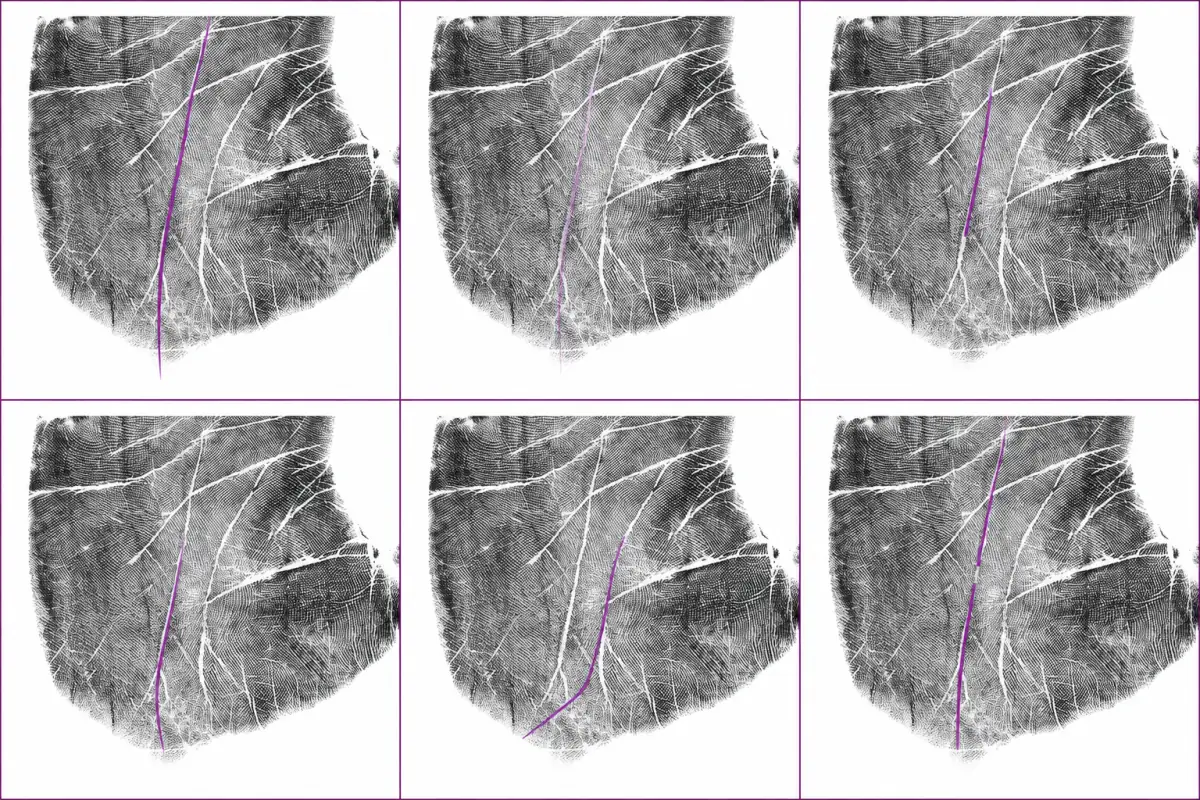
Use a nine-part wrist-origin fate-line method: expose the full wrist, identify the top bracelet crease, confirm an independent start above it, trace one continuous route toward Saturn, record depth and clarity, inspect the head-line crossing, inspect the heart-line crossing, map the endpoint and branches, then compare both palms. The low origin tells you where the pattern begins. The rest of the line tells you how it develops.
A low start is only the first clue
The fate line is traditionally read as a route of responsibility, work, purpose, or the structure that organizes daily life. Beginning near the wrist gives that theme an early starting point. It does not mean every event was decided at birth. Changes, breaks, branches, crossings, destinations, mounts, and the active hand can all modify the route.
Where a wrist-origin fate line begins
The bracelet or rascette lines run horizontally across the wrist. A true wrist-origin fate line begins at the central base of the palm, usually just above the upper bracelet, then travels upward through the lower palm. Its expected direction is toward the Mount of Saturn beneath the middle finger. The start may sit exactly in the center or slightly toward the thumb or outer edge, but direction and destination must still identify it as a fate line.
| Starting position | Geometry to verify | Traditional emphasis |
|---|---|---|
| Central base above the bracelet | Independent vertical route toward Saturn | Early structure, duty, or established direction |
| From the life-line arc | First visible route leaves a true life-line junction | Personal effort, family foundation, or self-directed duty |
| From the Mount of Moon | Begins at the lower outer palm and curves inward | Public response, clients, travel, environment, or other people |
| From the middle palm | No traceable Saturn route exists below the start | Direction or sustained responsibility develops later |
Keep the whole wrist visible in photographs. A crop can make a mid-palm line appear to begin at the base, while a deep bracelet crease can look like a connected origin. The bracelet-line guide explains the horizontal wrist formations separately.
How to verify the line before reading it
Start at the lowest visible point and follow the same groove upward. A fate line can be fine, but it must have a coherent Saturn-bound direction. Do not join nearby fragments merely because they seem to form a convenient vertical route. Tilt the palm under side light and check whether the segments truly connect, overlap, or shift.
| Lookalike | Defining difference | How to classify it |
|---|---|---|
| True wrist-origin fate line | Begins independently above the bracelet and rises toward Saturn | Read origin, route, crossings, quality, and endpoint |
| Rising bracelet branch | Leaves a horizontal wrist crease at a shared junction | Read it first as a bracelet branch and verify its destination |
| Moon-origin fate line | Starts on the lower outer palm rather than the center base | Trace its curved approach toward Saturn |
| Life-line-origin fate line | Emerges from the arc around Venus | Confirm a shared junction and no route below it |
| Sun line | Travels toward Apollo beneath the ring finger | Read recognition, expression, or fulfillment |
| Mercury line | Travels toward the little-finger mount | Read communication and applied skill separately |
| Lower fragment | Fades before forming one dependable route | Record a fragment rather than inventing continuity |
Destination is the strongest identity check. A route from the wrist that ends below Apollo is not converted into a fate line simply because it is vertical. The complete fate-line guide maps the whole family of origins, destinations, branches, breaks, and parallel routes.
Traditional meaning of a fate line starting at the wrist
Palmists traditionally associate a low fate-line origin with an early awareness of duty, routine, ambition, vocation, family expectations, or the need to create a dependable path. The person may have encountered structure early, formed goals young, or learned to organize life through work and responsibility. Which of these fits depends on the line's exact position and the rest of the hand.
A central origin can emphasize an internally organized path. A start slightly toward Venus may bring family roots, personal obligations, or close relationships into the foundation. A start closer to Moon may give more weight to environment, public contact, movement, imagination, or opportunities that come through other people. These are gradations, so trace the actual start rather than forcing every low line into one label.
A strong line is not proof of a prestigious career. It can describe steady responsibility in paid work, family care, study, a business, community service, or another long-running commitment. Likewise, a person without this origin can still be focused and successful. Palmistry reads how the hand organizes a theme; it does not rank lives.
How depth, clarity, and continuity change the meaning
Origin answers where the route begins. Quality shows how strongly and consistently it appears. Assess the full line in sections because a fate line can change after major crossings.
| Line quality | Traditional reading | What to inspect next |
|---|---|---|
| Deep, clear, continuous | A sustained sense of duty or organized direction | Destination, crossings, and whether the route becomes rigid |
| Fine but clear | A quieter structure that still remains coherent | Supporting thumb, Saturn, head, and Mercury features |
| Strong below, faint above | Early structure may loosen or become less central later | Where fading begins and whether another route takes over |
| Faint below, stronger above | Early foundations become more defined through experience | The level where clarity increases |
| Broken with aligned restart | A pause, transition, or reorganization of responsibility | Gap, overlap, timing, and new line quality |
| Shifted continuation | A change in role, environment, priorities, or method | Direction of the shift and the new destination |
| Chained or repeatedly crossed | Several adjustments or competing pressures | Where clean continuity returns |
Color and width can help only when the photograph is reliable. Use the same lighting on both hands and avoid filters that exaggerate contrast. A fine continuous line may be more coherent than a deep line repeatedly disrupted by bars.
What the head- and heart-line crossings add
A wrist-origin fate line normally encounters the head line in the middle palm and the heart line higher up. These levels are useful landmarks. Palmists associate the head-line level with judgment, education, strategy, or a major decision. The heart-line level brings values, close relationships, family priorities, and emotional commitments into the reading.
| At the landmark | Geometry | Traditional interpretation |
|---|---|---|
| Crosses cleanly | The fate line remains visible through the junction | Direction continues while decisions or values are integrated |
| Strengthens after crossing | Upper route becomes clearer | Greater definition after a decision, skill, or commitment |
| Weakens after crossing | Upper route becomes finer | Responsibility may be reorganized or shared differently |
| Stops at head line | No traceable continuation above | A decision or mental turning point becomes central |
| Stops at heart line | No traceable continuation above | Values or relationship priorities become central |
| Restarts on a shifted axis | A separate upper route appears to one side | A changed role, method, environment, or goal |
Do not assume every intersection is a stop. Follow the groove through the crossing with angled light. The head-line endpoint guide shows how to separate a true ending from a crossing, fade, break, or shifted restart.
Destinations, branches, and supporting features
A classic fate line finishes on the Saturn axis beneath the middle finger, reinforcing duty, patience, accountability, and sustained direction. A route that bends toward Jupiter can add leadership or ambition. A branch toward Apollo can add visibility, creative satisfaction, or recognition. A branch toward Mercury can add business, communication, teaching, or applied skill. Identify the parent line and destination before assigning meaning.
| Combination | Traditional synthesis | Check next |
|---|---|---|
| Clear wrist origin + balanced Saturn | Early structure supported by patience and sustained responsibility | Line quality above the head and heart lines |
| Clear wrist origin + firm flexible thumb | Direction supported by will, judgment, and adaptability | Whether choices strengthen or redirect the route |
| Wrist origin + Apollo branch | Responsibility develops a visible or fulfilling outlet | Sun-line independence and branch destination |
| Wrist origin + Mercury branch | Structured path gains a communication or commercial channel | Mercury line, finger, and line clarity |
| Wrist origin + Moon influence joining | Other people, audiences, travel, or environment affect the path | Which route continues after the join |
| Wrist origin + second fate line | Parallel duties, roles, or projects may coexist | Both origins, destinations, length, and relative strength |
Can a wrist-origin fate line predict career timing?
The low start places the beginning of the visible pattern in the early section of the fate line. Palmists then use the head and heart lines as broad developmental landmarks, not exact calendar rulers. The spacing between crossings differs from hand to hand, photographs distort distance, and changes often develop gradually. Use timing to identify sequence: before the head-line level, around it, between the two major crossings, or above the heart line.
If you are asking about a current career decision, locate the relevant change first, then compare it with the active hand, the full fate-line route, head-line branches, Apollo and Mercury features, and actual circumstances. A date derived from one millimeter of a photograph creates more certainty than the hand can support.
Fate line from the wrist on one hand or both
A similar wrist origin on both palms gives early structure or responsibility more weight in the overall pattern. If it appears clearly only on the less-active hand, the underlying background may contain that structure while present choices organize life differently. If it becomes stronger or newly visible on the active hand, current life may be developing greater focus, duty, or deliberate direction.
Compare origin, position, depth, continuity, crossings, branches, endpoint, Saturn, thumb, and supporting lines on both sides. Do not apply fixed male or female hand rules. The which-hand guide explains a consistent active and less-active comparison.
Worked examples
A deep line runs from above the wrist to Saturn on both hands
The repeated pattern traditionally emphasizes early responsibility and a sustained organizing direction. A balanced Saturn mount and flexible thumb add patience and adaptability; branches show where secondary aims or opportunities enter.
The line starts at the wrist but shifts after crossing the head line
The early foundation remains relevant, while the shifted upper route suggests that a decision, training period, move, or change of method reorganizes the path. Compare the new axis and destination rather than treating the lower line as a failed promise.
A low vertical line ends beneath the ring finger
Its origin resembles the position discussed here, but its Apollo destination makes it a Sun-line candidate. Read expression, recognition, and fulfillment before assigning fate-line meaning.
Photo checklist for a wrist-origin fate line
- Photograph both palms from the full wrist to every fingertip.
- Keep the upper bracelet crease and central palm base visible together.
- Add a close image of the wrist, lower palm, and life-line arc.
- Use soft side light so faint lower segments remain visible.
- Relax the wrist instead of bending it sharply.
- Trace one route from its lowest point to its final destination.
- Check whether it joins a bracelet, life line, or Moon-origin route.
- Record depth before and after the head and heart lines.
- Note every break, shift, branch, join, and endpoint.
- Include Saturn, Apollo, Mercury, Jupiter, thumb, and both full palms.
- State hand dominance and the work, duty, purpose, or direction question you want explored.
Read the origin inside your complete direction pattern
A Full Palm Reading maps the bracelet boundary, independent fate-line origin, complete route, strength, head- and heart-line crossings, stops, restarts, branches, destinations, timing, Saturn, supporting career features, and both palms. It then adds the life, head, heart, Sun, and Mercury lines, mounts, thumb, fingers, shape, and texture into one holistic reading focused on your questions.
The complete answer
A fate line beginning independently at or just above the wrist traditionally points to structure, duty, or direction taking shape early. A clear route suggests continuity; changes in depth, breaks, shifts, branches, crossings, and destination show how that foundation develops. Verify the bracelet boundary and Saturn-bound path first, then add the head and heart landmarks, thumb, mounts, supporting career lines, timing sequence, and both hands. A Full Palm Reading maps every important feature across both palms and combines them into a holistic reading focused on your questions about work, decisions, responsibility, recognition, communication, purpose, and direction.
A Full Palm Reading
Ask how your wrist-origin fate line develops through the whole hand
Your reading maps the bracelet boundary, independent fate-line origin, complete route, strength, head- and heart-line crossings, stops, restarts, branches, destinations, timing, Saturn, supporting career features, and both palms, then adds the life, head, heart, Sun, and Mercury lines, mounts, thumb, fingers, shape, and texture into one holistic reading focused on your questions.
Your Full Palm Reading maps all the important features—hand shape, skin texture, thumb, fingers, mounts, major and minor lines, markings, and the differences between both palms—and brings them together in a holistic reading focused on your questions.