
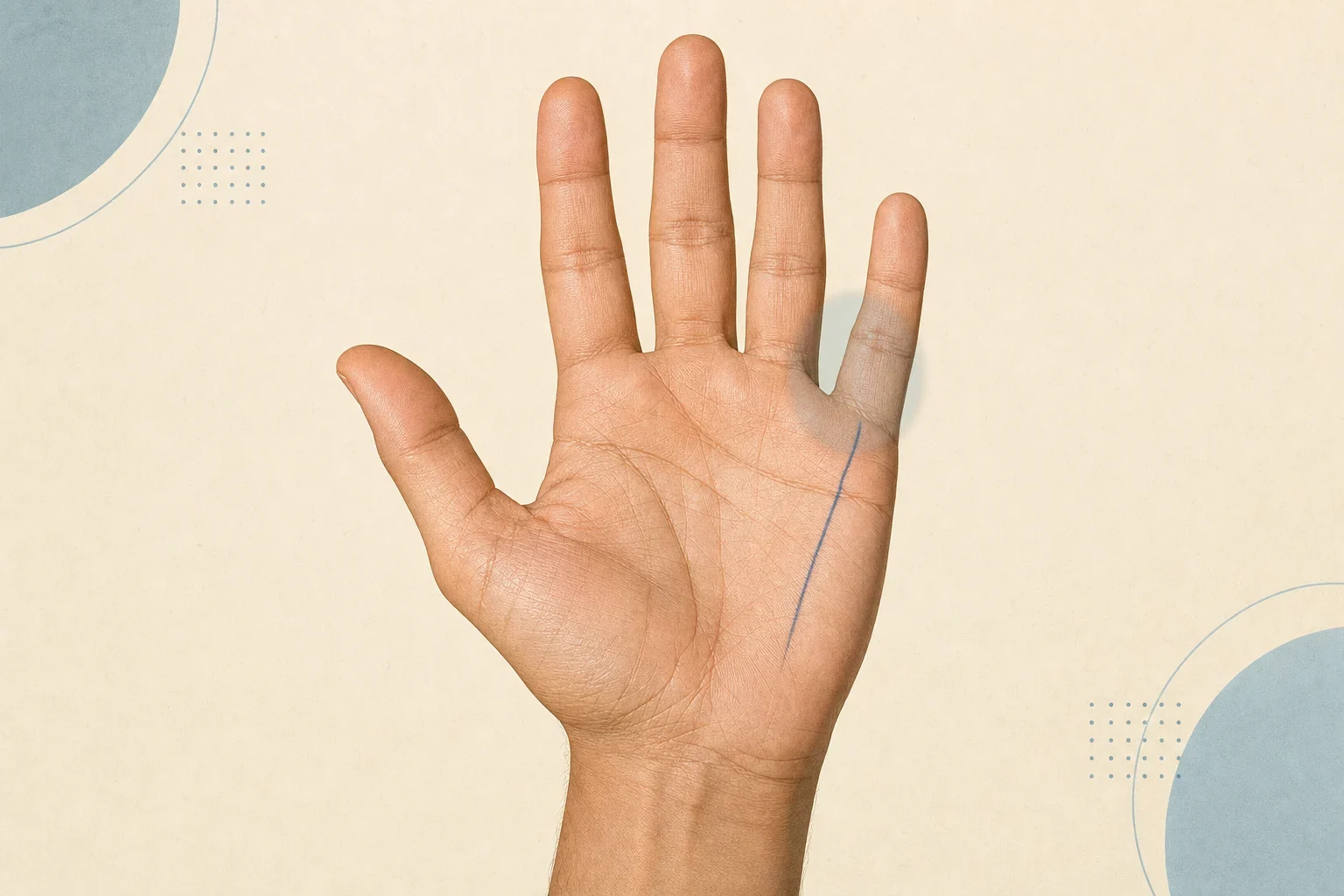
The Mount of Mercury is the compact padded area directly below the little finger, above the heart line, at the outer edge of the upper palm. Traditional palmistry connects it with communication, language, observation, calculation, adaptability, negotiation, trade, teaching, research, practical intelligence, and the ability to turn ideas into useful results. A balanced resilient mount suggests skill and communication used in proportion. Its meaning changes with firmness, apex, texture, little finger, vertical lines, markings, and both hands.
A Mercury-mount reading becomes useful only after its boundaries, height, firmness, apex, texture, vertical lines, markings, little finger, head line, fate line, and the other hand are compared. A whole-hand reading can show how communication, applied skill, teaching, business, and adaptability connect with work, relationships, purpose, or direction.
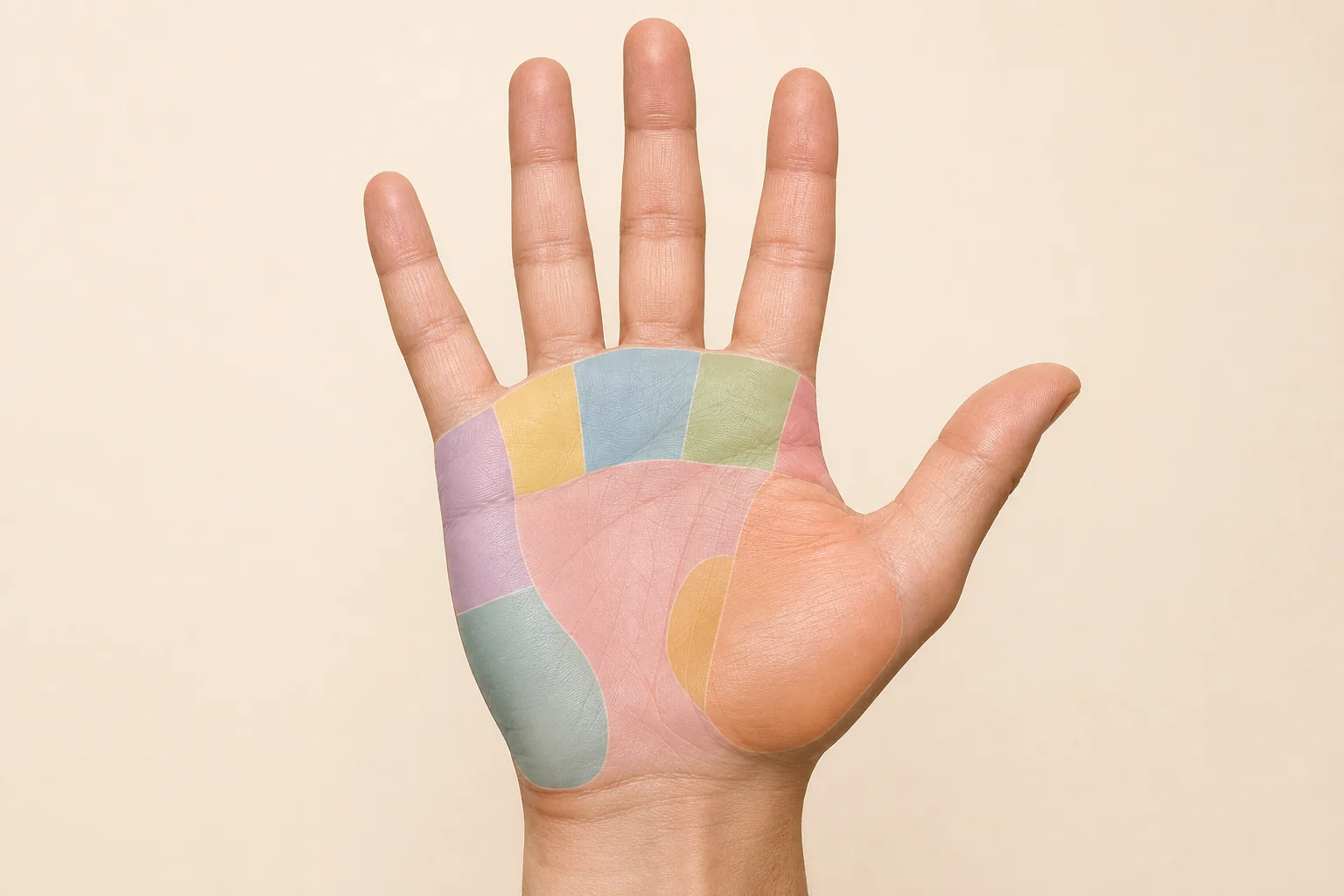
Use a seven-part Mercury mount reading sequence: confirm the boundaries, compare height, test firmness, find the apex, inspect texture, study the little finger and vertical lines, then compare both palms. One raised pad or one line cannot decide whether someone is persuasive, commercial, technical, or communicative.
Mercury joins communication with application
The mount shows how readily knowledge is exchanged or applied. The little finger shows communication style and confidence. The head line adds reasoning, the thumb adds judgment, Apollo adds presentation, and the fate line shows whether skill becomes part of sustained work.
Where is the Mount of Mercury?
Find the little finger, then move directly down to the cushion between its base crease and the heart line. Mercury is bordered by Apollo beneath the ring finger on one side and the outer edge of the hand on the other. The upper outer edge below the heart line belongs closer to Upper Mars, so do not extend Mercury too far downward.
| Boundary | How to locate it | Beyond it |
|---|---|---|
| Upper | Base crease of the little finger | Little finger |
| Ring-finger side | Valley between ring and little fingers | Apollo mount |
| Outer | Percussion edge of the upper palm | Side of the hand |
| Lower | Heart-line zone below the little finger | Upper Mars and quadrangle |
| Apex | Highest local point under side light | Shows an Apollo or outer-edge lean |
Use the complete mount map when the boundary blends. This guide owns the deeper Mercury reading: development, displacement, little-finger support, vertical lines, markings, applied-skill questions, and both-hand comparison.
Flat, balanced, prominent and displaced Mercury mounts
| Form | Visual and touch cues | Traditional emphasis | Next check |
|---|---|---|---|
| Flat or low | Little rise below the little finger | Reserved exchange, selective networking, or skills shown through action | Little finger and head line |
| Balanced | Proportionate resilient cushion | Clear exchange, adaptability, and practical intelligence | Vertical lines and thumb |
| Prominent and firm | Distinct local rise that springs back | Strong communication, enterprise, analysis, teaching, or applied skill | Fate line and Apollo |
| Prominent and soft | Full but yielding pad | Responsive social intelligence with possible diffusion | Texture and head line |
| Hard or heavily lined | Tight pad or dense crossed creases | Communication can become restless, strategic, or overloaded | Verify a grille and thumb balance |
| Apex toward Apollo | Peak approaches ring-little valley | Communication blends with presentation, creativity, or audience appeal | Ring finger and Sun line |
A flat Mercury mount does not mean poor communication. Speech, writing, mathematics, design, research, sales, or technical work can be supported by the little finger, head line, fingerprints, and fate line even when the mount is low. A prominent mount strengthens Mercury themes but does not name one occupation or guarantee business success.
Firmness, texture and the Mercury apex
| Cue | Traditional reading | Cross-check |
|---|---|---|
| Firm and resilient | Knowledge translated into action with steady follow-through | Thumb and fate line |
| Soft and yielding | Flexible response to people and changing situations | Head line and skin texture |
| Fine clear texture | Selective language, sensitivity to nuance, refined technique | Fingerprints and finger tip |
| Coarse clear texture | Direct practical communication and hands-on application | Whole-hand texture |
| Dense grille | Too many messages, methods, or competing calculations | Distinguish random crossings |
| Centered apex | Mercury qualities operate directly | Little finger and vertical lines |
How the little finger changes Mercury
Read the little finger's length, setting, straightness, lean, tip, and spacing. A longer finger traditionally supports verbal confidence and complex exchange. A shorter or low-set finger can show communication that develops more gradually or works best in trusted settings. A lean toward Apollo blends expression with presentation; a wide gap from the ring finger suggests independent opinions.
| Little-finger feature | Traditional contribution | Combined reading |
|---|---|---|
| Long and straight | Direct verbal or technical confidence | Firm Mercury adds application |
| Short or low set | More private, delayed, or selective expression | Head line shows reasoning strength |
| Leans toward Apollo | Communication shaped for an audience | Useful in teaching, media, design, or trade |
| Wide ring-little gap | Independent speech and dislike of imposed scripts | Thumb shows judgment |
| Square tip | Methodical, literal, organized delivery | Saturn adds precision |
| Conic tip | Responsive, persuasive, adaptive delivery | Apollo adds style |
Vertical lines and the Mercury line
The Mercury line rises through the outer half of the palm toward Mercury. Traditional books sometimes call it a health line, but it should not be used to diagnose health. For a mount reading, focus on source, direction, clarity, breaks, branches, and whether the line actually ends below the little finger.
| Line form | Traditional emphasis | Verify |
|---|---|---|
| One clear vertical line | A focused channel for applied skill or communication | True ending on Mercury |
| Several fine verticals | Multiple skills, languages, clients, or methods | Whether one line leads |
| Line from fate line | Skill or communication grows from vocation | Continuation of both lines |
| Line from Moon | Public contact, imagination, travel, or clients contribute | Route through outer palm |
| Broken overlap | Change of method or communication channel with continuity | New segment alignment |
| Horizontal bars | Interruptions or competing demands | Source and continuation |
Marks on the Mount of Mercury
| Mark | Shape test | Traditional emphasis |
|---|---|---|
| Triangle | Three closed sides | Strategy, analysis, or specialized technique |
| Square | Four closed sides | Organization or containment around communication matters |
| Star | Three independent strokes share a center | Concentrated attention around skill or exchange |
| Cross | Two independent strokes and four arms | Conflict, interruption, or decisive intersection |
| Grille | Several repeated cells | Scattered messages, interests, or methods |
| Trident | One stem divides into three prongs | Several useful applications of one skill |
Use the triangle guide or other marking guides before assigning a meaning. A symbol on Mercury modifies the communication or skill pattern; it does not prove honesty, deception, medical status, or a guaranteed commercial outcome.
Communication, business, teaching and applied skill
For “job or business” questions, combine Mercury with the job-versus-business feature map. Enterprise needs more than one mount: add Jupiter for leadership, Apollo for visibility, Saturn for discipline, the fate line for sustained direction, and the thumb for decisions.
| Question | Start with Mercury | Add |
|---|---|---|
| How do I communicate best? | Texture, little finger, vertical lines | Head line and finger tips |
| Do I suit business? | Firmness, apex, clear lines | Jupiter, Apollo, fate line, thumb |
| Where is my practical skill? | Clear local texture and line direction | Head line, fingerprints, career context |
| Why is communication scattered? | Softness, grille, multiple fine lines | Head line and both hands |
| Can teaching or advising fit? | Little finger, clear vertical route | Jupiter, head line, Saturn |
Compare Mercury on both hands
Matched photographs and equal pressure matter. A firmer or clearer active-hand pattern is traditionally read as communication or skill strengthened through use. A stronger less-active pattern may describe an underlying ability expressed selectively. Work habits can change muscle, callus, and texture, so compare the whole hand before calling a difference meaningful.
Worked Mercury combinations
Balanced mount, long straight little finger
This supports confident exchange with practical application. A clear head line and flexible thumb strengthen adaptable judgment.
Flat mount, clear line from fate
Communication may be less socially driven but becomes important through a defined role or technical responsibility.
Prominent soft mount with grille
Strong responsiveness meets divided attention. Saturn and the thumb show whether structure can focus the many interests.
Apex toward Apollo with two vertical lines
Skill moves toward presentation or audience contact through more than one channel. The Sun line shows whether recognition develops.
Firmer active-hand Mercury
After pose and work effects are controlled, this traditionally suggests learned confidence, technique, or communication through practice.
Photo and touch checklist
- Photograph both palms with the full little finger and outer edge visible.
- Keep the ring and little fingers relaxed with equal spacing.
- Add side light to reveal height and apex.
- Take a close-up from the ring-finger base to Upper Mars.
- Trace each vertical line to its source and ending.
- Compare firmness with equal light pressure.
- State handedness and the communication, work, teaching, or business question.
Read Mercury inside the complete hand
Map the boundaries, height, firmness, apex, texture, vertical lines, and markings, then add the little finger, head line, fate line, Apollo, Jupiter, Saturn, thumb, timing, and both palms. This connects communication and applied skill with the question you are asking.
The complete answer
The Mount of Mercury is the upper outer-palm cushion directly below the little finger and above the heart line. Traditional palmistry associates it with communication, language, observation, adaptability, negotiation, trade, teaching, analysis, and applied skill. A balanced resilient mount suggests practical intelligence used in proportion; a flat mount suggests reserved or selective exchange; a prominent firm mount strengthens communication and enterprise; and a soft, hard, or grilled mount changes how focused those qualities are. The apex shows whether Mercury blends toward Apollo, the little finger shows communication style, and vertical lines show possible outlets for skill. A Full Palm Reading maps Mercury and all other important features across both hands and combines them into a holistic reading focused on your questions about communication, work, teaching, business, creativity, relationships, purpose, and direction.
A Full Palm Reading
Ask what your Mount of Mercury means across the complete hand
Your reading maps the mount's boundaries, height, firmness, apex, texture, vertical lines, and markings, then adds the little finger, head line, fate line, Apollo, Jupiter, Saturn, thumb, hand shape, timing, and both palms into one holistic reading focused on your questions about communication, work, teaching, business, creativity, relationships, purpose, and direction.
Your Full Palm Reading maps all the important features—hand shape, skin texture, thumb, fingers, mounts, major and minor lines, markings, and the differences between both palms—and brings them together in a holistic reading focused on your questions.