
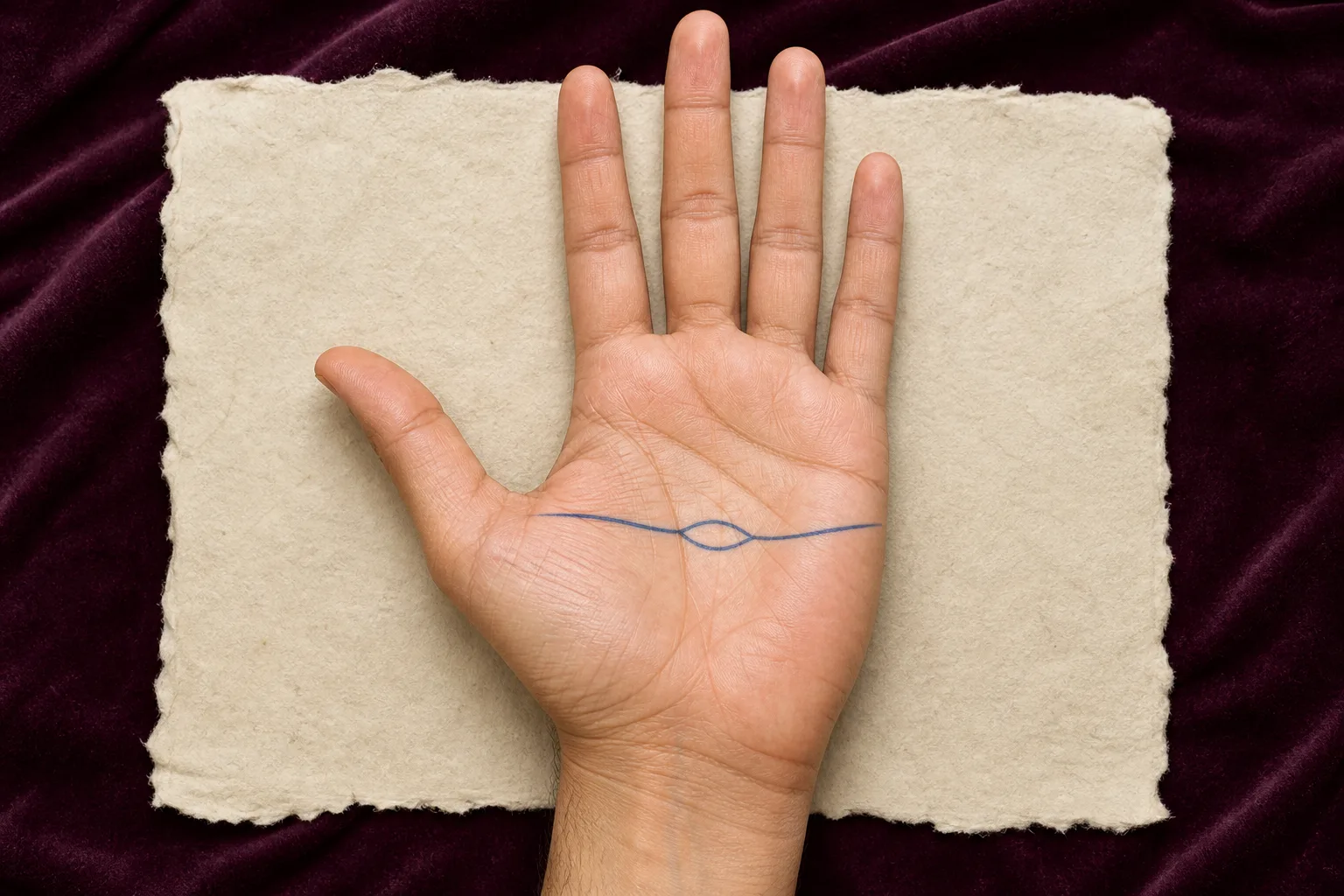
An island on the Head line is one closed oval or almond-shaped space formed when the Head line divides into two strands and then rejoins. In traditional palmistry, it describes a bounded stretch of divided attention, mental pressure, uncertainty, or competing ideas. It does not define intelligence, diagnose a condition, or decide whether a plan will succeed.
One Head-line island becomes personal only after the true thumb-side parent, single closed split-and-reunion geometry, exact position, proportional size, depth, clarity before and after, chain, crossing, triangle, fork, break and faintness tests, straight or Moonward direction, Life-line origin, Fate crossing, Heart, thumb, Mercury, Mars, hand shape, timing, real decisions, and both palms are compared. A whole-hand reading can show what divided attention, what supported it, and what becomes clearer afterward.
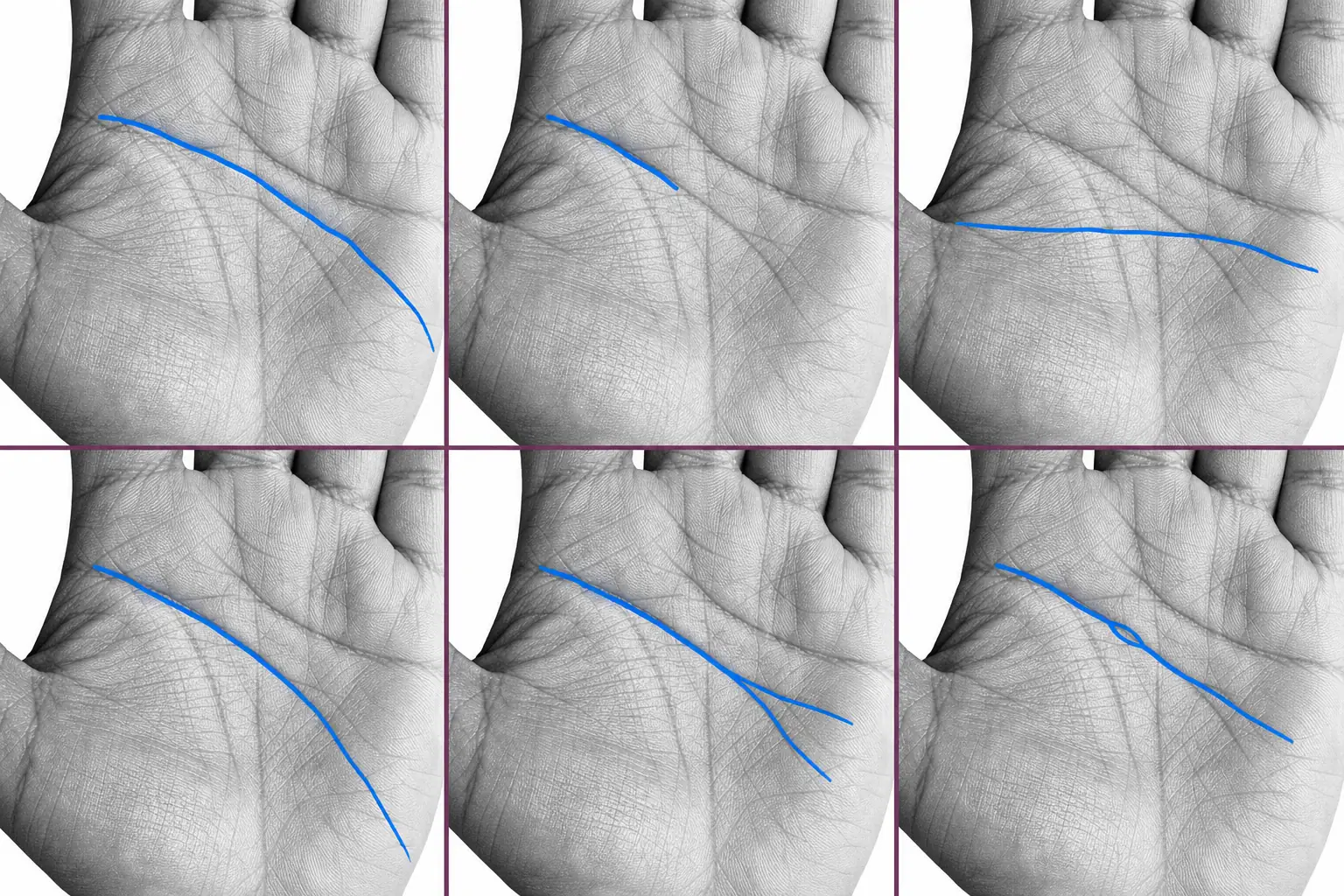
The most useful reading comes from the complete shape. Find where the split begins, where it closes, what part of the Head line contains it, and whether the outgoing line becomes clearer, weaker, straighter, or more Moonward. One island followed by a clear route tells a different story from several linked loops or an island followed by a break.
Read the island as a section, not a permanent identity
The incoming Head line shows the thinking pattern before the divided section. The island shows the bounded interval or subject under pressure. The reunited line shows how judgment, concentration, or direction continues afterward. Always compare all three.
How to identify an island on the Head line
Start at the thumb-index web and locate the major crease that crosses the middle of the palm. This is the Head line, also called the wisdom line or mental line. Trace the same groove outward without jumping to a nearby crease. A genuine island is made by that parent: one route splits, its two sides enclose visible skin, and those sides reunite into one route.
Use this ten-part island-on-Head-line method:
- Confirm the thumb-side Head-line parent.
- Trace it continuously to the suspected oval.
- Find the exact point where one groove becomes two.
- Confirm that the two sides enclose empty skin.
- Find the exact point where both sides rejoin.
- Record whether the island sits near the start, middle, or end.
- Compare the line's depth and clarity before and after it.
- Record whether the route is straight, Moonward, or forked.
- Separate Fate crossings, branches, chains, and photo shadows.
- Compare the same area on the other palm and with real decisions.
The broader island-on-palm-line guide explains the shared geometry across all major lines. This page owns the focused question: what one enclosed loop means when it belongs specifically to the Head line.
Island versus chain, crossing, triangle, fork, and break
An eye-shaped outline is not enough. Fine crossing lines often create a convincing oval in a photograph even though the Head line never divides. Trace each stroke from both directions and retake the palm under gentle side light before reading the mark.
| Formation | Geometry | Reading boundary |
|---|---|---|
| One island | Head line splits once, encloses one space, and rejoins | Read one bounded section |
| Chained Head line | Several adjacent linked loops repeat | Read a recurring or extended texture |
| Crossed-line oval | Independent creases cross around an intact parent | Read the crossing lines separately |
| Triangle | Three distinct sides create corners | Verify every side and parent before naming it |
| Fork | One line divides into two arms that do not rejoin | Read the destinations of both arms |
| Break | Empty skin separates related sections | Read the interruption and restart |
| Faint patch | The groove loses depth without enclosing space | Read clarity rather than island geometry |
Several connected ovals belong in the chained Head line guide. Empty space between two related routes belongs in the broken Head line guide. Keeping those formations separate prevents a dramatic label from replacing what is actually visible.
What an island on the Head line traditionally means
The Head line is traditionally associated with how a person processes information, chooses, learns, plans, and communicates judgment. When its route briefly divides and returns, palmists explore a period or subject in which attention was split: two competing plans, pressure from several responsibilities, prolonged reconsideration, uncertainty during study or work, or the need to hold practical and imaginative demands at the same time.
The island does not reveal the cause by itself. A demanding examination, retraining, caregiving, a career decision, a move, grief, a complex project, or several simultaneous obligations can all create a lived experience of divided attention. Ask what was happening instead of assigning one event from the marking.
Size changes emphasis, but it does not supply a diagnosis. A small, sharply closed island can describe a concentrated issue or short interval. A long island suggests a more extended divided section. A wide island can show two clearly separated routes through the same period. Depth matters too: if one side is much stronger, one approach may dominate while the other remains secondary.
Island near the start, middle, or end of the Head line
Location shows where the island belongs within the Head-line route. It can also guide a broad timing estimate, but the line's direction and the person's history matter more than an exact age claim.
| Location | Traditional focus | What to compare |
|---|---|---|
| Near the thumb-side start | Early learning, family influence, caution, or forming independent judgment | Joined or separated Life-line origin, Jupiter, thumb, childhood context |
| Before the central palm | Education, skill building, or a decision pattern taking shape | Line depth, branches, Fate approach, known study choices |
| At a Fate-line crossing | Thought and work direction under simultaneous pressure | Whether Fate crosses, starts, stops, or changes strength |
| Beyond the center | Later plans, communication, imagination, or competing directions | Upper Mars or Moon destination, Mercury, outgoing clarity |
| Near a terminal fork | Division before two continuing modes or destinations | Whether the island closes before the fork begins |
An island at the Life-line origin should not be read until both parents are traced. The oval may belong to Life, Head, or the shared section. The joined and separated origins guide shows how to identify that relationship.
Why the Head line before and after the island matters
The continuation often answers the reader's real question: does the divided section resolve? A clear outgoing route traditionally suggests restored focus, a decision made, or a mental framework becoming more coherent. If the outgoing section becomes deeper than the incoming line, the later approach may be more organized or confident. If it becomes faint, chained, broken, or strongly redirected, the next condition needs its own reading.
Direction changes the type of thought emphasized. A straight continuation toward Upper Mars keeps the focus on practical sequence, implementation, and tangible results. A descending route toward the Mount of Moon adds imagination, empathy, narrative, visual thought, or unfamiliar contexts. A rising branch toward Mercury can add communication or commercial application. Use the Moonward Head-line guide when the complete parent clearly descends.
- Clear before, clear after: a bounded divided period within an otherwise steady style.
- Faint before, clearer after: focus or judgment consolidates after uncertainty.
- Clear before, faint after: a decision remains tentative or attention stays dispersed.
- Straight before, Moonward after: the later method uses more imagination or context.
- Island followed by a fork: one divided section resolves before two lasting modes emerge.
- Island followed by a break: complexity and interruption are separate stages.
What Fate, Heart, thumb, Mercury, and Mars add
A vertical Fate line crossing the island can connect the divided Head-line theme with work, responsibility, or direction. First confirm that Fate passes through the formation rather than forming one side of it. If Fate becomes clearer above the crossing, responsibilities may gain definition after the decision period. A broken or shifted Fate route adds career change, but it still does not identify the event.
The Heart line shows whether feelings and values support or complicate the decision. A clear Heart line can add emotional consistency while the Head section is divided. A marked Heart section at a similar level may suggest that thought and feeling were both engaged, especially in relationship or family questions.
The thumb adds traditional clues about will, reasoning, flexibility, and follow-through. Mercury adds expression, calculation, negotiation, and applied skill. Upper Mars supports persistence under pressure, while Moon supports imagination and contextual thought. Hand shape and finger proportions show the broader style. None of these features cancels the island; together they explain how the person handles the theme.
Can an island on the Head line show an age?
Only broadly. Head-line timing systems divide the route proportionally from the thumb-side origin toward the outer palm, and different schools use different scales. The central vertical axis or Fate crossing can act as a landmark. Treat the start and end of a long island as a range rather than assigning one age to its center.
- Mark where the island opens and where it closes.
- Place both points relative to the whole Head-line length.
- Note the central palm and verified Fate-line crossing.
- Compare nearby changes on Fate, Life, Heart, and travel lines.
- Calibrate with a known study, work, move, family, or major decision period.
- Repeat the estimate on the other hand and keep the range broad.
The palmistry timing guide explains landmarks and calibration. Palmistry cannot use this oval to date an illness, examination result, breakdown, or unavoidable future event.
What the island means in one hand or both
Photograph both palms in matched light and state which hand is used most. A common modern method reads the less-active palm as background tendency and the active palm as current development. Use that as a comparison convention, then give greater weight to the line that matches the person's actual habits and decisions.
| Two-hand pattern | Traditional comparison | Useful question |
|---|---|---|
| Similar island in both hands | The divided section repeats strongly | What sustained demand or decision fits both routes? |
| Island only in the active hand | Current experience may have formed the pressure theme | What present work, learning, or choice divides attention? |
| Island only in the less-active hand | An underlying pattern may be handled more clearly now | What skill, routine, or decision strengthened the active line? |
| Shorter island in the active hand | The divided interval may be more contained in present expression | What improved focus or support? |
| Clearer outgoing active line | Later judgment or organization may be consolidating | Which choice or practice created clarity? |
Read the two-hand comparison guide before calling one palm the future and the other the past. The difference between hands is often more informative than the island alone.
Five worked examples
1. Small central island with a clear continuation
The Head line runs clearly into one narrow oval near the center and reunites at equal depth. Fate crosses nearby without changing. This can describe a concentrated decision or demanding project within an otherwise steady mental style. The clear continuation suggests that focus returns after the issue is worked through.
2. Island where Fate changes direction
The Head island overlaps a Fate-line shift, and the Fate route is clearer above the crossing. Traditional reading can connect a period of reconsideration with training, work direction, or responsibility becoming more defined. It cannot decide whether the change is a promotion, new job, or self-employment.
3. Straight line becomes Moonward after the island
The incoming line is level, while the outgoing route descends clearly toward Moon. The divided section may sit between a more practical earlier method and a later style that uses imagination, empathy, visual thinking, or narrative. Thumb and Fate support show how the ideas are carried into action.
4. Crossing creases mistaken for an island
Two fine strokes cross above and below the Head line, creating an eye shape in flat light. Side lighting shows that the main groove stays intact through the center. Because the parent never splits, the mark is not a Head-line island; read the crossing pressure separately.
5. One island followed by three linked loops
The first oval closes independently, then the line enters a repeated chained section. Record the local island and the longer variable texture as two conditions. The transition between them and the final clear route matter more than choosing one label for the entire line.
Photo checklist for a Head-line island
- Photograph both full palms from fingertips through wrists.
- Keep the thumb-index origin and complete outer edge visible.
- Use bright indirect light without flash glare.
- Add one gentle side-lit close-up of the suspected oval.
- Relax the hand instead of stretching the fingers backward.
- Trace the incoming parent, both island sides, and outgoing route.
- Check whether a Fate or influence line crosses the shape.
- Keep an unmarked original and annotate only a duplicate.
- State hand dominance and the question about focus, learning, plans, or work.
Frequently asked questions
Is an island on the Head line bad?
It is traditionally treated as a section of divided attention, pressure, or uncertainty, but the location and continuation decide its emphasis. A small island followed by a deep clear route can describe a bounded issue that resolves.
Does it mean low intelligence?
No. Palm creases cannot measure intelligence, memory, education, creativity, or potential. The symbolic reading concerns how attention or judgment moves through one period or subject.
Does a Head-line island show anxiety or mental illness?
No. It cannot diagnose anxiety, depression, neurological conditions, or any other health issue. If symptoms affect daily life, use qualified professional support rather than a palm marking.
What is the difference between an island and a chained Head line?
An island is one closed oval where the Head line splits and reunites once. A chain contains several adjacent linked loops. One is local; the other shows a repeated texture across a longer section.
What if the island is large?
Record its proportional length, width, and the strength of both sides. A larger formation traditionally broadens the divided section, but the outgoing line, supporting features, real context, and both hands still decide the reading.
What if the line is clearer after the island?
A clearer outgoing route traditionally emphasizes focus, judgment, or organization becoming stronger after the divided section. Ask what decision, routine, training, or support fits that change.
Can it show the exact age of a stressful period?
No. Position offers a broad range. Mark both ends, compare the Fate crossing and other lines, and calibrate against known events rather than claiming a precise age.
Can the island change over time?
Fine crease visibility changes with light, skin condition, hand position, and image quality. Compare matched photographs over time before deciding that the formation itself has changed.
The complete answer
An island on the Head line is one enclosed oval formed when the middle-palm Head-line parent divides and then rejoins. Traditional palmistry associates it with a bounded period or theme of divided attention, mental pressure, uncertainty, or competing ideas, not low intelligence or a medical condition. Verify the incoming parent, closed space, reunion, and outgoing route against a chain, crossed-line oval, triangle, fork, break, or faint patch. Then add exact location, proportional size, depth, clarity before and after, straight or Moonward direction, Life-line origin, Fate crossing, Heart, thumb, Mercury, Mars, hand shape, broad timing, real decisions, and both palms. A Full Palm Reading maps all the important features across both hands and combines them into a holistic reading focused on your questions about concentration, learning, decisions, communication, work direction, and what becomes clearer after a demanding phase.
A Full Palm Reading
Ask how your Head-line island fits your complete thinking pattern
Your reading maps the true Head-line parent, one closed split-and-reunion island, exact position, proportional size, depth, clarity before and after, chain, crossing, triangle, fork, break and faintness tests, straight or Moonward direction, Life-line origin, Fate crossing, Heart, thumb, Mercury, Mars, hand shape, timing, real decisions, and both palms, then adds every other important line, mount, finger, marking, shape, and texture into one holistic reading focused on your questions.
Your Full Palm Reading maps all the important features—hand shape, skin texture, thumb, fingers, mounts, major and minor lines, markings, and the differences between both palms—and brings them together in a holistic reading focused on your questions.