
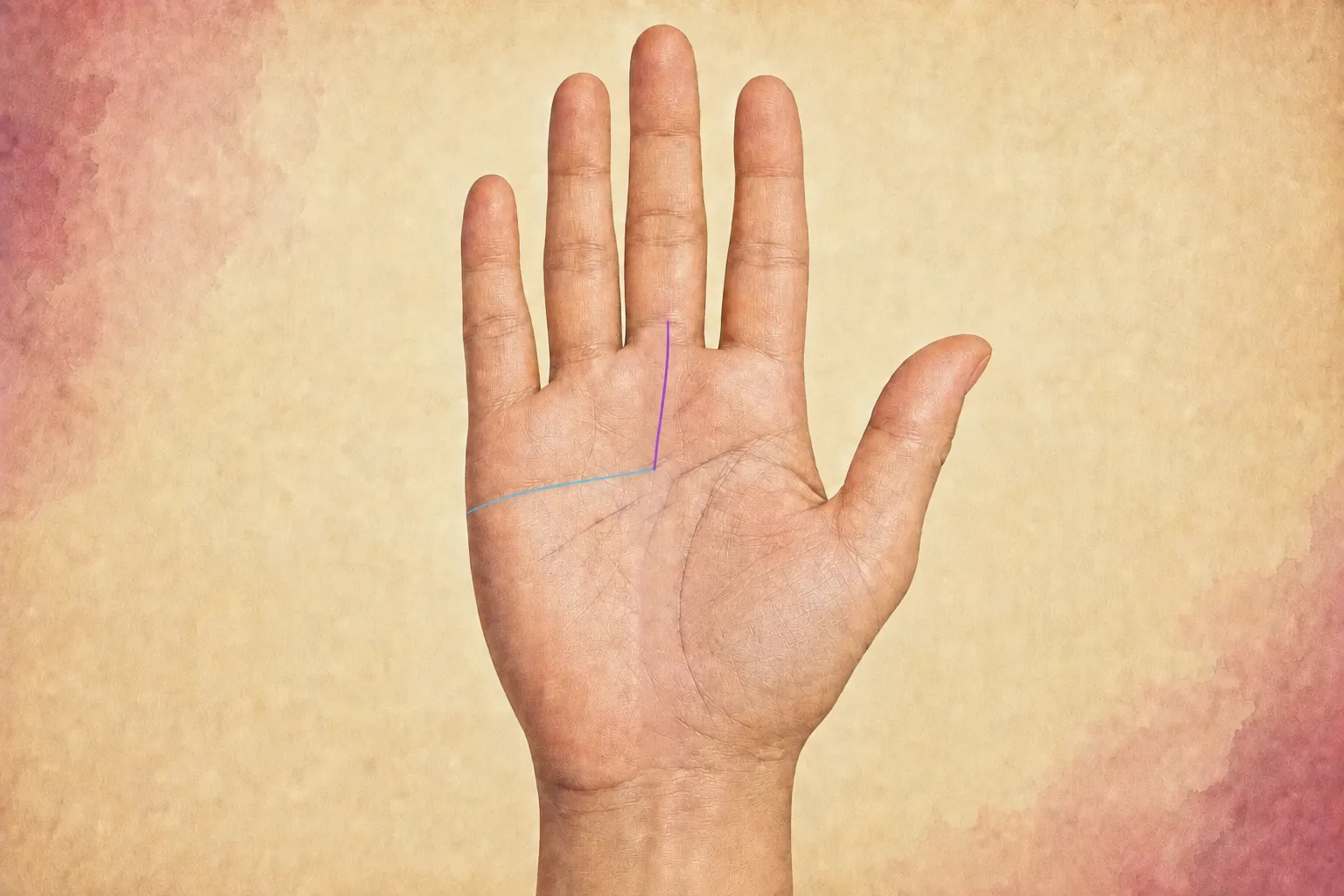
In traditional palmistry, a late-starting fate line means a Saturn-bound vertical route becomes visible only in the middle or upper palm instead of rising from the wrist, life line, or Mount of Moon. It is commonly read as structure, career direction, or a sustained responsibility becoming clearer after experience, education, a deliberate choice, or a major change. It does not mean the earlier part of life was wasted, that success is guaranteed late, or that nothing meaningful happens before the line begins.
A late-starting fate line becomes meaningful only after the lower palm, first visible point, Saturn direction, head- and heart-line landmarks, faint continuation, restart test, strength after emergence, timing, supporting career features, and both hands are compared. A whole-hand reading can show how experience, education, choice, changing roles, recognition, and responsibility shape later direction.
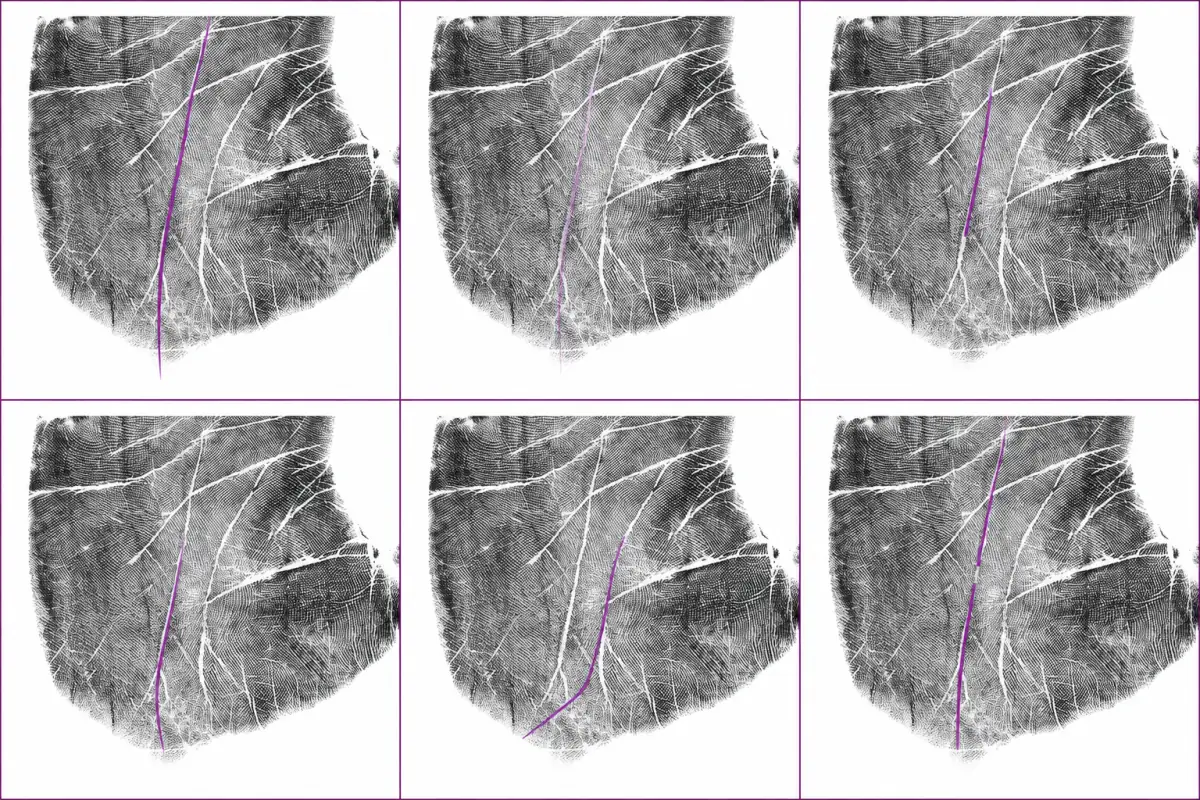
Use an eight-part late-starting fate-line method: check the lower palm under side light, find the first true point of the route, confirm its direction toward Saturn, distinguish a start from a break or crossing, note its level against the head and heart lines, read the strength after emergence, compare supporting career features, and examine both hands. The start tells you when structured direction becomes visible in the traditional sequence; the later route shows what happens to it.
First rule out a faint lower fate line
A late-starting fate line has no traceable Saturn-bound parent below its visible beginning. If a fine segment rises from the wrist and becomes deeper mid-palm, the fate line started earlier and only strengthened later. If a lower segment stops before a gap and a new segment begins above, read a break or restart instead of one late origin.
Where does a late-starting fate line begin?
The fate line is identified by its destination: it travels toward the middle-finger axis or Mount of Saturn. A late start may appear in the Plain of Mars at the center of the palm, directly from the head line, just above the head line, between the head and heart lines, or, less commonly, from the heart line. The complete fate-line guide maps all common origins and destinations.
| Visible starting area | What to confirm | Traditional emphasis |
|---|---|---|
| Lower Plain of Mars | No route reaches it from wrist, life, or Moon | Direction forms after testing or early changes |
| At the head line | New vertical route begins at the junction | A decision, skill, or mental commitment organizes the path |
| Just above head line | Clear skin separates it from lower marks | Structure consolidates after the decision period |
| Between head and heart lines | Route still aims toward Saturn | A defined role develops in a later chapter |
| At the heart line | No fate route exists below the contact | Values, relationship, or fulfillment shapes later direction |
Do not identify a fate line from vertical position alone. A route to the ring finger belongs to the Sun or Apollo system; one to the little finger belongs to Mercury. Keep the fingers in the photograph so the destination remains visible.
How to verify a true mid-palm fate-line start
Begin at the first visible point and trace upward. The line should form one coherent route toward Saturn. Then trace downward with the palm relaxed and light coming from the side. Check whether the apparent start is actually a strengthening point, a shifted continuation, a branch rising from the head line, or a short crease that never develops toward Saturn.
| What you see | Classification | Why it matters |
|---|---|---|
| Clear lower palm; one route begins mid-palm | Late-starting fate line | The structured route first appears at this level |
| Fine aligned route exists below | Fate line strengthens mid-palm | Direction existed earlier but gained definition |
| Lower route ends, gap follows, upper route begins | Break and restart | Two chapters are separated by an interruption |
| Upper route is offset from lower route | Shifted continuation | Direction changes form or setting |
| Line begins on head line and aims at Apollo | Head-line branch or Sun line | Destination changes the line identity |
| Short vertical crease ends quickly | Minor fragment | Not enough route to classify confidently |
The no-fate-line guide owns the question of true absence. This page applies when a coherent upper fate route is present and the question is why it starts later.
Traditional meaning: direction shaped through experience
A late-starting fate line is often described as the mark of a “late bloomer,” but that phrase can be misleading. The line does not grade the earlier life. It suggests that one steady Saturn-style structure becomes clearer after exploration, competing duties, changing roles, study, independent judgment, or accumulated skill. Earlier work can still be productive even if it is less linear.
Career is one expression, not the only one. The fate line can describe any sustained organizing duty: raising a family, building a practice, taking over a business, returning to education, committing to a craft, entering public service, caring for others, or creating a schedule after years of flexible work. Read the question and supporting features before choosing the theme.
| Possible pathway | How the late start may read | Confirm with |
|---|---|---|
| Career discovery | Several roles precede a clearer occupational direction | Head line, thumb, and Saturn |
| Training or qualification | Study creates the structure needed for one path | Head-line start and Jupiter |
| Career change | A later role becomes more defining than earlier work | Breaks, shifted routes, and timing |
| Independent work | Experience eventually supports a self-directed structure | Thumb, Mercury, and life-line origin |
| Family-to-work transition | Care or home duties precede a stronger public role | Venus influences and active hand |
| Purposeful second chapter | Responsibility becomes aligned with values later | Heart line and Sun line |
How the starting level changes the reading
A start below the head line belongs to an earlier broad period than a start above it. A line beginning exactly at the head line gives judgment, education, strategy, or a conscious decision more interpretive weight. A start from the heart line points to a later structure shaped by commitment, values, family, or emotional meaning. These are symbolic landmarks, not exact calendar guarantees.
Be careful with opposite-looking formations. A fate line that ends at the head line has an established route below and none above; a fate line starting there has no parent below and rises from the junction. Trace both directions before reading a decision as an ending or beginning.
Strength after the line appears
The most useful question is not simply how late the line starts, but what it does next. A deep, clear route to Saturn suggests the newer structure becomes sustained. A faint route may show an emerging commitment that remains flexible. Wavering or chained quality can describe adjustment; a break signals another chapter; branches show added aims.
| Upper route | Traditional synthesis | Check next |
|---|---|---|
| Deep and clear to Saturn | Later direction becomes steady and responsibility-led | Saturn mount and finger |
| Starts faint, then deepens | Commitment gathers definition over time | Exact strengthening level |
| Wavy or chained | The new structure requires repeated adjustment | Head line and thumb consistency |
| Branch toward Jupiter | Leadership, teaching, or ambition expands the route | Index finger and Jupiter mount |
| Branch toward Apollo | Visibility, craft, or fulfillment joins responsibility | Sun line and Apollo mount |
| Stops at heart line | Values or relationships reshape the later structure | Endpoint quality and continuation |
The career-lines guide combines fate with the head, Sun, and Mercury lines, thumb, fingers, and mounts. This prevents one late origin from being turned into a promised profession or outcome.
What age does a late-starting fate line indicate?
Many palmistry systems place the fate line’s meeting with the head line around the mid-thirties and its heart-line meeting around the mid-to-late fifties. A start below, at, or above those landmarks is estimated proportionally. Treat the result as a broad chapter window. Palm length, crease angle, photography, and timing tradition can shift the estimate.
Calibrate before interpreting. Compare a known study, move, job, business, caregiving, or responsibility change with the visible starting or strengthening point. If it fits one hand but not the other, widen the window and read the hands as a pair. The palmistry timing guide explains landmark-based estimates without invented precision.
Late-starting fate line on one hand or both
A similar mid-palm start on both hands gives the later-forming structure more weight. If it appears only on the active hand, lived choices may have created a clearer direction than the underlying pattern suggested. If it appears only on the less-active hand while the active hand shows an earlier or stronger route, current development may have organized direction sooner.
Compare the lowest visible point, line strength, head- and heart-line landmarks, destination, branches, and later continuity. The which-hand guide explains active and less-active comparison without relying on gender rules.
Late-starting fate-line combinations
| Combination | Traditional synthesis | Read with |
|---|---|---|
| Head-line start + firm flexible thumb | A deliberate decision becomes sustainable action | Head-line direction and thumb phalanges |
| Mid-palm start + strong Sun line | Later structure develops with recognition or fulfillment | Apollo timing and destination |
| Mid-palm start + strong Mercury | Communication, enterprise, or applied skill organizes direction | Mercury line and little finger |
| Head-line start + Jupiter branch | Training or judgment develops toward leadership | Jupiter mount and branch strength |
| Late fate + Moon influence joining | Clients, travel, or a wider environment supports the new chapter | Moon origin and exact join |
| Late fate only on active hand | Current choices have made the path more structured | Matching features on both palms |
Worked examples
A clear fate line begins exactly at the head line
The lower palm contains no Saturn route, and the upper line travels cleanly toward the middle finger. Traditional synthesis emphasizes a decision, training period, or new strategy that creates lasting structure. Its depth and later branches show how established that path becomes.
A faint line from the wrist becomes deep above the head line
This is an early-starting fate line that strengthens later, not a true late start. Direction may have existed quietly before becoming more defined through experience or opportunity.
The less-active hand starts late, but the active hand begins lower
The underlying pattern may form structure later, while present choices show earlier continuity. Compare known life chapters with both routes rather than treating one hand as the whole answer.
Photo checklist for a late-starting fate line
- Photograph both full palms from wrist crease to fingertips.
- Use soft side light across the lower and middle palm.
- Keep the head line, heart line, and Saturn mount in focus.
- Trace upward from the first visible point toward the middle finger.
- Check for a faint aligned route below the apparent start.
- Take a second angle to reveal gaps or shifted continuations.
- Record where the line begins, deepens, branches, or stops.
- State hand dominance and the career or direction question you want explored.
Read the late start inside your complete direction pattern
A Full Palm Reading maps the lowest visible fate-line point, exact starting level, lower-palm absence check, strength after emergence, route, Saturn destination, branches, timing, supporting career features, and both palms. It then adds the head, heart, Sun, Mercury, and life lines, mounts, thumb, fingers, shape, and texture into one holistic reading focused on your questions.
The complete answer
A late-starting fate line begins in the middle or upper palm and develops toward Saturn without a traceable lower parent. Traditional palmistry connects it with direction or responsibility becoming structured after experience, education, choice, or a major change. Verify that the lower route is truly absent, distinguish a start from strengthening or a restart, read the starting landmark, upper quality, timing, combinations, and both hands. A Full Palm Reading maps this route and all important features across both palms and combines them into a holistic reading focused on your questions about career direction, changing work, study, business, recognition, purpose, timing, and the next chapter.
A Full Palm Reading
Ask what organizes your direction after the fate line begins
Your reading maps the lowest visible fate-line point, exact starting level, lower-palm absence check, strength after emergence, route, Saturn destination, branches, timing, supporting career features, and both palms, then adds the head, heart, Sun, Mercury, and life lines, mounts, thumb, fingers, shape, and texture into one holistic reading focused on your questions.
Your Full Palm Reading maps all the important features—hand shape, skin texture, thumb, fingers, mounts, major and minor lines, markings, and the differences between both palms—and brings them together in a holistic reading focused on your questions.