
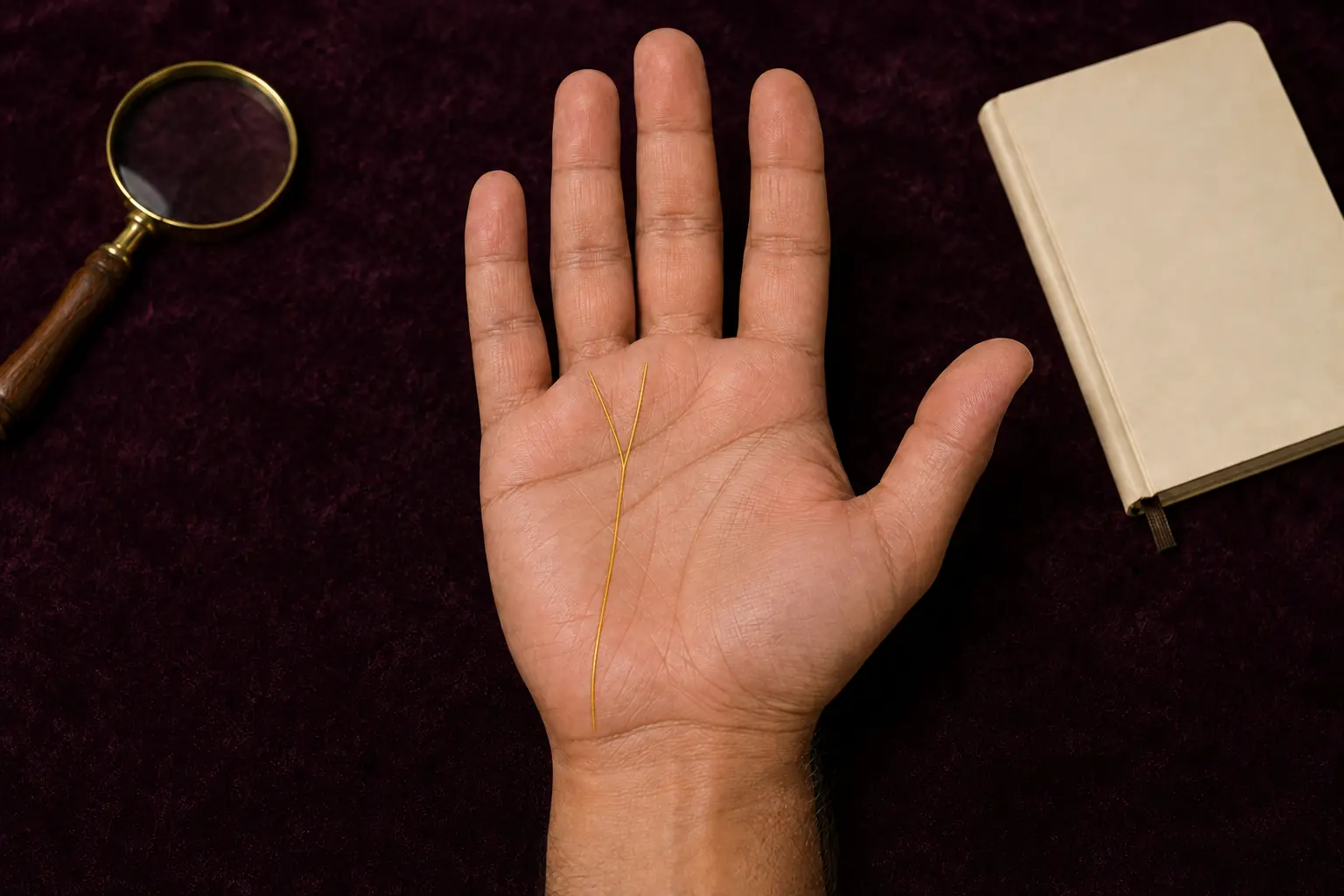
In traditional palmistry, a forked Sun line means one Apollo-bound parent reaches a shared junction and divides into exactly two connected arms. The sign is commonly read as one established talent, contribution, reputation, or source of fulfillment developing two expressions. Two balanced arms can suggest parallel audiences or outlets; one stronger arm can show a main channel and a secondary possibility. The destinations, depth, and continuity of both branches matter more than calling the fork automatically lucky.
A Sun-line fork becomes meaningful only after one Apollo-bound parent, one shared junction, exactly two upper arms, their Apollo, Jupiter, Saturn, or Mercury destinations, relative depth and length, opening width, double-line, trident, break and crossbar tests, broad timing, Fate, Head, Heart, Mercury, Jupiter, Apollo, thumb, and both palms are compared. A whole-hand reading can show how talent, expression, recognition, audience, focus, and fulfillment work together.
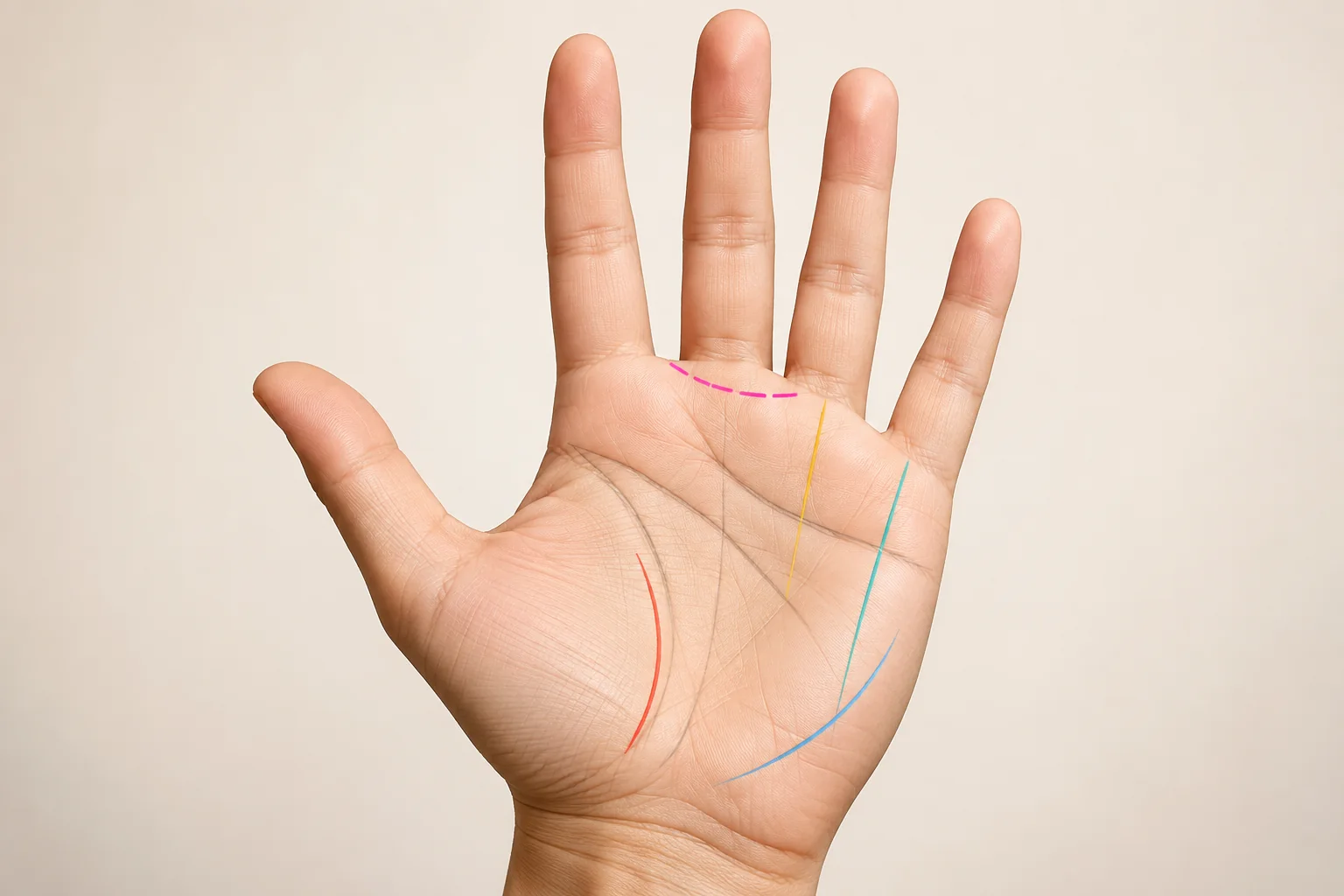
Use a ten-part forked-Sun-line method: locate Apollo below the ring finger, trace one parent from below, prove one shared junction, count exactly two arms, exclude double Sun lines and a trident, compare each destination, judge relative depth and length, test for breaks or crossbars, place the junction in a broad timing zone, then add Fate, Head, Mercury, Jupiter, thumb, both palms, and real history. A fork does not guarantee fame, wealth, awards, or success in two fields.
One parent must become two arms
If two Apollo routes never meet, the formation is a double Sun line. If the stem divides into three connected prongs, it is a trident. If empty skin separates an upper segment from the lower route, it is a break and restart. The shared two-arm junction is the defining evidence for a fork.
Where to find a fork in the Sun line
The Sun or Apollo line rises toward the Mount of Apollo below the ring finger. It may begin near the wrist, from Moon, Life, Fate, Head, or Heart, or appear only in the upper palm. A fork can form below the Head line, between Head and Heart, at the Heart line, or inside Apollo itself.
Start at the lower candidate and trace upward toward the ring-finger mount. Confirm that one coherent parent reaches the suspected junction. Then follow both arms independently to their final visible points. They may remain within Apollo, or one may angle toward Jupiter, Saturn, or Mercury. If neither branch remains connected with the Apollo axis, reconsider whether the parent is truly a Sun line.
| What you see | Decisive visual test | Best classification |
|---|---|---|
| One Apollo parent becomes two connected arms | Both branches begin at one shared junction | Forked Sun line |
| Two separate Apollo routes | They retain independent origins and never meet | Double Sun line |
| One stem becomes three arms | Three prongs share one terminal junction | Trident |
| Empty skin separates lower and upper pieces | No shared groove or junction survives | Broken Sun line |
| A short line cuts across the parent | The main route continues beneath the crossing | Crossbar, not a branch |
| Central Fate line sends one branch to Apollo | The parent continues to Saturn rather than Apollo | Sun line from the Fate line |
How to verify a true Sun-line fork
Use a full-palm photograph in bright indirect light and another with gentle side light. Include every finger base and the lower origin. A crop of Apollo can hide whether the routes join below, begin independently, or belong to Fate and Mercury. Avoid direct flash, heavy contrast, and traced originals.
- Locate Apollo directly below the ring finger.
- Trace the lower parent upward from its origin.
- Confirm it occupies an Apollo-bound route before the split.
- Identify one exact shared junction.
- Count exactly two connected arms.
- Follow each arm to its final mount or endpoint.
- Exclude a third prong, crossing line, gap, or separate parent.
- Compare depth, length, clarity, and continuity.
- Record the junction relative to the Head and Heart lines.
- Repeat the trace on the other palm.
The general fork guide explains shared junctions, prong width, branches, tridents, islands, and crossings across different parent lines. This page owns Apollo intent: how recognition, expression, appreciation, reputation, and personal satisfaction divide into two connected channels.
What the two Sun-line branches mean
Read the final point of each branch. Mount direction adds a quality to the Apollo parent; it does not specify a profession or guarantee an outcome. A branch that fades before reaching a mount carries less weight than one that arrives clearly.
| Branch pattern | Traditional emphasis | Possible practical expression |
|---|---|---|
| Two arms remain within Apollo | Two outlets, audiences, styles, or sources of satisfaction | Professional and creative work, two media, public and private expression |
| Apollo + Jupiter | Expression joined with leadership, ambition, standards, or teaching | Leading visible work, directing a creative project, building authority |
| Apollo + Saturn | Recognition joined with discipline, responsibility, craft, or long-term mastery | Visibility built through expertise, sustained practice, or institutional work |
| Apollo + Mercury | Expression joined with communication, business, analysis, or exchange | Writing, presenting, consulting, selling, teaching, or audience strategy |
| Wide Apollo fork | Distinct expressions or audiences need more separate identities | Two brands, media, roles, or creative directions |
| Narrow Apollo fork | Closely related outlets develop from the same contribution | One skill expressed in two formats or contexts |
A route to Jupiter or Saturn must remain visibly connected to an Apollo parent. If the lower parent is central and clearly continues to Saturn, with a subordinate Apollo branch, use the Fate-to-Sun classification. Destination and parent identity come before the appealing idea of a fork.
How branch strength changes the reading
Two equally deep, long, and continuous arms give both channels comparable weight. One deep arm with a fine short branch suggests one established outlet and a secondary experiment. A branch that strengthens only near its endpoint may describe recognition that develops gradually. A broken or crossed arm shows interruption specific to that direction while the other may retain continuity.
| Branch balance | Balanced traditional reading | Question to ask |
|---|---|---|
| Two equally clear arms | Two meaningful channels may operate together | Where do both outlets already appear? |
| Central Apollo arm stronger | The established expression stays primary | Is the second arm an emerging project or audience? |
| Jupiter arm strengthens | Leadership or authority may grow from recognized work | What responsibility is becoming more visible? |
| Mercury arm strengthens | Communication or commercial expression may gain weight | Which message, client group, or format is growing? |
| One arm has a break or bar | One channel meets more interruption | Which route retains quality and support? |
| Several hair-fine endings | Expression may scatter rather than form a clean fork | Are exactly two coherent arms truly present? |
More branches do not automatically mean more recognition. A clean focused route may carry more weight than several weak prongs. Head-line clarity, thumb balance, Fate continuity, Apollo development, and actual follow-through show whether variety becomes integrated work or divided attention.
What Fate, Head, Mercury, and Apollo add
The Fate line shows whether work structure supports the forked expression. A strong Fate route can provide continuity while Apollo diversifies. A weak or broken Fate line does not cancel the Sun fork, but it may separate fulfillment or visibility from a conventional career path. The double Sun-line guide helps when two routes stay independent instead of sharing a junction.
The Head line adds judgment, skill development, planning, and communication style. A clear Head line can support focus across two outlets. Mercury adds messaging, trade, analysis, teaching, and client work. Jupiter adds ambition and leadership; Saturn adds discipline. The Apollo mount shows whether the receiving area is balanced, firm, marked, or scattered.
Money needs separate evidence. Recognition, satisfaction, and income can overlap, but they are not interchangeable. Compare Fate, Mercury, Head, thumb, the career pattern, and actual conditions before connecting a Sun fork with earnings.
How to estimate when the Sun line forks
The shared junction is the timing point. Use its position relative to the Head and Heart lines as a broad landmark. A split below Head belongs to an earlier zone; one around Head suggests a broad adult middle; one between Head and Heart is later; and one near or above Heart is later still. A fork high inside Apollo may describe diversification after recognition or satisfaction is already established.
- Mark the exact shared two-arm junction.
- Place it below, at, between, or above the Head and Heart landmarks.
- Record when each branch becomes independently clear.
- Compare Fate, Head, Heart, Mercury, and Apollo changes nearby.
- Calibrate with a known launch, new medium, role, audience, award, or shift in satisfaction.
- Repeat the estimate on the other palm.
- Report a broad phase rather than an exact date.
The palmistry timing guide explains proportional zones. A fork cannot predict the exact date of fame, a promotion, a creative breakthrough, an audience increase, or financial success.
What a forked Sun line means in both palms
Compare both hands in matching light and state hand dominance. A common modern convention treats the less-active hand as background pattern and the active hand as current development. Use it as a comparison method rather than a fixed rule.
| Two-hand pattern | Traditional comparison | Useful focus |
|---|---|---|
| Similar fork in both palms | The two-channel expression repeats strongly | Compare branch destinations and current strength |
| Fork only in the dominant hand | Present work or choices may be developing a second outlet | Current audience, projects, and capacity |
| Fork only in the non-dominant hand | Available variety may be consolidated into one present route | Which channel was chosen or integrated? |
| Second arm stronger in the dominant hand | The additional expression may be gaining practical weight | Evidence of output, response, skill, and continuity |
| Different branch directions | Background and current recognition needs may differ | Trace the active endpoints and present goals |
Differences between the palms can show whether the fork is an available talent pattern, a current diversification, or an earlier possibility that has become more focused.
Five worked examples
1. Two balanced Apollo arms
One deep Sun parent divides above the Heart line into two similarly clear arms that remain within Apollo. Fate and Head are steady. This can support two related outlets or audiences carried with comparable confidence, such as one skill expressed professionally and creatively.
2. Apollo arm with a finer Jupiter direction
The central Apollo arm remains stronger while a shorter branch angles toward Jupiter. The main contribution stays primary, while leadership, teaching, direction, or personal authority develops as a secondary expression. Jupiter and thumb quality show whether it gains structure.
3. Double Sun lines mistaken for a fork
Two Apollo routes travel close together but never join. Each has a separate lower origin. This is a double Sun line, not a fork, and the timing should compare the duration and overlap of both independent lines.
4. Three prongs mistaken for a two-arm fork
A close view reveals three connected endings from one stem. The formation is a trident. Count only continuous prongs; a nearby crossing crease should not be promoted into a third branch.
5. One interrupted branch
A clear parent divides into Apollo and Mercury-directed arms, but the Mercury arm contains a small gap while Apollo remains steady. Expression retains continuity, while communication, client, or commercial development may require revision or a later restart.
Photo checklist for a forked Sun line
- Photograph both full palms from fingertips through wrists.
- Keep the ring-finger base and complete Apollo mount visible.
- Use bright indirect light and one gentle side-lit frame.
- Capture a close-up of the parent, junction, and both arms.
- Trace the lower origin before counting branches.
- Follow each arm to Apollo, Jupiter, Saturn, or Mercury.
- Check for a third prong, separate parent, gap, or crossbar.
- Do not sharpen, smooth, trace, or raise contrast on the original.
- Keep one unmarked image and annotate only a duplicate.
- State hand dominance and the recognition, career, creative, or timing question.
Frequently asked questions
Is a forked Sun line lucky?
A clear fork can show range and more than one channel of expression or appreciation, but quality and support decide whether that variety becomes focused. It does not guarantee fame, wealth, or awards.
Does it mean two talents?
It may describe two outlets, audiences, styles, or applications of one underlying ability. Branch destinations and actual practice show whether the arms represent separate talents or connected forms of expression.
What is the difference between a fork and double Sun lines?
A fork has one parent and one shared junction. Double Sun lines have independent origins and remain separate. Trace both routes downward to settle the classification.
What is the difference between a fork and a trident?
A fork has exactly two arms after the shared junction. A trident has three. Count only connected, coherent prongs rather than nearby scratches or crossings.
What does a branch toward Jupiter mean?
Traditional readers add leadership, ambition, authority, standards, or teaching to the Apollo pattern. Compare Jupiter development, Head, thumb, and real responsibilities before choosing a practical expression.
Can the fork show an exact age?
No. Head and Heart crossings provide broad zones. Use known events and both palms to calibrate a phase rather than predicting an exact date.
What if only one hand has the fork?
Compare background pattern with current development. A fork in the active hand can show diversification through present choices; a fork only in the other hand can show potential that has become more focused.
Can the branches change over time?
Fine crease visibility can vary with light, dryness, hand position, and longer-term use. Keep matched photographs before deciding that a branch has appeared, faded, or deepened.
The complete answer
A forked Sun line has one Apollo-bound parent, one shared junction, and exactly two connected arms. Traditional palmistry reads it as one established ability, contribution, reputation, or source of fulfillment developing two expressions, audiences, or ambitions. Verify the parent and junction, distinguish the formation from double Sun lines, a trident, broken restart, crossbar, or Fate-to-Sun branch, then trace each arm within Apollo or toward Jupiter, Saturn, or Mercury. Compare depth, length, opening width, continuity, junction timing, Fate, Head, Heart, Mercury, Jupiter, Apollo, thumb, real history, and both palms. A Full Palm Reading maps all the important features across both hands and combines them into a holistic reading focused on your questions about talent, career, creativity, recognition, audience, money, satisfaction, timing, and how two channels can work together.
A Full Palm Reading
Ask how both Sun-line branches fit your complete recognition pattern
Your reading maps one Apollo-bound parent, the shared junction, exactly two upper arms, their Apollo, Jupiter, Saturn, or Mercury destinations, relative depth and length, opening width, double-line, trident, break and crossbar tests, broad timing, Fate, Head, Heart, Mercury, Jupiter, Apollo, thumb, and both palms, then adds every other important line, mount, finger, marking, shape, and texture into one holistic reading focused on your questions.
Your Full Palm Reading maps all the important features—hand shape, skin texture, thumb, fingers, mounts, major and minor lines, markings, and the differences between both palms—and brings them together in a holistic reading focused on your questions.