
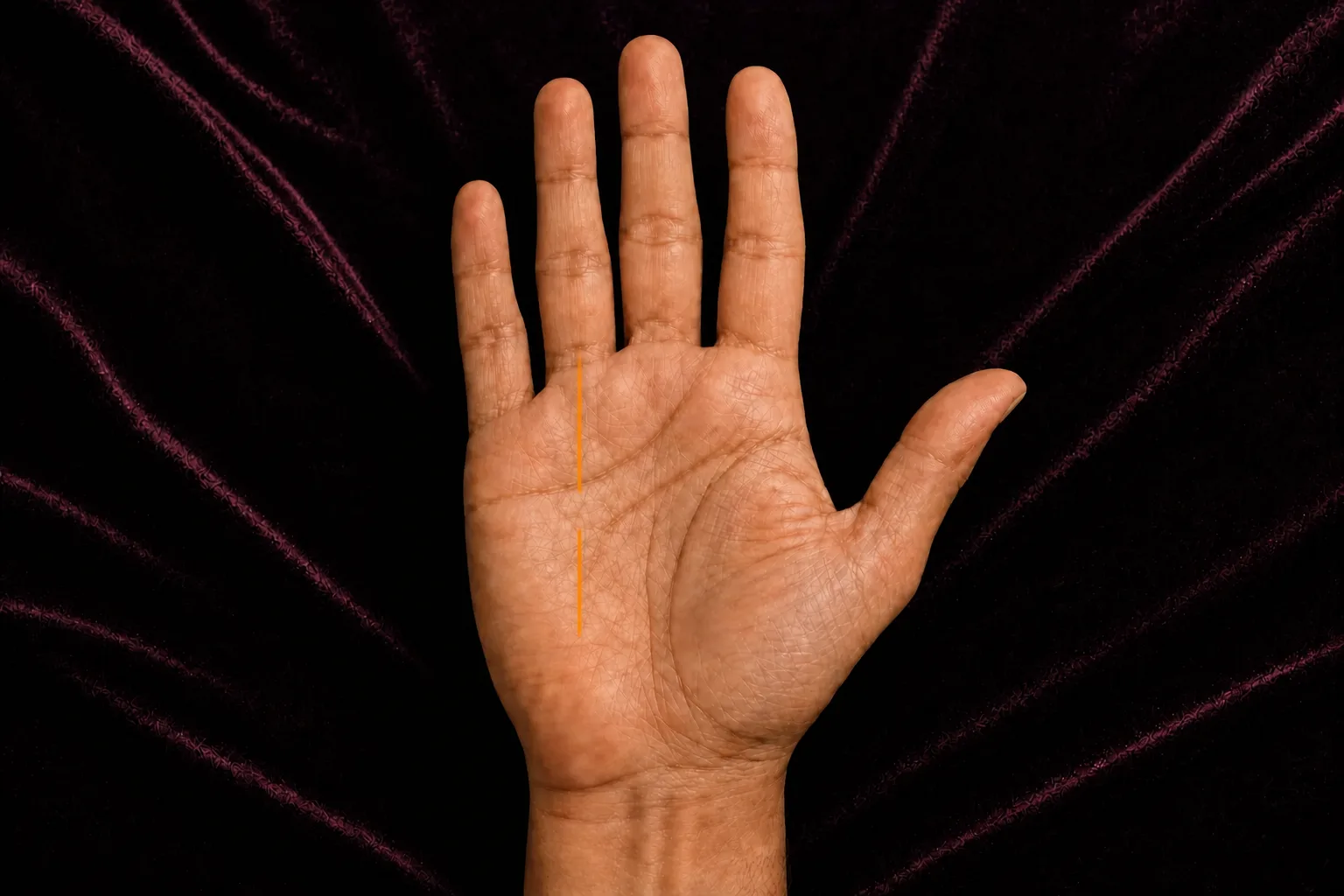
In traditional palmistry, a broken Sun or Apollo line is a line toward the ring-finger mount that stops, leaves a visible empty gap, and restarts above it as a separate Apollo-bound segment. The gap is commonly read as an interruption or change in recognition, expression, reputation, creative output, or personal fulfillment. The upper segment matters most: a clear, stronger restart suggests renewed visibility or satisfaction after a change, while a weak or scattered continuation suggests the theme returns less steadily. A break does not prove failure, career loss, financial loss, or permanent damage.
A Sun-line break becomes meaningful only after the lower Apollo route, true empty gap, upper restart, alignment or displacement, strength before and after, overlap and faintness tests, islands, bars, broad timing, Fate-line continuity, Apollo condition, Head, Mercury, Jupiter, thumb, and both palms are compared. A whole-hand reading can show how work, expression, reputation, satisfaction, interruption, renewal, and direction work together.
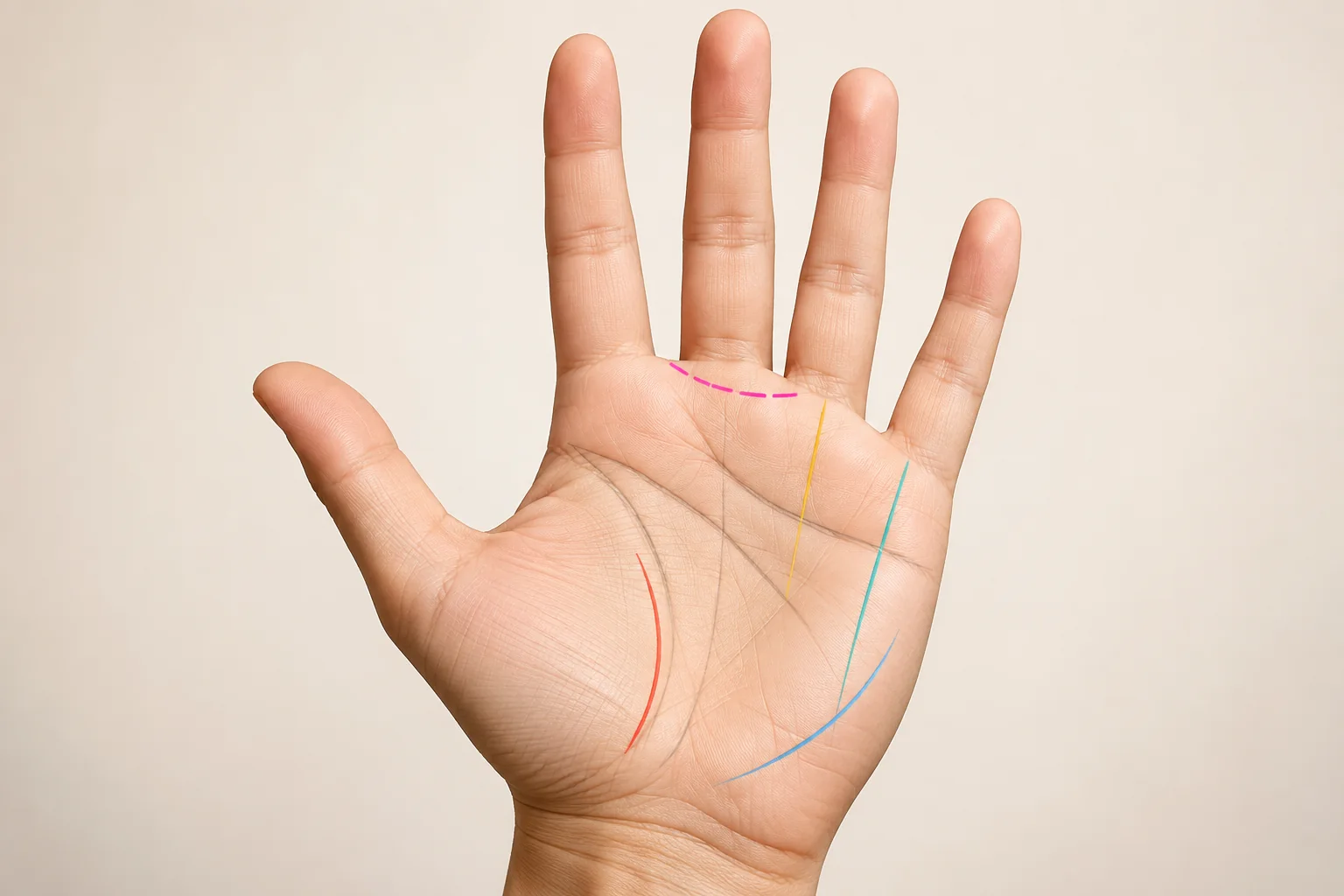
Use a ten-part broken-Apollo method: confirm the ring-finger destination, trace the lower segment upward, find its clean endpoint, verify skin is genuinely empty across the gap, trace the upper segment independently to Apollo, exclude faintness and a late start, distinguish an island, crossbar, chain, or overlap, compare strength before and after the interruption, estimate only a broad timing zone, then add the Fate line, Head line, Apollo mount, Mercury, Jupiter, thumb, and both palms. The empty space is the defining feature.
A break is a gap, not a frightening label
Palmistry reads the Sun line for appreciation, expression, visibility, and contentment as well as public recognition. A gap can therefore describe a pause, changed outlet, private phase, altered audience, or dissatisfaction before it describes any dramatic external event. Read what continues around the gap.
Where to find a break in the Sun line
Locate the Mount of Apollo directly beneath the ring finger. Trace any vertical line in this zone downward. A Sun line may begin low in the hand, at the life or Fate line, from Moon, near the Head line, at the Heart line, or only in the upper palm.
For a true break, you need two parts of what appears to be the same route. The lower segment rises toward Apollo and stops. The upper segment begins higher, usually on the same axis or slightly displaced, and continues toward the ring-finger mount. Between them lies an area of visible skin with no connecting groove.
The segments need not align like a ruler. A restart slightly to one side can still belong to the same broad Apollo route when its direction and destination agree. Record the displacement rather than forcing the lines into one imaginary path. If the upper segment begins far away or reaches another mount, it may be a different line.
| Formation | Visual test | How it differs from a break |
|---|---|---|
| True break | Lower line stops; empty skin; separate upper line resumes to Apollo | The route has a visible interruption |
| Faint section | A shallow groove remains visible through the weak area | Continuity survives even though depth changes |
| Island | Line divides and rejoins around an eye-shaped space | Two sides enclose the space; the route is not empty |
| Crossbar | A horizontal or diagonal stroke cuts a continuing Sun line | The parent remains beneath the crossing |
| Overlap | Upper segment begins before the lower one ends, running beside it briefly | A parallel handover bridges the change |
| Late-starting line | Only an upper route exists; no lower parent points toward it | There is a start, not a break after earlier continuity |
How to verify that the gap is real
Photograph the relaxed hand in bright indirect light. Take one image straight above the palm and another with gentle side light. Flash glare can erase a fine bridge; strong side shadow can invent one. Compare the raw photographs before zooming or tracing.
Follow the lower segment from its origin to its endpoint. At the suspected gap, inspect whether a fine continuous groove survives. Then trace the upper segment from Apollo downward. If both pieces point toward each other and the space between them stays blank under more than one lighting angle, the geometry supports a break.
Check the line's identity on both sides. A central lower Fate line and an upper Sun line can appear aligned even though they belong to different destinations. Likewise, one lower segment may stop at the Head line while a separate upper line begins beside it. A convincing broken Sun route keeps an Apollo direction before and after the gap.
| Verification question | What to record | Why it matters |
|---|---|---|
| Is there truly no groove in the gap? | Check direct and side light | Separates a break from faintness |
| Do both segments aim at Apollo? | Trace their direction and upper destination | Separates one broken route from two different lines |
| Does the upper segment overlap the lower? | Note any parallel section | An overlap can soften the interruption into a handover |
| Does a bar cross the gap area? | Trace the bar beyond both sides | A crossing is a modifier, not the missing parent |
| Is the mark repeatable in several photos? | Compare neutral hand positions | Excludes pressure creases and camera artifacts |
Traditional meaning: interruption, redirection, or renewal
The Sun line is traditionally associated with the way ability is expressed and appreciated, the visibility of one's contribution, aesthetic or creative satisfaction, and the inner contentment that comes from meaningful activity. A gap suggests that this flow changes. The person may leave an outlet, lose interest in being visible, change audience, revise a professional identity, pause a practice, or feel that effort is no longer satisfying in the old form.
The word “reputation” can make readers assume scandal. The palm does not justify that leap. An interruption may be chosen and constructive: study, caregiving, relocation, a private building phase, recovery from overwork, a shift from one medium to another, or deliberate withdrawal from public attention. Real history should decide which description fits.
The restart prevents the gap from being read as an ending. A coherent upper route suggests expression or appreciation resumes. Sometimes it returns through the same work; sometimes it returns through a different role, audience, or source of satisfaction. This is why the condition above the gap carries more practical value than alarming labels attached to the empty space.
Read the upper restart before predicting the outcome
Compare the lower and upper segments under the same light. Depth, clarity, position, and continuity show what changes after the gap.
| Upper continuation | Balanced traditional reading | What to check next |
|---|---|---|
| Deeper and clearer than below | Recognition or fulfillment returns with stronger focus | New origin, Apollo, Head line, and real redirection |
| Similar strength and aligned | A pause followed by continuation in a familiar channel | Gap width and supporting Fate line |
| Shifted to one side | Expression may resume through a changed outlet or audience | Whether the new route stays Apollo-bound |
| Overlaps the lower segment | A transition with some continuity or support | Length and strength of the overlap |
| Faint or fragmented above | The theme returns tentatively or inconsistently | Crossbars, Apollo texture, and the other hand |
| Forks only after restarting | Renewed expression later develops two directions | Each prong's destination and relative strength |
A square surrounding the gap, a close parallel sister line, or an overlapping segment is traditionally read as support around the transition. Treat the visible geometry first: does another line actually bridge the empty section, run alongside it, or merely pass nearby? A vague supporting crease should not be promoted into a rescue sign.
If the upper section never reaches Apollo, the line may end rather than restart. If several separate fragments continue upward, describe a fragmented or intermittent Sun line. The general broken-lines guide explains gaps, overlaps, sister lines, squares, and shifted continuation across different parents.
What the Fate line and Apollo mount add
The Fate line shows whether direction, responsibility, and work structure continue through the same zone. A clear Fate line beside a broken Sun line can mean the work or duty remains steady while recognition, enjoyment, audience, or expression pauses. If both Fate and Sun routes change at a similar level, the interruption may sit inside a wider redirection.
A balanced Apollo mount and ring finger can support taste, performance, presentation, creative confidence, or appreciation even when the line is interrupted. A grille or many confused verticals on Apollo can add scattered attention or sensitivity to response. A clear Head line can show the ability to reorganize and rebuild; Mercury may support communication or commercial adaptation; Jupiter may add ambition and renewed direction.
Money needs separate evidence. A gap in the Sun line does not prove income loss, just as a strong restart does not guarantee wealth. Compare Fate, Head, Mercury, financial markings where relevant, actual circumstances, and the person's question. Recognition and earnings can move together, but they are not the same subject.
Ask what continued during the gap
Did the work remain stable while public response changed? Did the role continue while satisfaction faded? Did the person stop showing a skill but keep developing it privately? Fate, Head, Apollo, Mercury, and real history often reveal the bridge that the Sun line itself leaves blank.
How to time a break in the Sun line
Timing begins only after the break is verified. Mark the lower endpoint, the empty span, and the upper restart relative to the Head and Heart lines. A gap below the Head line occupies an earlier zone. One around the Head-line level belongs to a broad adult midpoint. A gap between Head and Heart is later, and one near or above Heart is later still.
Use two ranges when the gap is wide: one for where the lower route stops and another for where the upper route resumes. This preserves the interruption rather than assigning a single age to the whole space. If the segments overlap, the timing zones overlap too and can indicate a gradual handover.
Calibrate the scale against a known event on the same line or neighboring Fate route. The palmistry age-calculation guide explains landmark crossings and proportional sections. Palm timing is approximate, so use a broad range and never claim the exact date of a promotion, career break, reputation change, creative return, or award.
Compare a broken Sun line in both palms
Photograph both hands in matching positions and light, and state which hand you use most. Traditional systems disagree on fixed active-passive formulas, so compare the visible pattern before attaching a story.
| Two-hand pattern | Balanced reading | Useful follow-up |
|---|---|---|
| Break only in the dominant hand | A present expression or recognition route may have changed | Compare current choices, work, audience, and satisfaction |
| Break only in the non-dominant hand | An available or earlier pattern may be organized more continuously now | Inspect the dominant continuation and supporting lines |
| Similar gap in both hands | The interruption may be a stable repeated theme | Compare exact levels and restart strength |
| Restart stronger in the dominant hand | Current effort may be developing a clearer later route | Name the practice or role that became more focused |
| One broken line becomes two | Expression may diversify after the transition | Verify two independent Apollo parents rather than a fork |
A difference between hands can be the most useful evidence because it shows how the visible formation has changed. Read it alongside hand shape, line quality, mounts, fingers, and actual choices rather than deciding one palm is “good” and the other “bad.”
Four worked examples
1. Strong Fate line, clearer Sun restart
The Sun line stops near the Head-line level and restarts above it with greater depth, while the Fate line continues cleanly through the center. Traditionally, work structure may remain stable while recognition or fulfillment pauses and then returns more clearly. A Head-line change and the person's history can show whether new learning, focus, or presentation shaped the renewal.
2. Shifted upper segment
The lower Apollo route stops, and an upper segment begins slightly nearer the outer palm before reaching Apollo. The displacement can suggest a changed outlet, audience, or style rather than a simple return to the same track. Confirm the upper route does not point to Mercury and compare the Mount of Moon for public or imaginative support.
3. A faint bridge mistaken for a clean gap
Under overhead light the line appears broken, but side light reveals a shallow groove connecting the two stronger sections. This is a line that weakens and recovers, not a true empty break. The reading shifts from interruption to reduced emphasis during the faint section.
4. Upper-only line mistaken for a restart
A clear Sun line begins above the Heart line, but no lower segment points toward it. This is a later-starting Sun line rather than a broken one. Its traditional emphasis is later visibility or fulfillment. Compare it with the no-Sun-line guide when the lower and middle Apollo route are absent.
Photo checklist for a Sun-line gap
- Photograph the full palm from wrist to fingertips.
- Keep the camera directly above the relaxed hand.
- Use bright indirect light without flash glare.
- Take a second image with gentle side light.
- Capture a close-up centered on the suspected gap.
- Trace the lower segment to its clean endpoint.
- Trace the upper segment down from Apollo.
- Confirm that both pieces share an Apollo direction.
- Check the empty space for a faint connecting groove.
- Check for an island, crossbar, chain, or overlap.
- Record strength and displacement above the gap.
- Repeat the same photographs for the other palm.
Keep one photo unmarked. Trace on a duplicate so the overlay cannot conceal a fine bridge, branch, or texture change. The full-hand image establishes identity and destination; the close-up establishes the gap.
Frequently asked questions
Is a broken Sun line bad?
It traditionally marks interruption or change in expression, appreciation, recognition, or fulfillment. The restart, surrounding support, and both hands decide whether the pattern looks like a pause, difficult transition, reinvention, or renewed focus.
Does it mean loss of fame or reputation?
It can describe changing visibility or reception, but a palm cannot prove scandal or public loss. Many gaps fit quieter changes such as a new role, private phase, study, relocation, different audience, or altered source of satisfaction.
What if the line is stronger after the break?
A clearer upper continuation is traditionally read as renewed expression or recognition after change. Compare its new position, origin, crossings, Apollo condition, and the work or practice that became stronger in real life.
What if it is weaker after the break?
The theme may return tentatively, intermittently, or with less emphasis. Look for a second Apollo route, supporting Fate line, Head-line clarity, Mercury, Jupiter, and differences in the other hand.
Can a crossbar create a break?
A bar may interrupt or obscure the Sun line, but if the parent groove continues beneath it there is no empty gap. Record the crossbar as a modifier. A true break requires absence between two segments.
Is a late-starting Sun line broken?
No. A late-starting line has an upper route without a lower segment that stops below it. A broken line has both a before and an after.
Can the break give an exact age?
No. Its position provides a broad stage on the line. Use Head- and Heart-line landmarks, proportional sections, known events, and both palms to estimate a range.
Can palm lines change?
Fine line depth and visibility can appear different with skin condition, hand use, light, and over longer observation. Use comparable photographs over time before calling a new break or restart.
The complete answer
A broken Sun line traditionally represents an interruption or redirection in expression, visibility, reputation, appreciation, creative output, or inner fulfillment, followed by a possible return when an upper Apollo-bound segment resumes. Confirm two related segments and genuinely empty skin between them so faintness, an island, crossbar, chain, overlap, late start, or two unrelated lines is not mistaken for a break. Then compare the lower route, gap width, upper strength and displacement, timing zone, Fate line, Apollo, Head, Mercury, Jupiter, thumb, real history, and both hands. A Full Palm Reading maps all important features across both palms and combines them into a holistic reading focused on your questions about work, creativity, visibility, reputation, money, satisfaction, change, renewal, timing, and direction.
A Full Palm Reading
Ask what changes across your Apollo-line gap
Your reading maps the lower Apollo route, true empty gap, upper restart, alignment or displacement, strength before and after, overlap and faintness tests, islands, bars, broad timing, Fate-line continuity, Apollo condition, Head, Mercury, Jupiter, thumb, and both palms, then adds every other important line, mount, finger, marking, shape, and texture into one holistic reading focused on your questions.
Your Full Palm Reading maps all the important features—hand shape, skin texture, thumb, fingers, mounts, major and minor lines, markings, and the differences between both palms—and brings them together in a holistic reading focused on your questions.