
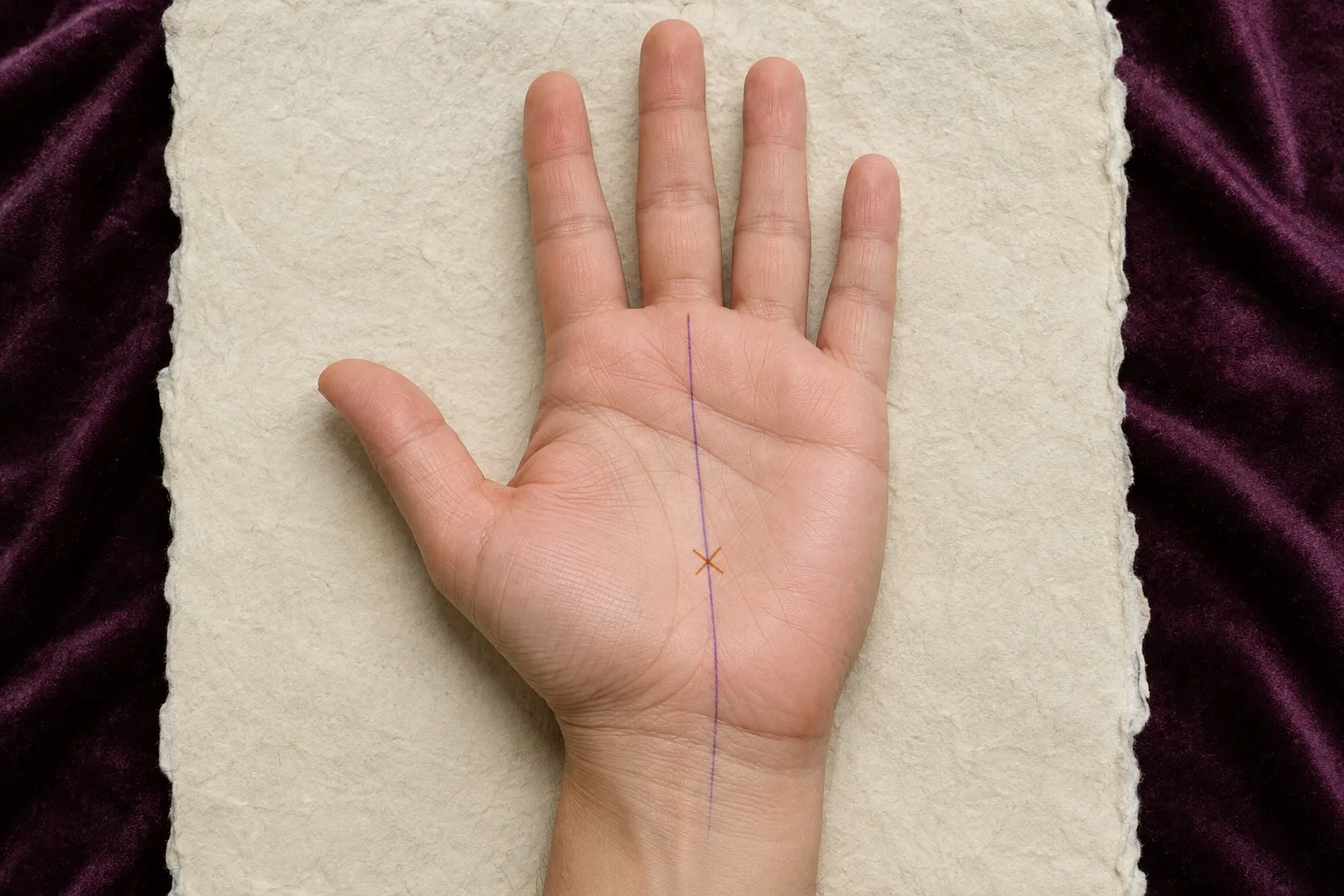
A cross on the Fate line is a compact X made by two short strokes whose central intersection touches one verified Saturn-bound Fate-line parent. Traditional palmistry uses it to explore a concentrated career obstacle, competing responsibility, difficult decision, interruption, or redirection in life structure. It does not guarantee unemployment, business failure, poverty, or a ruined future. Verify the X, every arm, exact position, Fate-line origin and destination, clarity before and after, Sun, Head, Heart, Jupiter, Mercury, real work circumstances, broad timing, and both palms.
A cross on the Fate line becomes personal only after the complete Saturn-bound parent, exactly two short intersecting strokes, central contact, arm origins, position around Head and Heart, origin, destination, clarity before and after, major-line-crossing, Venus-influence, break, overlap, star, grille, branch, Mystic-Cross and texture tests, Sun, Jupiter, Mercury, Head, Heart, thumb, timing, real work, and both palms are compared. A whole-hand reading can show how work, responsibility, skill, recognition, values, and direction work together.
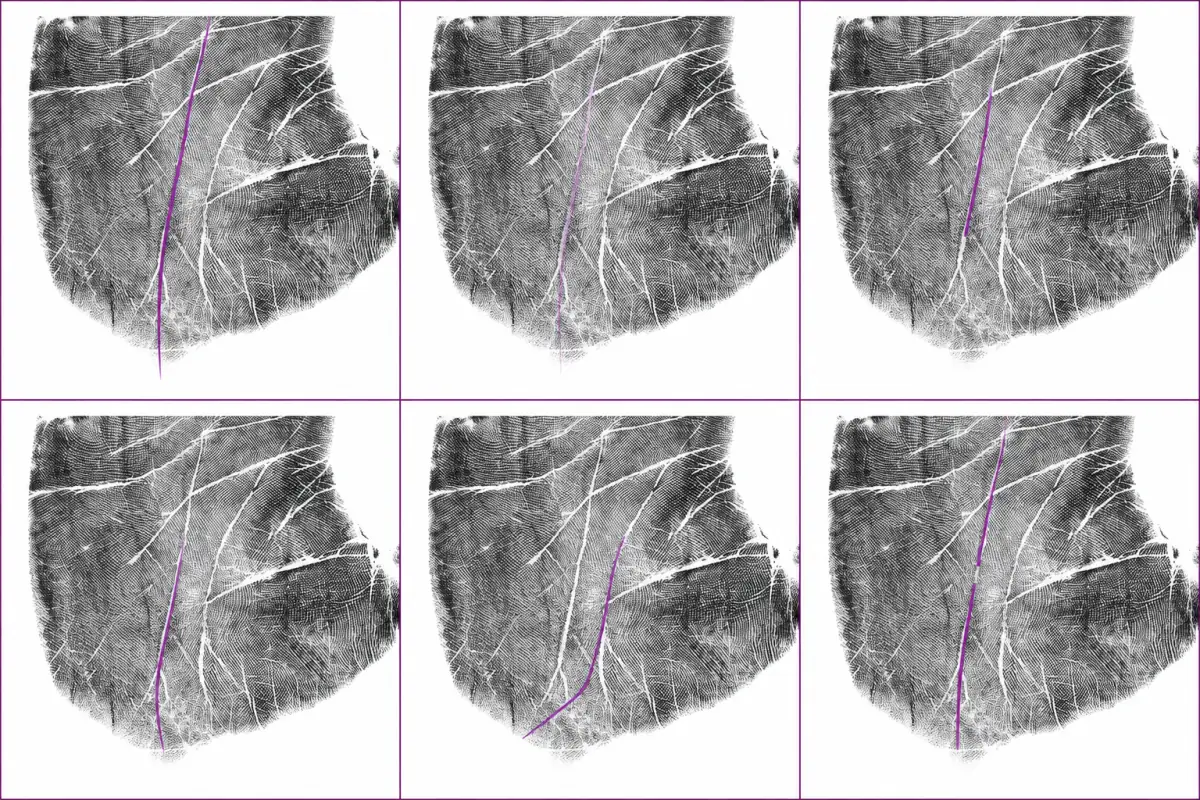
The Fate line is a vertical route that generally travels toward the Mount of Saturn below the middle finger. It may begin at the wrist, Life line, Moon, middle palm, or another point, and it may be faint, fragmented, or absent. Traditional readers associate the complete route with structure, responsibility, vocation, and the way a person organizes sustained effort. One cross is a local modifier within that wider pattern.
How to identify a true cross on the Fate line
Start with the complete Fate-line guide. The central palm contains the Head and Heart lines, influence lines from Venus, vertical Sun and Mercury routes, and ordinary crossing creases. Any of them can create an apparent X.
- Trace one Fate-line parent toward Saturn below the middle finger.
- Confirm two short strokes that intersect rather than merely touch.
- Find one shared center that creates exactly four arms.
- Place that center on Fate, not beside the route or inside the quadrangle.
- Trace every arm to learn whether one belongs to Head, Heart, Venus, Sun, or another long line.
- Record the exact position below Head, at Head, between Head and Heart, at Heart, or above Heart.
- Trace Fate below and above the mark to its actual origin and destination.
- Compare line quality before and after the X.
- Add career support from Sun, Jupiter, Mercury, Head, and thumb.
- Compare both palms under the same lighting and hand position.
This is the ten-part Fate-line-cross method: parent, two strokes, center, contact, arm origins, position, complete route, continuation, support, and both palms. A natural Head or Heart line crossing Fate is a landmark first. Call it a separate cross only when a second short independent stroke also forms a compact X at that point.
Cross, natural line crossing, break, overlap, star, grille, or Mystic Cross?
| Formation | What to trace | Why it differs |
|---|---|---|
| Cross on Fate line | Two short strokes intersect at one center touching Fate | A compact four-armed X modifies one point |
| Head or Heart crossing | One major horizontal parent passes through Fate | A normal junction between two major lines |
| Venus influence | One longer diagonal route comes from the thumb-side mount | Its origin adds family, attachment, or close influence |
| Break or overlap | Fate stops at empty skin or resumes in a shifted segment | The parent is interrupted rather than crossed by two strokes |
| Star | At least three strokes converge at one compact center | Six or more arms rather than four |
| Grille | Several vertical and horizontal strokes form multiple cells | A repeated network rather than one isolated X |
| Mystic Cross | An independent X sits between Head and Heart | Its center is not attached to a traced Fate parent |
The broken Fate-line guide owns a true empty gap or restart. The Fate-line island guide owns a single closed split and reunion. The general cross and X guide covers independent crosses by mount.
What a cross on the Fate line traditionally means
A cross concentrates the Fate-line subject at one point. Traditional readers explore a blocked route, competing obligations, a difficult professional choice, a clash between personal direction and outside demands, or a period when the existing structure has to change. The X may correspond to a demanding project, promotion choice, training decision, business pivot, relocation, caregiving duty, or change of role. It does not identify the event by itself.
The arms matter. A genuine Venus-origin arm may connect the decision with family or close relationships. A Sun-bound arm may connect it with visibility, creative output, or reputation. A Mercury-bound arm may add communication, trade, analysis, or organization. A long horizontal arm may simply be Head or Heart crossing Fate. Trace first; interpret second.
The mark cannot establish that an employer will fire you, a business will collapse, money will disappear, or another person will block your success. Use contracts, financial records, performance feedback, market conditions, and direct conversations for real decisions. Palmistry can help frame which pressures, values, and choices deserve attention.
| Common fear | What the mark establishes | Useful question |
|---|---|---|
| “I will lose my job” | Only a compact X touches one point on Fate | What evidence shows risk, and what options exist? |
| “My career is permanently blocked” | One local mark does not define the entire route | How clear is the Fate line after the X? |
| “It means poverty” | The crease does not measure income or wealth | What do skills, plans, resources, and actions show? |
| “Someone will ruin my success” | The X cannot identify another person's conduct | Where do the arms actually originate? |
| “I chose the wrong path” | The mark may frame a choice or redirection | Which direction gains clarity above the mark? |
What the cross position changes
Position describes the traditional chapter involved. Use Head and Heart as visible landmarks, then calibrate against known work and responsibility changes. Do not assign a fixed age from a generic diagram.
| Position | Traditional focus | What to verify |
|---|---|---|
| Low palm, below Head | Foundation, education, early work structure, family or practical demands | True origin, wrist, Life or Moon connection |
| At the Head-line level | A decision, plan, judgment, study, or strategy changes direction | Whether it is simply the normal Fate-Head crossing |
| Between Head and Heart | Responsibility, role development, competing structures, sustained effort | Independent X versus Mystic Cross or crossing texture |
| At the Heart-line level | Values, relationships, family, fulfillment, or duty enter the direction question | Whether Heart alone creates the apparent cross |
| Above Heart | Later responsibility, authority, expertise, or long-term purpose | Clear route toward Saturn and mount condition |
| Near a branch junction | One route divides toward a second goal or role | Cross versus branch or fork geometry |
What the Fate line after the cross changes
Continuation often matters more than the dramatic-looking X. Follow Fate upward toward Saturn and compare its depth, alignment, direction, and connections before and after the mark.
- Clear continuation: the obstacle or decision is followed by renewed structure.
- Deeper continuation: responsibility, focus, or commitment may consolidate afterward.
- Fainter continuation: the existing route may become less central or remain unsettled.
- Shifted restart: direction may resume through a different role, environment, or method.
- Branch toward Apollo: visibility, creative output, audience, or recognition joins the path.
- Branch toward Jupiter: ambition, leadership, teaching, or advancement becomes relevant.
- End at the X: verify a true endpoint before reading the chapter as complete.
- Island or chain after it: one concentrated decision is followed by a longer divided or variable phase.
A strong upper continuation does not promise success, but it changes the reading from permanent blockage to adjustment and ongoing direction.
What Sun, Jupiter, Mercury, Head, and Heart add
The career-line guide shows why work questions need more than Fate. Sun adds visible output, satisfaction, and recognition. Jupiter adds ambition, leadership, teaching, and standards. Mercury adds communication, analysis, organization, commerce, and practical skill. Head adds strategy and learning; Heart adds values and fulfillment.
| Supporting feature | Traditional contribution | Real-world check |
|---|---|---|
| Clear Sun line | Visible output or fulfillment continues beside the obstacle | Portfolio, audience, feedback, and completed work |
| Developed balanced Jupiter | Ambition and leadership support redirection | Responsibility, mentoring, and chosen goals |
| Clear Mercury signs | Communication or practical skill helps solve the problem | Negotiation, systems, analysis, and client work |
| Clear Head line | Planning and judgment support the next structure | Options, training, decisions, and follow-through |
| Coherent Heart line | Values and fulfillment remain part of the decision | Boundaries, motivation, and sustainable priorities |
| Balanced thumb | Will and reason can act together | Commitment, flexibility, and practical constraints |
How to time a Fate-line cross
Fate-line timing is proportional and schools use different scales. Head and Heart crossings are broad landmarks, not exact birthdays. First identify the complete route, then place the X relative to those junctions and calibrate with known education, role, family, relocation, or business changes.
- Trace the Fate line from its actual origin to destination.
- Verify two short strokes and central contact.
- Mark the X below, at, between, or above the major-line landmarks.
- Compare strength, alignment, branches, and continuation around it.
- Add any true Venus, Sun, Jupiter, or Mercury connection.
- Calibrate with known changes in work or responsibility.
- Compare the other palm and report a broad phase.
The palmistry timing guide explains the method and its limits. A cross cannot provide a guaranteed resignation, promotion, loss, or business date.
What the cross means in one palm or both
State which hand is active for writing and compare matched photographs. A common modern convention treats the less-active hand as background and the active hand as present development. Match the same Fate-line segment and landmark position rather than any two crosses.
- Similar cross in both palms: the work or responsibility theme appears deeply repeated.
- Cross mainly in the active hand: present choices or conditions may shape the concentrated challenge.
- Cross mainly in the less-active hand: an inherited or earlier pattern may be handled differently now.
- Clearer active continuation: current structure may be more coherent after the decision point.
- Different positions: treat them as separate chapters until other features connect them.
Five worked examples
1. Low Fate-line cross with a clear upper route
A compact X touches Fate below Head, while the route grows deeper above it and continues to Saturn. Traditional synthesis suggests an early obstacle or structural decision followed by stronger direction.
2. Apparent cross at the Head line
Fate passes through Head, but no second short independent stroke exists. Read the normal Fate-Head junction and the decisions around it instead of inventing a separate X.
3. Cross with one arm traced to Venus
A diagonal arm begins inside Venus and reaches Fate at the X. Family, attachment, home, or close influence may enter the career decision, subject to real circumstances and the upper continuation.
4. Cross followed by an Apollo branch
Fate remains clear and later sends a route toward the ring finger. A difficult work choice may be followed by greater emphasis on visible output, audience, craft, or recognition.
5. Active-hand cross with a stronger continuation
The X is clear only in the active hand, and Fate becomes more coherent above it than in the less-active palm. Current choices may be reorganizing responsibility rather than ending direction.
Photo checklist for a Fate-line cross
- Capture the whole palm from wrist to fingertips.
- Keep Saturn, Fate, Head, Heart, Venus, Apollo, and Mercury visible.
- Use bright indirect light plus one side-lit close-up.
- Trace the full Saturn-bound parent before marking the X.
- Confirm two short strokes, four arms, and one centered intersection.
- Trace each arm to exclude Head, Heart, Venus, Sun, and Mercury routes.
- Record the X position and line quality before and after it.
- Separate breaks, overlaps, stars, grilles, Mystic Cross, and random texture.
- Keep one unmarked original and annotate only a duplicate.
- Photograph both palms at the same distance and exposure.
Frequently asked questions
Does a cross on the Fate line mean career failure?
No. Traditional palmistry treats it as a concentrated obstacle, choice, or redirection. Continuation and supporting features show whether structure strengthens, shifts, or fades afterward.
Does it mean I will lose my job?
No palm mark predicts a dismissal. Use workplace evidence, feedback, contracts, performance, finances, and options for that decision.
Does it predict poverty?
No. The Fate line does not measure income or guarantee financial outcomes.
Is the Head line crossing Fate automatically a cross?
No. That is a normal major-line junction. A compact X needs a second short independent stroke whose center also touches Fate.
Is a cross between Head and Heart a Mystic Cross?
It may be if it floats independently in the quadrangle. If its center touches a traced Saturn-bound Fate parent, use the Fate-line-cross method first.
What if Fate becomes stronger after the X?
A deeper continuation traditionally suggests greater structure, responsibility, or commitment after the obstacle or decision.
Can it show the exact age of a career change?
No. Use proportional position, known milestones, both hands, and a broad phase.
Can the cross change?
Fine-line visibility varies with light, skin condition, pressure, and camera angle. Compare matched dated photographs before deciding its geometry changed.
The complete answer
A cross on the Fate line is one compact X made by two short strokes whose center touches a verified Saturn-bound Fate-line parent. Traditional palmistry associates it with a concentrated career obstacle, competing responsibility, difficult decision, interruption, or redirection in structure, not guaranteed job loss, business failure, poverty, or permanent blockage. Verify the parent, two strokes, central intersection, exact contact, arm origins, position, complete route, and continuation against a natural Head or Heart crossing, Venus influence, break, overlap, star, grille, branch, and Mystic Cross. Then add Sun, Jupiter, Mercury, Head, Heart, thumb, broad timing, real work conditions, and both palms. A Full Palm Reading maps all important features across both hands and combines them into a holistic reading focused on your questions about work, responsibility, opportunity, recognition, direction, timing, and what becomes clearer afterward.
A Full Palm Reading
Ask how your Fate-line cross fits your complete career and direction pattern
Your reading maps the complete Saturn-bound Fate parent, exactly two short intersecting strokes, central contact, arm origins, position around Head and Heart, origin, destination, clarity before and after, major-line-crossing, Venus-influence, break, overlap, star, grille, branch, Mystic-Cross and texture tests, Sun, Jupiter, Mercury, Head, Heart, thumb, timing, real work, and both palms, then adds every other important line, mount, finger, marking, shape, and texture into one holistic reading focused on your questions.
Your Full Palm Reading maps all the important features—hand shape, skin texture, thumb, fingers, mounts, major and minor lines, markings, and the differences between both palms—and brings them together in a holistic reading focused on your questions.