
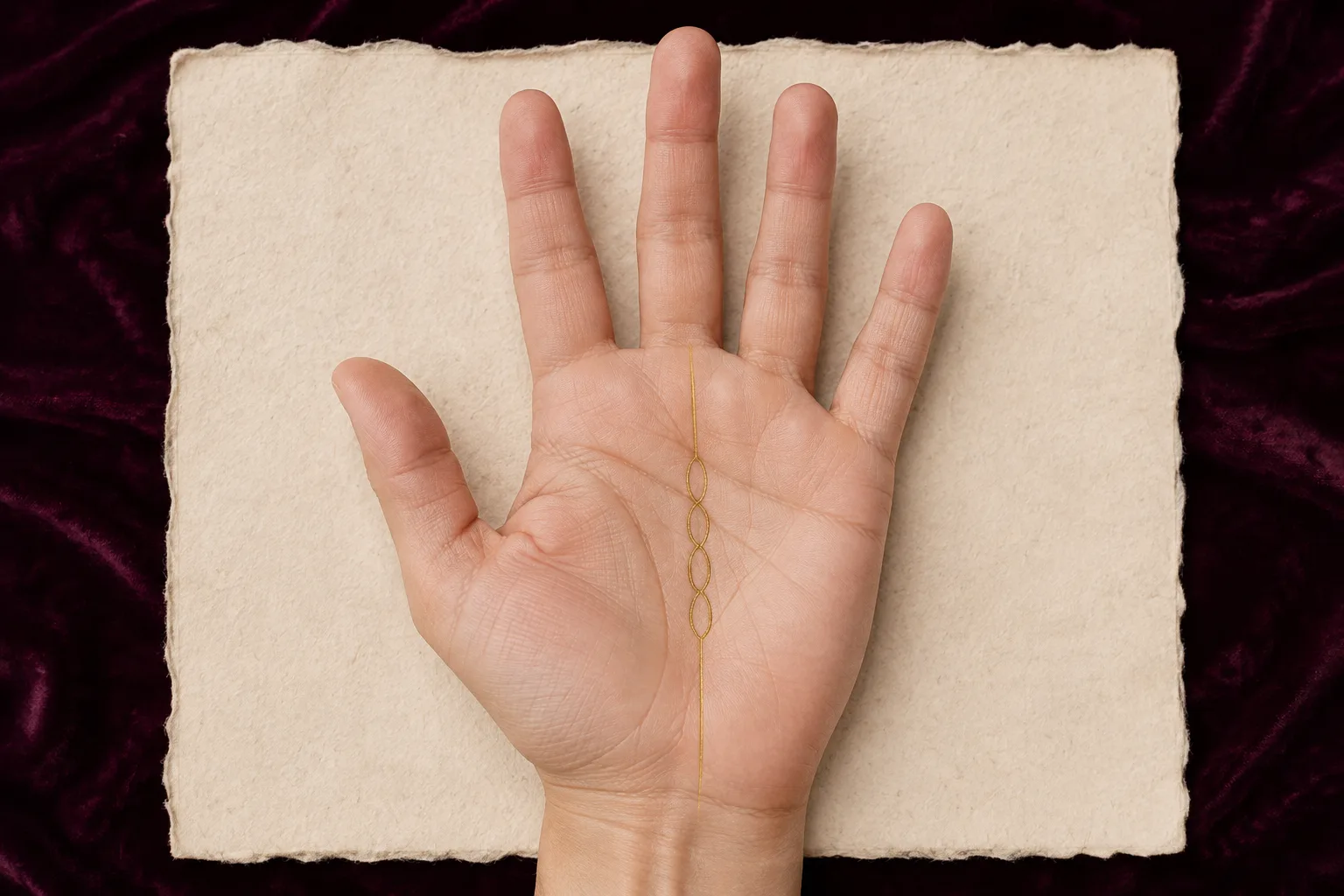
A chained Fate line contains several adjacent closed loops made when one verified Saturn-bound parent repeatedly divides and rejoins. Traditional palmistry reads the chained span as a period or pattern of variable direction, recurring work friction, split responsibilities, or an unsettled structure. It does not guarantee career failure, unemployment, poverty, or bad luck. First prove the linked-loop geometry; then read its position around the Head and Heart lines, the clear sections before and after it, Sun, Jupiter, Mercury, real work circumstances, broad timing, and both palms.
A chained Fate line becomes personal only after one true Saturn-bound parent, repeated linked-loop geometry, affected span, position around Head and Heart, depth, clear sections, island, break, overlap, grille, double-route and crossing tests, Sun, Jupiter, Mercury, branches, timing, real work, and both palms are compared. A whole-hand reading can show how direction, responsibility, skill, recognition, values, and change work together.
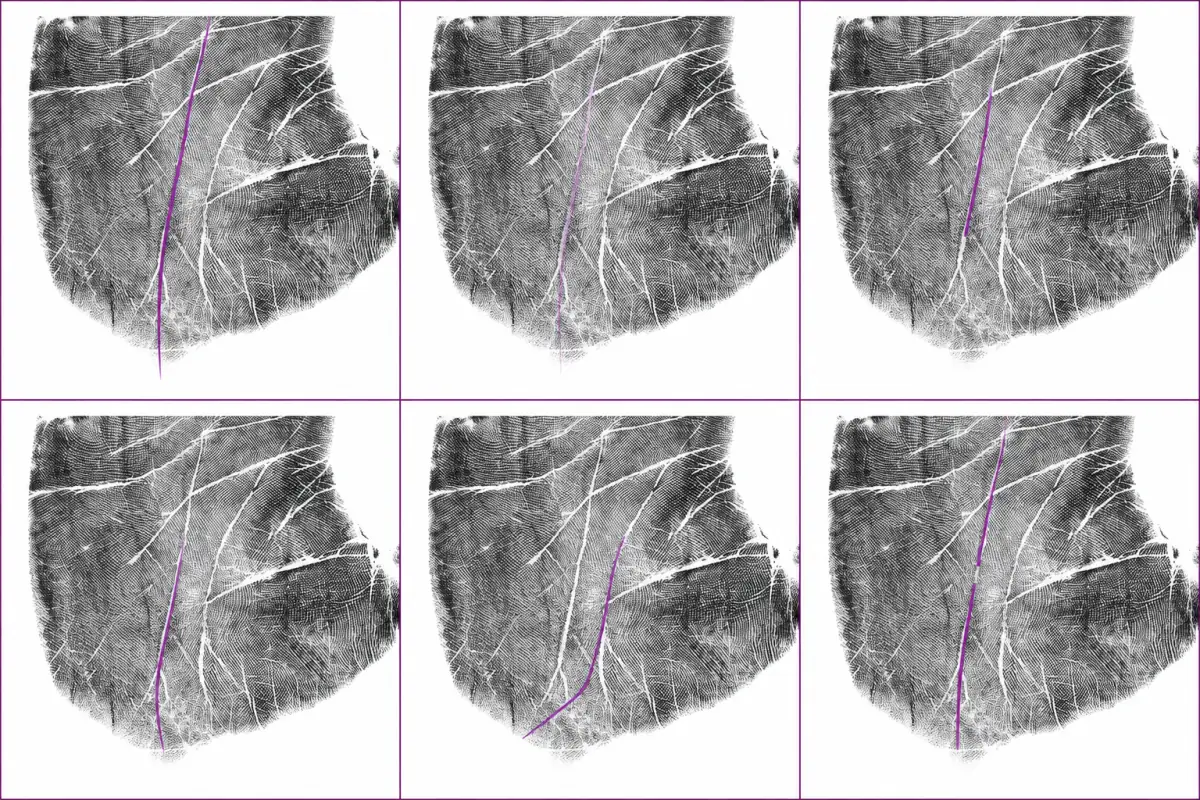
The Fate line is a vertical route that moves toward the Mount of Saturn below the middle finger. It may begin at the wrist, Life line, Moon mount, or higher in the palm, and it may be absent without implying a life without purpose. Its traditional subject is structure: work, duty, chosen direction, external responsibility, and the way a path develops. A chain describes texture inside one route rather than several separate careers.
Read the visual sequence first. One route enters, forms repeated connected loops, then either becomes one line again or remains chained. The point where looping begins and the point where it ends bound the section under discussion. A clear continuation can be more important than the loops because it shows whether the direction becomes more coherent afterward.
How to identify a true chained Fate line
Begin with the complete Fate-line guide. A crop of the middle palm can make unrelated vertical fragments and crossing creases look connected. Trace a genuine Saturn-bound parent before reading texture.
- Locate Saturn. Find the mount directly beneath the middle finger.
- Verify the parent. Trace one vertical route whose direction is toward Saturn.
- Find the first split. The parent must divide into two connected sides.
- Confirm the first reunion. The sides must close a visible loop.
- Trace repetition. At least one more adjacent loop must follow through another split and reunion.
- Mark the affected span. Record where the repeated loop texture starts and stops.
- Trace the continuation. Check whether one route resumes and where it goes.
- Place the Head and Heart landmarks. Note whether the chain is below, across, between, or above them.
- Exclude nearby routes. Separate Sun, Mercury, double Fate, branch, crossing, and grille lines.
- Compare both palms. Use matched photographs and state hand dominance.
This is the ten-part chained-Fate-line method: Saturn target, parent, first split, first reunion, repetition, affected span, continuation, major-line landmarks, nearby-route exclusion, and both palms. One closed oval belongs to the Fate-line island guide. Open fragments, stacked breaks, and crossed diamonds are not a chain.
Chain, breaks, overlaps, grille, double Fate line, or crossings?
The central palm is crowded. The Head and Heart lines cross the Fate line, while influence and effort lines can cut across it at different angles. Every loop side must belong to the same parent; a group of crossing strokes does not become a chain simply because it looks net-like.
| Formation | What to trace | Why it differs |
|---|---|---|
| Chained Fate line | One Saturn-bound parent repeatedly splits and rejoins into linked closed loops | An extended repeated texture within one route |
| One island | One split, one closed space, one reunion | A single bounded complication |
| Broken line | The route stops, leaves empty space, and may restart | No connected loop sides |
| Overlapping restarts | One fragment fades while another begins beside it | Parallel overlap without repeated closed spaces |
| Double Fate lines | Two independent Saturn-bound routes run side by side | Neither repeatedly rejoins the other |
| Grille | Several vertical and horizontal lines form a mesh | No single parent makes every enclosure |
| Crossing work lines | Independent strokes cut across the Fate route | The crossers do not become its two sides |
The broken Fate-line guide owns a genuine gap, while the double Fate-line guide owns two independent routes. Use the general chain guide if the line identity is unclear.
What a chained Fate line traditionally means for career
Traditional readers associate a chained Fate span with stop-start progress, repeated obligations, divided professional attention, unstable systems, or a direction that is maintained through many small adjustments. It can fit several roles at once, inconsistent management, short contracts, a changing industry, side work alongside a main job, recurring family duty, or uncertainty about which structure deserves commitment.
The palm does not identify the employer or cause. A chain cannot prove dismissal, business loss, debt, poverty, or permanent failure. It can be used to ask better questions: Where is effort repeatedly divided? Which structure changes too often? What responsibility keeps returning? What becomes clearer after the loops?
Depth changes emphasis. Deep loop edges can suggest that the repeated structure is strongly expressed. Fine shallow loops can describe subtler uncertainty or require better photography. A strong parent before and after a short chain reads differently from a Fate line made mostly of faint loops. The first pattern is a bounded phase; the second may describe a more persistent way of organizing work and duty.
Chained Fate line below, at, or above the Head and Heart lines
Head and Heart are the most useful landmarks for Fate-line sequence. The wrist side is earlier; movement toward Saturn is later. Exact ages remain approximate and should be calibrated against known events.
| Chained location | Traditional focus | Question to ask |
|---|---|---|
| Near the wrist | Early structure, family conditions, first responsibilities, or an unsettled starting direction | Which conditions shaped the first path? |
| Lower palm below Head | Education, skill building, early work, repeated starts, or practical constraints | Which skill or system needed repeated adjustment? |
| Around the Head line | Decision, strategy, retraining, or judgment becomes central to the friction | Which choice could simplify the structure? |
| Between Head and Heart | Established career, management, divided roles, duty, or recognition pressure | Which responsibility competes with the main direction? |
| Around the Heart line | Values, relationships, satisfaction, or emotional priorities affect direction | What no longer fits the life you want? |
| Above Heart toward Saturn | Later responsibility, authority, legacy, or continued work identity | What structure remains meaningful over time? |
If the chain appears exactly where the Head or Heart line crosses, inspect the junction from two angles. A crossing can create an eye or diamond without the Fate parent splitting and rejoining repeatedly. Label the geometry before assigning a timing zone.
What the Fate line after the chain changes
Trace the route after the last loop. Its depth, alignment, endpoint, branches, and neighboring lines show how the traditional story develops.
- Clear line after a short chain: repeated friction gives way to a more stable direction or system.
- Deeper continuation: responsibility, commitment, or authority may consolidate.
- Faint continuation: the path may become less structured, more flexible, or still uncertain.
- Branch toward Jupiter: leadership, ambition, teaching, or advancement may become more important.
- Branch toward Apollo: recognition, creative output, public value, or satisfaction may support the path.
- New Mercury route: communication, business, analysis, service, or independent exchange may gain emphasis.
- Break after the chain: treat the variable span and later interruption as separate stages.
A clear continuation does not erase the chain. It resolves the sequence: a variable or divided structure across one span, followed by greater coherence. Look for the real decision, skill, role, system, or boundary that fits the change.
What Sun, Jupiter, Mercury, Head, and Heart add
The Sun line adds recognition, output, satisfaction, reputation, and the visibility of work. A clear Sun line during a chained Fate span can show meaningful output even while the structure around it is complicated. Jupiter adds ambition, leadership, standards, and growth. Mercury adds communication, trade, analysis, organization, and service.
The Head line shows how decisions, skills, and planning interact with the path. The Heart line adds values, relationships, and satisfaction. Saturn's mount and finger add duty, patience, caution, and endurance. The career palm-reading guide combines these features rather than asking one vertical line to answer every work question.
| Supporting feature | What it can add | What to verify |
|---|---|---|
| Clear Sun line | Recognition or satisfying output despite structural friction | Is it truly Apollo-bound below the ring finger? |
| Strong Jupiter | Ambition, leadership, teaching, or advancement | Do finger, mount, and upward branches repeat the theme? |
| Clear Mercury route | Business, communication, analysis, service, or organization | Does it travel toward the little-finger mount? |
| Clear Head line | Planning can organize a variable structure | What direction and depth does it maintain? |
| Fate deepens after Head | A decision or learned skill may consolidate direction | Is the change independent of the crossing itself? |
| Fate clears after Heart | Values or relationships may align with later work | What real priority changed? |
How to time a chained Fate-line span
Fate-line timing is proportional. The Head and Heart crossings are broad landmarks, while the line's origin and endpoint vary from hand to hand. Do not assign an exact age from a photograph without calibration.
- Trace the Saturn-bound parent from its actual origin.
- Mark where the first repeated loop begins.
- Mark where the final loop reunites and one route resumes.
- Place the span relative to the Head and Heart lines.
- Compare Sun, Jupiter, Mercury, branches, and other Fate changes.
- Calibrate with a known job, study, business, move, or responsibility change.
- Repeat on the other hand and report a broad range.
The palmistry timing guide explains proportional calibration. A chain cannot produce an exact dismissal, promotion, business-success, or income date.
What a chained Fate line means in one hand or both
Photograph both hands under matched light and state which hand is dominant. A common modern convention reads the less-active hand as background and the active hand as present development. Use the comparison to explore change, then test it against the person's real career history.
| Two-hand pattern | Traditional comparison | Useful question |
|---|---|---|
| Similar chain in both hands | A repeating structural theme is strongly emphasized | Which work condition or divided duty has remained consistent? |
| Chain mainly in the active hand | Current choices or systems may be creating friction | What could be simplified now? |
| Chain mainly in the less-active hand | An underlying uncertainty may be handled differently today | Which skill, boundary, or support changed the pattern? |
| Shorter chain in the active hand | The difficult span may be more contained in current expression | What reduced repeated disruption? |
| Clearer active-hand continuation | Present direction may be consolidating | Which commitment or system creates coherence? |
Five worked examples
1. Lower chain followed by a clear Fate line
Several linked loops appear below the Head line, then one deep route continues toward Saturn. This can fit repeated early work or study adjustments followed by a more stable professional direction. Known jobs and training show which interpretation belongs.
2. Chain around the Head line with a Jupiter branch
The repeated texture surrounds the Head-line crossing, and the outgoing Fate line sends a branch toward Jupiter. Traditional synthesis may connect a difficult decision or retraining period with later leadership, teaching, or advancement. The branch must be independently visible.
3. Middle chain with a clear Sun line
The Fate line is chained between Head and Heart while a distinct Apollo-bound Sun line remains clear. Structure may be complicated while the person's work still earns recognition or feels worthwhile. This separates organizational friction from the quality of output.
4. Fine chain across most of the route
A faint Fate line is made of many small loops from the lower palm upward. This can describe a flexible or repeatedly changing relationship with work rather than one bounded crisis. Multiple projects, contract work, caregiving, or an unconventional path may fit, but the palm cannot choose among them.
5. Chained background hand and clearer active hand
The less-active palm shows a long chain, while the active palm has fewer loops and a stronger continuation. This can be explored as underlying uncertainty expressed through a more coherent current system. Matched dated photographs are needed before claiming the line itself changed.
Photo checklist for a chained Fate line
- Photograph the complete palm from wrist to fingertips.
- Keep the middle finger, Saturn mount, Head line, and Heart line visible.
- Use bright indirect light plus one gentle side-lit close-up.
- Trace one vertical parent toward Saturn before counting loops.
- Confirm at least two adjacent closed split-and-reunion shapes.
- Mark where the chain begins, ends, and returns to one route.
- Separate Sun, Mercury, double Fate, crossings, and grille texture.
- Keep the hand relaxed and the camera square to the palm.
- Photograph both palms at the same distance and exposure.
- State the career question and relevant real milestones.
Frequently asked questions
Does a chained Fate line mean career failure?
No. Traditional palmistry uses it to explore repeated friction, changing structure, or divided responsibility. Continuation, supporting features, actual work, and both hands matter.
Does it mean unemployment or poverty?
No. A palm line cannot predict employment status or income. It may prompt questions about stability and organization, but financial conclusions require real evidence and planning.
What is the difference between a chained Fate line and an island?
An island is one closed oval. A chain contains several adjacent loops formed by repeated splitting and rejoining of the same Fate parent.
What does chaining below the Head line mean?
Traditional readers explore education, early work, skill building, practical constraints, and repeated starts. A clearer route after Head can suggest that a decision or learned skill improves structure.
What if the Fate line becomes stronger after the chain?
A deeper continuation traditionally suggests greater coherence, commitment, or responsibility after the variable span. Ask which real choice, role, or system fits the change.
Can a clear Sun line improve the reading?
It adds a separate theme of recognition, meaningful output, or satisfaction. It does not erase the chain; it shows that value or visibility can coexist with structural friction.
Can the chain show an exact career age?
No. Place it proportionally around Head and Heart landmarks, calibrate with known milestones, and report a broad phase.
Can a chained Fate line change?
Fine lines can look different with lighting, skin condition, pressure, and camera angle. Compare matched dated photographs before concluding that the texture has changed.
The complete answer
A chained Fate line is one verified Saturn-bound parent that repeatedly divides and rejoins into several adjacent closed loops. Traditional palmistry associates the affected span with variable direction, recurring work friction, divided responsibility, changing systems, or an unsettled structure, not guaranteed failure, unemployment, or poverty. Verify the Saturn target, parent, first split and reunion, repeated loops, affected span, major-line landmarks, and continuation against one island, breaks, overlapping restarts, a grille, double Fate lines, and crossing work lines. Then add its location below, around, between, or above Head and Heart; depth; clarity before and after; Sun; Jupiter; Mercury; branches; broad timing; actual work and decisions; and both palms. A Full Palm Reading maps all important features across both hands and combines them into a holistic reading focused on your questions about career direction, responsibility, recognition, timing, change, and what makes the path more coherent.
A Full Palm Reading
Ask how your chained Fate line fits your complete career pattern
Your reading maps the true Saturn-bound Fate parent, repeated linked-loop geometry, affected span, position around Head and Heart, depth, clear sections, island, break, overlap, grille, double-route and crossing tests, Sun, Jupiter, Mercury, branches, timing, real work, and both palms, then adds every other important line, mount, finger, marking, shape, and texture into one holistic reading focused on your questions.
Your Full Palm Reading maps all the important features—hand shape, skin texture, thumb, fingers, mounts, major and minor lines, markings, and the differences between both palms—and brings them together in a holistic reading focused on your questions.