
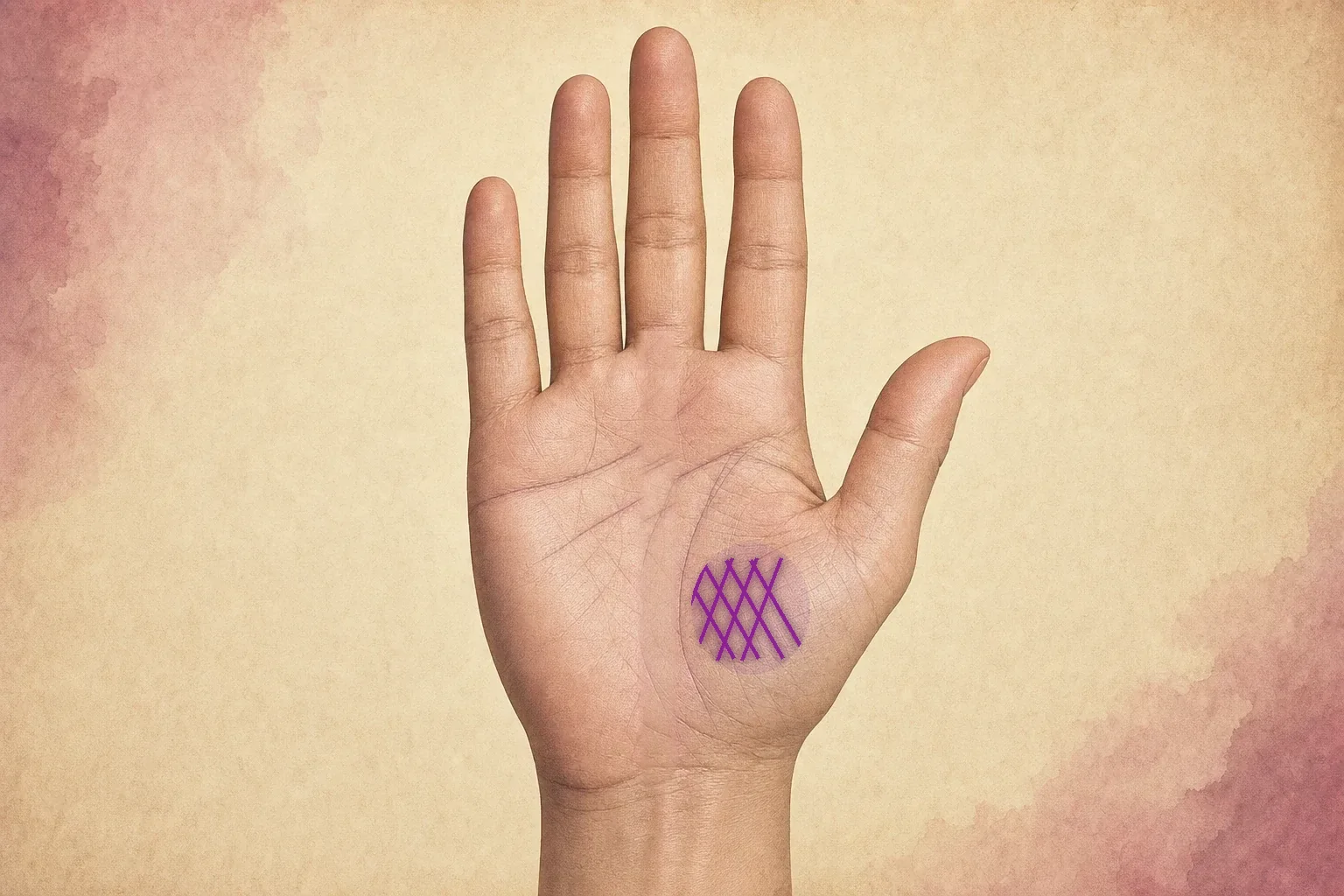
A grille on the palm is a compact group of several lines crossing in two directions, creating multiple small cells like a loose grid or lattice. Traditional palmistry reads it as concentration without clean direction: the subject of the mount becomes busy, divided, overworked, or expressed through many competing channels. Location decides the subject. A grille on Venus differs from one on Jupiter, Saturn, Apollo, Mercury, Moon, or Mars.
A grille becomes meaningful only after its crossing line sets, multiple cells, mount center, boundary, density, depth, major-line contact, combinations, timing limits, and both hands are compared. A whole-hand reading can show how concentrated or divided energy connects with work, ambition, creativity, communication, relationships, travel, or purpose.
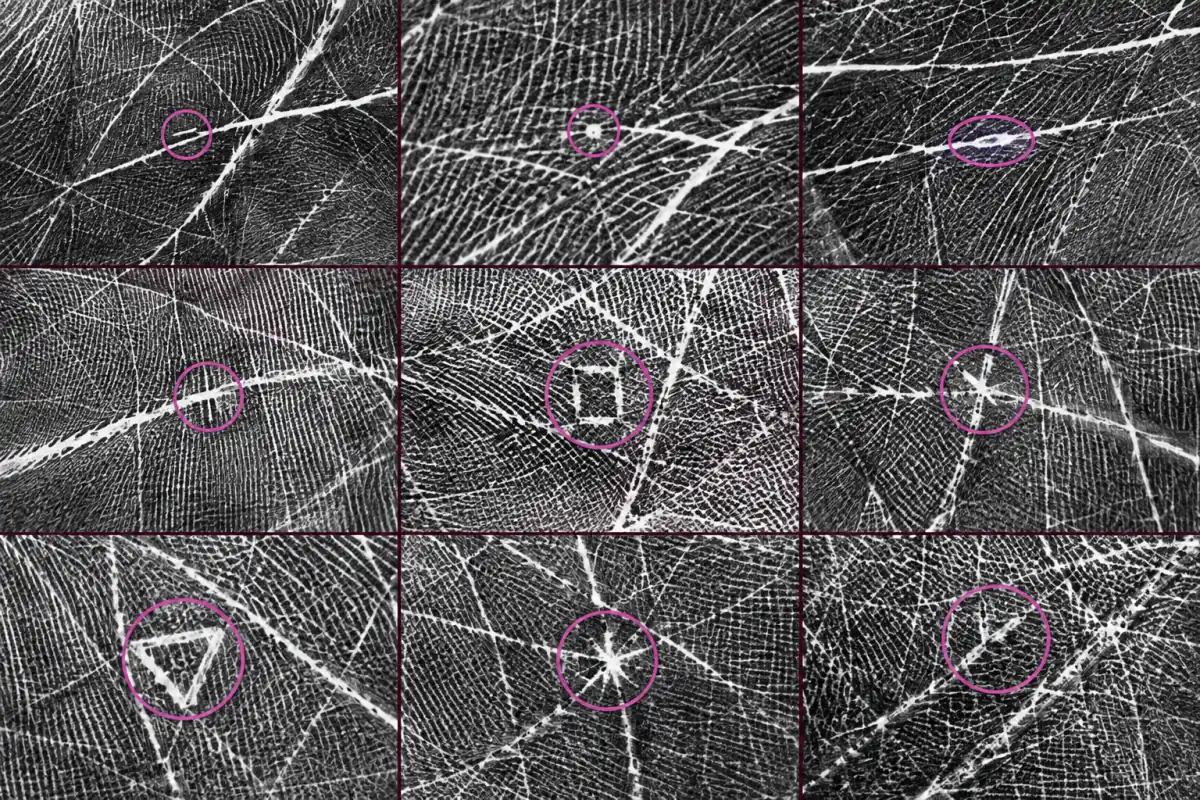
Use a seven-part grille-reading method: verify two crossing line sets, count several intersections, locate the center by mount, mark the boundary, compare density and depth, inspect any major line involved, and compare both hands. Do not name a grille from one cross or one four-sided shape.
A grille is a pattern, not a single symbol
Look for repeated intersections and several neighboring cells. If all strokes meet at one center, test for a star. If only two strokes cross, test for an X. If one continuous parent line forms linked loops, test for a chain.
How to verify a true grille on the palm
A grille normally contains at least a small set of roughly parallel lines crossed by another set at a different angle. The cells may be square, rectangular, or diamond-like. The mark can be neat or irregular, but repeated crossings must create a visible local network. Use the complete marks guide to compare the basic geometries.
| Pattern | Geometry | Deciding feature |
|---|---|---|
| Grille | Several lines cross in two directions | Multiple intersections and cells |
| Cross or X | Two strokes intersect once | Four arms around one crossing |
| Star | Three or more strokes share a center | Several rays from one point |
| Square | Four sides enclose one space | One complete boundary |
| Chain | One line repeatedly splits and rejoins | Linked loops along a parent route |
| Random texture | Fine creases point in many directions | No stable boundary or repeated cell pattern |
A grille can contain imperfect cells. It does not need machine-straight strokes, but it should remain recognizable when the hand relaxes and the light changes. Fingerprint ridges, dry-skin cracks, scars, and compression folds can resemble fine grids in a close photograph; confirm the structure on the palm itself.
What a grille traditionally means
The traditional theme is dispersed or overdistributed energy. The mount has capacity, but its subject is divided across repeated impulses, concerns, duties, or expressions. A compact grille may show one concentrated area of complexity. A wide field of crosshatching can show the mount's theme spreading through much of the hand.
This is not a universal bad-luck sign. A fine open grille on an otherwise balanced hand differs from a dense, deeply cut lattice crossed by major lines. Traditional interpretation asks whether the network contains the mount's energy, fragments it, or simply reflects the hand's overall fine texture.
| Grille quality | Traditional emphasis | What to compare |
|---|---|---|
| Fine and open | Sensitivity or several subtle channels | Overall hand fineness |
| Clear and compact | One concentrated area of divided attention | Mount center and boundary |
| Dense and deep | Mount theme is strongly overworked or complicated | Major-line contact and both hands |
| Broad and irregular | Energy is diffuse rather than locally contained | Whether a true grid persists |
| One side clearer | The pattern has a dominant direction | Origins and destinations of clearer strokes |
| Fading at the edge | Influence weakens outside the central area | Exact mount boundary |
Grille meanings on each palm mount
Locate the center of the grille, not its longest stray line. The palm mounts map shows the cushions below the fingers, Venus beside the thumb, Moon on the lower outer palm, and the Mars zones.
| Grille location | Traditional subject | Possible expression |
|---|---|---|
| Jupiter, below index finger | Ambition, leadership, ideals, self-direction | Goals compete or leadership energy scatters |
| Saturn, below middle finger | Responsibility, discipline, seriousness, mastery | Duties become complex or overly concentrated |
| Apollo, below ring finger | Expression, recognition, creativity, satisfaction | Creative energy divides across too many outlets |
| Mercury, below little finger | Communication, business, practical skill | Many messages, tasks, or skills compete |
| Venus, inside life-line arc | Attachment, affection, engagement, close ties | Relationships or personal involvements occupy many channels |
| Moon, lower outer palm | Imagination, travel, intuition, wider environment | Impressions or possibilities are numerous and diffuse |
| Upper Mars | Resistance, courage, handling pressure | Conflict or defensive effort becomes repeated |
| Lower Mars | Initiative, physical drive, direct response | Action is forceful but split across pressures |
| Plain of Mars, palm center | Coordination under competing demands | Several tensions meet in the central pattern |
Grille on the Mount of Venus
Venus is the most common place readers ask about a network of fine lines. A verified grille here traditionally emphasizes strong involvement with close relationships, family, affection, pleasure, and personal commitments, sometimes spread across many concerns. Separate it from ordinary influence lines crossing the life line and from the natural fine texture of a full Venus mount.
Grille under a finger mount
Under Jupiter, Saturn, Apollo, or Mercury, check whether the lattice is centered on one mount or spans two. A grille between Apollo and Mercury can combine expression with communication; one between Jupiter and Saturn may combine ambition with duty. Finger shape, vertical lines, and nearby marks show which side leads.
Grille on the Mount of Moon
A Moon grille traditionally concentrates imagination, impressions, movement, or sensitivity into many intersecting channels. Trace any travel line or intuition line separately; a long route passing through the network keeps its own identity.
How density, size, depth, and boundaries change the reading
Record the smallest stable boundary containing most cells. Then compare how many lines participate, whether one set is deeper, and whether the cells remain open. A small clear grille carries a local message. A large irregular network may belong more to general texture than to one mount sign.
| Observation | Traditional reading | Verification question |
|---|---|---|
| Three-by-three compact lattice | Focused complexity within one mount | Where is its center? |
| Many tightly packed cells | Theme is densely occupied or overworked | Are the strokes true creases? |
| Large open cells | Several broad channels rather than fine agitation | Is this multiple crossings instead? |
| One set deep, one set faint | One direction dominates the network | Where do deeper lines begin and end? |
| Grid extends over mount border | Two neighboring subjects interact | Which mount holds most cells? |
| Cells collapse when hand relaxes | Compression folds created the appearance | Does the grille persist naturally? |
Use the deep-vs-faint line guide to record line depth, width, clarity, and continuity separately. A fine grille on a finely lined palm should not be weighted like a deep isolated lattice on an otherwise clear hand.
When a grille touches or crosses a major line
A mount grille and a line marking can coexist. Identify the major line first, follow it through the lattice, and note whether its route stays intact. The grille describes repeated influences around the mount subject; a break, island, or bar on the parent line carries a more specific geometry.
| Line relationship | How to read it | Keep separate |
|---|---|---|
| Life line borders a Venus grille | Relationship or family complexity sits beside the foundation route | Crossing influence lines |
| Heart line enters a mount grille | Emotional expression meets that mount's competing channels | Heart-line chain or island |
| Fate line passes through Saturn grille | Direction continues amid concentrated duties | True fate-line breaks |
| Sun line ends inside Apollo grille | Expression or recognition enters multiple creative channels | Several separate Sun lines |
| Branch becomes part of grid | A secondary route joins a wider local network | Original branch destination |
| Grid cuts several lines | One local pattern affects multiple subjects | Each parent's continuity |
The chained-line guide applies when the cells grow directly along one parent line through repeated split-and-rejoin loops. A grille instead uses crossing strokes from more than one direction.
Can a grille be timed?
A grille sitting freely on a mount does not supply a reliable age by itself. Traditional timing becomes more plausible only when a major line passes through the network or one clear branch reaches it. Use the position on that parent route as a broad stage, then check whether the grille begins before, within, or after the crossing.
Avoid assigning an exact year from the center of a mount. The palmistry timing guide uses proportional sections and known events for calibration. The grille's density describes intensity or complexity in the tradition, not duration.
Grille on one hand or both
Photograph both palms under the same conditions. Traditional readers often treat the less-active hand as underlying capacity and the active hand as present expression. A grille repeated in the same mount on both hands carries more structural weight. One appearing only on the active hand may show developed or current complexity. One clearer on the less-active hand may describe a background tendency expressed differently now.
| Hand comparison | Traditional emphasis | Check |
|---|---|---|
| Same grille on both | Mount theme repeats across capacity and expression | Density and boundaries |
| Only on active hand | Current experience has developed the network | Nearby active-hand changes |
| Only on less-active hand | Underlying complexity is redirected in present expression | Active mount and major lines |
| Denser on active hand | More current channels or competing demands | Photo light and hand tension |
| Visible in one close-up only | Evidence remains uncertain | Retake full matched palms |
The which-hand guide explains this comparison without relying on gender rules.
Grille combinations
| Combination | Traditional synthesis | Confirmation |
|---|---|---|
| Venus grille + many influence lines | Close relationships or family concerns occupy several channels | Line origins and life-line crossings |
| Jupiter grille + rising fate branch | Advancement aims meet competing leadership goals | Branch endpoint and index finger |
| Saturn grille + deep fate line | Strong responsibility operates amid dense duties | Fate-line continuity |
| Apollo grille + several Sun lines | Creative or visible effort spreads across multiple outlets | Distinct Apollo-bound routes |
| Mercury grille + clear head line | Many practical or communication tasks meet defined thinking | Little finger and Mercury lines |
| Moon grille + travel branches | Imagination or wider environments connect with several movements | Branch origins and destinations |
Worked grille examples
Small fine grille centered on Venus
The pattern traditionally emphasizes several subtle relationship, family, or personal involvements. Compare it with the life line, influence lines, thumb, Venus development, and the other hand.
Dense grille below Saturn crossed by the fate line
Responsibility or direction continues through a concentrated field of duties. First confirm whether the fate line stays intact; a break or shifted restart changes the reading.
Three strokes meet at one point below Apollo
This is more likely a star than a grille because the rays share one center without forming several cells. Use the star guide before interpreting Apollo.
One four-sided enclosure on the Mount of Moon
One complete box is a square, not a grille. The square guide explains how one boundary differs from a repeated lattice.
Photo checklist for a palm grille
- Photograph both full palms before taking a close-up.
- Use soft side light to reveal fine crossing creases.
- Keep the palm relaxed so compression folds do not create cells.
- Include the nearest fingers, life line, and palm edge to locate the mount.
- Take a second angle to exclude glare and sharpened shadows.
- Show the grille boundary and any line that enters or leaves it.
- Do not trace over the strokes before photographing them.
- State hand dominance and the question you want the complete hand to answer.
Read the grid inside the complete hand
A Full Palm Reading verifies the grille's crossing sets, cells, center, mount, boundary, density, depth, connected lines, combinations, timing limits, and appearance on both palms. It then combines that pattern with all important lines, mounts, fingers, thumb, shape, and texture into one holistic reading focused on your questions.
The complete answer
A grille on the palm is a local lattice made from several lines crossing in two directions and forming multiple cells. Traditional palmistry reads it as a mount theme distributed through many competing or intersecting channels. Verify the repeated geometry, then identify the mount, boundary, density, depth, major-line contact, combinations, and appearance on both hands. Crosses, stars, squares, chains, and random texture may resemble parts of a grille but carry different structures. A Full Palm Reading maps the grid and all important features across both hands and combines them into a holistic reading focused on your questions about work, leadership, creativity, communication, relationships, family, travel, change, timing, purpose, and direction.
A Full Palm Reading
Ask what the grille changes across your complete hand
Your reading verifies the grille's crossing sets, cells, center, mount, boundary, density, depth, connected lines, combinations, and timing limits, then adds all important lines, mounts, fingers, thumb, shape, texture, and both palms into one holistic reading focused on your questions.
Your Full Palm Reading maps all the important features—hand shape, skin texture, thumb, fingers, mounts, major and minor lines, markings, and the differences between both palms—and brings them together in a holistic reading focused on your questions.