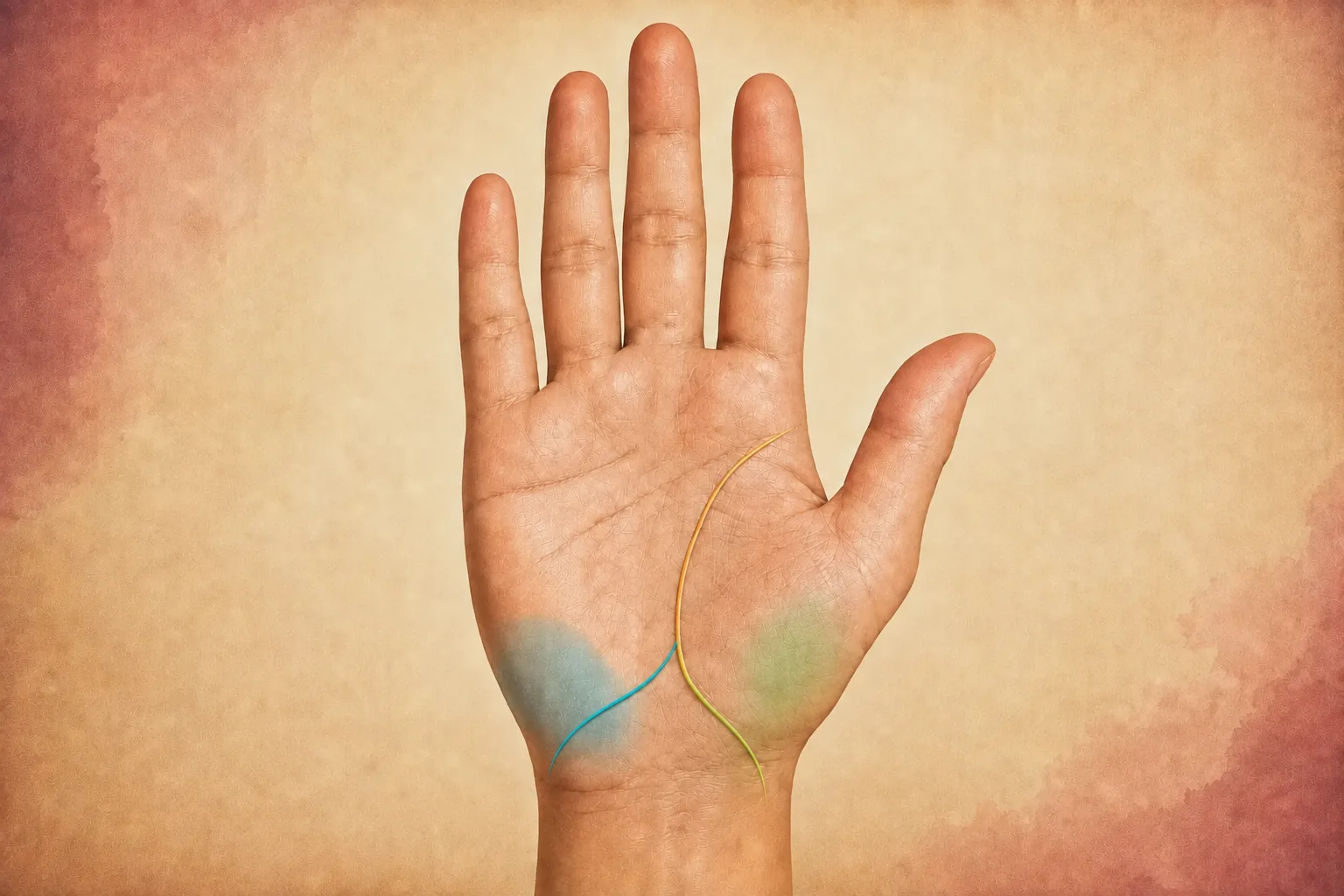
In traditional palmistry, a forked life line is one life-line parent that reaches a single junction and ends in two connected terminal prongs. A lower fork is commonly read as a later chapter divided between two places, cultures, homes, lifestyles, responsibilities, or directions. When one prong stays near the Mount of Venus and the other travels toward the Mount of Moon, palmists often emphasize the pull between familiar roots and a wider environment. It does not predict lifespan or guarantee emigration.
A terminal life-line fork becomes meaningful only after the complete parent arc, one final junction, exactly two connected prongs, their Venus and Moon destinations, relative strength, opening width, timing, travel signs, fate changes, and both hands are compared. A whole-hand reading can show how roots, family, movement, two homes, cultures, work, and direction share the later pattern.
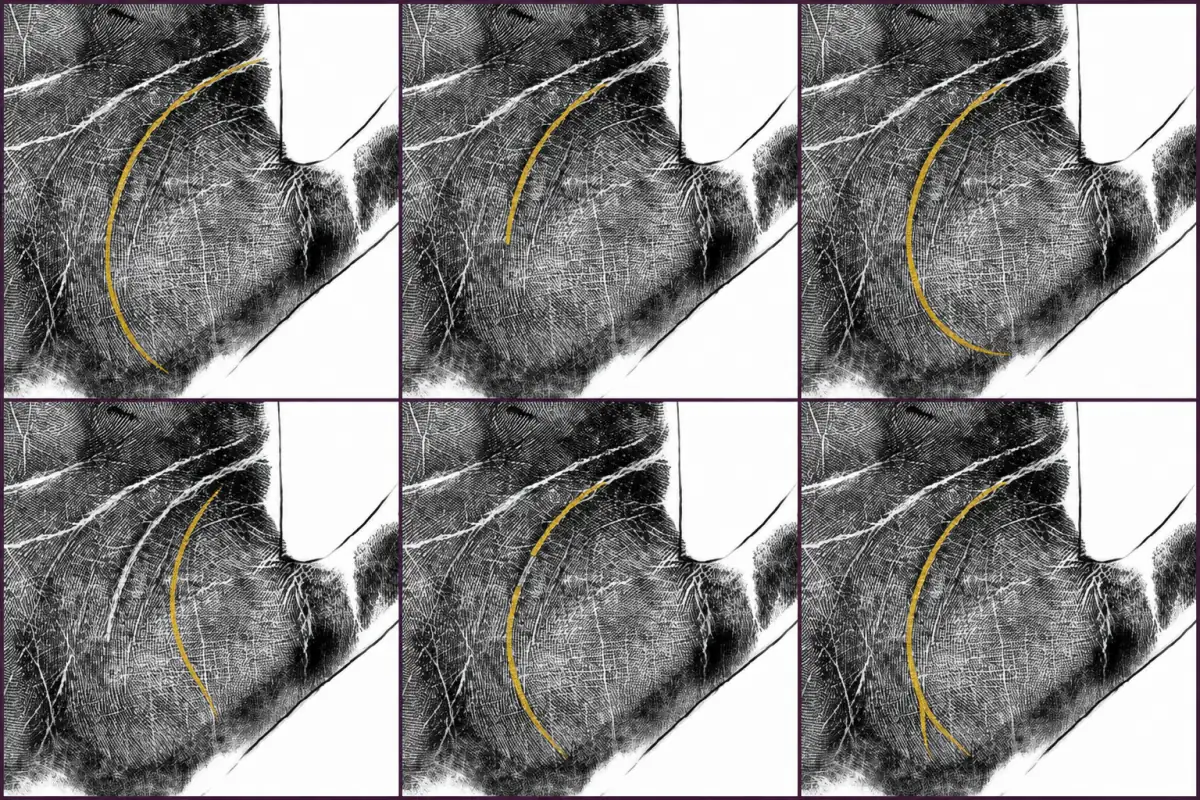
Use an eight-part terminal life-line-fork method: trace the complete parent, confirm one final junction, verify that no parent continues below it, follow both connected prongs, identify each destination, compare their depth and length, judge the opening width, estimate broad timing, and compare both hands. The parent describes the established life structure; the two endings show how that structure divides after the junction.
A terminal fork has exactly two endings
The life line must end at the shared Y-shaped junction. If one main route continues while a smaller route leaves its side, that is a branch. If open skin separates two sections, it is a break. If another line parallels the life line, it is a sister or Mars line. Classify the geometry before interpreting travel, change, or divided roots.
Where a life-line fork appears
The life line begins near the thumb-index web and curves around the Mount of Venus toward the wrist. Most photographed forks appear in the lower third of that arc. A higher split can refer to an earlier turning point, but the same structural test applies. The complete life-line guide maps the parent route before its ending is isolated.
| Part of the pattern | What to see | Reading role |
|---|---|---|
| Parent life line | One continuous arc before the junction | Established roots, energy, environment, and life structure |
| Terminal junction | One point where the parent stops and divides | Start of the two-route chapter |
| Venus-directed prong | Curves inward beside the thumb | Home, family, familiar roots, continuity, and close ties |
| Moon-directed prong | Sweeps outward across the lower palm | Travel, distance, cultural variety, imagination, and wider environment |
| Two endpoints | Each prong finishes separately | Shows how strongly the ending is divided |
How to verify a true terminal life-line fork
Start above the suspected split and trace downward. The parent should arrive at one shared junction, then become two routes. Neither route should remain obviously dominant as a continuing parent with a fine offshoot attached. Tilt the relaxed palm under side light and inspect the junction from more than one angle; lower-palm flexion creases can meet by chance and imitate a fork.
| Lookalike | Defining difference | Correct classification |
|---|---|---|
| True terminal fork | One parent ends in two connected prongs | Read both final directions |
| Moon-bound side branch | Parent continues clearly after one outward route leaves | Read a life-line branch to Moon |
| Upward or downward branch | Smaller line leaves a continuing parent before its end | Read direction and destination as a branch |
| Break with shifted restart | Open skin or overlap separates two parent sections | Read interruption and continuation |
| Sister life line | Second route runs parallel beside the main arc | Read reinforcement or support |
| Wrist crease crossing | Horizontal fold intersects the ending without sharing its route | Keep the bracelet line separate |
The general fork guide explains the shared-parent test across every major line. The Moon-branch guide owns the different pattern in which the life-line parent continues past the outward junction.
What each life-line fork direction means
Direction changes the subject of each prong. A Venus-directed ending stays close to the thumb pad traditionally associated with home, family, familiar surroundings, affection, physical engagement, and rootedness. A Moon-directed ending travels toward the lower outer palm associated with movement, distant environments, cultural exchange, responsiveness to place, imagination, and variety.
A fork with one Venus and one Moon prong does not force a choice between staying and leaving. It can describe two homes, a life shared between countries, frequent travel with a strong return base, family ties maintained across distance, work that alternates between locations, or a practical home life combined with a persistent need for a wider world. Ask how the routes coexist before deciding that one replaces the other.
| Fork direction | Traditional emphasis | Check next |
|---|---|---|
| Both prongs remain near Venus | Two close-rooted roles, family settings, or lifestyles | Separation, depth, and Venus influences |
| One prong toward Venus, one toward Moon | Roots and wider environments both matter | Relative strength and travel signs |
| Both prongs angle toward Moon | Variety, movement, distance, or several outside settings | Whether this is a true two-prong fork or feathering |
| One prong joins fate | One route connects lifestyle change with duty or direction | Fate-line destination and timing |
| One prong ends quickly | A secondary possibility or temporary parallel route | Whether the shorter prong is deep enough to count |
How fork width and prong strength change the reading
A narrow fork keeps the two routes close and may fit a modest change of setting, overlapping responsibilities, frequent travel, or two roles within one base. A wide fork separates the directions more strongly and can give greater weight to distant environments, dual residence, divided roots, or lifestyles that feel meaningfully different. Width measures separation of direction, not whether the change is good or bad.
Compare each prong's depth, clarity, length, and continuity with the parent. Two equally strong prongs give both directions similar weight. A stronger Venus prong keeps the rooted or familiar base dominant while the Moon route remains secondary. A stronger Moon prong shifts more emphasis toward movement or the wider environment. A faint extra thread may be a minor option rather than half of a major fork.
| Prong balance | Traditional synthesis | Reading limit |
|---|---|---|
| Equal, deep prongs | Two substantial environments or life routes coexist | Does not prove two countries |
| Venus prong stronger | Roots remain primary while movement adds variety | Travel may still be significant |
| Moon prong stronger | The outside environment gains greater later weight | Settlement still needs corroboration |
| One faint, short prong | A secondary choice, desire, or temporary route | Verify it is not skin texture |
| Both prongs fragmented | The divided chapter develops unevenly | Inspect support and later continuation |
Does a forked life line mean travel or living abroad?
A wide terminal fork that sends one prong toward Moon is a classic travel or relocation sign in many palmistry traditions. Its strongest safe reading is a pull toward more than one environment. Permanent foreign settlement becomes more plausible within that system when the Moon prong is long and strong, Moon travel lines repeat the theme, the fate line changes or receives a Moon influence around comparable timing, and both hands show supporting evidence.
A deep Venus prong can preserve the original base even when the Moon prong is strong. That pattern may fit living abroad while maintaining close family ties, returning regularly, holding property in two places, or belonging to two cultures. The travel and foreign-settlement guide combines the fork with Moon, fate, travel, and both-hand evidence before distinguishing a journey from a lasting move.
How to estimate the timing of a life-line fork
Palmists estimate timing from the shared junction, following the life-line arc from its upper origin toward the wrist. A split in the lower section is therefore read later than one near the upper or middle arc. Hands differ in proportion and printed scales disagree, so use a broad life chapter rather than an exact age.
Calibrate the parent against a known move, family transition, work change, or other dated turning point before estimating the fork. The junction marks when the two-route theme begins; prong length does not automatically measure how many years it lasts. Cross-check any fate-line shift or Moon travel line at a similar level. The timing guide explains proportional landmarks and calibration.
Forked life line on one hand or both
A comparable terminal fork on both palms gives the divided-root or two-environment theme more structural weight. A fork mainly on the active hand may show travel, relocation, or a dual lifestyle developed through choices and circumstances. If the less-active hand carries a strong fork but the active hand does not, the underlying pull toward variety or two bases may be expressed differently in present life.
Compare the junction level, opening width, Venus and Moon directions, prong strength, travel lines, fate changes, and parent quality. The routes do not need to be mirror images. The which-hand guide explains active and less-active comparison without relying on gender.
Forked life-line combinations
| Combination | Traditional synthesis | Verify next |
|---|---|---|
| Wide Venus–Moon fork + deep Moon travel lines | Movement or two environments gain repeated emphasis | Which lines meet and their timing |
| Moon prong + Moon-origin fate line | Wider surroundings may shape both lifestyle and direction | Saturn destination and line independence |
| Strong Venus prong + full firm Venus mount | Roots and close ties remain substantial | Family influences and thumb |
| Fork junction + fate-line shift | A change of base and responsibility may share one chapter | Fate restart, destination, and strength |
| Fork + sister life line before junction | Support or reserve accompanies the approach to change | Where the sister line starts and ends |
| Similar fork on both hands | Two settings or lifestyles recur across potential and lived pattern | Which prong becomes stronger actively |
Worked examples
A wide fork has equal Venus and Moon prongs
Both roots and the wider environment carry weight. The pattern may fit two homes, two cultures, extended movement with return, or genuinely divided later priorities. Fate and travel lines clarify how the split is lived.
The Moon prong is deep while the Venus prong is fine
The outward route is more strongly marked after the junction. A matching fate change and repeated sign on the active hand would strengthen a lasting relocation interpretation, while the fine Venus route preserves some continuing tie.
A fine Moon line leaves before the life line ends
If the parent remains clear after that junction and ends separately, this is a side branch rather than the terminal fork covered here. Read its destination and timing without converting it into two final life-line endings.
Photo checklist for a forked life line
- Photograph both full palms from fingertips through the wrist.
- Add one close image of the lower life-line ending.
- Keep the full Mounts of Venus and Moon visible together.
- Use soft side light across the shared junction.
- Relax the thumb so folds do not create a false prong.
- Trace one parent into exactly two connected endpoints.
- Check that no third parent route continues below the junction.
- Record fork width, both destinations, depth, length, and interruptions.
- State hand dominance and whether your question concerns travel, two homes, culture, family, or a life change.
Read both prongs inside the complete life pattern
A Full Palm Reading maps the life-line parent, exact terminal junction, both prong routes, Venus and Moon destinations, relative strength, width, timing, travel lines, fate changes, support signs, and both palms. It then adds the head, heart, Sun, and Mercury lines, mounts, thumb, fingers, shape, and texture into one holistic reading focused on your questions.
The complete answer
A forked life line is one parent ending in two connected terminal prongs. Traditional palmistry reads a Venus–Moon fork as two meaningful pulls: familiar roots and a wider environment. Fork width and relative prong strength show how separated and substantial those directions appear, while travel lines, fate changes, timing, and both hands determine whether the pattern fits travel, relocation, dual bases, two cultures, or a different division of lifestyle. It does not measure lifespan or guarantee settlement abroad. A Full Palm Reading maps the fork and every important feature across both palms and combines them into a holistic reading focused on your questions about home, family, travel, relocation, work, relationships, timing, purpose, and direction.
A Full Palm Reading
Ask how both life-line endings work together
Your reading maps the complete life-line parent, exact terminal junction, both prong routes, Venus and Moon destinations, relative strength, opening width, timing, travel lines, fate changes, support signs, and both palms, then adds the head, heart, Sun, and Mercury lines, mounts, thumb, fingers, shape, and texture into one holistic reading focused on your questions.
Your Full Palm Reading maps all the important features—hand shape, skin texture, thumb, fingers, mounts, major and minor lines, markings, and the differences between both palms—and brings them together in a holistic reading focused on your questions.