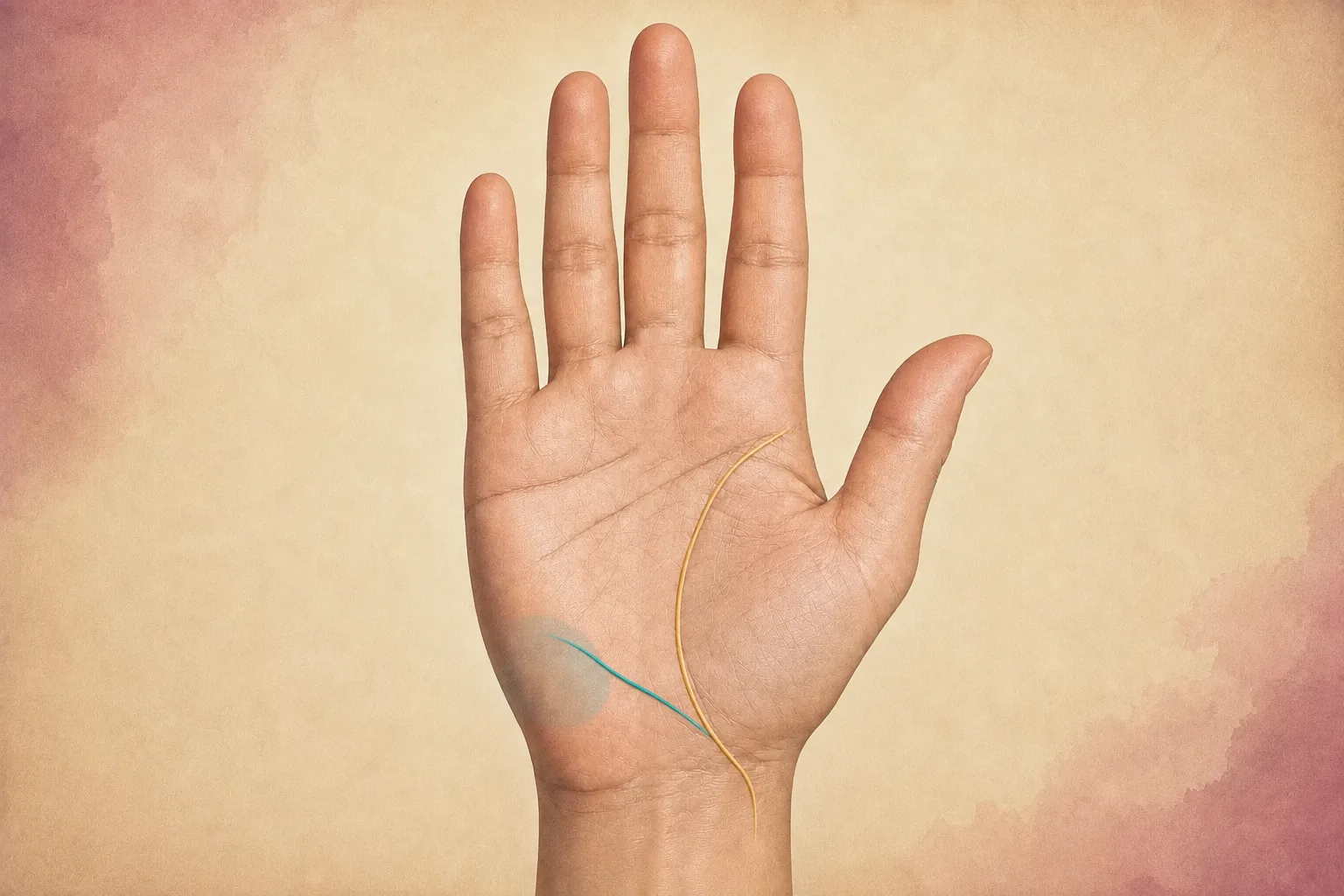
In traditional palmistry, a branch that leaves the life line and travels across the lower palm toward the Mount of Moon is read as energy moving toward travel, relocation, unfamiliar environments, cultural exchange, independence from established roots, imagination, or a wider life experience. The sign becomes more important when the branch is long, clear, deeply etched, reaches Moon cleanly, appears on both hands, and is supported by fate-line or travel-line changes. It is not automatic proof that you will move abroad or settle permanently.
A Moon-bound life-line branch becomes meaningful only after the complete parent arc, exact junction, full outward route, Moon endpoint, relative strength, travel lines, fate changes, timing, and both hands are compared. A whole-hand reading can show whether movement, relocation, dual bases, public contact, imagination, family roots, and direction belong to one chapter.
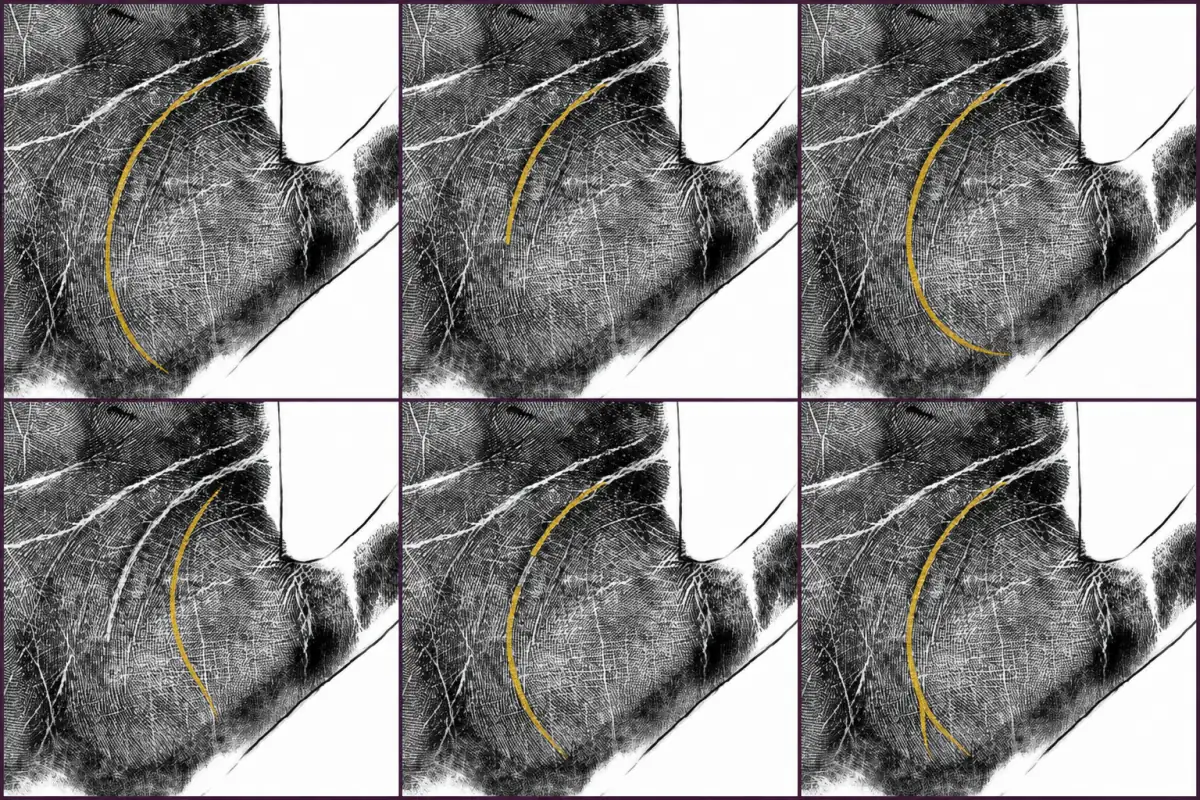
Use a nine-part Moon-branch method: trace the complete life-line parent, confirm that it continues past the junction, find the branch's exact origin, follow its whole route, verify a Moon destination, compare branch and parent strength, inspect supporting travel and fate features, estimate broad timing at the junction, and compare both hands. This sequence separates a genuine side branch from a terminal fork, ordinary Moon travel line, Moon-origin fate line, incoming influence, or sloping head line.
The direction must run from life line to Moon
Start at the life line and follow the smaller route outward. A true Moon-bound life-line branch shares one junction with the parent and ends in the lower outer palm opposite the thumb. The parent life line remains traceable after that junction. If the life line itself ends and divides into two competing routes, you are looking at a terminal fork instead.
Where to find a life-line branch to Moon
The life line begins near the thumb-index web and curves around the Mount of Venus toward the wrist. The Mount of Moon occupies the lower outer palm, opposite the thumb and above the wrist. A Moon-bound branch crosses the lower palm from the life-line arc toward that outer zone. The complete life-line guide helps you establish the parent arc, while the Moon mount guide defines the destination.
| Checkpoint | What you should see | Why it matters |
|---|---|---|
| Life-line origin | Branch begins from the curved parent around Venus | Confirms the source theme |
| Shared junction | One visible point connects branch and parent | Separates a branch from a crossing crease |
| Continuing parent | Life line remains traceable toward the wrist | Separates a side branch from a terminal fork |
| Outward route | Branch travels away from the thumb | Shows movement toward the outer palm |
| Moon endpoint | Line finishes in the lower outer mount | Names travel, environment, distance, and imagination as context |
Distinguish the Moon branch from similar lines
Many creases cross the lower palm, so source and destination matter more than resemblance. Use side light, relax the hand, and trace each candidate in both directions. A line that begins at the outer edge and moves inward is a Moon travel line. A route that begins on Moon and organizes upward toward Saturn is a Moon-origin fate line. A line that ends the life line rather than leaving it is a fork.
| Lookalike | Defining geometry | Correct reading task |
|---|---|---|
| Moon-bound life-line branch | Leaves life; parent continues; branch ends on Moon | Read the outward life chapter |
| Terminal life-line fork | Parent ends where two final prongs separate | Compare the strength and destination of both endings |
| Moon travel line | Begins at the outer edge or within Moon | Read the journey line independently |
| Fate line from Moon | Begins on Moon and rises toward Saturn | Read public or environmental influence on direction |
| Incoming influence line | Approaches life from Moon or Venus and joins it | Identify what enters the life-line period |
| Sloping head line or fork | Begins near the upper life-line area and crosses the middle palm | Read thinking style and Moon-directed imagination |
The life-line branches guide explains the parent-continuation test in more detail. The Moon-origin fate-line guide shows why a Saturn destination creates a different line even when both patterns involve Moon.
Traditional meaning of a branch from life line to Moon
The branch is traditionally read as part of the person's established life structure reaching toward a wider environment. It may fit a period of moving city or country, extended travel, living between places, study away from home, work with international or public contact, entry into a different culture, or a strong need for variety and distance. Because Moon also carries imagination and responsiveness to surroundings, the change can be psychological or creative as well as geographical.
The parent life line gives the baseline. If it stays clear after the junction, the outward chapter can coexist with a continuing home base, family tie, or stable inner reserve. If the branch becomes almost as strong as the parent, movement or the wider environment may become a major competing direction. If the parent weakens while the branch strengthens, attention shifts more decisively outward. Read the actual hand rather than treating every Moon route as the same story.
| Pattern | Traditional emphasis | Question to ask |
|---|---|---|
| Fine short branch enters upper Moon | Curiosity, a trip, wider contacts, or a temporary change | Does another line make the movement more substantial? |
| Long clear branch reaches lower Moon | Distance, relocation, repeated travel, or a changed environment | Does the route appear on both hands? |
| Branch and parent equally strong | Two meaningful bases, loyalties, or ways of living | Which route remains clearer later? |
| Branch strengthens as parent fades | Greater investment in the new environment | Do fate and travel lines support a lasting change? |
| Parent stays dominant | Travel or expansion without abandoning established roots | Does the branch end cleanly or return through another influence? |
Does it mean foreign travel or permanent settlement?
A Moon-bound life-line branch supports a travel or relocation interpretation, but one line cannot distinguish a holiday, temporary assignment, long stay, migration, dual residence, or permanent settlement with certainty. Its strongest claim is that movement away from familiar surroundings becomes a meaningful life theme around the junction period.
Settlement gains traditional weight when several independent features repeat the same story: a deep branch reaches lower Moon; the Moon route is stronger on the active hand; a clear Moon travel line meets or parallels it; the fate line changes, begins from Moon, or receives a Moon influence near the same level; the life line shifts its emphasis outward; and comparable signs appear on both hands. The travel and foreign-settlement guide owns that complete multi-feature question.
| Evidence | Supports travel | Adds settlement weight |
|---|---|---|
| Moon branch | Clear route from life toward Moon | Long, deep route reaching lower Moon |
| Life-line parent | Continues clearly after junction | Outward route becomes equal or stronger |
| Moon travel lines | One or more clear edge-origin routes | A strong route meets the branch or fate pattern |
| Fate line | Minor change around similar timing | Moon origin, Moon join, or clear shift after relocation |
| Both hands | Feature appears on the active hand | Comparable pattern repeats on both palms |
Return, dual-base, and settlement stories can also differ. A clear continuing life line around Venus preserves a strong root while the side branch explores Moon. A terminal fork with one Venus prong and one Moon prong is a different geometry and can describe two bases more directly. A branch that fades quickly after entering Moon carries less lasting weight than one that remains deep to its endpoint.
How line quality changes the interpretation
Depth shows emphasis, clarity shows how directly the theme is expressed, continuity shows whether the route develops without interruption, and length shows how fully it reaches the destination. Compare the branch with the parent rather than labeling it in isolation. A fine branch can mark an option, desire, short phase, or secondary route. A deep branch approaching parent strength deserves more attention.
Breaks, islands, crosses, or bars on the branch do not automatically predict danger during travel. They traditionally complicate the route through delay, uncertainty, competing obligations, or interrupted plans. A square or supporting parallel may be read as containment or assistance. Confirm every small mark under steady side light before using it; skin texture and photo glare often create false interruptions.
How to estimate timing from the branch junction
Palmists time the pattern from the point where the branch leaves the life line, moving from the upper origin toward the wrist. Because life-line arcs vary and published scales disagree, use a broad life chapter rather than promising an exact age. Calibrate the arc against one known move, study period, work transfer, family transition, or other dated change before estimating an unknown junction.
The junction marks when the outward theme becomes active; the endpoint does not automatically show how long the person stays away. If the branch meets a fate or travel line, compare their timing landmarks. The palmistry timing guide explains proportional mapping and why corroboration is stronger than a single printed age chart.
What the branch means on one hand or both
A comparable Moon-bound branch on both palms gives travel, cultural variety, or relocation more structural weight. When it appears mainly on the active hand, the outward direction may have developed through choices, work, relationships, opportunity, or a current need for change. When it is clearer on the less-active hand but reduced on the active hand, present life may be expressing the underlying desire through shorter travel, imagination, international contact, or another form of environmental variety.
Compare the exact junction, route, endpoint, depth, parent-line condition, fate changes, and Moon development across both hands. Do not demand mirror-image geometry. The which-hand guide explains active and less-active comparison without gender rules.
Life-line branch to Moon combinations
| Combination | Traditional synthesis | Verify next |
|---|---|---|
| Moon branch + clear Moon-origin fate line | A wider environment may reshape both lifestyle and direction | Whether the branch joins fate or stays separate |
| Moon branch + strong travel line meeting it | A particular journey gains life-changing weight | Exact meeting point and line quality |
| Moon branch + developed firm Moon mount | Travel, imagination, or responsiveness to place is emphasized | Head-line slope and mount texture |
| Moon branch + clear continuing life line | Expansion occurs alongside a retained base or reserve | Venus development and family influences |
| Moon branch + fate-line shift at similar level | Relocation and work redirection may belong to one chapter | Fate restart and destination |
| Moon branch on both hands | The outward theme is repeated across potential and lived pattern | Which hand carries the stronger route |
Worked examples
A deep branch reaches lower Moon while the life line stays strong
The hand combines a meaningful move, long-distance chapter, or wider environment with continuing roots and reserve. If fate and travel lines remain unchanged, call it important movement rather than automatic permanent settlement.
The Moon branch strengthens as the life line becomes faint
The outward route carries more of the pattern after the junction. A matching fate-line change and a repeated active-hand sign would strengthen a relocation or lasting change of base interpretation.
A line starts at the outer edge and touches the life line
Trace direction before naming it. This is an edge-origin Moon travel or influence line approaching the life line, not necessarily a branch leaving it. Its own origin, endpoint, and meeting point must be read.
Photo checklist for a Moon-bound life-line branch
- Photograph both full palms from wrist to fingertips.
- Add one closer image of the lower life-line arc and Moon mount.
- Keep the outer hand edge visible so edge-origin travel lines can be identified.
- Use soft side light to reveal the shared junction without glare.
- Relax the thumb and palm so flexion folds do not imitate a branch.
- Trace the life-line parent past the junction toward the wrist.
- Follow the suspected branch to its exact Moon endpoint.
- Record branch and parent depth, continuity, color, and nearby marks.
- State hand dominance and whether your question concerns travel, a move, a dual base, or settlement.
Read the branch inside your complete relocation pattern
A Full Palm Reading maps the complete life-line arc, the Moon-bound junction, branch route, destination, strength, timing, travel lines, fate-line changes, Moon and Venus development, supporting signs, and both palms. It then adds the head, heart, Sun, and Mercury lines, mounts, thumb, fingers, shape, and texture into one holistic reading focused on your questions.
The complete answer
A life-line branch that reaches the Mount of Moon traditionally points toward travel, relocation, cultural variety, a wider environment, or a life chapter that moves beyond familiar roots. Verify that the parent life line continues, follow the branch to Moon, compare its strength with the parent, inspect travel and fate features, estimate broad timing at the junction, and read both hands. Permanent settlement needs repeated support rather than one branch. A Full Palm Reading maps every important feature across both palms and brings them together into a holistic reading focused on your questions about travel, relocation, settlement, work, relationships, family, timing, purpose, and direction.
A Full Palm Reading
Ask how far the Moon branch carries your life pattern
Your reading maps the complete life-line arc, Moon-bound junction, branch route, destination, relative strength, timing, travel lines, fate-line changes, Moon and Venus development, supporting signs, and both palms, then adds the head, heart, Sun, and Mercury lines, mounts, thumb, fingers, shape, and texture into one holistic reading focused on your questions.
Your Full Palm Reading maps all the important features—hand shape, skin texture, thumb, fingers, mounts, major and minor lines, markings, and the differences between both palms—and brings them together in a holistic reading focused on your questions.