
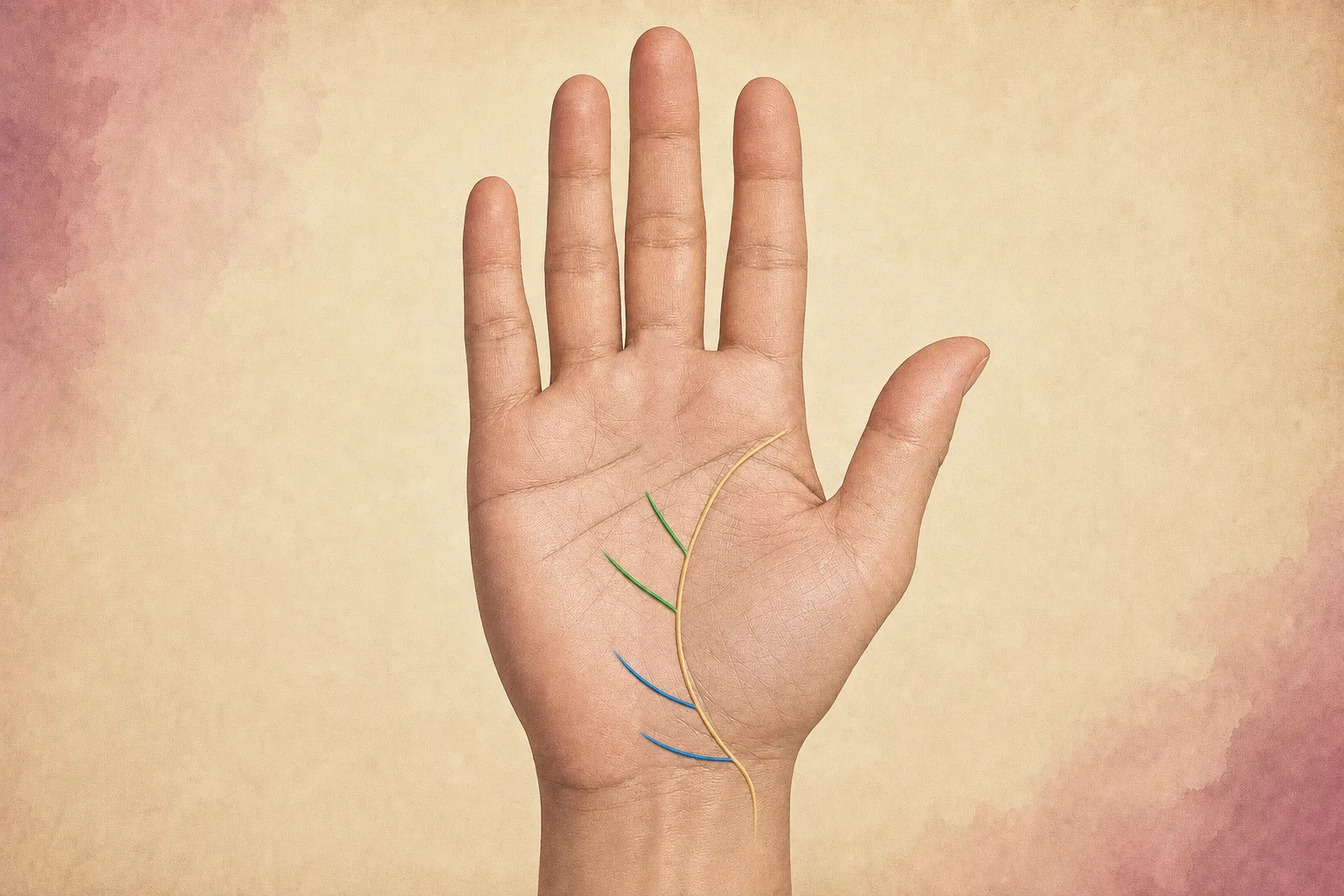
In traditional palmistry, an upward branch from the life line is usually read as energy directed toward growth, ambition, opportunity, recovery, or a new undertaking; a downward branch is read as energy being spent through pressure, divided priorities, fatigue, disappointment, or a demanding change. Direction alone is not the full answer. The branch's destination, depth, junction, timing, parent-line condition, supporting features, and appearance on both hands decide which theme fits.
A life-line branch becomes meaningful only after the complete parent arc, exact junction, upward or downward direction, destination mount, branch strength, parent-line condition, timing, support signs, and both hands are compared. A whole-hand reading can show how growth, ambition, opportunity, pressure, expenditure, recovery, travel, family, and direction fit together.
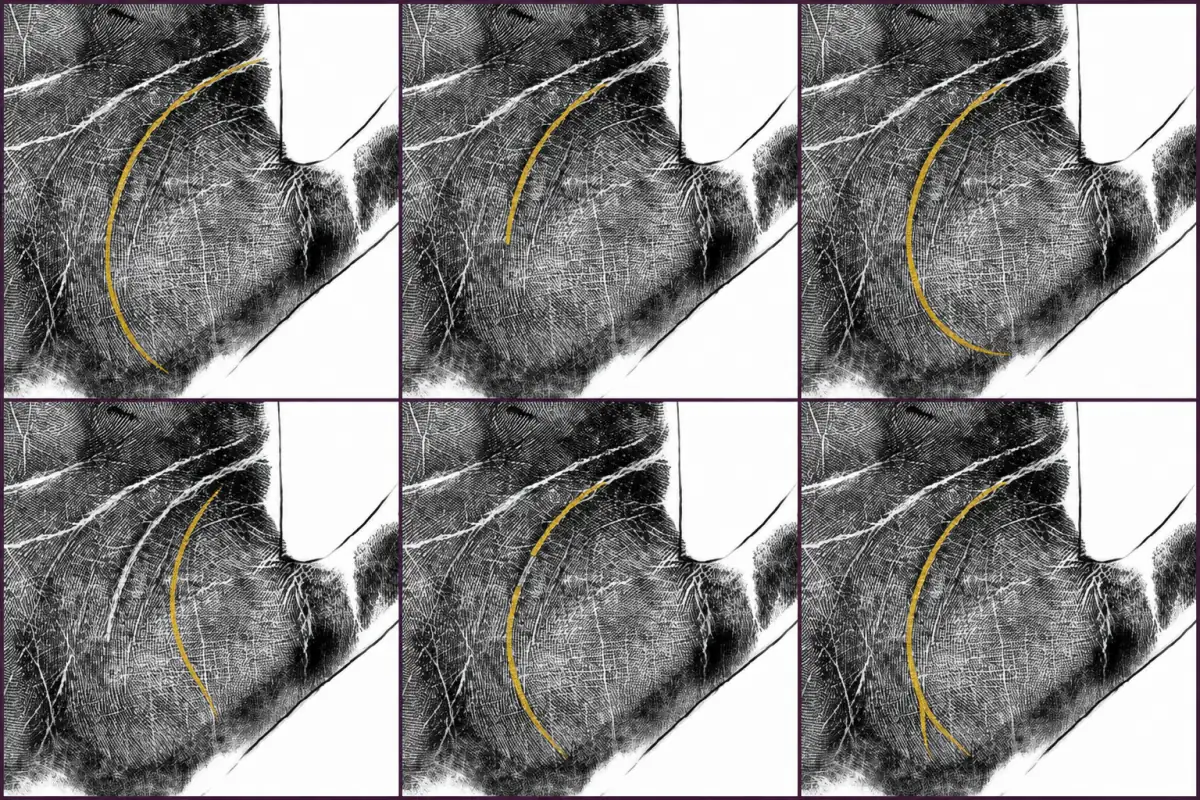
Use an eight-part life-line-branch method: trace the complete life-line parent, confirm it continues after the junction, locate the branch's exact start, classify its direction, follow it to a destination, compare branch and parent strength, estimate the junction's broad timing, and read both hands. A branch describes a secondary current leaving the life-line structure; it is not automatically a break, fork, travel line, fate line, or prediction of health.
The parent life line must continue
A true side branch leaves the life line while the main arc remains traceable beyond the junction. If the parent ends and two routes separate, that is a terminal fork. If open skin interrupts the arc, it is a break. If another line arrives and joins the life line, identify the incoming influence instead of reversing its direction.
Where branches appear on the life line
The life line begins near the thumb-index web and curves around the Mount of Venus toward the wrist. Branches can leave its upper, middle, or lower sections. “Upward” means the branch rises toward the fingers or upper mounts when the hand is held upright. “Downward” means it falls toward the wrist or lower outer palm. The complete life-line guide maps the parent arc before any side route is interpreted.
| Feature | What to see | Reading role |
|---|---|---|
| Parent life line | Continuous arc around Venus | Foundation, energy, environment, and life structure |
| Branch junction | One smaller route leaves the parent | Starting point of the secondary theme |
| Upward branch | Moves toward fingers or upper mounts | Effort, growth, aim, or outward development |
| Downward branch | Moves toward wrist or lower palm | Expenditure, pressure, dispersal, or release |
| Destination | Mount or major line reached by the branch | Names the subject of the branch |
How to verify a true life-line branch
Start on the life-line arc and trace through the suspected junction. The parent should continue and the smaller line should depart from it. Check the line from both directions: a route that can be followed from Moon, Venus, or a major line into the life line may be an influence joining the parent rather than a branch leaving it. Soft side light and a relaxed hand make the junction easier to classify.
| Pattern | How it differs | Classification |
|---|---|---|
| Parent continues; smaller route departs | One clear junction and independent endpoint | Life-line branch |
| Parent ends and divides into two | No single continuing main arc | Terminal fork |
| Gap interrupts the parent | Open skin separates sections | Break or restart |
| Fine Venus line approaches life | Route comes from inside the thumb pad | Influence joining the life line |
| Long vertical route aims at Saturn | Organizes toward the middle finger | Fate line or fate-line connection |
| Short unrelated crease crosses life | No shared starting direction | Crossing line |
The general branch guide explains parent-line geometry across the hand. This guide stays with life-line branches and the specific themes created by their upward or downward movement.
Meaning of upward branches from the life line
Upward branches are traditionally read as effort becoming constructive movement. They may coincide symbolically with greater independence, a demanding goal, education, promotion, enterprise, relocation for opportunity, restored momentum, or the confidence to act. The destination tells you what kind of development is being emphasized.
A fine upward line is a supporting tendency; a deep branch approaching the strength of the parent carries more weight. Several clean upward branches can show repeated phases of initiative. They do not guarantee money, status, or success, and they should not be counted as a score. Read whether the parent remains clear and whether the destination is supported elsewhere.
| Upward destination | Traditional theme | Confirm with |
|---|---|---|
| Jupiter below index finger | Ambition, leadership, study, or advancement | Jupiter mount, index finger, and head line |
| Saturn below middle finger | Responsibility, discipline, or a structured work path | Fate line and Saturn quality |
| Apollo below ring finger | Recognition, craft, visibility, or fulfillment | Sun line and Apollo mount |
| Mercury below little finger | Communication, commerce, teaching, or applied skill | Mercury line and little finger |
| Upper Mars | Assertiveness, persistence, or standing ground | Mars development and thumb |
Meaning of downward branches from the life line
Downward branches are traditionally associated with energy leaving the central base. This can describe effort spent on obligations, pressure, discouragement, divided attention, a draining environment, financial outlay, a long transition, or letting go of an old structure. A downward branch is not proof of illness, loss, or decline.
Look at the parent line after the junction. If it remains deep and clear, the demanding chapter may be contained while the larger foundation continues. If the parent also becomes faint, chained, or broken, the period carries more structural weight. Support lines, squares, a sister life line, strong thumb, and a clear head line can show resources available around the same section.
| Downward pattern | Traditional emphasis | Reading limit |
|---|---|---|
| Short fine downward branch | Temporary expenditure or a minor dip in momentum | Do not make it a major event |
| Deep branch; parent stays clear | A substantial demand alongside continuing stability | Destination is still needed |
| Several downward branches | Repeated drains, divided effort, or many obligations | Check whether they are skin texture |
| Branch toward lower Moon | Movement, distance, environment, or relocation may carry the energy outward | Read with travel features |
| Branch toward wrist | Release, withdrawal, or resources directed downward | Not a lifespan prediction |
Why the destination matters more than “good” or “bad”
An upward route to Jupiter and one to Mercury both rise, but one emphasizes aspiration and leadership while the other emphasizes communication or enterprise. A downward branch that ends quickly differs from one that reaches Moon and becomes part of a wider travel or relocation pattern. The mounts guide helps identify the area where each branch finishes.
Also inspect whether the branch crosses the head or fate line, receives another influence, forms a triangle, or ends in a mark. The branch's direction names movement; its destination and connections name the subject. A whole-hand reading should synthesize both.
How to time a life-line branch
Palmists estimate timing from the branch junction on the life-line arc, moving from the upper origin toward the wrist. Because hands differ in length and curve and timing systems disagree, use a broad chapter rather than an exact age. Calibrate the scale with a known move, study period, job change, family duty, or recovery point before estimating an unknown branch.
The junction gives the approximate start; the branch length does not automatically show duration. A change in the parent line before or after the junction can widen the window. The palmistry timing guide explains proportional landmarks and cross-checking without invented precision.
Life-line branches on one hand or both
A similar branch at a comparable level on both palms gives the theme more structural weight. An upward branch appearing only on the active hand may show initiative or opportunity developed through lived choices. A downward branch appearing only there may reflect current pressure, a demanding commitment, or changed use of energy. If the less-active hand contains the branch but the active hand does not, present habits may have redirected the underlying tendency.
Compare the junction, direction, destination, strength, parent-line quality, and nearby support. The which-hand guide explains active and less-active comparison without using gender rules.
Life-line branch combinations
| Combination | Traditional synthesis | Read with |
|---|---|---|
| Jupiter branch + firm flexible thumb | Ambition gains will, judgment, and adaptability | Index finger and head line |
| Apollo branch + clear Sun line | Effort may support visible work or fulfillment | Apollo timing and line quality |
| Mercury branch + strong Mercury | Communication, business, or applied skill develops | Little finger and Mercury line |
| Downward branch + sister life line | A demanding period is accompanied by reserve or support | Parallel support-line timing |
| Downward branch + fate-line break | Pressure and a change of responsibility coincide | Restart and destination |
| Several clean upward branches | Repeated effort or openings build across different chapters | Each destination separately |
The major life-change guide shows how a branch gains credibility when fate, head, Sun, Moon, and both hands repeat the same transition.
Worked examples
A strong upward branch reaches Jupiter while the life line stays clear
The parent foundation continues while effort rises toward ambition, leadership, education, or advancement. Jupiter development and a firm flexible thumb help identify how the opportunity may be pursued.
A downward branch appears but a sister life line parallels the same section
The branch can mark pressure or expenditure, while the parallel support route suggests reserve, protection, or help around the same chapter. Neither line cancels the other.
A fine line from Venus joins the life line and looks upward
Trace it back to its source. If it begins inside Venus and approaches the life line, it is an incoming influence rather than an upward branch leaving the parent.
Photo checklist for life-line branches
- Photograph both full palms from wrist to fingertips.
- Keep the complete life-line arc and destination mounts visible.
- Use soft side light across each suspected junction.
- Relax the hand so folds do not create false branches.
- Trace the parent beyond the junction before classifying the line.
- Follow every branch to its actual endpoint.
- Record branch and parent depth, clarity, and nearby changes.
- State hand dominance and the growth, pressure, work, or relocation question you want explored.
Read each branch inside your complete life pattern
A Full Palm Reading maps the complete life-line arc, each branch junction, upward or downward direction, destination mount, strength, timing, parent-line condition, support signs, and both palms. It then adds the fate, head, heart, Sun, and Mercury lines, mounts, thumb, fingers, shape, and texture into one holistic reading focused on your questions.
The complete answer
Upward branches from the life line traditionally show energy directed toward growth, effort, opportunity, recovery, or outward aims. Downward branches can show energy spent through pressure, divided priorities, demanding transitions, or release. Verify that the parent continues, then read each junction, direction, destination, relative strength, timing, combinations, and both hands. A Full Palm Reading maps these branches and all important features across both palms and combines them into a holistic reading focused on your questions about work, ambition, money, family, travel, pressure, recovery, timing, purpose, and direction.
A Full Palm Reading
Ask where each life-line branch directs your energy
Your reading maps the complete life-line arc, every branch junction, upward or downward direction, destination mount, relative strength, timing, parent-line condition, support signs, and both palms, then adds the fate, head, heart, Sun, and Mercury lines, mounts, thumb, fingers, shape, and texture into one holistic reading focused on your questions.
Your Full Palm Reading maps all the important features—hand shape, skin texture, thumb, fingers, mounts, major and minor lines, markings, and the differences between both palms—and brings them together in a holistic reading focused on your questions.