
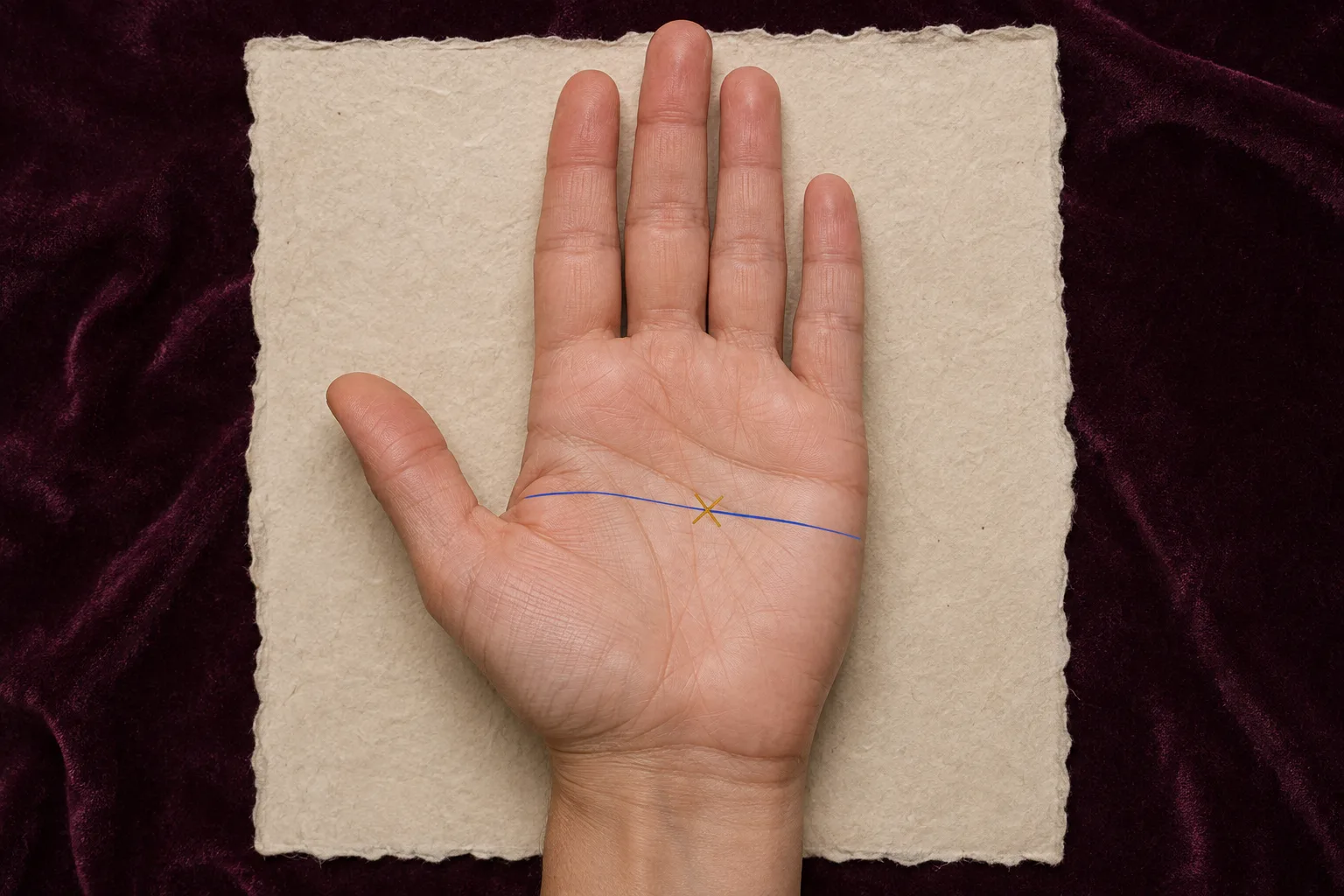
A cross on the Head line is a compact X made by two short strokes whose central intersection sits directly on a verified Head-line parent. Traditional palmistry uses it to explore a concentrated decision, conflict, interruption, competing idea, or change in mental direction at that part of the line. It does not diagnose a neurological or mental-health condition, prove injury, rank intelligence, or predict permanent confusion. Verify the X, each arm, exact position, Head-line direction, clarity before and after, Life-line start, Mercury, Mars, Fate, real decisions, timing, and both palms.
A cross on the Head line becomes personal only after the complete Head-line parent, exactly two short intersecting strokes, central contact, arm origins, mount position, straight or Moonward direction, clarity before and after, cutting-line, Fate-crossing, Mystic-Cross, star, branch, break, island, triangle and texture tests, Life-line start, Mercury, Mars, Fate, Heart, timing, real choices, and both palms are compared. A whole-hand reading can show how judgment, learning, communication, responsibility, values, and direction work together.
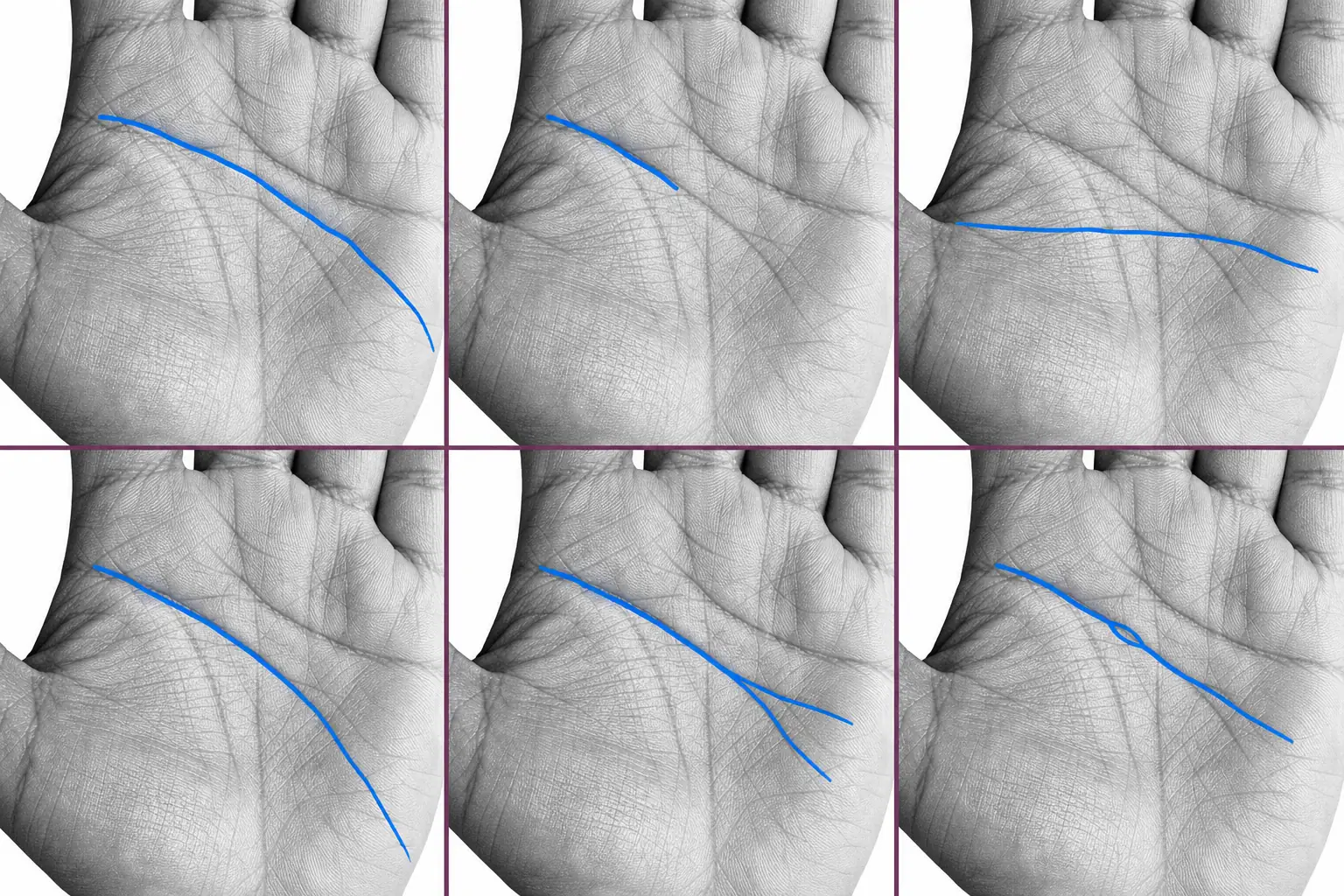
The Head line begins near the thumb-index side and travels across the middle of the palm toward Mars or Moon. It describes how thought is organized and expressed in traditional practice: practical sequence, imagination, concentration, judgment, learning, and decisions. A cross is one local marking within that route, not a summary of the mind.
How to identify a true cross on the Head line
Trace the parent with the complete Head-line guide. Vertical Fate and Mercury routes, influence lines, branches, and random creases frequently cross this area. One crossing line does not make a separate X.
- Trace one Head-line parent from the thumb-index side to its true endpoint.
- Find two short strokes that intersect rather than merely meet.
- Confirm one central intersection with four visible arms.
- Place the center on the Head line, not in the open quadrangle above it.
- Trace each arm to exclude a longer Fate, Mercury, or influence line.
- Mark the position under Jupiter, Saturn, Apollo, Mercury, or toward Moon.
- Record Head-line direction as straight, gently sloping, or deeply Moonward.
- Inspect the route before and after for clarity, break, island, chain, fork, or branch.
- Check the Life-line start, Mars, Mercury, and Fate for context.
- Compare both palms under matched light.
This is the ten-part Head-line-cross method: parent, two strokes, center, contact, arm origins, position, direction, continuation, support, and both palms. An independent X between Head and Heart belongs to the Mystic Cross guide.
Cross, one cutting line, Mystic Cross, star, branch, break, or island?
| Formation | What to trace | Why it differs |
|---|---|---|
| Cross on Head line | Two short strokes intersect at one center touching the Head-line parent | A compact four-armed X at one point |
| One cutting influence | A single longer line passes across Head | No second short stroke creates an independent X |
| Mystic Cross | An independent X sits between Head and Heart, usually near Saturn | Its center does not sit on Head |
| Fate crossing | One Saturn-bound vertical route crosses Head | The intersection is part of the Fate-line architecture |
| Star | At least three strokes converge at one compact center | Six or more arms rather than four |
| Branch | One stroke grows from a shared junction on Head | It does not cross through another short stroke |
| Break | Related Head-line segments sit around empty skin | The parent stops instead of being crossed |
| Island | The parent splits, encloses one space, and reunites | A closed oval rather than a central intersection |
Use the broken Head-line guide for genuine empty skin and the Head-line island guide for a closed split and reunion.
What a cross on the Head line traditionally means
A compact X concentrates a Head-line theme at one point. Traditional readers explore a difficult choice, conflicting plans, a strong challenge to an existing belief, an interruption in study or work, divided judgment, or a period that changes how the person thinks. The cross may mark a demanding chapter, but the line after it shows whether the method becomes clearer, changes direction, or remains unsettled.
The mark cannot identify a cause. An X near a Fate connection may involve work or responsibility; an arm from Venus can bring family or close influence into the decision; an outer-palm arm can involve environment, imagination, or travel. Trace those routes before naming the issue.
A cross is not proof of brain injury, depression, anxiety, memory loss, learning disability, or low intelligence. Palm creases cannot diagnose a condition. If a real symptom or injury is involved, its evidence belongs outside palmistry. Within the traditional reading, stay with observable choices, workloads, thinking habits, and what changes after the mark.
| Common claim | What the mark establishes | Better reading question |
|---|---|---|
| “It means head injury” | Only two short strokes intersect on a crease | What real event or evidence is actually known? |
| “It means mental illness” | No diagnosis follows from palm geometry | Which decision, demand, or thought conflict fits? |
| “It means low intelligence” | Ability cannot be ranked by one mark | How does the complete Head line organize information? |
| “It means permanent confusion” | The X occupies one local point | How clear is the continuing route? |
| “It is a Mystic Cross” | Address decides the formation | Does its center sit on Head or above it? |
How a straight or sloping Head line changes the reading
Direction describes the wider thinking style surrounding the cross. A relatively straight Head line traditionally emphasizes practical sequence, concrete planning, and direct evaluation. A Moonward line adds imagination, synthesis, empathy, and associative thinking. Neither direction is superior.
- Cross on a straight route: explore a practical conflict, plan, calculation, or competing obligation.
- Cross on a gently sloping route: practical and imaginative considerations may pull together or apart.
- Cross on a deep Moonward route: creative direction, uncertainty, meaning, or emotional imagery may shape the choice.
- Direction changes after the X: the decision may alter how problems are approached.
- Fork follows the X: two valid perspectives or methods remain available afterward.
What the cross's position changes
| Position on Head line | Traditional focus | Question to test |
|---|---|---|
| Near the Life-line start | Early caution, family framework, independence, first major choices | Whose expectations shaped the decision? |
| Under Jupiter | Ambition, education, leadership, standards, confidence | Which goal or standard created the conflict? |
| Under Saturn | Responsibility, work, consequence, discipline, realism | Which duty or risk had to be weighed? |
| Under Apollo | Expression, recognition, creative judgment, audience | What choice affected visible output? |
| Under Mercury | Communication, analysis, business, negotiation | Which message or agreement needed clarity? |
| Toward Moon | Imagination, environment, travel, empathy, inner narrative | Which possibility or feeling changed the plan? |
Mount zones overlap, and hand proportions vary. Treat location as a domain clue, then verify it against real choices and connected lines.
What the Head line after the cross changes
The outgoing section answers whether the X is one contained point or part of a wider change.
- Clear continuation: a difficult decision or interruption is followed by coherent thinking.
- Deeper continuation: judgment or commitment may consolidate after the conflict.
- Fainter continuation: the later approach may be quieter, more tentative, or still under demand.
- Shifted restart: the cross and a genuine break describe a larger change of method.
- Island after the cross: one concentrated issue is followed by a bounded period of divided attention.
- Chain after the cross: one decision point is followed by a longer variable processing rhythm.
- Upward branch: ambition, practical engagement, or confidence may rise.
- Moonward branch: imagination or a different perspective gains weight.
The chained Head-line guide owns repeated linked loops rather than one X.
What Life, Fate, Mercury, Mars, and Heart add
The Head and Life lines may begin joined or separate. A joined start adds deliberation and environmental awareness; a separate start adds independent initiative. This start condition frames the broader style but does not cancel the cross.
Fate connects the decision to structure, duty, or work when its route genuinely reaches Saturn. Mercury adds communication, analysis, and exchange. Mars adds assertion, stamina in conflict, and practical courage. Heart adds values and emotional considerations. Read these features as a system.
| Supporting feature | Traditional contribution | What to verify |
|---|---|---|
| Joined Life-line start | Caution, consultation, or context precedes action | Length and clarity of the shared start |
| Separate Life-line start | Independent judgment and faster initiation | A real gap rather than faint joining skin |
| Clear Fate line | Work or responsibility gives the decision structure | Trace the route to Saturn |
| Balanced Mercury | Communication or analysis can resolve competing information | Mount, finger, lines, and behavior together |
| Firm Mars areas | Persistence and constructive assertion under pressure | Whole-hand firmness and actual response |
| Clear Heart line | Values and feelings add context without overwhelming judgment | Endpoint, curve, quality, and behavior |
How to time a Head-line cross
Head-line timing is proportional. The thumb-side start is earlier and the outer endpoint is later, but line length and direction vary. Use the X center as one broad landmark, compare Fate and mount position, and calibrate with a known decision or study, work, communication, or direction change.
- Trace the complete Head-line route.
- Confirm the two-stroke X and its center.
- Place the center proportionally from start to endpoint.
- Add the mount zone and any genuine Fate crossing.
- Compare the route before and after.
- Calibrate with known choices rather than forcing a match.
- Compare the other palm and report a broad phase.
The timing guide explains the method. A cross cannot supply an exact date for an injury, diagnosis, exam, job, breakup, or other event.
What the cross means in one hand or both
Photograph both palms identically and state dominance. A common modern convention reads the less-active hand as background and the active hand as current development. Compare the same proportional area, not just two X shapes in different places.
- Similar cross in both palms: the concentrated decision theme repeats strongly.
- Cross mainly in the active hand: current choices or demands may be shaping it.
- Cross mainly in the less-active hand: a background conflict may be handled differently now.
- Clearer active continuation: present judgment or method may be more settled.
- Different positions: read separate themes before proposing one event.
Five worked examples
1. Cross under Saturn with a clear continuation
A compact X touches Head below the middle finger, and the line remains strong toward the outer palm. Traditional synthesis explores a consequential work or responsibility decision followed by coherent judgment.
2. Apparent X made by the Fate line
One vertical arm continues from the wrist to Saturn. This is primarily a Fate crossing, not an independent cross. Read how work structure meets a decision, then inspect for a second truly separate short stroke.
3. Cross on a straight Head line with strong Mercury
The route stays level, one X appears under Apollo-Mercury, and the little finger and Mercury mount are balanced. A negotiation, message, system, or commercial choice may fit better than a vague mental-crisis reading.
4. Cross followed by a Moonward fork
After the X, the parent divides into a level arm and a descending arm. A concentrated decision may open two methods: practical sequence and imaginative synthesis. Confirm a shared fork junction.
5. Cross in one palm and Mystic Cross in the other
The active hand has an X centered on Head; the less-active hand has an independent X clearly above Head. These are different formations and must not be matched simply because both look like an X.
Photo checklist for a Head-line cross
- Capture the whole palm from wrist to fingertips.
- Keep the Head line, Heart line, Life-line start, mounts, and vertical routes visible.
- Use bright indirect light and one side-lit close-up.
- Trace the complete Head-line parent before marking the X.
- Confirm exactly two short strokes and one central intersection.
- Trace every arm to exclude Fate, Mercury, and influence lines.
- Record direction and clarity before and after the center.
- Separate Mystic Cross, star, branch, break, island, triangle, and random texture.
- Keep one unmarked original and annotate only a duplicate.
- Photograph both palms at the same distance and exposure.
Frequently asked questions
Does a cross on the Head line mean brain injury?
No. A palm crease cannot predict or diagnose injury. Traditional reading explores a concentrated decision, conflict, interruption, or change in thinking.
Does it mean mental illness?
No diagnosis follows from a cross. Use real symptoms and qualified care for health questions, and keep the palm reading focused on decisions and habits.
Does it mean low intelligence?
No. Intelligence cannot be ranked from one line or marking. Direction, quality, supporting features, actual skills, and both hands create a fuller picture.
Is it a Mystic Cross?
Only if the X is independent in the quadrangle between Head and Heart. If its center sits on the Head line, use this line-specific reading.
What if the Head line is clear after the X?
A strong continuation traditionally suggests coherent judgment or method after a concentrated challenge or choice.
What if one arm is the Fate line?
Treat it primarily as a Fate-Head crossing. Trace the vertical route to Saturn and check whether a second independent short stroke truly creates an X.
Can the cross show an exact age?
No. Use proportional placement, known decisions, support features, and both hands to describe a broad phase.
Can the cross change?
Fine-line visibility varies with light, skin condition, pressure, and camera angle. Compare matched dated photographs before deciding its geometry changed.
The complete answer
A cross on the Head line is one compact X made by two short strokes whose center touches a verified Head-line parent. Traditional palmistry associates it with a concentrated decision, conflict, interruption, competing idea, or change in mental direction, not injury, illness, low intelligence, or permanent confusion. Verify the parent, two strokes, central intersection, exact contact, arm origins, mount position, line direction, and continuation against one cutting influence, Fate crossing, Mystic Cross, star, branch, break, island, triangle, and random texture. Then add the Life-line start, Mercury, Mars, Fate, Heart, forks, broad timing, real choices, and both palms. A Full Palm Reading maps all important features across both hands and combines them into a holistic reading focused on your questions about decisions, work, communication, learning, direction, timing, and what becomes clearer afterward.
A Full Palm Reading
Ask how your Head-line cross fits your complete decision pattern
Your reading maps the complete Head-line parent, exactly two short intersecting strokes, central contact, arm origins, mount position, straight or Moonward direction, clarity before and after, cutting-line, Fate-crossing, Mystic-Cross, star, branch, break, island, triangle and texture tests, Life-line start, Mercury, Mars, Fate, Heart, timing, real choices, and both palms, then adds every other important line, mount, finger, marking, shape, and texture into one holistic reading focused on your questions.
Your Full Palm Reading maps all the important features—hand shape, skin texture, thumb, fingers, mounts, major and minor lines, markings, and the differences between both palms—and brings them together in a holistic reading focused on your questions.