
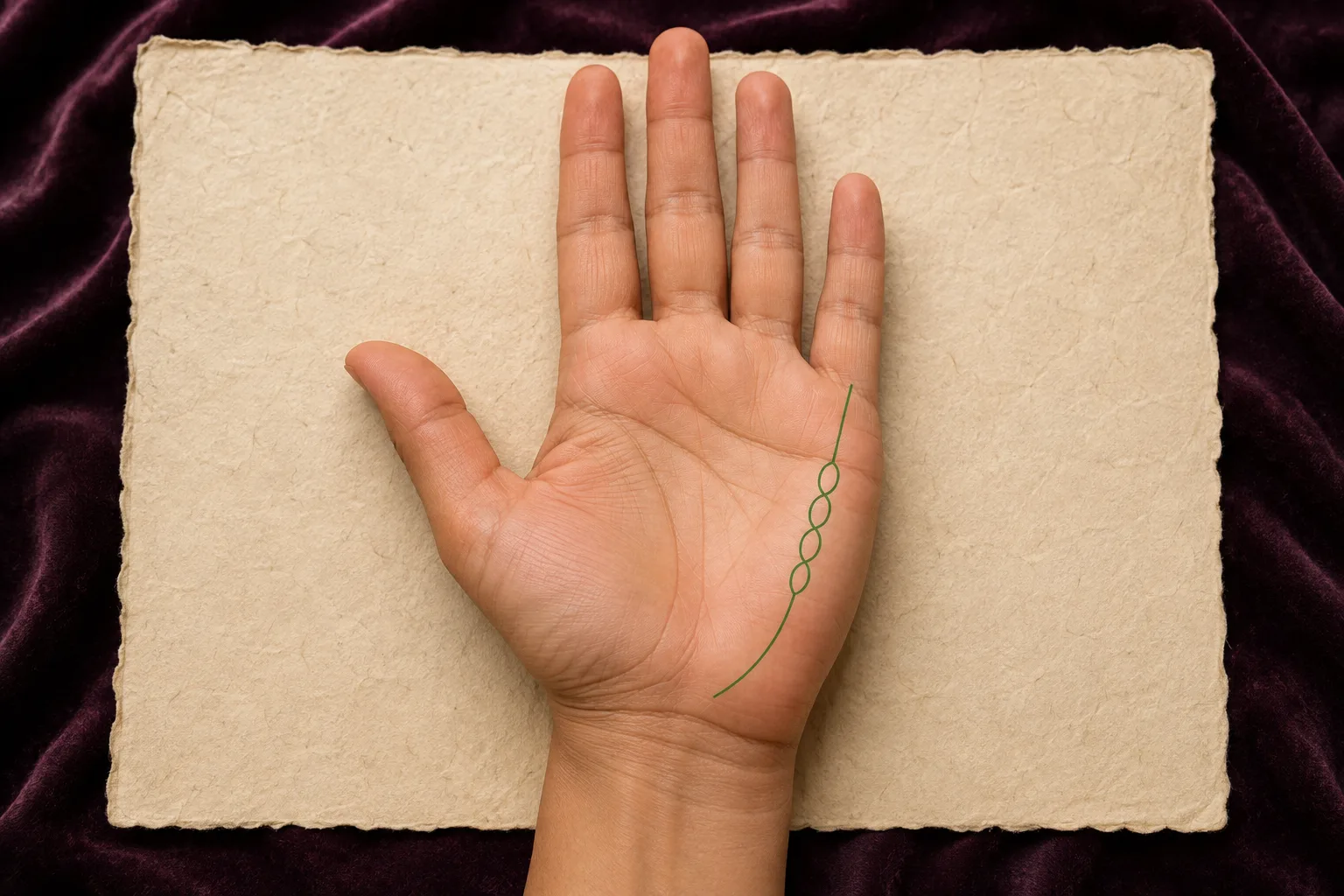
A chained Mercury line contains several adjacent closed loops made when one verified Mercury-bound parent repeatedly divides and rejoins on its way toward the mount below the little finger. Traditional palmistry reads the chained span as a variable rhythm in communication, business, organization, practical judgment, or nervous pace. It does not diagnose illness, prove dishonesty, predict business failure, or measure lifespan. First prove the line and the repeated geometry; then add the affected span, clear sections, Head, little finger, Mercury mount, Fate, Sun, Heart, real habits, timing, and both palms.
A chained Mercury line becomes personal only after the true Mercury-bound parent, repeated linked-loop geometry, affected span, depth, clear sections, island, wave, break, crossing, Fate, Sun, grille and weak-line tests, Head, little finger, Mercury mount, Fate, Sun, Heart, timing, communication, business, organization, real habits, and both palms are compared. A whole-hand reading can show how communication, practical intelligence, work structure, audience, sensitivity, and pace work together.
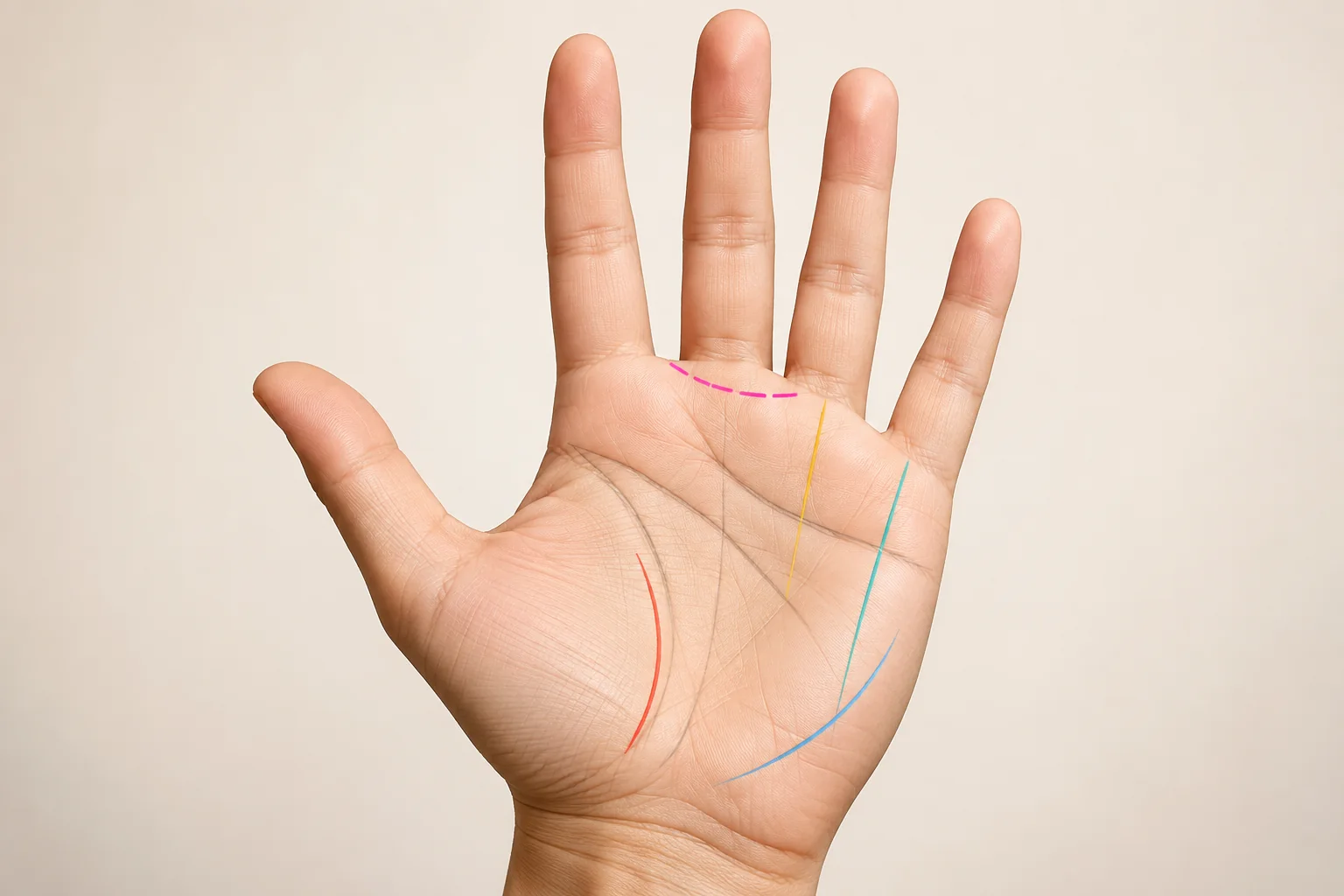
The Mercury line is also called the line of Mercury and, in older palmistry, the Health line or hepatic line. Its direction matters more than its label: it normally rises from the lower outer palm toward Mercury below the little finger. Some hands have no distinct Mercury line. A chain is texture within one route, not a count of jobs, illnesses, lies, or stressful events.
How to identify a true chained Mercury line
Start with the complete Mercury-line guide. A close crop can make unrelated fine creases look connected, so trace the whole route before naming its texture.
- Locate Mercury on the outer upper palm below the little finger.
- Trace one parent from the lower outer palm toward that mount.
- Find the first split into two connected sides.
- Confirm the reunion that closes the first loop.
- Trace repetition through at least one adjacent closed loop.
- Mark the affected span from first split to final reunion.
- Trace clear sections before and after the chain.
- Place Head and Heart as broad sequence landmarks.
- Exclude nearby routes including Fate, Sun, waves, breaks, crossings, and grille texture.
- Compare both palms under the same light and hand position.
This is the ten-part chained-Mercury-line method: Mercury target, parent, first split, first reunion, repetition, affected span, continuation, major-line position, nearby-route exclusion, and both palms. One closed oval belongs to the island guide; it is not a chain.
Chain, one island, wave, break, crossings, or another vertical line?
| Formation | What to trace | Why it differs |
|---|---|---|
| Chained Mercury line | One Mercury-bound parent repeatedly splits and rejoins into linked closed loops | An extended repeated texture within one route |
| One island | One split, one enclosure, one reunion | A single bounded formation |
| Wavy Mercury line | One route bends repeatedly without enclosing space | Direction changes, but the curves stay open |
| Broken line | Related segments sit around genuinely empty skin | No connected sides or closed loops |
| Crossed texture | Independent creases make eye-like shapes across a parent | The crossing lines do not become the parent's sides |
| Fate line | A central route rises toward Saturn below the middle finger | Different destination and subject |
| Sun line | A route rises toward Apollo below the ring finger | Different destination and subject |
| Mercury grille | Several independent vertical and horizontal strokes form a mesh | No single parent makes every enclosure |
Rotate the whole-hand photograph until the fingers are naturally vertical, then trace the endpoint. The broken-lines guide owns a true empty gap, while the general chain guide helps when the parent line remains uncertain.
What a chained Mercury line traditionally means
Mercury brings together language, exchange, practical intelligence, commerce, analysis, adaptation, and coordination. Traditional readers associate a chained section with these capacities moving in an uneven or highly responsive rhythm. Communication may be fluent in one setting and effortful in another. Work may involve repeated revisions, interruptions, switching between people, or several small operational demands. Organization may improve when the person has a clear system and scatter when too many channels compete.
The mark does not prove that someone lies, manipulates, lacks business ability, or will lose money. Nor does it say that a person is always anxious. Ask what happens during the affected span: rapid context switching, overexplaining, inconsistent follow-through, changing commercial priorities, a busy service role, or sensitivity to environment. Then look at the clean line before and after. A short chain between strong sections describes a contained variable phase; chaining across most of the route suggests a more persistent style that benefits from deliberate structure.
Why “Health line” is a historical name, not a diagnosis
Older palmistry texts often call the Mercury line the Health line because they associated Mercury with digestion, nerves, and the way strain is processed. That historical name still appears in searches, but a palm crease cannot identify a disease, organ problem, mental-health condition, or medical cause. Skin hydration, work, age, lighting, pressure, and camera angle can also change how fine loops appear.
For a useful palmistry reading, translate the old label into observable questions about pace and regulation. Does communication become rushed when the schedule is crowded? Do sleep, breaks, workload, and information volume change concentration? Does a checklist improve follow-through? Treat symptoms through ordinary professional care; use the palm pattern as a reflective prompt about habits and demands.
| Claim | What the crease can support | Better next question |
|---|---|---|
| “It means poor health” | No diagnosis follows from a palm line | Which routines and demands change your usable pace? |
| “It means anxiety” | Traditional language may describe sensitivity or variable rhythm | When does communication feel settled or overloaded? |
| “It means business loss” | No financial outcome is guaranteed | Which system, agreement, or follow-up needs clarity? |
| “It means dishonesty” | Character cannot be proved by crease texture | What does real behavior show about reliability? |
| “It shortens life” | Mercury-line length does not measure lifespan | What practical question are you trying to answer? |
What the chain's location changes
Use location as sequence, not a fixed event code. A Mercury line may start from different places, so Head and Heart are more reliable shared landmarks than an exact age chart.
| Chained span | Traditional focus | Useful question |
|---|---|---|
| Lower outer palm | Early routines, sensitivity to surroundings, emerging practical skill, or changing pace | Which setting helps you settle into a working rhythm? |
| Below the Head line | Execution, logistics, learning by doing, and repeated adjustment | Where would a simpler system reduce switching? |
| Around the Head line | Decisions, analysis, language, study, or information load | Which decision or message needs one clear next step? |
| Between Head and Heart | Established work, clients, coordination, commerce, or divided demands | Which responsibility or channel fragments attention? |
| Around the Heart line | Values, relationships, audience response, and expression interact | Does emotional context change how directly you communicate? |
| Upper Mercury mount | Later mastery, advising, teaching, negotiation, or public communication | Does the line truly remain one parent near its endpoint? |
What the Mercury line after the chain changes
The outgoing route often tells more than the loops alone. A clear, deeper continuation traditionally suggests that communication, systems, or work rhythm becomes more coherent. A finer continuation can indicate a quieter or more selective expression. A route that branches toward Apollo may connect communication with an audience or visible output; a Fate connection can tie it to work structure and responsibility.
- Short chain, clear continuation: a variable phase gives way to a steadier practical rhythm.
- Long chain, stronger ending: repeated adjustment may eventually produce an effective method.
- Chain followed by a break: variable flow and later interruption are two separate features.
- Chain followed by a fork: the route divides into two directions after the linked span.
- Fine line after the chain: expression may become more selective, specialized, or still unsettled.
- Clear line before the chain: ask what new workload, audience, system, or environment entered.
What Head, little finger, Mercury mount, Fate, Sun, and Heart add
The Head line shows the broader style of thought and decision. A straight Head line can add sequence and practical focus; a Moonward slope can add imagination and associative thinking. The little finger and Mercury mount add expression, exchange, analysis, and confidence in using those skills. Mount fullness alone does not cancel a chained line; compare proportion, firmness, fine markings, and actual habits.
Fate adds structure, responsibility, and continuity of work. Sun adds visible output, audience, confidence, and satisfaction. Heart adds values and emotional context. The Mercury-mount guide explains the mount, while the career-lines guide shows why work cannot be read from Mercury alone.
| Supporting feature | What it can add | What to verify |
|---|---|---|
| Clear Head line | A dependable thinking framework around variable delivery | Direction, depth, ending, and real decision style |
| Balanced Mercury mount | Communication and practical exchange have a stable base | Mount proportion rather than one crease |
| Strong little finger | Confidence in language, negotiation, or technical expression | Length, set, flexibility, and behavior together |
| Clear Fate line | Work structure stays coherent despite changing operational pace | Keep the Saturn-bound route separate |
| Clear Sun line | Message or service can reach an audience and feel meaningful | Keep the Apollo-bound route separate |
| Balanced Heart line | Values and emotional context support direct exchange | Endpoint, quality, branches, and conduct |
How to time a chained Mercury line
Mercury-line timing is approximate because origins differ and fine lines can appear discontinuous. Use the first split and final reunion to define a span, then place that span relative to Head and Heart. Do not turn every loop into a year or event.
- Trace the entire Mercury-bound parent from its true origin.
- Mark the first split and final reunion.
- Place the span below, around, between, or above Head and Heart.
- Compare clear sections, Fate, Sun, Heart, mount, finger, and branches.
- Match the span with a known change in work, communication, systems, or pace.
- Repeat the method on the other palm.
- Report a broad phase and the evidence that supports it.
The palmistry timing guide explains proportional calibration. A chain cannot supply an exact illness, job loss, contract, promotion, or financial date.
What a chained Mercury line means in one hand or both
Photograph both palms under matched light and state which hand is active. A common modern convention treats the less-active hand as background tendencies and the active hand as current development. Use that convention consistently and test it against lived behavior.
- Similar chain in both palms: the variable Mercury rhythm is strongly repeated.
- Chain mainly in the active hand: current work, communication, or routines may be shaping the pattern.
- Chain mainly in the less-active hand: a background tendency may be handled differently now.
- Shorter active-hand chain: the variable span may be more contained in present expression.
- Clearer active continuation: present systems or communication may be consolidating.
Five worked examples
1. Chain around Head with a clear continuation
Four linked loops cross the Head-line level, and the Mercury route deepens above them. Traditional synthesis explores a period of heavy information, revisions, or changing decisions followed by clearer language or organization. Confirm that the Head crossing did not create false enclosures.
2. Middle chain with a strong Fate line
The chained span lies between Head and Heart while Fate stays clear and Saturn-bound. Work structure may remain stable even when daily coordination, clients, or information flow varies. Actual calendars and responsibilities clarify the reading.
3. Chained Mercury line with a clear Sun line
Mercury is linked through one span while Apollo remains clear. Communication or operations may require repeated adjustment, yet visible output or audience response can remain consistent. The two destinations must be traced separately.
4. Long chain with a strong little finger
A long linked span appears with a well-set little finger and balanced mount. Traditional reading may describe a capable communicator whose effectiveness depends on structure, pacing, and audience. The chain does not cancel the finger's strengths.
5. Chain in one palm and clear route in the other
The less-active palm shows linked loops, while the active palm has a cleaner Mercury route through the same broad span. This can be explored as background variability handled through present systems or experience. Dated matched photographs are needed before claiming the line changed.
Photo checklist for a chained Mercury line
- Photograph the whole palm from wrist to every fingertip.
- Keep the little finger, Mercury mount, Head line, and Heart line visible.
- Use bright indirect light and one gentle side-lit close-up.
- Trace one lower-outer-palm route toward Mercury before labeling loops.
- Confirm repeated splits, connected sides, closed spaces, and reunions.
- Trace the clear line before and after the chained span.
- Separate one island, wave, break, crossings, Fate, Sun, grille, and weak texture.
- Keep an unmarked original and annotate only a duplicate.
- Photograph both palms at the same distance and exposure.
- State the communication, business, organization, work, or pace question.
Frequently asked questions
Is a chained Mercury line the same as a chained Health line?
Usually yes. Health line is an older name for the Mercury line. The name does not make the crease a diagnostic test.
Does it mean poor health or anxiety?
No medical condition follows from the mark. Traditional readers may explore variable pace or sensitivity, then compare real routines and appropriate health evidence separately.
Does it mean business failure?
No. Mercury relates to exchange and organization, but outcomes depend on decisions, systems, demand, agreements, and behavior. Fate and Sun add different parts of the work picture.
Does a chained Mercury line mean someone is dishonest?
No. A crease cannot prove character. Judge honesty through consistent behavior, evidence, and communication.
What is the difference between a chained and wavy Mercury line?
A chain contains repeated closed loops made by splitting and rejoining. A wavy line bends repeatedly without enclosing spaces.
What if the Mercury line becomes clearer after the chain?
Traditional reading suggests communication, organization, or practical pace becomes more coherent after a variable phase. Test that idea against a real change in systems or work.
Can I date each loop?
No. Treat the first split to final reunion as one broad span and calibrate it with Head, Heart, known events, and both palms.
Can a chained Mercury line change?
Fine-line visibility varies with light, hydration, pressure, skin condition, and camera angle. Compare matched dated photographs before deciding that its geometry changed.
The complete answer
A chained Mercury line is one verified route toward the mount below the little finger that repeatedly splits and rejoins into adjacent closed loops. Traditional palmistry associates the chained span with variable communication, business rhythm, organization, practical judgment, or nervous pace, not illness, dishonesty, failure, or shortened life. Verify Mercury, the parent, linked-loop geometry, affected span, clear sections, major-line position, and continuation against one island, a wave, break, crossed texture, Fate, Sun, grille, and weak unrelated creases. Then add the Head line, little finger, Mercury mount, Fate, Sun, Heart, branches, broad timing, real communication and work habits, and both palms. A Full Palm Reading maps all important features across both hands and combines them into a holistic reading focused on your questions about communication, work, business, organization, pace, timing, and what becomes clearer.
A Full Palm Reading
Ask how your chained Mercury line fits your complete communication pattern
Your reading maps the true Mercury-bound parent, repeated linked-loop geometry, affected span, depth, clear sections, island, wave, break, crossing, Fate, Sun, grille and weak-line tests, Head, little finger, Mercury mount, Fate, Sun, Heart, timing, communication, business, organization, real habits, and both palms, then adds every other important line, mount, finger, marking, shape, and texture into one holistic reading focused on your questions.
Your Full Palm Reading maps all the important features—hand shape, skin texture, thumb, fingers, mounts, major and minor lines, markings, and the differences between both palms—and brings them together in a holistic reading focused on your questions.